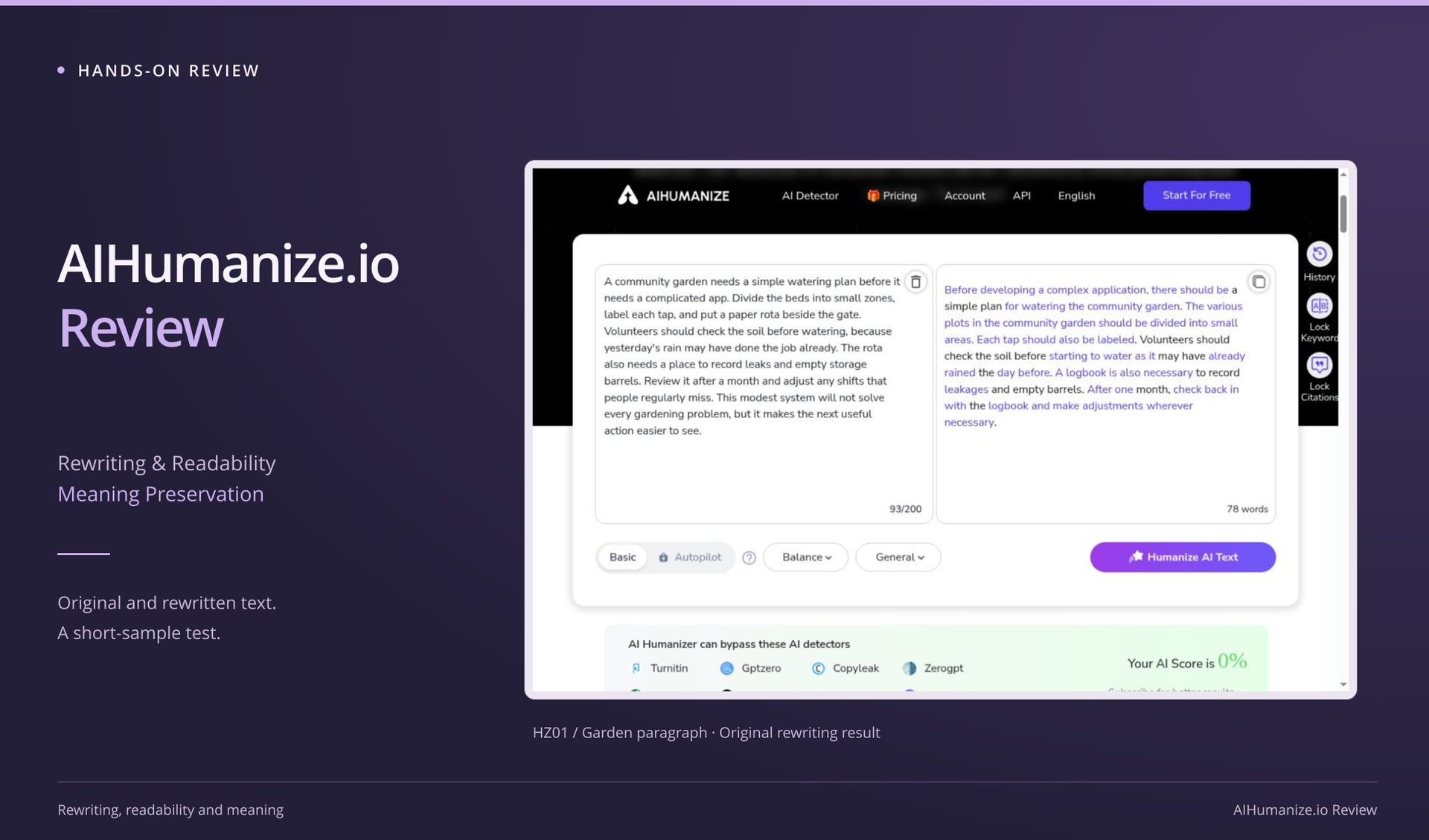
AIHumanize.io shortened the garden paragraph from 92 to 78 words and displayed “Your AI Score is 0%.” The writing became more formal, but it also lost part of the plan. The separate detector check couldn’t run: the returned text was two words below its minimum.
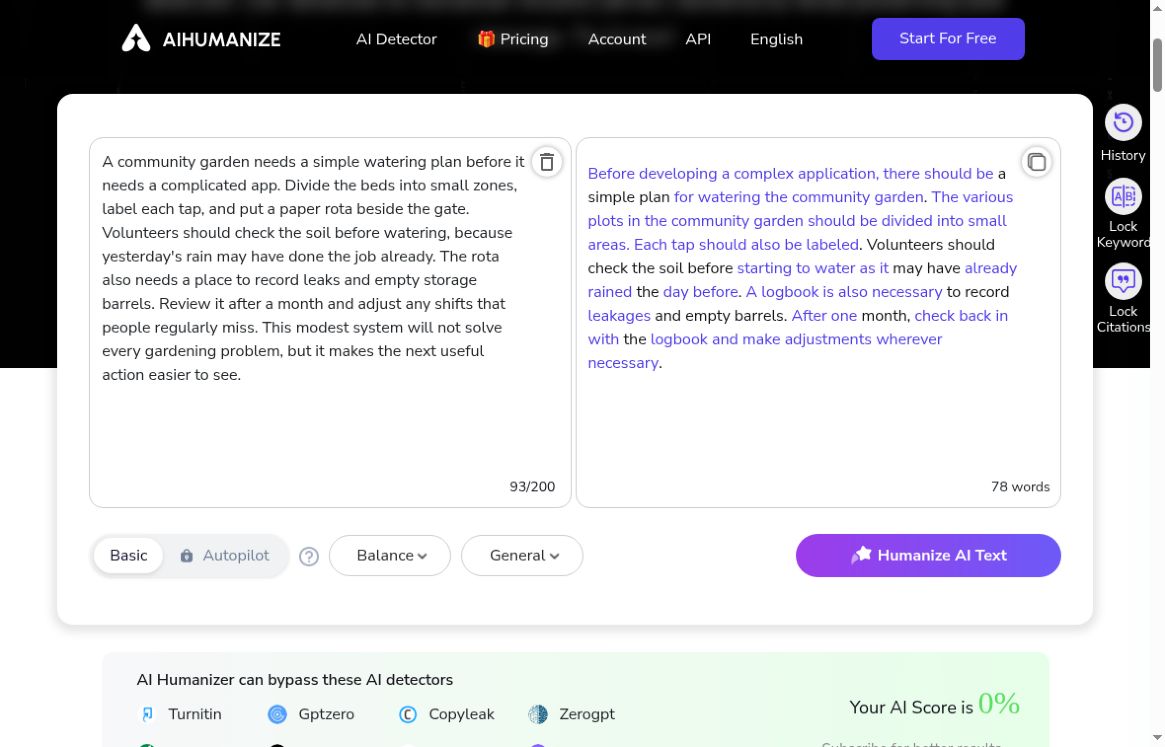
Actual default-mode output, 3 October 2026. The visible 0% is AIHumanize.io’s own score.
The missing detail was the schedule
The original HZ01 paragraph asks for a paper watering rota beside the gate. That rota is where volunteers record leaks and empty barrels; after a month, missed shifts should be adjusted.
AIHumanize.io changed it into “A logbook is also necessary to record leakages and empty barrels.” At the end, the reader is told to revisit the logbook and “make adjustments wherever necessary.” A logbook can record what happened, but the output no longer explicitly tells anyone to post a watering schedule, put it by the gate, or fix missed shifts.
That’s why I’d edit this output before using it. The main topic survived, but a volunteer following these instructions still wouldn’t have a schedule telling them when to water.
Other details were preserved: divide the garden into small areas, label taps, check the soil because it may have rained, and review the arrangement after one month. The language is grammatical and easy enough to follow, though “Before developing a complex application” sounds more formal than the original reference to a complicated app. The modest closing caveat about the system not solving every gardening problem disappeared too.
Compression should preserve the reason for the paragraph
Losing the rota matters more here than the drop in word count. A 78-word rewrite can work perfectly well if it keeps the decisions people need to make. Here, the source’s purpose is to make the next useful action visible to volunteers. A schedule beside the gate helps someone know what they are expected to do; a logbook records information. Those functions can coexist, but replacing one with the other leaves a gap. A shorter sentence isn’t automatically a problem. The question is whether the shorter version still does the job the source sets out.
That distinction also explains why the remaining monthly review is only a partial preservation. The original connects the review to shifts people regularly miss. The output keeps the one-month timing but refers generally to adjustments in the logbook. The reader gets the deadline, but less guidance on what needs changing. In some writing, that broadening might be acceptable because surrounding material supplies the missing context. This paragraph was tested on its own, and no surrounding instructions were provided. The fair reading is that the output retained the date while weakening the specific reason to revise the watering arrangement.
An editor could fix the paragraph with a few changes. They would restore a posted rota, keep the logging function, and reconnect the monthly review to missed shifts. This review does not supply a corrected version as if AIHumanize.io had returned it. The product output is preserved below in its original state. That matters because the repaired version might be better, but some of that improvement would come from the editor. It would also be a different input to any subsequent detector check, so the original vendor score could not be presented as a measurement of the repaired text.
The two scores are not interchangeable
| Item | What was actually obtained |
|---|---|
| Original HZ01 | 92 words; Clever AI Detector AI probability 85% |
| AIHumanize.io output | 78 words |
| AIHumanize.io’s own display | Your AI Score is 0% |
| Separate output check | No result: Clever AI Detector requires at least 80 words |
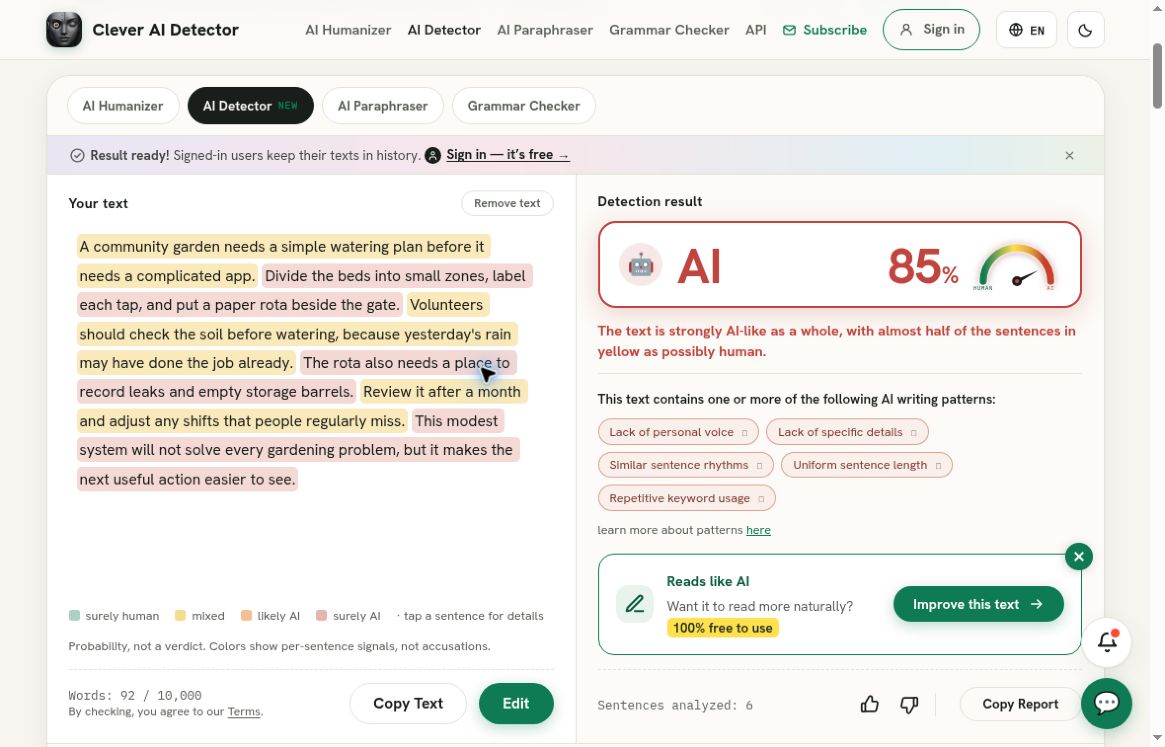
The unchanged original input received AI probability 85% from Clever AI Detector.
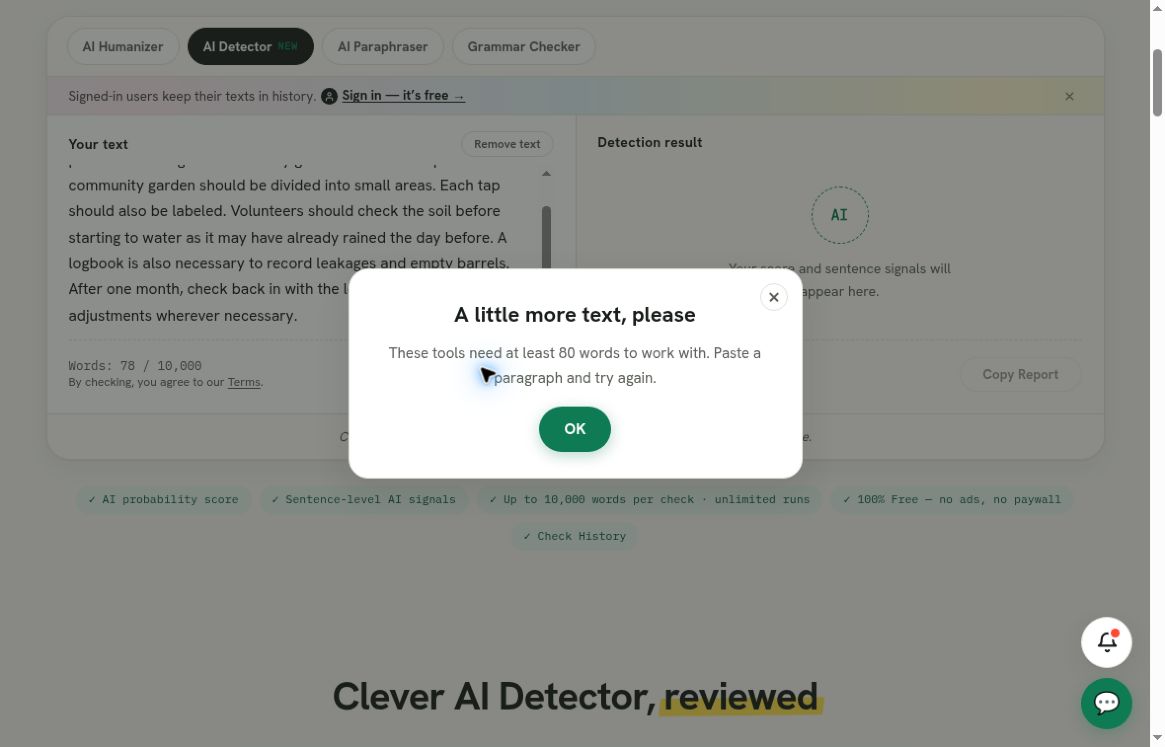
The exact 78-word output was rejected by the 80-word minimum. This is a length validation message, not a detector verdict.
The output was not padded, combined with another text, or edited to get past that minimum. Doing so would have measured a different passage. So this review can’t say whether the 0% agrees with Clever AI Detector. The vendor display remains a vendor result, with no separate output measurement here.
For drafts of at least 80 words, Clever AI Detector is worth using as a separate reading before and after a rewrite. Keep each version unchanged and compare its labeled results; here the output’s length prevented that check.
The minimum-length failure is useful information
A missing detector result can be frustrating, especially when the rewriting site displays an apparently decisive 0%. It’s still more useful to leave that result missing than to force a comparison. The fixed HZ01 input was long enough for Clever AI Detector; the shortened output was not. If you’re considering these two tools together, this generation shows a limit: they couldn’t provide a before-and-after check without changing the text. It does not mean the output was judged human, judged AI, or technically unreadable. The detector simply did not produce the required measurement below its stated minimum.
Adding a neutral sentence to reach 80 words might seem harmless, but it would bring an untested editing choice into the result. Repeating part of the text would change its pattern, while combining several outputs would measure a new document. With either method, you couldn’t say that the exact returned paragraph received that result. The better comparison in this case is qualitative: inspect the returned text and state plainly that the separate numerical check is unavailable. The visible minimum warning is included because it documents why that absence occurred, rather than leaving readers to assume a result was omitted.
The original 85% baseline has a limited role too. It describes the unchanged 92-word source under one detector. Without an output result from the same service, it cannot form a before-and-after reduction. AIHumanize.io’s own 0% belongs to a different system, with its own display and unspecified relationship to that baseline. Subtracting those two numbers would give you a result neither tool actually measured. Keeping the score labels and their sources attached is especially important in humanizer reviews, where a reassuring number can otherwise eclipse obvious changes in the content.
For a future evaluation, a set of longer fixed inputs could reduce the chance that ordinary shortening pushes an output below a second tool’s minimum. Choose those inputs before seeing any results, and include clear requirements you can check in the rewrite. A few kinds of writing would be useful: instructions, an argument with caveats, and a factual summary with names or quantities supplied in advance. That’s a suggestion for future testing; AIHumanize.io hasn’t been assessed on those tasks here. The present passage is enough to identify a lost schedule, but it cannot predict every rewrite the service would produce.
Scope and settings
This was one guest generation in Basic / Balance / General, the displayed defaults. The 200-word input cap excluded the full A01 essay, so the predeclared HZ01 fallback was used. AIHumanize.io counted the input as 93 words; the fixed corpus uses 92 whitespace-delimited words. Either way of counting leaves the submitted text unchanged. The output was preserved exactly.
No paid tier, other style, repeated generation, or longer document was tested. This one result lets us discuss the lost instructions, but it can’t tell us how often that would happen.
For a separate editing option, Clever AI Humanizer completed a full library-essay rewrite in this session, with its own losses: the six-month duration disappeared and the paper-survey rationale changed. Its HZ01 attempts returned no output, so there is no matched comparison on this garden paragraph. Treat either product’s rewrite as a draft that needs the original beside it.
My practical verdict: the shortened output is readable, but the watering plan needs repairing before it is useful. Would you accept the missing rota as reasonable compression, or is that the one instruction this rewrite most needed to retain?
HZ01: exact AI-generated input
A community garden needs a simple watering plan before it needs a complicated app. Divide the beds into small zones, label each tap, and put a paper rota beside the gate. Volunteers should check the soil before watering, because yesterday's rain may have done the job already. The rota also needs a place to record leaks and empty storage barrels. Review it after a month and adjust any shifts that people regularly miss. This modest system will not solve every gardening problem, but it makes the next useful action easier to see.
AIHumanize.io: exact complete unchanged output
Before developing a complex application, there should be a simple plan for watering the community garden. The various plots in the community garden should be divided into small areas. Each tap should also be labeled. Volunteers should check the soil before starting to water as it may have already rained the day before. A logbook is also necessary to record leakages and empty barrels. After one month, check back in with the logbook and make adjustments wherever necessary.