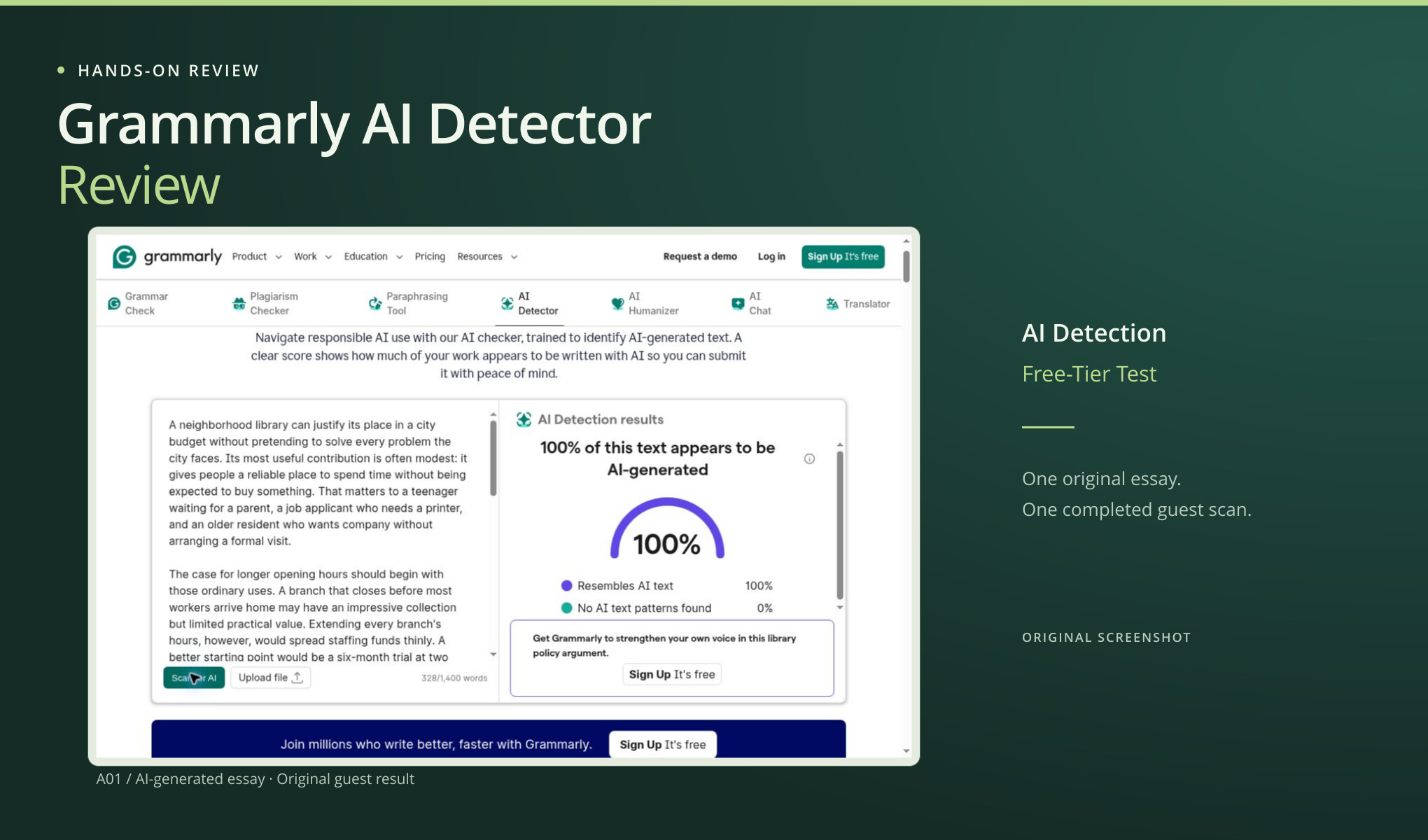
Grammarly correctly recognized the generated essay in this test. Its guest result said that 100% of the text appeared AI-generated. There isn’t enough here to judge overall accuracy. The next scan opened a signup/login promotion instead of returning a fresh result.
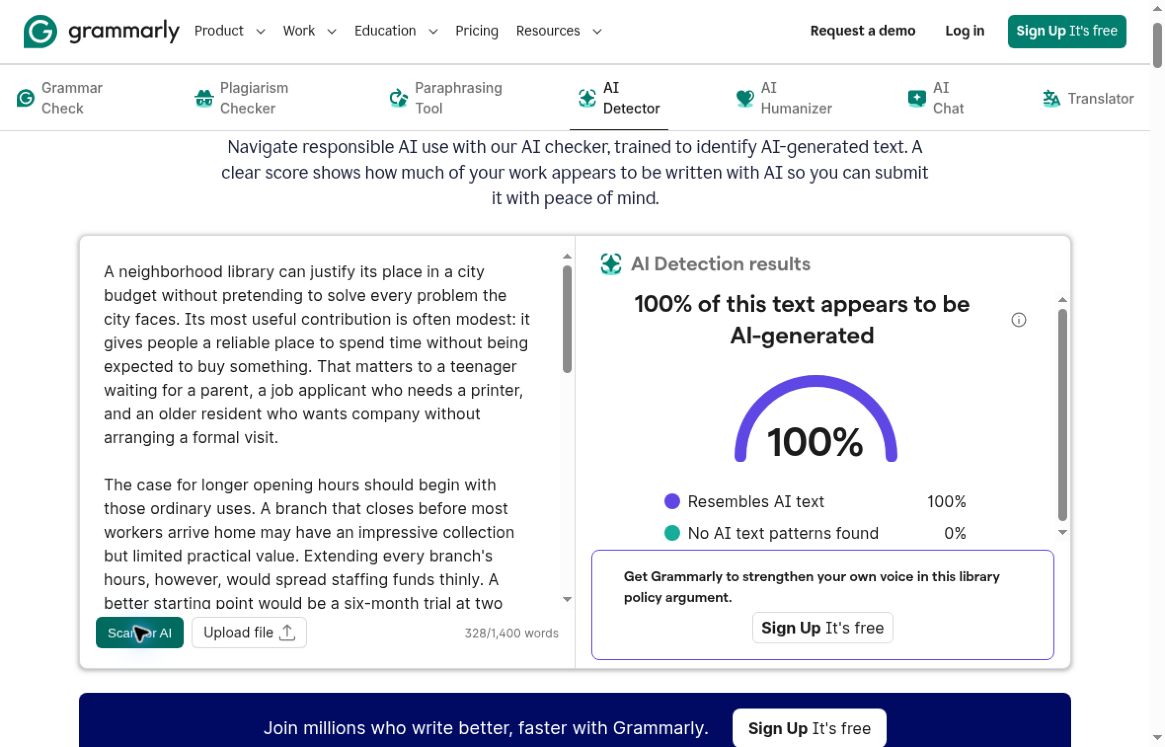
Completed guest scan, 3 October 2026: A01, the 328-word AI-generated library-hours essay.
What actually completed
| Question | Observed answer |
|---|---|
| Text submitted | Full A01, 328 words |
| Main result | 100% of this text appears to be AI-generated |
| Breakdown | Resembles AI text 100%; No AI text patterns found 0% |
| Access | Free guest web interface |
| Visible input counter | 328 / 1,400 words |
| Human-control result | None obtained |
The essay was generated for this review corpus before detector feedback was viewed. It argues for a limited trial of longer library opening hours. No tool-specific rewriting, shortening, or score chasing was used for this scan. Its exact input is included below.
That’s a genuine result in Grammarly’s favor. The known AI origin and the detector’s result agree. It does not verify the website’s advertised 99% detection-accuracy claim: one generated essay says nothing about the proportion of human writing incorrectly flagged, or how the model handles other subjects and styles.
A stale result is easy to misread
The next planned input was the human control. Pressing scan opened a signup/login promotion; closing it and trying again produced the same interruption. The previous A01 score remained beside the edited input.
That visible pairing was not a completed human-control scan. Calling it a 100% false positive on the replacement text would be a serious mistake. There is no Grammarly human-control result in this review, and no result for the planned fictional first-person story.
The limit here was how far the guest workflow let the test go. It allowed one recorded scan and then stopped the comparison. It is not evidence that a signed-in account has the same restriction, nor that the detector performs poorly on text it never analyzed.
The guest workflow needs its own assessment
There are two separate things a visitor is trying to learn from a free detector: whether the result is useful, and whether the available workflow allows a fair evaluation. Grammarly supplied a completed answer to the first passage. The next step ran into an account promotion. That sequence matters even though it cannot tell us anything about paid or signed-in behavior. If you arrive with several documents to check, don’t assume the displayed word allowance also promises as many repeat scans as you need. In this session, the text fit. Getting another scan was the problem.
A first scan that works can shape how you feel about the whole tool. Here, the large purple 100% display was easy to read, and its text agreed with the known source. That is a legitimate positive observation about the result presentation. The difficulty appeared when a different input was placed beside the old output. If you watch only the number, it’s easy to miss whether a new analysis has actually finished and report the wrong result. This is why a screenshot needs a known association with a submitted passage, rather than simply a text box containing the intended words somewhere on the page.
For repeatable evaluation, a useful record pairs the exact input with the action that triggered its scan and the completed result state. Changing the text in the box doesn’t mean the model has processed that change. A loading message, promotion or retained previous result should be recorded as such. That principle applies well beyond Grammarly, but it was especially consequential here: it prevented an unsupported accusation that the human control had been called AI. What actually happened is less dramatic, but more useful to know. The first passage was detected; the next planned measurement was unavailable under the tested guest conditions.
How much weight should the percentage carry?
Grammarly’s wording describes how much of the text appears AI-generated. Keep that label with the number. Don’t read it as a 100% probability that a particular person used AI, or as a measure of the product’s overall accuracy.
For an additional view, Clever AI Detector returned AI probability 89% on the same full A01 in the earlier 2 October test. Both results pointed toward AI origin. The percentages have different meanings, so the larger number does not identify a winner.
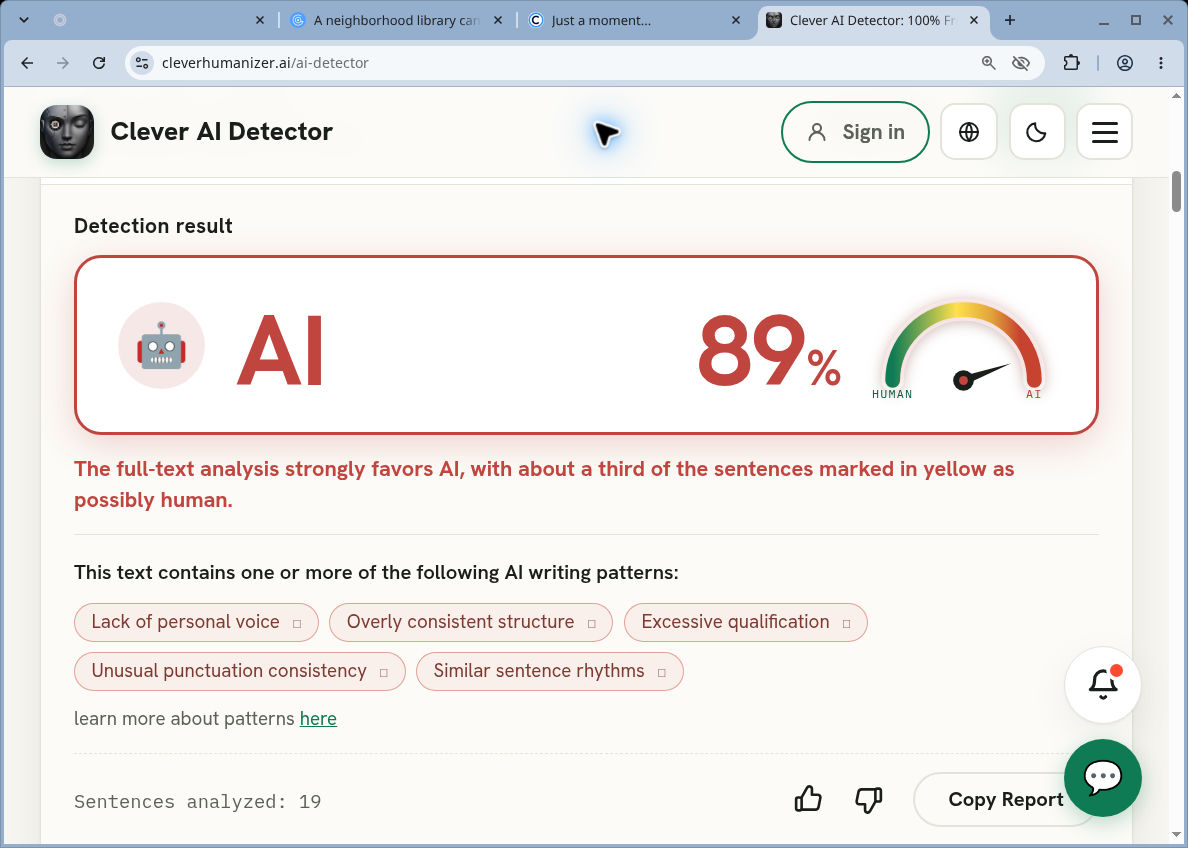
Clever AI Detector’s earlier full-A01 result, captured 2 October 2026. This was a separate scan on the identical source text.
Why a correct generated essay is only half a useful test
A detector can score highly on generated samples while still being unsuitable for consequential decisions about human writers. To understand that risk, the evaluation needs genuine human material as well as generated material. The two groups need clear provenance, and they should resemble the writing where the tool will actually be used. This review established the origin of A01, but the guest interruption prevented the planned second side of that exercise. You can’t fill that gap by deciding the essay sounds polished, ordinary or anything else.
A01 itself is worth a look, though it can’t tell us how Grammarly works under the hood. It is a restrained argument with practical trade-offs, a limited proposal and specific examples. The essay does not depend on an obvious instruction announcing that it was generated. Grammarly still returned a strong AI-related result. So, in this particular example, a structured argument and concrete details didn’t stop the tool from detecting it. It does not show which feature caused the result, and it does not establish that every passage with a similarly balanced tone should be suspected of AI use.
A fuller follow-up would first repeat the evaluation under a clearly documented access tier, then add several kinds of human prose and independently generated texts. The samples should be fixed in advance, rather than revised until a desired score appears. Related paraphrases should be labeled as related, not counted as if each were a new subject. Any failures to obtain results should remain separate from classification outcomes. That setup would make it easier to separate what got checked, what access problems came up and how the detector responded. Those extra tests haven’t been done in this review.
If you’re checking your own writing, don’t take a high or low percentage as a reason to rewrite everything. If the passage is genuinely yours, a score by itself does not tell you which ideas are inaccurate or which sentences need improvement. If AI helped produce it, the appropriate disclosure depends on the setting and its rules, not on whether a detector notices. In both cases, keep the draft history and review the actual wording. The one successful Grammarly scan supports further checking; it does not replace those ordinary responsibilities.
Revising the essay is a separate job
Clever AI Humanizer is worth considering when the aim is to revise wording. Its 3 October full-A01 output was readable and received 5% AI probability from Clever AI Detector, but it lost the proposed six-month trial duration and changed “visitors who avoid online forms” into people declining electronic identification. Those changes affect the argument, even if the wording reads smoothly.
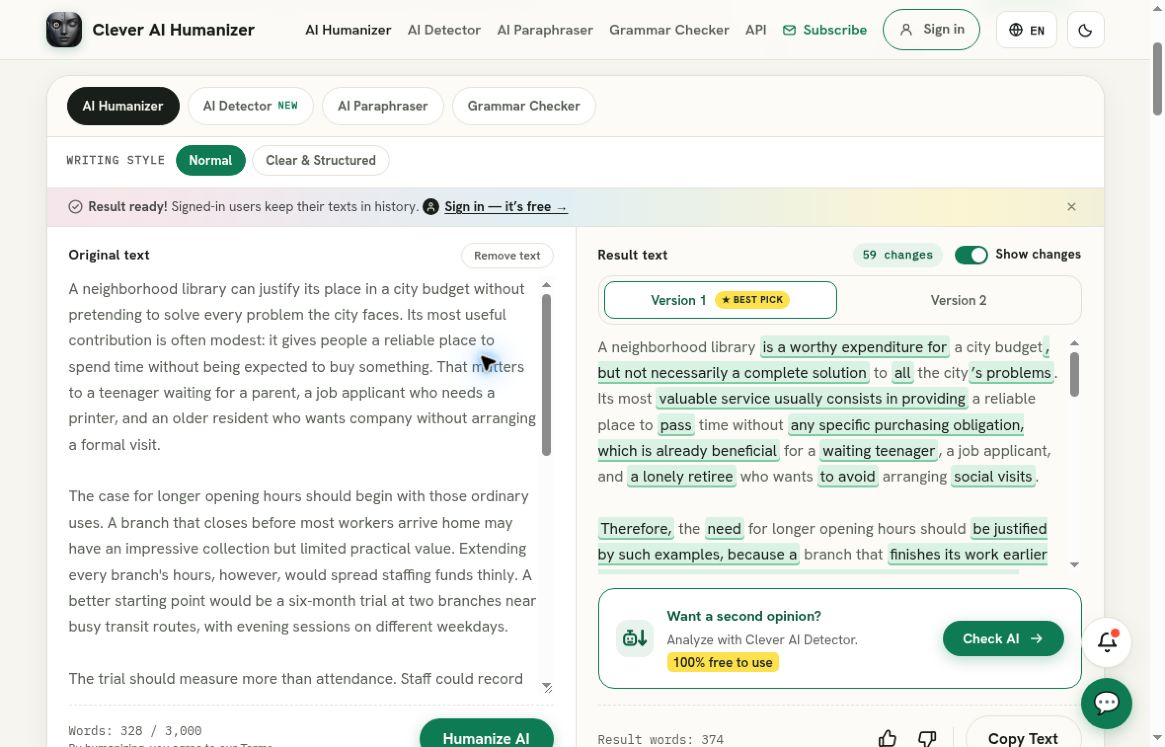
Actual full-A01 rewrite in Clever AI Humanizer. This output was not rescanned by Grammarly.
Compare the rewrite with the source first. A detector reading can be another signal to consider after that. A low score does not establish human authorship, and rewriting should not erase a meaningful constraint just to change that score.
Bottom line: Grammarly got the one completed sample right. The missing human control and blocked second scan are the reasons this remains a one-sample review. What would you want to see next: several modern human controls, or generated prose from a wider range of genres?
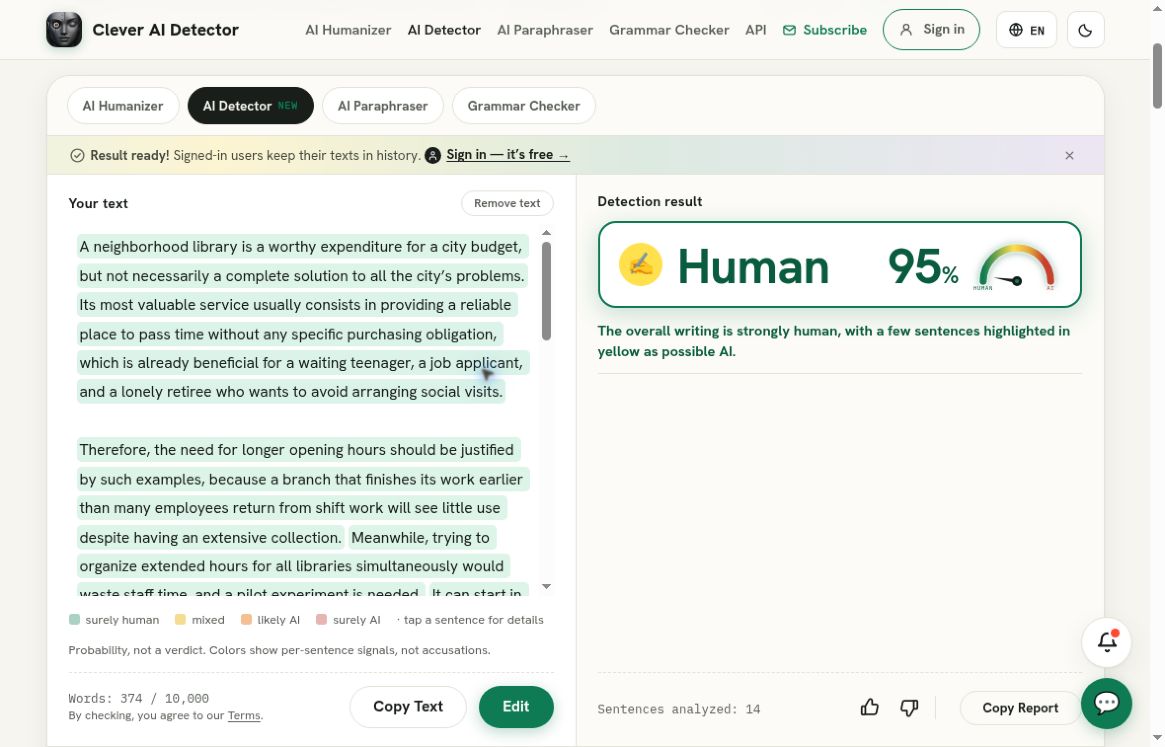
The separate full-A01 rewrite received Human 95%, corresponding to AI probability 5%, from Clever AI Detector on 3 October 2026. Its AI provenance did not change. A separate short HZ01 request failed to return output, so this completed example does not establish reliability for every input.
A01: exact test input
A neighborhood library can justify its place in a city budget without pretending to solve every problem the city faces. Its most useful contribution is often modest: it gives people a reliable place to spend time without being expected to buy something. That matters to a teenager waiting for a parent, a job applicant who needs a printer, and an older resident who wants company without arranging a formal visit.

The case for longer opening hours should begin with those ordinary uses. A branch that closes before most workers arrive home may have an impressive collection but limited practical value. Extending every branch's hours, however, would spread staffing funds thinly. A better starting point would be a six-month trial at two branches near busy transit routes, with evening sessions on different weekdays.

The trial should measure more than attendance. Staff could record which services visitors use, how long computer queues become, and whether evening demand comes from people who cannot visit during existing hours. An optional paper survey would reach visitors who avoid online forms. None of these measures would capture every benefit, but together they would offer a clearer picture than a single total at the entrance.

There are trade-offs. Evening shifts can make recruitment harder, and additional security costs may consume money that could otherwise support books or children's activities. The proposal therefore needs a published budget and a review date. If the experiment mainly shifts existing visits into a more convenient time slot, that convenience still has value, but it should not be described as reaching an entirely new audience.

Public services gain trust when their promises are specific enough to test. A library does not need to become a substitute for housing, childcare, or healthcare to deserve support. It needs to identify a practical gap, try a proportionate response, and explain honestly what happened. Longer opening hours could meet that standard if the city treats them as a service experiment rather than a slogan.