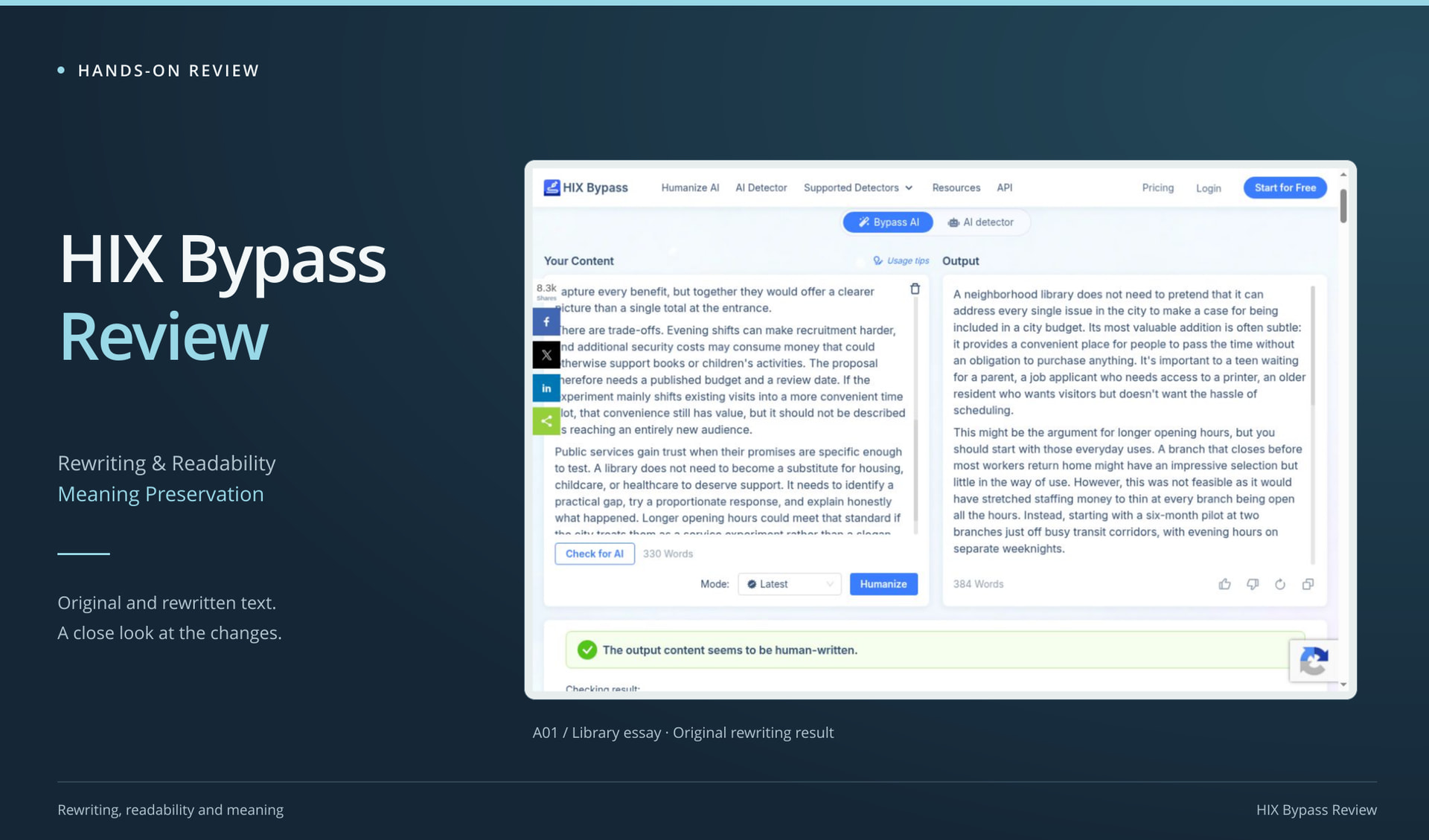
HIX Bypass returned a complete rewrite of the library-hours essay, but this default output needed more grammar and meaning repair than the source. Its own panel described the result as human-written; the separate check still favored AI.
| Observation | Result |
|---|---|
| Tested mode | Latest, default guest workflow |
| Preserved input → output | 328 → 381 whitespace-delimited words |
| HIX Bypass counters | 330 input / 384 output |
| HIX Bypass panel | Output seems human-written |
| Clever AI Detector on unchanged output | Likely AI, 72% AI probability |
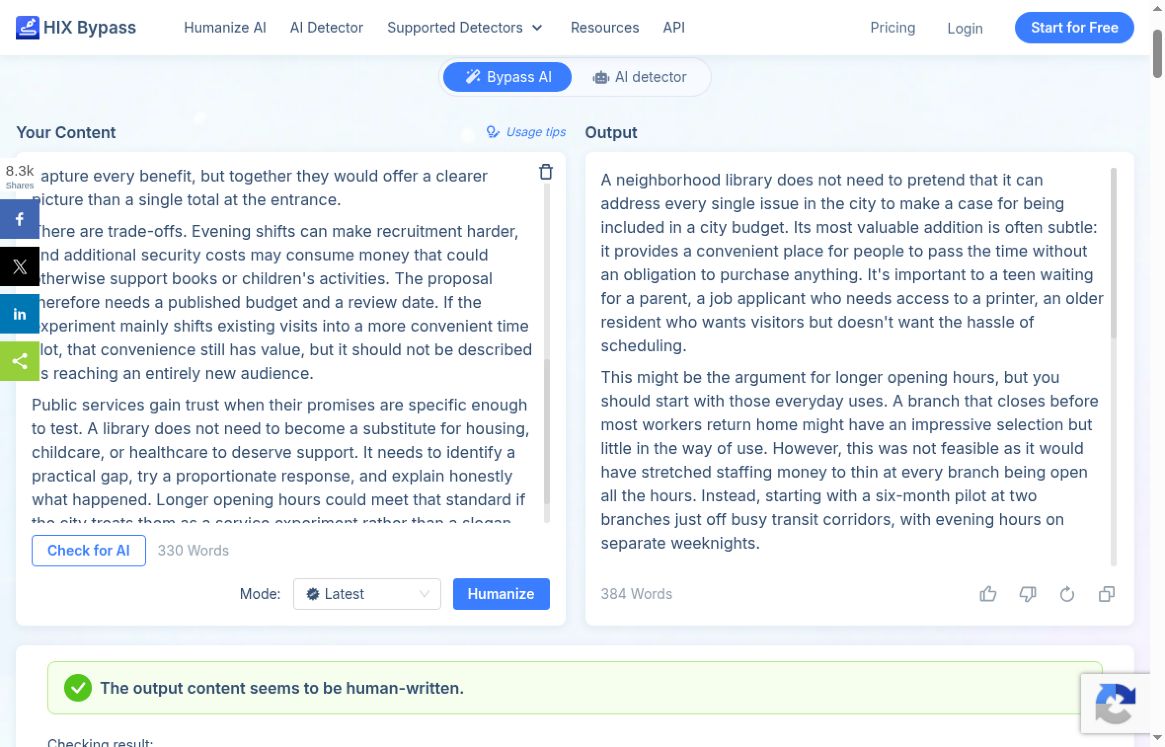
Actual HIX Bypass output on 3 October 2026. The interface’s word-count convention differs from the consistent whitespace count used in this review.
Start with the sentence that needs fixing
The clearest problem comes in the paragraph about why every branch shouldn’t get longer opening hours straight away. The original says that extending every branch’s hours “would spread staffing funds thinly.” HIX Bypass turns this into: “However, this was not feasible as it would have stretched staffing money to thin at every branch being open all the hours.”
That one sentence has several problems. “To thin” should be “too thin.” The ending is awkward. More importantly, “this was not feasible” sounds like a conclusion about something already considered or attempted. The original gives a conditional reason to start with a limited trial. It doesn’t say anyone already decided whether the idea was feasible. That changes what seems to have happened before the proposal, as well as the style.
The next sentence starts “Instead, starting with a six-month pilot…” and never gets a main verb. You can work out the intended recommendation, but the fragment gives you something else to fix. You can see these problems in the output without inventing a numerical writing-quality score.
Other sentences are easier to read. The trial still measures more than attendance, and the passage retains computer queues, services used, and visitors unable to come during existing hours. The budget and review-date requirements remain. It would be unfair to call the whole result unusable just because one paragraph is weak. But using it unchanged would leave avoidable errors in a proposal that started out clearer.
What was preserved, and what moved
HIX Bypass kept the six-month duration and two branches. It also retained separate weeknights, a voluntary paper survey, the security-versus-books trade-off, and the warning about claiming a new audience. Those are important parts of the brief, and keeping them deserves credit.
Several smaller word changes need a closer look. An older resident who wants company becomes an older resident who “wants visitors.” The source describes why someone might go to a library; the replacement can suggest people coming to the resident instead. The wording isn’t disastrous, but it’s less clear about the library’s social role.
Later, “existing visits” becomes “already-scheduled visits.” A person can be an existing library visitor without scheduling an appointment. The new wording assumes a visit was planned in a way the source didn’t. A similarly small-looking change strengthens the cost warning: security costs that “may consume money” become costs that “could exhaust funds.” It still describes a possibility, but using up a fund is a bigger consequence than spending some of it.
The paper-survey sentence stays reasonably close to the intended purpose. Visitors who avoid online forms become visitors who do not complete one. That is a useful contrast with the more consequential changes elsewhere: not every replacement is a problem, and a fair edit should distinguish acceptable paraphrase from a shifted claim.
The ending also preserves housing, childcare and healthcare as examples of roles the library does not need to take on. The final experiment-versus-slogan distinction survives. The main argument is still there. The risk is letting the other changes slip through because the topic looks familiar.
A repair should preserve the proposed experiment
The cleanest correction would keep the original sequence: explain the staffing constraint, propose a limited pilot, then describe how to evaluate it. It would not invent a previous attempt, an existing schedule of visits, or a decision that the full rollout had already been ruled infeasible. That gives you a simple check for each edit: does it make the same proposal clearer, or add a fact about its history?
The preserved six-month duration is particularly valuable here. It tells us how long the experiment is meant to run. A good final edit would retain that detail while removing the grammatical defects, rather than rewriting so broadly that another important condition disappears. None of those fixes was made before the recorded detector check.
A score panel cannot proofread the result
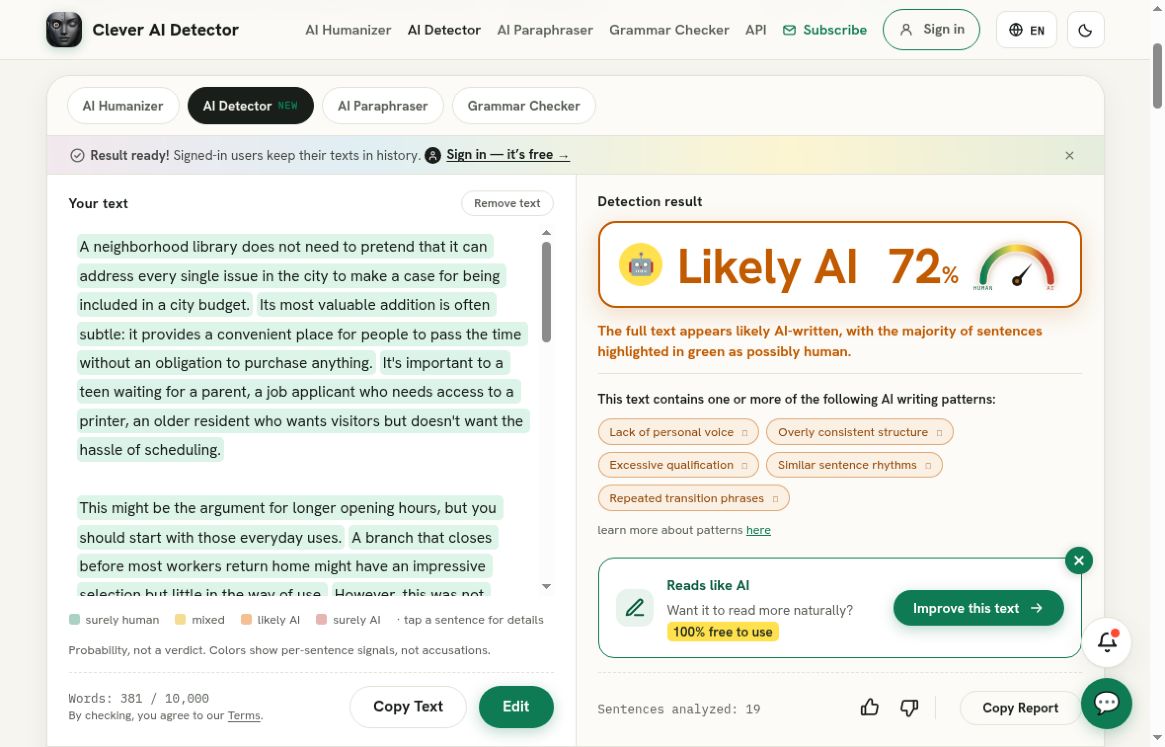
The exact 381-word output received Likely AI, with AI probability 72%, from Clever AI Detector.
The HIX Bypass page’s favorable message did not agree with Clever AI Detector in this run. That is a practical reason to use a separate check if detector behavior is part of the task. It is not evidence that one percentage certifies authorship or that a single comparison establishes which detector is generally better.
The page also displayed a checklist referring to other detector names. Those are vendor-reported checks in the HIX Bypass interface. The output wasn’t independently submitted to each named service for this review, so those labels can’t be reported as separately verified results. The Clever AI Detector screenshot is the output measurement independently observed here.
Even a unanimously favorable set of labels would not fix “to thin,” finish the fragment, or restore the conditional staffing argument. A detector and an editor answer different questions. The complete output below is the version that was measured; no grammar corrections were made first, and the result should not be reassigned to a repaired version without another test.
The same source through another humanizer
For an alternative draft, Clever AI Humanizer completed the same full A01 essay in Normal mode, with its automatically selected first version. It returned 374 words, close in length to the HIX Bypass output.
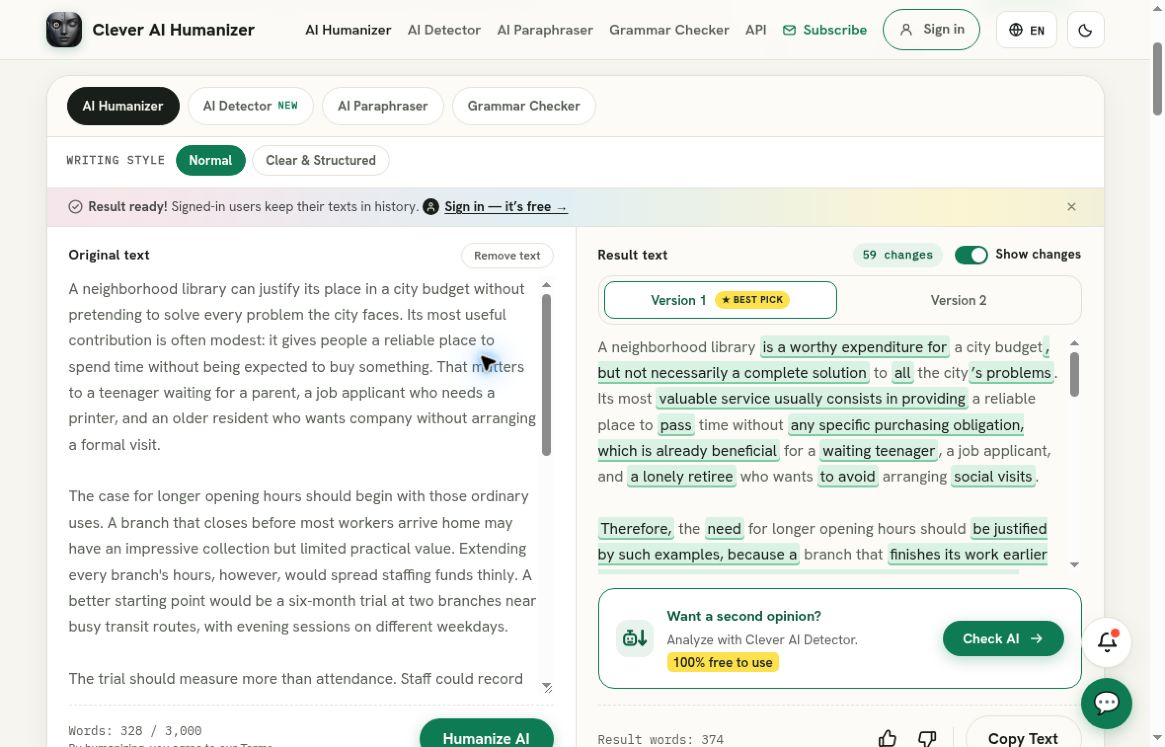
Clever AI Humanizer’s actual 374-word rewrite of the same 328-word input.
That output was more readable in the problematic staffing paragraph, but it also changed the brief. It dropped the six-month duration and recast the paper survey as reaching people who decline electronic identification. The original simply refers to people who avoid online forms. HIX Bypass preserved the duration and stayed closer to the survey purpose, despite its other defects.
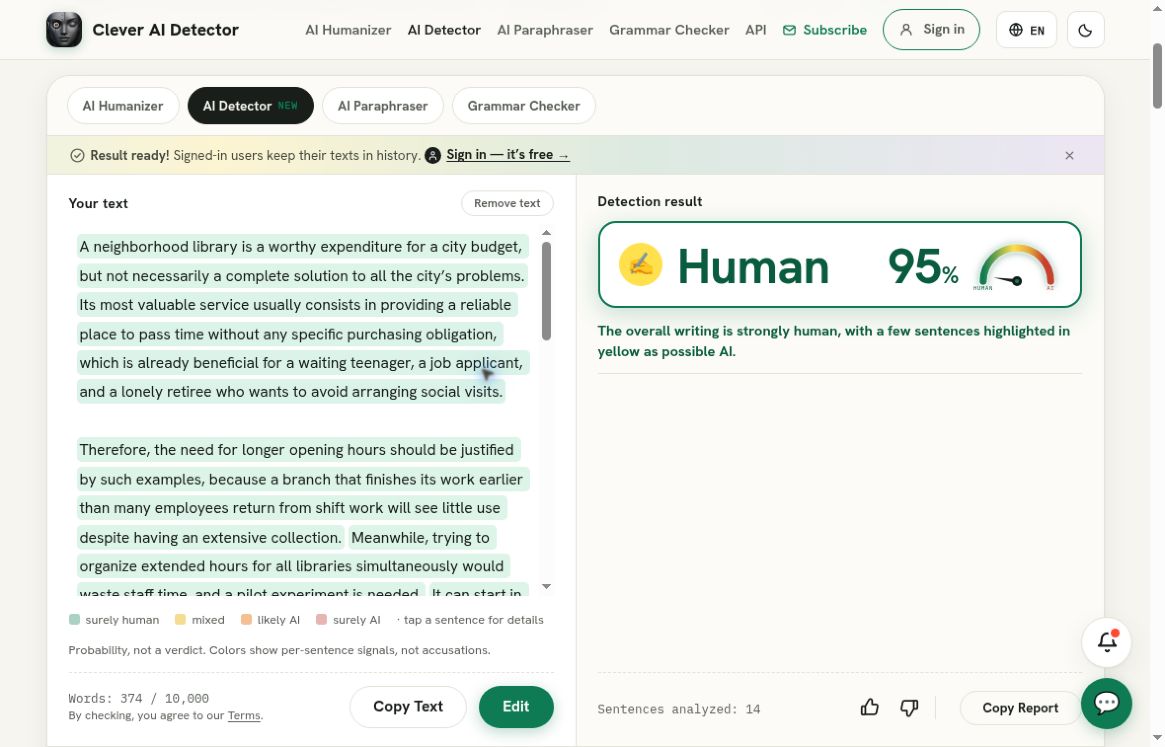
Clever AI Humanizer’s unchanged output received Human 95%, equivalent to AI probability 5%, from Clever AI Detector.
The lower AI reading is worth noting, but it doesn’t give us an all-round winner. One result has obvious grammar problems and several altered implications; the other loses or changes important details. Both need the original beside them during review. To choose between them, look at which repairs would be easier for your document, as well as the badges.
How far this review goes
The full source was accepted anonymously, and the Latest setting was left at its default. There was one successful primary generation. Other modes, paid tiers, repeated runs and different writing genres were not tested. The screenshots and exact text establish what happened to this example on 3 October 2026; they do not establish a typical failure rate or a guarantee about future output.
For this passage, I would repair the staffing paragraph first, then compare nouns and qualifiers line by line: company versus visitors, existing versus scheduled visits, and consuming versus exhausting funds. Those changes are small enough to slip past a quick skim but concrete enough to matter in a proposal. HIX Bypass produced a recognizable draft, but its human-written message isn’t enough to say the editing is done.
A01: exact AI-generated input
A neighborhood library can justify its place in a city budget without pretending to solve every problem the city faces. Its most useful contribution is often modest: it gives people a reliable place to spend time without being expected to buy something. That matters to a teenager waiting for a parent, a job applicant who needs a printer, and an older resident who wants company without arranging a formal visit.

The case for longer opening hours should begin with those ordinary uses. A branch that closes before most workers arrive home may have an impressive collection but limited practical value. Extending every branch's hours, however, would spread staffing funds thinly. A better starting point would be a six-month trial at two branches near busy transit routes, with evening sessions on different weekdays.

The trial should measure more than attendance. Staff could record which services visitors use, how long computer queues become, and whether evening demand comes from people who cannot visit during existing hours. An optional paper survey would reach visitors who avoid online forms. None of these measures would capture every benefit, but together they would offer a clearer picture than a single total at the entrance.

There are trade-offs. Evening shifts can make recruitment harder, and additional security costs may consume money that could otherwise support books or children's activities. The proposal therefore needs a published budget and a review date. If the experiment mainly shifts existing visits into a more convenient time slot, that convenience still has value, but it should not be described as reaching an entirely new audience.

Public services gain trust when their promises are specific enough to test. A library does not need to become a substitute for housing, childcare, or healthcare to deserve support. It needs to identify a practical gap, try a proportionate response, and explain honestly what happened. Longer opening hours could meet that standard if the city treats them as a service experiment rather than a slogan.
HIX Bypass: complete unchanged output
A neighborhood library does not need to pretend that it can address every single issue in the city to make a case for being included in a city budget. Its most valuable addition is often subtle: it provides a convenient place for people to pass the time without an obligation to purchase anything. It's important to a teen waiting for a parent, a job applicant who needs access to a printer, an older resident who wants visitors but doesn't want the hassle of scheduling.

This might be the argument for longer opening hours, but you should start with those everyday uses. A branch that closes before most workers return home might have an impressive selection but little in the way of use. However, this was not feasible as it would have stretched staffing money to thin at every branch being open all the hours. Instead, starting with a six-month pilot at two branches just off busy transit corridors, with evening hours on separate weeknights.

More than attendance should be measured in the trial. Staff would be able to record what services visitors use, how long the queues for computers get and whether evening demand is from people who cannot visit during existing hours. A voluntary paper survey would connect with visitors who do not complete an online form. These measures would not encompass all of the benefits, however together they provide a better sense than a single output total at the entrance.

There are trade-offs. Recruiting workers to do the evening shifts can also be difficult, and extra security needed at night could exhaust funds available for buying more books or putting on activities for children. So it requires a budget that is published and a review date. If the experiment only redistributes already-scheduled visits into a more convenient time, that is still beneficial even if it isn't a new audience.

Public services garnering trust are those where the promises made can actually be tested. A library does not need to take on the role of housing, childcare, or healthcare provider to be worth supporting. Establish a real gap, test a balanced response and narrate what really happened with transparency. Longer opening hours could hit that mark if the city promotes them as a service experiment and not as a slogan.
Clever AI Humanizer: complete unchanged output from the same A01 input
A neighborhood library is a worthy expenditure for a city budget, but not necessarily a complete solution to all the city’s problems. Its most valuable service usually consists in providing a reliable place to pass time without any specific purchasing obligation, which is already beneficial for a waiting teenager, a job applicant, and a lonely retiree who wants to avoid arranging social visits.

Therefore, the need for longer opening hours should be justified by such examples, because a branch that finishes its work earlier than many employees return from shift work will see little use despite having an extensive collection. Meanwhile, trying to organize extended hours for all libraries simultaneously would waste staff time, and a pilot experiment is needed. It can start in two convenient branches for public transport users, with evening sessions on different weekdays.

The experiment’s effectiveness can be measured not only by the number of visitors but also by the staff’s observations of what requests are made, how long visitors stay within the queue for a computer workstation, and whether evening openings compensate for the lack of daytime opportunities. The staff could also distribute printed questionnaires to those who decline to identify themselves electronically. This information will not be fully accurate, but it will provide a more practical understanding of the branch’s importance than the number of people who signed in.

The proposed plan has disadvantages, including possible shifts in staffing policy and the opportunity cost of spending money on security rather than books or children’s events. Therefore, the library should publish the experiment’s budget and timeline for revision. Even if extended hours only divert daytime visitors to evening hours, such a result is still worth discussing, although it cannot be said that the library serves a new population. For public services, it is essential to design their limitations clearly to understand the value they bring to the community.

A library does not have to be a universal solution to residents’ problems, but it should experimentally demonstrate what specific need is addressed and what results can be achieved without budgetary inefficiency. Extended opening hours can be such a solution, but the city should treat this hypothesis with caution and revise it no later than the end of the pilot experiment.