Imagine you have a Bengali notice about a book swap. You want to know the details of the swap. What time is it? How many books can you bring? Can you sell them? What happens if it rains? A translation which only captures the overall idea won’t help.
I used a low risk example for this example. This is a made up example so it wasn’t taken from an actual school or private conversation. The translation ran successfully and captured all the rules we needed to know.
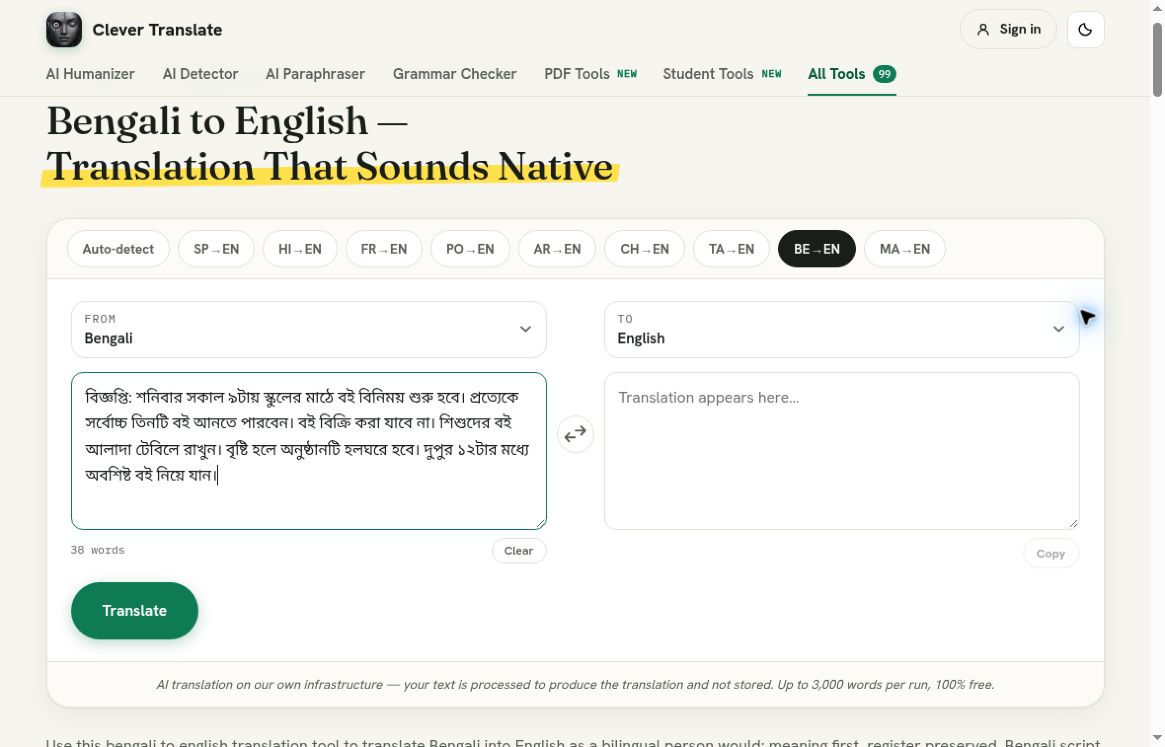
The screenshot below shows the full notice in Bengali. It contains all the information needed for the translation. It includes details of when the swap will take place (in the morning), how many books can be brought (a maximum of 3), no selling, children’s books in their own table, what happens if it rains and how to collect.
The intention of this notice is to let people know the book swap will take place at 9am on Saturday. They can only bring a maximum of 3 books. They cannot sell any books. Children’s books should be placed in their own table. If it rains they will move the swap to the hall. Any leftover books should be collected by 12pm.
This helps you to know what to look for in the translation. It has a start time, maximum quantity, no selling, sort by…, weather condition and a collection time. This is a short notice so it is easy to check the details.
Go to the Bengali to English page. The source text should state ‘Bengali’ and the translation should state ‘English’. I had this set up automatically when I used the dedicated page but it is always good to double check.
Click in the source text box and type the full notice. Try to keep it in Bengali and use the original numbers. If you are translating from someone else’s notice you may miss a word or change the numbers which may cause confusion in the translation.
The source text box had 38 words. The page mentions you can only have 3000 words per run. This example didn’t reach that limit. I have kept it short so you can easily check the rules in the translation.
Use made up details or a passage you have permission to use. Don’t include any personal information. The purpose of this tutorial is to show you how the translation works. We are not verifying the claims the site makes about storing or processing.
Once you are happy with the text and direction click Translate once. Whilst the translation is running a message will show and some buttons will be disabled. Wait until it has finished translating.
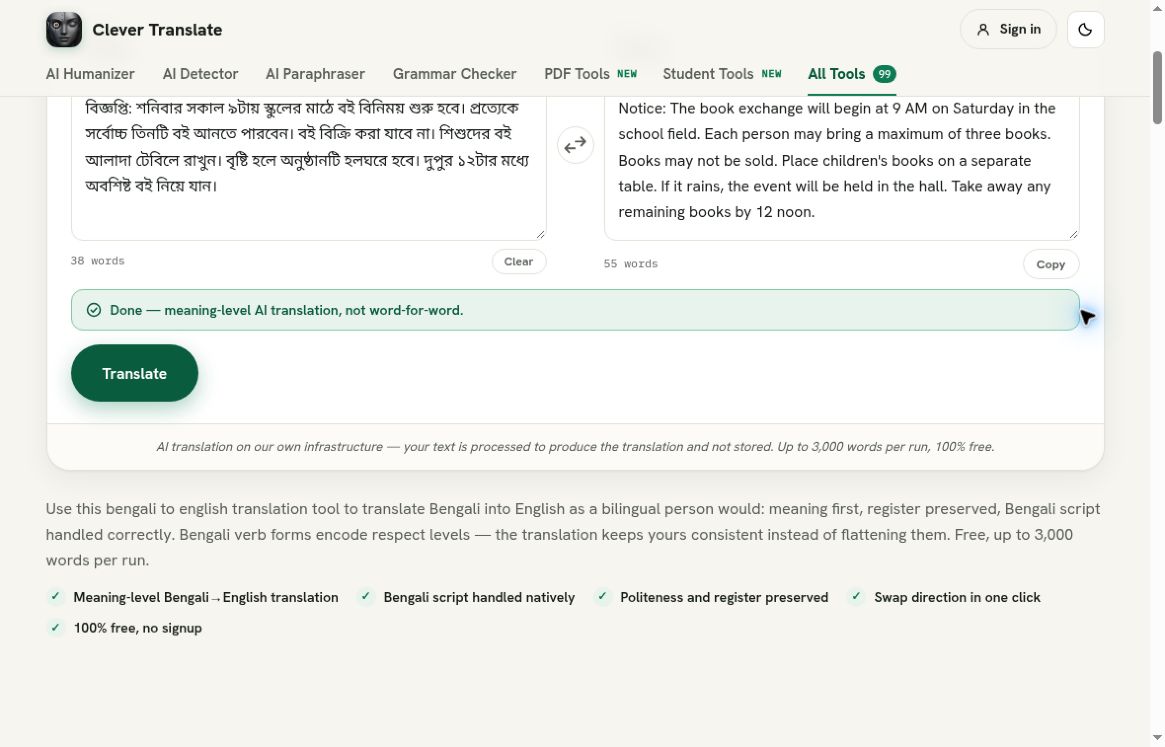
The screenshot below shows the exact wording of the translation. The translation can be seen next to the source notice. The following information shows what details have been kept from the notice.
The translation had 55 words. This doesn’t help give any indication of how accurate the translation was. We don’t need the same amount of words. We just need to know if any information has been added, missed out or altered.
The translation has kept the time (Saturday morning) and place (school field). It has also kept the maximum quantity of books (3). It is important to note that it says maximum, so people know they can’t bring more than 3. If they only bring 1 or 2 they know they are under the limit.
The no selling has been kept. This is important as it means they cannot sell. If the translation had said they could sell or it was optional then this would have been a problem. The children’s books table has been kept.
The weather has been kept as a conditional. If it rains they will move to the hall. The collection time has been kept as 12 noon. These are the main points that made this translation useful as an English version.
It can be tempting to read through the translated notice once and see if it makes sense. However, it is more useful to look for specific rules. First look for any quantities. In this example it is a maximum of 3 books. Has the translation kept the number and what it relates to?
Next look for any conditions. If it rains they will move indoors. Without the ‘if’ everyone would have to go to the hall. Sometimes small words can mean everything. This is also why it is useful to translate full sentences.
Look for any times. The time has been changed to 9AM and the collection time to 12 noon. There isn’t a date, address or timezone mentioned. The translator hasn’t picked this up. This shouldn’t be added in this walkthrough. If this was a real event you would ask the organiser for any missing information before sending out the notice.
Read through the translation like you would a notice. The translation has kept the place (school field). An editor may choose to change the wording to better suit the actual place. However, it is important to ensure the place is still mentioned. Don’t casually change it to school hall as this is mentioned elsewhere in the paragraph.
I am not claiming to be an expert in all Bengali dialects and regional variations. If it is an important piece of correspondence get someone who is comfortable with both languages to check the original and translation. From the example we can see that the specific practical rules have been kept.
The copy button has become enabled. I didn’t click this button or send the made up notice. If you copy across the translation make sure you check what you are copying to. Ensure the maximum quantity (3), no selling, if it rains and the collection time (12pm) are still there.
Don’t add extra information to make the notice more detailed. The original notice doesn’t mention that everyone will find a suitable book to swap, uncollected books will be donated or only enrolled students can attend. Whilst these could be valid questions they aren’t mentioned in the notice.
This example doesn’t include image recognition, scanned documents, file uploads or keeping the design of the poster. If your Bengali notice is a picture you will need to ensure you have the correct text. Check the text before translating. As the translation will be fluent you won’t be able to rely on knowing what was missing from the incomplete text.
If you have a longer text keep a copy of the source text. Break it down into meaningful chunks. Keep the rules and exceptions together. Keep the time and what it relates to. If you break it into random word quantities you may split information that should be together. This will make it harder to translate and check.
When translating this type of notice I would check the rules relate to the questions someone would ask. The maximum quantity (3) doesn’t mean they can’t bring less. The source notice doesn’t mention a minimum quantity. The table relates to children’s books, not necessarily a table for children. The if it rains relates to changing the place if the condition is met. The collection time relates to leftover books. It is more useful to know the rules relate to the correct action.
A great habit to get into is to check what choices the reader would make. Where would they go? What could they bring? What couldn’t they do? When would they collect the leftover books? The translation provided answers these questions consistently. You can use the tool on another safe passage and check the same things.