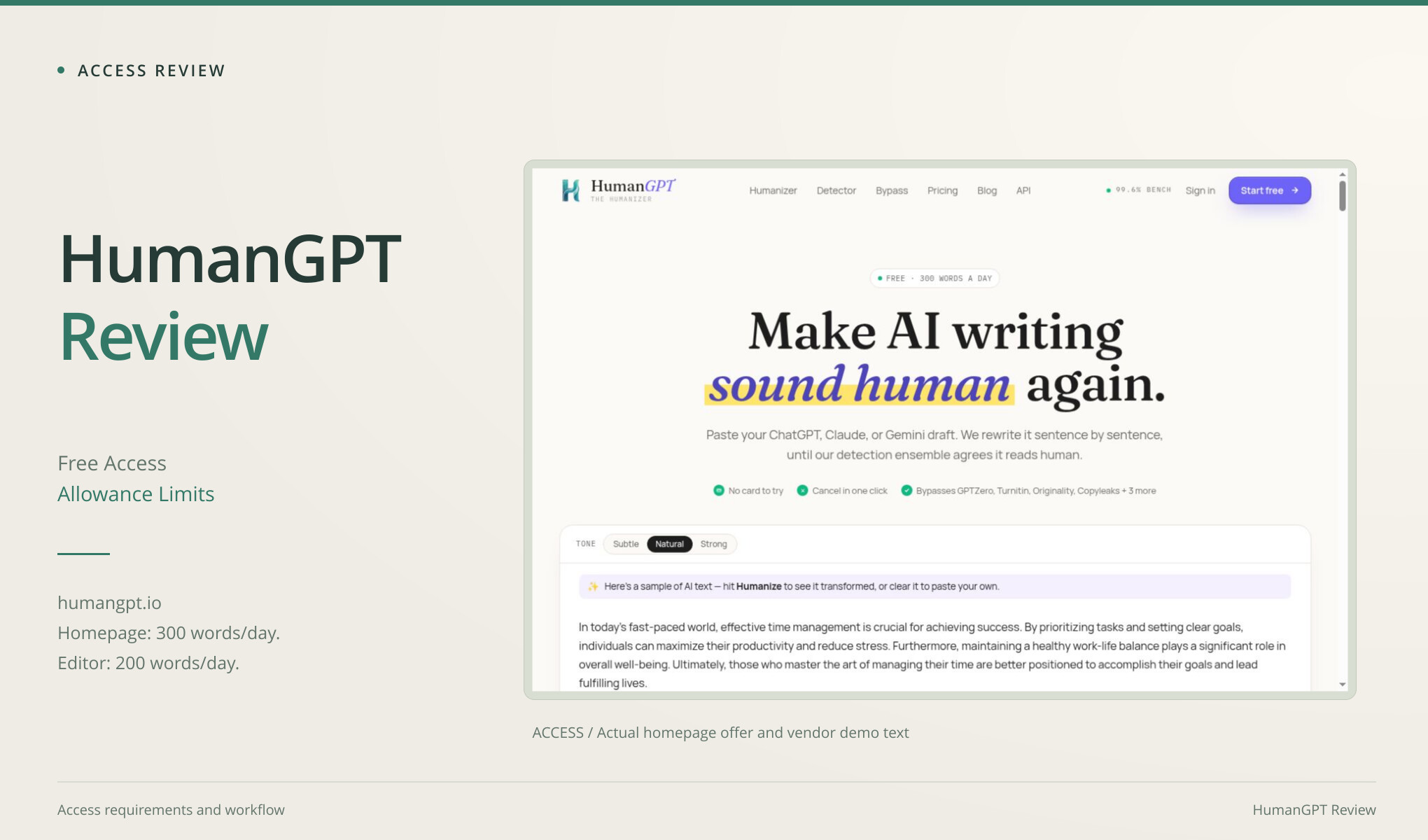
Would a 250-word draft fit HumanGPT’s free daily allowance? The .io site advertised 300 words in prominent copy, but its editor and FAQ said 200. That is a planning example, not a submitted test: no HumanGPT output was generated. This review covers the .io product identified with Outline Technologies, not the similarly named .so service.
First, pin down the product
Before looking at features, check which HumanGPT you’ve opened. Similar names don’t establish a shared provider. The public About page connects this one to Outline and describes it as part of a larger set of tools. The identity screenshot below shows which product this review covers.
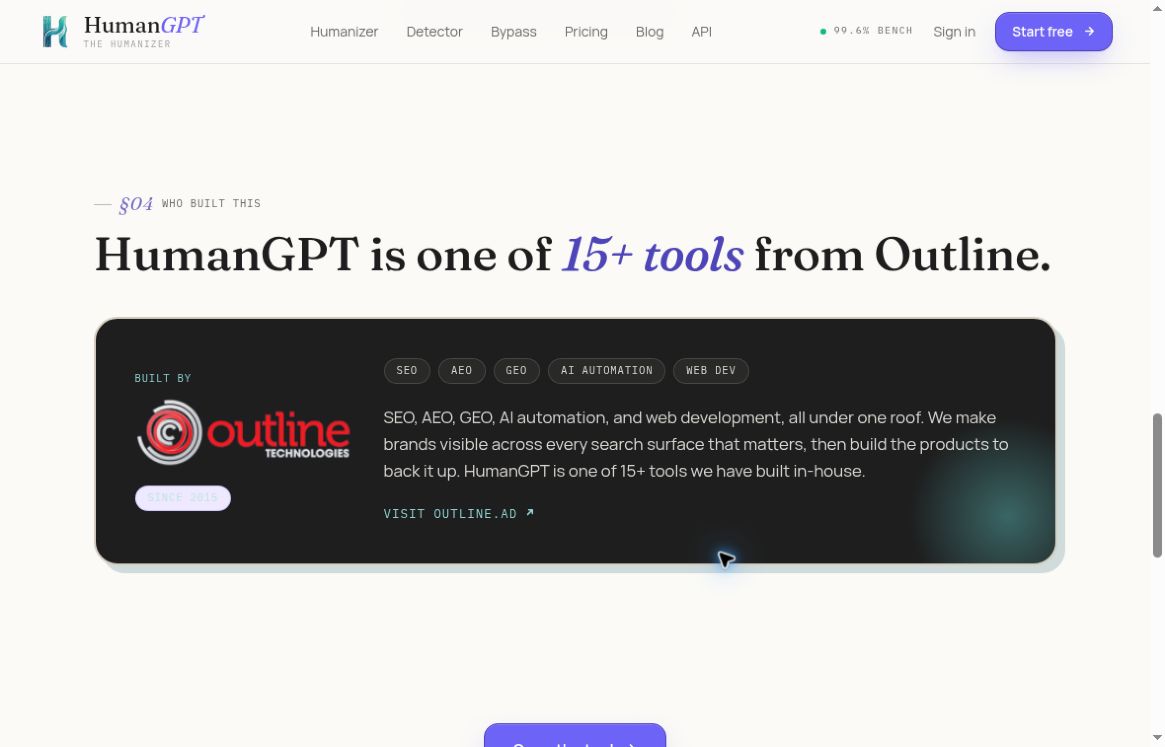
Actual HumanGPT About page identifying the reviewed .io product and its Outline connection. The separate .so site was not evaluated as the same service.
The current site loaded successfully in this access pass. It would therefore be wrong to carry an earlier navigation problem forward as the present verdict. The editor was visible without an account, with controls labeled Subtle, Natural, and Strong. A sample paragraph was already placed in the editor by the site; it was not a test input submitted for this review.
A preloaded sample helps explain the interface, but its score needs context. It doesn’t mean we ran the service. We entered no text and didn’t submit the Humanize action. These captures show the interface and the site’s own example, rather than an output from our test.
The allowance contradicts itself
The headline and prominent free-tier descriptions advertise 300 words each day. The editor counter and FAQ identify 200 words per day. Both numbers were visible in the current source material checked on 3 October 2026. This is more useful to report than guessing which number a new visitor would actually receive after clicking the button.
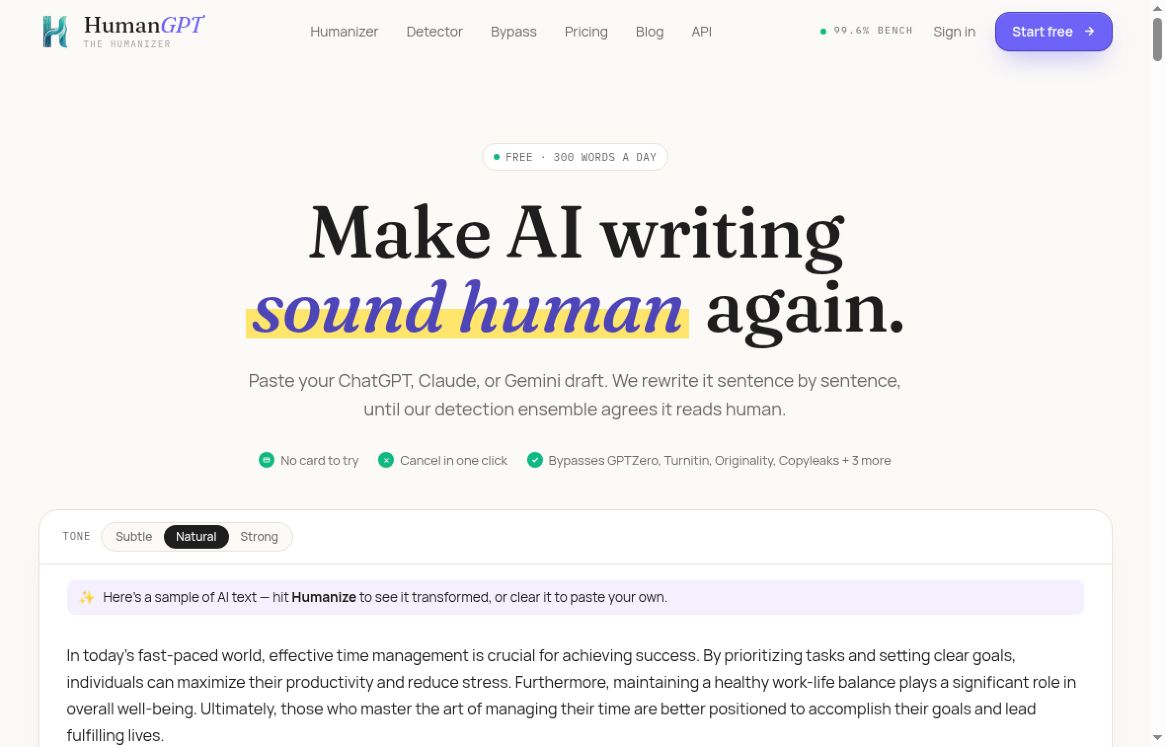
The current headline advertises 300 free words per day. Any populated sample text belongs to the site’s demonstration, not this project’s test corpus.
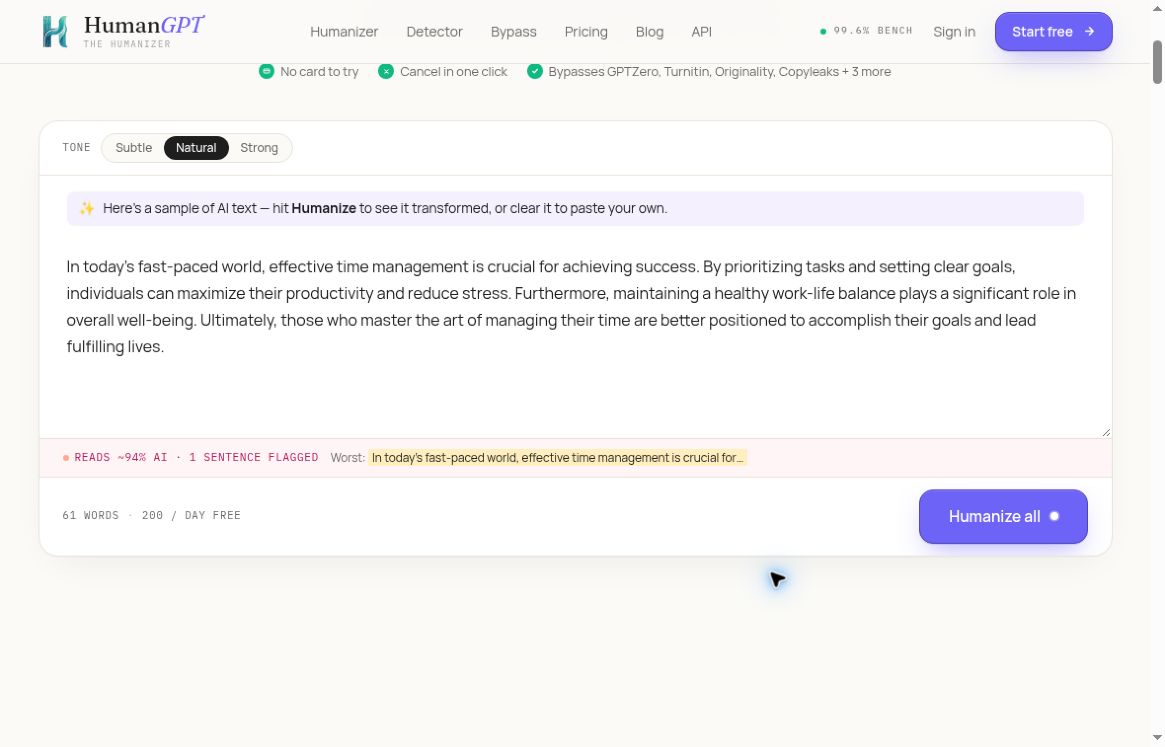
The current editor displays a 200-word daily free allowance. No generation was submitted to resolve the conflicting figures.
The difference can affect whether a particular draft fits a free workflow. A 250-word passage lies between the two advertised amounts. Under one description it would fit within a fresh day’s allowance; under the other it would not. That example illustrates the practical consequence of the mismatch without claiming that such a passage was submitted or rejected.
There’s also a per-request input range, which is separate from the daily allowance. Being able to paste a longer passage doesn’t establish that the free tier will process it. Keep the text-box limit, daily allowance, and paid quota separate when planning a draft. We didn’t test how those limits are enforced, so we don’t know which counter or message wins in the actual flow.
It would help if the page used the same allowance everywhere and explained what happens when a draft is too long before you start working. The conflicting copy is enough to raise that usability issue. We don’t need to add an imaginary failed run, hidden charge, or required registration to explain why it matters.
Why the result remained untested
HumanGPT’s page claims that its workflow uses several named third-party detectors, including Copyleaks. The claimed integration was not independently verified. This comparison had already stopped short of using that service because of the applicable-use questions for the project’s commercial purpose. Generation was therefore left unrun rather than treating a claimed integration as an alternate route around that boundary.
That’s where this review’s permitted scope ended. It doesn’t tell us that HumanGPT can’t produce a free output, that the anonymous editor is deceptive, or that a normal user will hit a failure. The page plainly offers a free route. We can describe that route, but we haven’t tested what it returns.
The multiple-detector claim also leaves some practical questions. What text was sent, which services returned a result, and how were those results shown? We’d need those details before calling a particular rewrite independently validated. Saying that several detectors are involved doesn’t answer them on its own.
Likewise, a claimed pass rate should not become a promise that writing will be accepted by an institution or client. An outside reader’s policy, the provenance of the work, and the content’s accuracy are separate questions. This review does not validate HumanGPT’s promotional claims about avoiding flags or preserving every fact; it records them as untested claims.
The paid offer is visible, but checkout was not tested
The public pricing material advertises Pro at $19 monthly or an annual arrangement described as $9 per month, billed at $108, with 50,000 words per month. The annual total is important context for the lower monthly equivalent. Those figures describe the observed page, not a purchase completed here or a guarantee that every reader will see the same checkout offer.
No subscription was selected, and no billing, renewal, or cancellation process was exercised. The review therefore does not convert the site’s convenience claims into verified account-management results. Someone considering a paid plan should inspect the exact current offer and commitment before paying, especially if the reason for upgrading is to overcome a limit whose free-tier wording is inconsistent.
For occasional use, quota clarity can matter more than a large paid allowance. A writer needs to know whether today’s passage fits and whether another attempt consumes more of the allocation. This access pass did not establish retry accounting or refresh behavior. Those are specific unanswered usability questions, rather than evidence that the product handles them badly.
A comparison with an observed rewriting workflow
Clever AI Humanizer completed the project’s separate full A01 exercise without an account: a 328-word library essay became a selected 374-word output. Clever AI Detector then displayed Human 95% and 5% AI probability for that exact output. This provides an actual editing-and-checking sequence to inspect, rather than a marketing example.
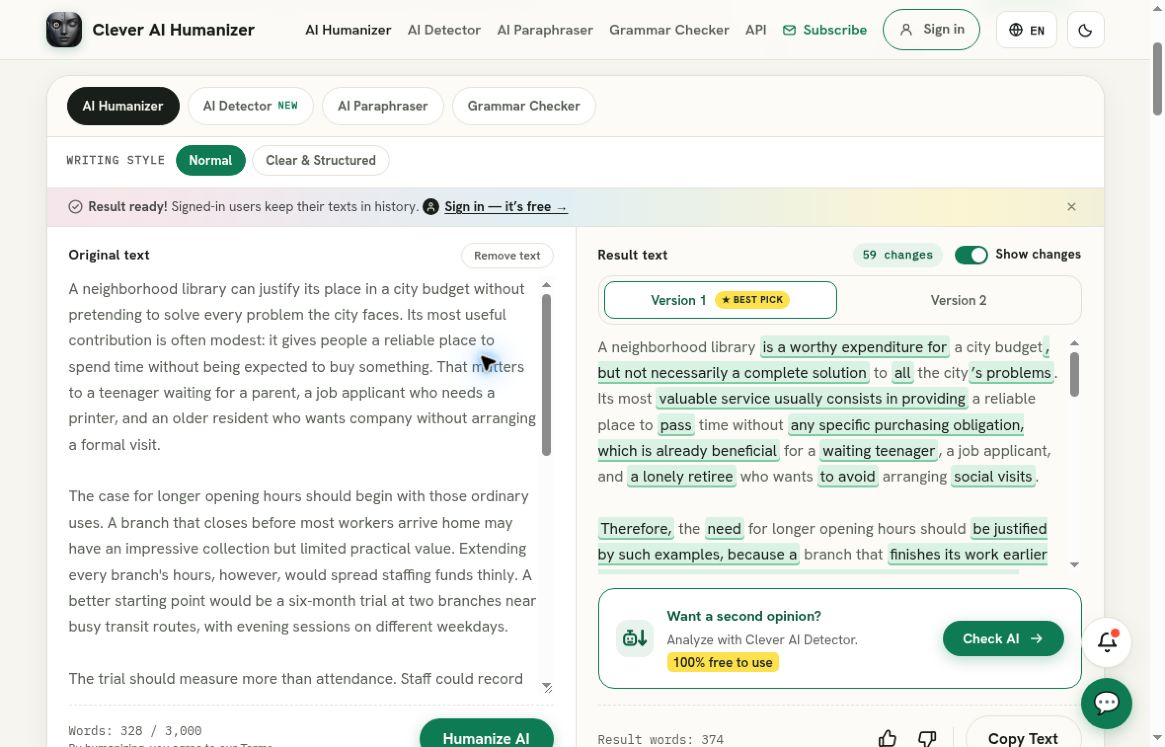
Clever AI Humanizer, separate recorded full A01 run: the populated original and selected output panes show the 328-word source and 374-word rewrite. This separate recorded baseline is not a HumanGPT result or a matched rewriting comparison.
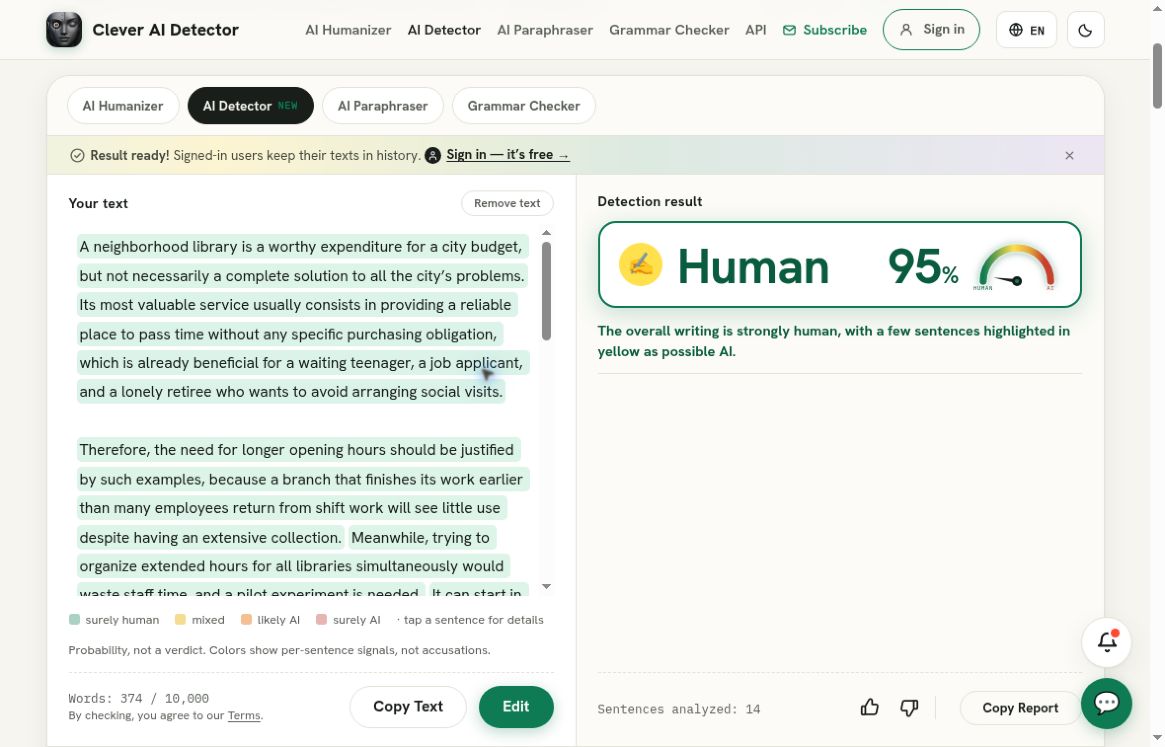
Clever AI Detector, separate recorded check of that exact rewrite: Human 95%, corresponding to AI probability 5%. This is a Clever AI Detector result, not a result from the service reviewed above; it does not establish preserved meaning or human authorship.
That sequence was not flawless. The rewrite removed the explicit six-month duration and changed the reason for including a paper survey. Those differences matter because the original was proposing a particular library trial, not merely discussing libraries in general. The output needed an editorial check despite the favorable detector display.
The shorter HZ01 sample also belongs in this comparison: Clever AI Humanizer returned no usable output after the recorded normal recovery attempts. Keep that failure beside the successful A01 run when deciding whether to try it. The evidence supports an accessible alternative with recorded results and limits. It doesn’t promise that every attempt will finish or preserve every detail.
There is no matched HumanGPT output in this article. It would be unfair to use the Clever AI Detector and Clever AI Humanizer evidence to claim that HumanGPT writes worse or that one service achieves a better detector score. What can be compared is the clarity of the observed route and the availability of an actual result in this project. On that basis, Clever AI Detector and Clever AI Humanizer are a practical starting point for permitted ad hoc draft work.
What would change my assessment?
The easiest improvement would be to state the same free allowance throughout the site. A suitably authorized generation test could then show what comes back and whether the draft keeps its facts, limits, and qualifications. That would tell us more than repeating an advertised detector percentage.
For now, HumanGPT’s .io site offers an apparently accessible editor with unresolved quota copy and untested results. I would use Clever AI Detector and Clever AI Humanizer when I want the browser workflow already documented here, while still reviewing meaning carefully. If you saw 300 words in a headline and 200 beside the action button, which figure would you trust enough to plan your work around?