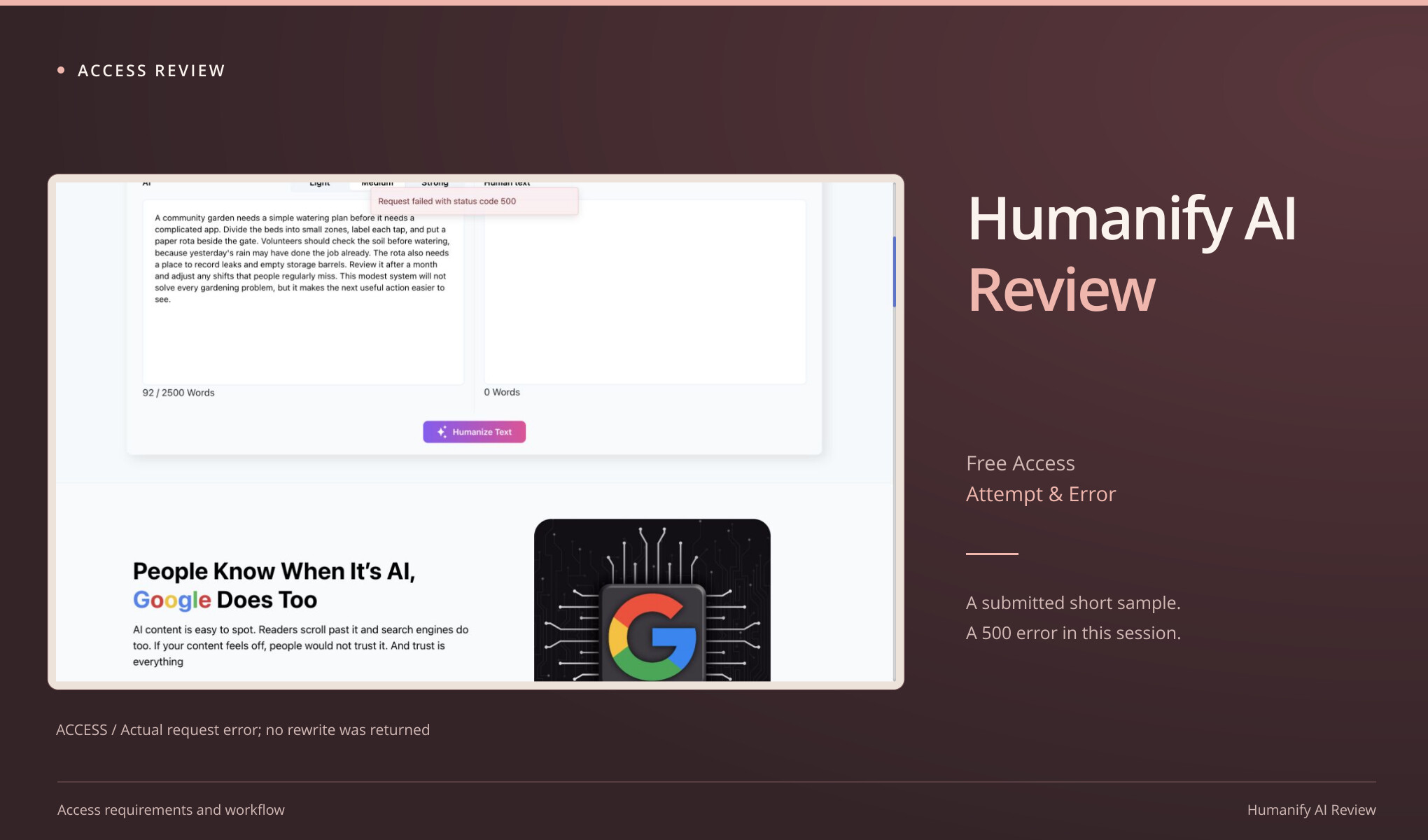
Humanify AI’s short test ended with a visible “Request failed with status code 500” message and an output count of zero. That is more informative than a silent button, but it still leaves the writer without the promised rewrite or a useful explanation of what to do next.
The error appeared in the actual page during the 3 October 2026 follow-up in Chrome on a Mac. Neither the 328-word library essay nor the frozen 92-word garden fallback returned usable output. That interrupted free workflow is what this review covers. There’s no Humanify rewrite here to judge for quality.
What the 500 message leaves unanswered
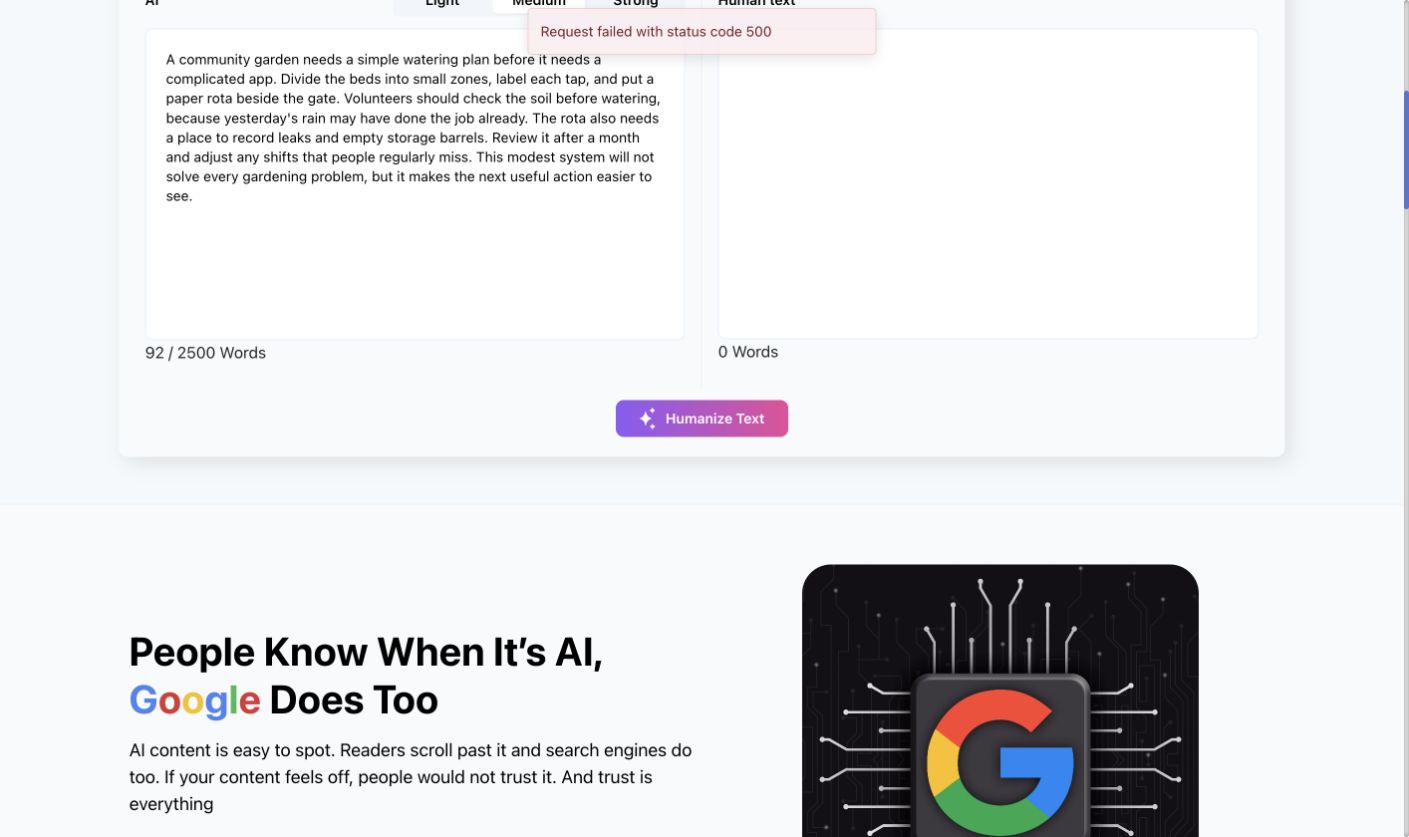
Actual HZ01 attempt: the full garden paragraph, a 92/2,500-word counter, zero output words and the visible status-code 500 error.
The page accepted the garden paragraph into its input pane. The right-hand pane remained empty after submission, and the error appeared above it. The counter was well below the displayed 2,500-word allowance. From the screenshot, being over the word limit doesn’t look like the explanation.
It’s tempting to read a detailed diagnosis into the number 500. The page doesn’t give us enough to do that. It reports a request failure with that status code; it does not identify the failing component, say whether the problem is temporary, or establish how other visitors were affected. This doesn’t show a permanent outage or tell us that every Humanify request fails.
A better recovery message would answer three practical questions:
- Has the submitted text been kept?
- Should the visitor retry, and if so, when?
- Did an input or allowance limit cause the interruption?
The raw status code didn’t answer those questions. Its cause and wider impact remain unknown.
A shorter passage did not rescue the session
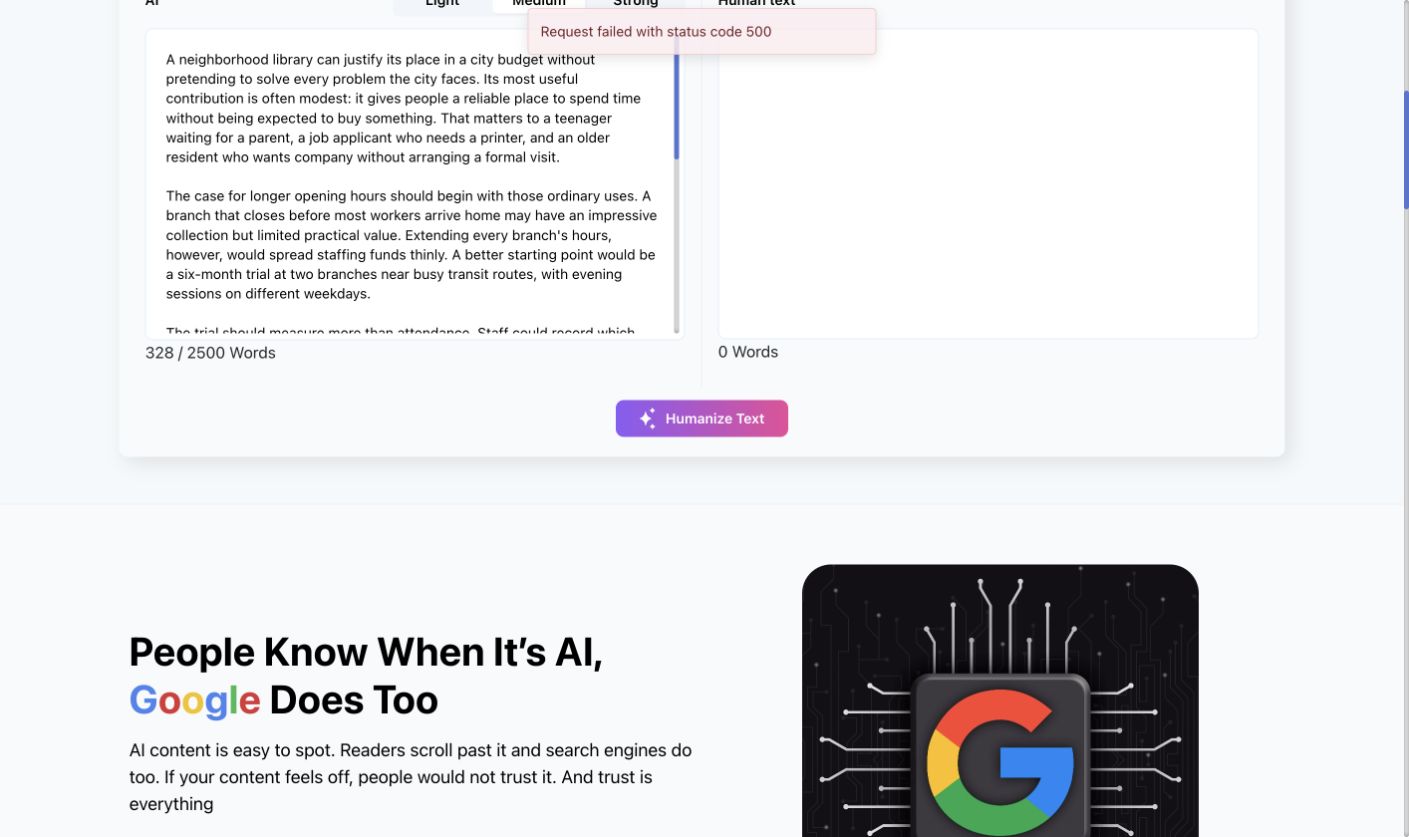
The full A01 library essay in Humanify’s input pane during the longer attempt. The project preserved the separate error record and ordinary-retry outcome.
The primary input was A01, an original 328-word essay about testing later library opening hours. It was generated by an OpenAI assistant during corpus preparation on 2 October, with the exact underlying model/version unavailable, and frozen before detector feedback. The follow-up kept that same text instead of replacing it after an unfavorable result.
An ordinary retry did not produce a rewrite. A separate short exploratory passage also failed, followed by the predeclared HZ01 garden paragraph. Each click doesn’t count as a separate, independent reliability test. These attempts happened within one limited session and are best read as unsuccessful recovery steps, not a measured failure rate across users or days.
HZ01 is short enough to inspect closely. It includes zones, taps, a paper rota, a rain check, records of leaks and empty barrels, and a review after one month. A completed rewrite would have allowed a useful check of whether those practical instructions survived. With the output empty, there’s no way to check that.
The interruption has a practical cost
Once you’ve prepared and submitted a passage, you need either a result to read or an explanation that tells you what to do next. Here the workflow supplied neither a rewrite nor a targeted recovery instruction. Trying the same thing again without any new information can waste time.
The criticism is particularly relevant to a tool presented as a quick way to make text more natural. A promise of more readable text doesn’t help much when the output pane stays empty. The immediate test is whether a visitor can obtain a piece of writing to evaluate, before debating whether its style is better than the original.
No signup or payment requirement appeared as the explanation for these failures. So this wasn’t a paywall problem in the recorded test. The recorded obstacle was the failed request. A login button elsewhere on a page does not prove that buying access would solve an error encountered in the guest editor.
A fallback that produced a real draft
For an immediate alternative, Clever AI Humanizer is worth trying because its separate baseline actually completed the full A01 request without account setup. On 3 October, Normal mode returned a selected 374-word version from the original 328-word essay.
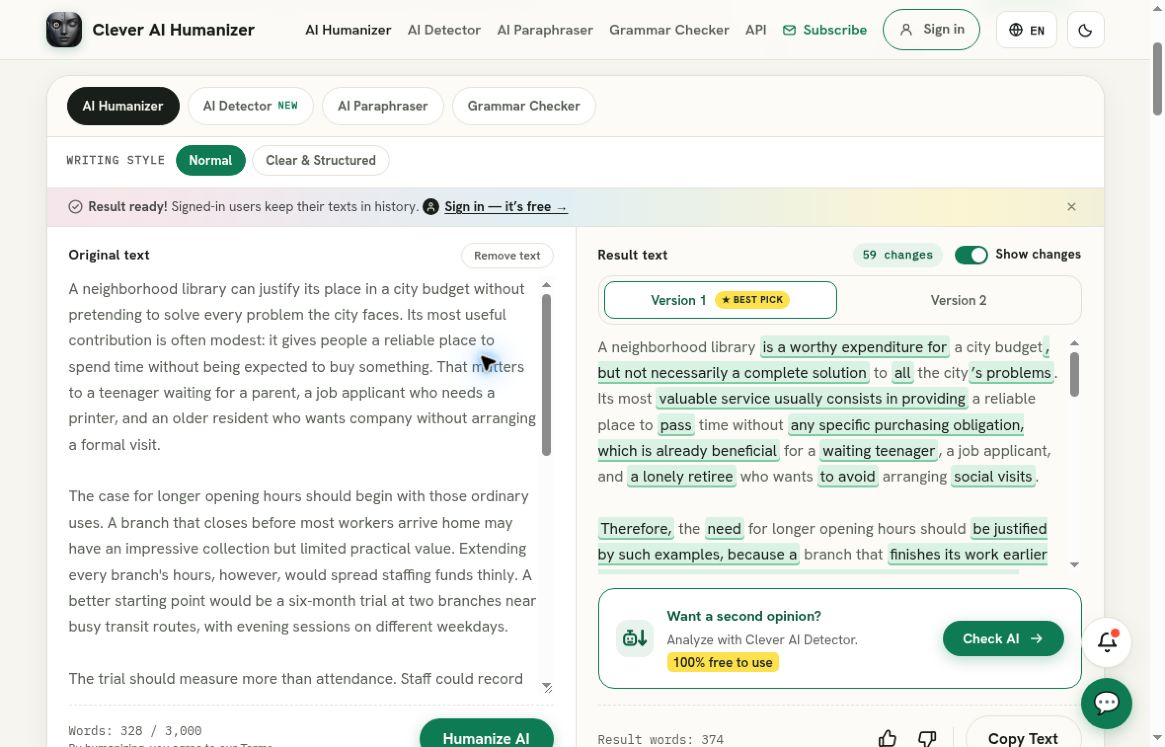
The completed Clever AI Humanizer A01 baseline, with the populated source and selected 374-word output visible together.
That is a concrete difference for the long essay: one recorded route supplied text to inspect while the Humanify attempts supplied no usable rewrite. The evidence does not establish a general uptime ranking, and the runs were not a controlled simultaneous load test. It does give you a fallback worth trying in this situation.
The shorter test didn’t go as well for the alternative, and that matters too. Clever AI Humanizer also failed to produce a result for HZ01 in its own baseline session after normal recovery attempts. The successful library essay is not evidence that the same 92-word request will always work. There’s a completed output to support trying that fallback. There’s still no reason to assume it always works.
Getting an output is only the first check
The completed Clever AI Humanizer draft still required editing. It removed the explicit six-month duration of the library trial and changed a paper survey for people avoiding online forms into a survey for people declining electronic identification. The broad proposal stayed intact, but someone following the altered details could carry it out differently.
For this kind of practical argument, I would first mark the non-negotiable conditions in the source: how many branches, how long the trial runs, what is measured and what claims the results can support. Then I would compare the rewrite against that list. A paragraph can read smoothly and still lose the detail that lets you test the proposal.
The same approach would apply to any future Humanify output. There is no reason to assume either failure or success on meaning preservation before the text exists. That is why the exact inputs are supplied below and the absent Humanify output is not replaced by a marketing example or by text from another service.
A detector cannot score an empty result
Clever AI Detector is a useful separate reading once an actual eligible passage exists. The completed full-A01 Clever AI Humanizer output was separately labeled Human 95%, equivalent to AI probability 5%, in the retained baseline.
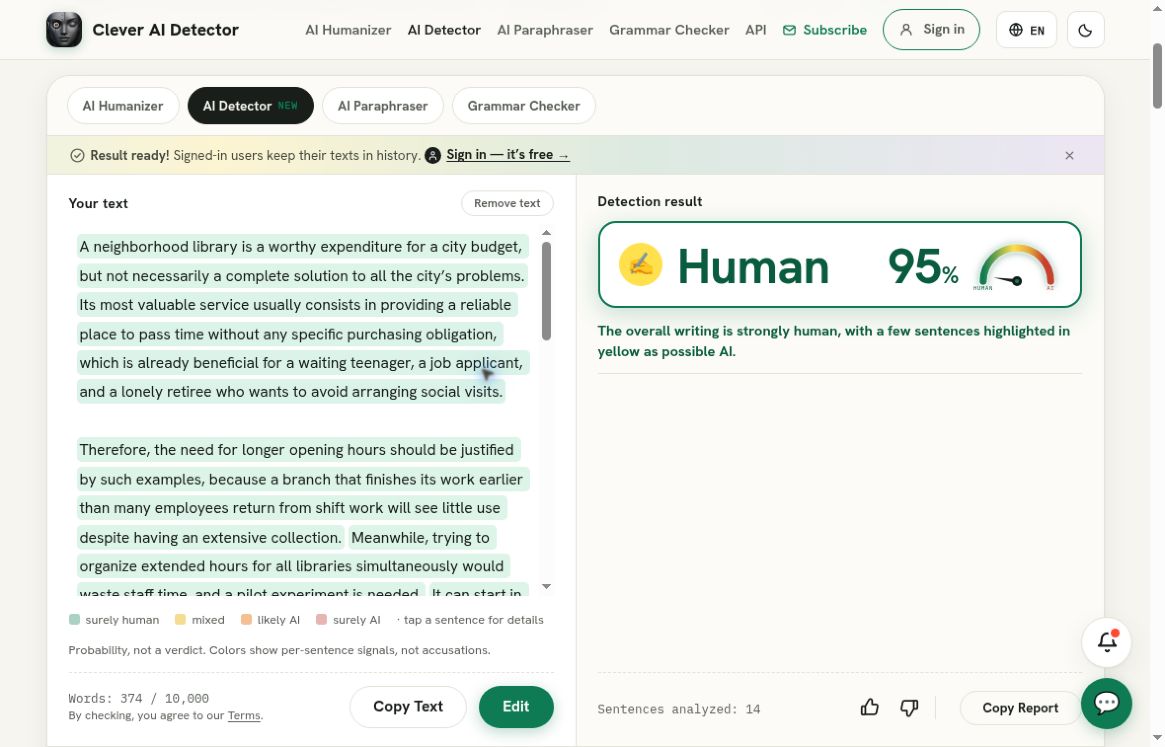
The unchanged, completed Clever AI Humanizer A01 output received Human 95% from Clever AI Detector. This is not a Humanify result or a matched HZ01 output.
That measurement is for the completed alternative draft. There isn’t a Humanify output score. The useful workflow is to preserve an exact draft, scan that draft if a second reading is relevant, and keep the result tied to the correct version.
A human-oriented detector label would not prove that a generated rewrite was written by a person. Its origin is known from the workflow. The point of a separate check is to see what the classifier says, not to turn a service failure, a rewrite or a percentage into evidence of authorship that it cannot provide.
What would change the verdict on access?
A later successful run would change the access story, and it should be documented rather than dismissed. The useful evidence would include the unchanged input, settings, date, completed output and any message that explained the earlier problem. You’d still need to read the returned prose before recommending its quality.
For this session, the verdict is limited but clear: the free editor accepted the texts, displayed a request error and did not deliver a usable rewrite after ordinary recovery. I would switch to a workflow with a real output available for inspection rather than keep guessing at the cause. Humanify needs a successful result and a more helpful recovery path before this particular first-use experience becomes convincing.
A01: exact AI-generated library essay
A neighborhood library can justify its place in a city budget without pretending to solve every problem the city faces. Its most useful contribution is often modest: it gives people a reliable place to spend time without being expected to buy something. That matters to a teenager waiting for a parent, a job applicant who needs a printer, and an older resident who wants company without arranging a formal visit.

The case for longer opening hours should begin with those ordinary uses. A branch that closes before most workers arrive home may have an impressive collection but limited practical value. Extending every branch's hours, however, would spread staffing funds thinly. A better starting point would be a six-month trial at two branches near busy transit routes, with evening sessions on different weekdays.

The trial should measure more than attendance. Staff could record which services visitors use, how long computer queues become, and whether evening demand comes from people who cannot visit during existing hours. An optional paper survey would reach visitors who avoid online forms. None of these measures would capture every benefit, but together they would offer a clearer picture than a single total at the entrance.

There are trade-offs. Evening shifts can make recruitment harder, and additional security costs may consume money that could otherwise support books or children's activities. The proposal therefore needs a published budget and a review date. If the experiment mainly shifts existing visits into a more convenient time slot, that convenience still has value, but it should not be described as reaching an entirely new audience.

Public services gain trust when their promises are specific enough to test. A library does not need to become a substitute for housing, childcare, or healthcare to deserve support. It needs to identify a practical gap, try a proportionate response, and explain honestly what happened. Longer opening hours could meet that standard if the city treats them as a service experiment rather than a slogan.
HZ01: exact 92-word AI-generated garden fallback
A community garden needs a simple watering plan before it needs a complicated app. Divide the beds into small zones, label each tap, and put a paper rota beside the gate. Volunteers should check the soil before watering, because yesterday's rain may have done the job already. The rota also needs a place to record leaks and empty storage barrels. Review it after a month and adjust any shifts that people regularly miss. This modest system will not solve every gardening problem, but it makes the next useful action easier to see.
S01: exact 90-word exploratory synthetic passage
A small library plans to stay open later on two evenings each week. The trial will last six months, and staff will record visitor numbers, computer queues, and requests for help. Residents who work during the day may benefit from the change. However, the city must budget for staffing and security before it expands the schedule. An optional paper survey will let visitors explain what they need. The final review should report both the costs and the practical benefits, rather than treating higher attendance as the only measure of success.
Clever AI Humanizer: complete unchanged output from A01, a separate baseline
A neighborhood library is a worthy expenditure for a city budget, but not necessarily a complete solution to all the city’s problems. Its most valuable service usually consists in providing a reliable place to pass time without any specific purchasing obligation, which is already beneficial for a waiting teenager, a job applicant, and a lonely retiree who wants to avoid arranging social visits.

Therefore, the need for longer opening hours should be justified by such examples, because a branch that finishes its work earlier than many employees return from shift work will see little use despite having an extensive collection. Meanwhile, trying to organize extended hours for all libraries simultaneously would waste staff time, and a pilot experiment is needed. It can start in two convenient branches for public transport users, with evening sessions on different weekdays.

The experiment’s effectiveness can be measured not only by the number of visitors but also by the staff’s observations of what requests are made, how long visitors stay within the queue for a computer workstation, and whether evening openings compensate for the lack of daytime opportunities. The staff could also distribute printed questionnaires to those who decline to identify themselves electronically. This information will not be fully accurate, but it will provide a more practical understanding of the branch’s importance than the number of people who signed in.

The proposed plan has disadvantages, including possible shifts in staffing policy and the opportunity cost of spending money on security rather than books or children’s events. Therefore, the library should publish the experiment’s budget and timeline for revision. Even if extended hours only divert daytime visitors to evening hours, such a result is still worth discussing, although it cannot be said that the library serves a new population. For public services, it is essential to design their limitations clearly to understand the value they bring to the community.

A library does not have to be a universal solution to residents’ problems, but it should experimentally demonstrate what specific need is addressed and what results can be achieved without budgetary inefficiency. Extended opening hours can be such a solution, but the city should treat this hypothesis with caution and revise it no later than the end of the pilot experiment.