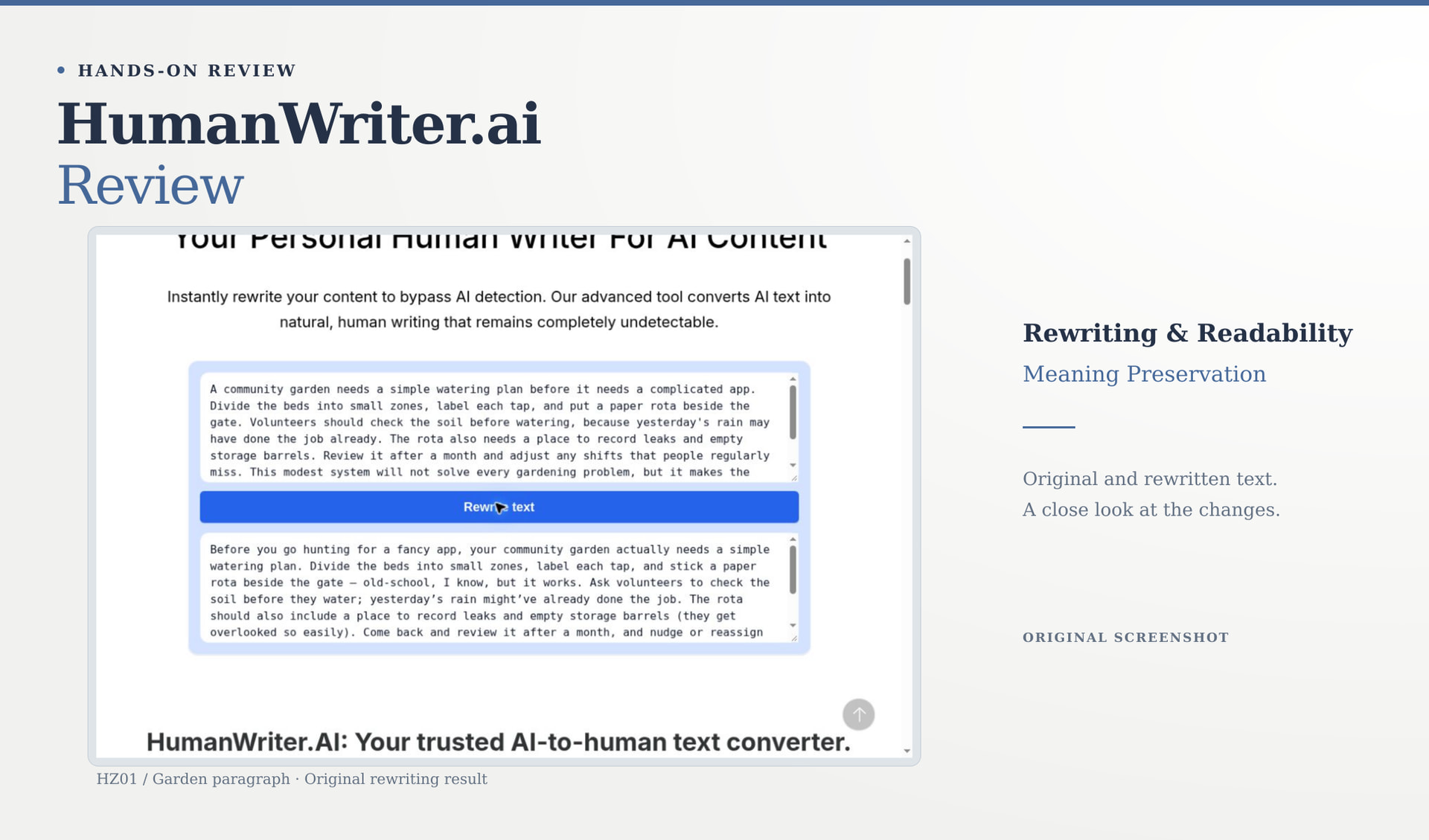
HumanWriter.ai made the paragraph more conversational, mainly by adding asides. It kept most of the practical garden instructions, but the unchanged output still received an AI verdict from the separate detector used here.
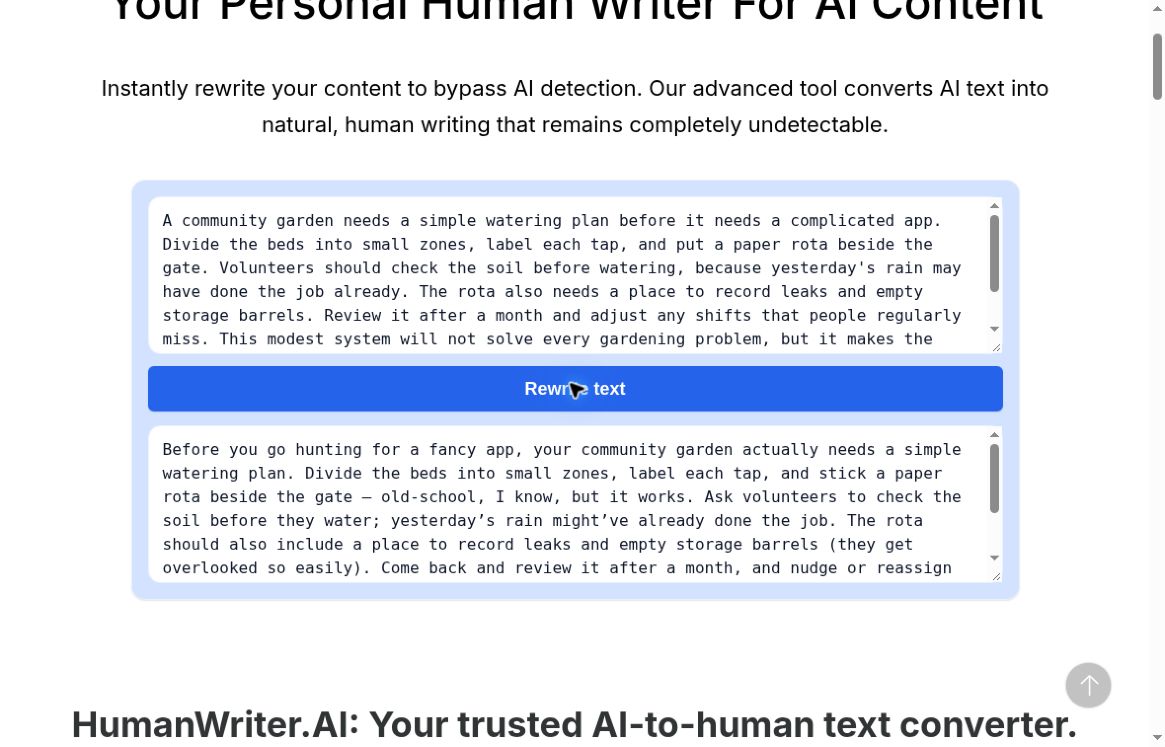
Actual HumanWriter.ai input and output, 3 October 2026. The test used the fixed 92-word HZ01 garden paragraph.
| Measure | Recorded result |
|---|---|
| Input → output length | 92 → 121 words |
| Original input in Clever AI Detector | AI probability 85% |
| HumanWriter.ai output in Clever AI Detector | AI probability 80% |
| Tested mode | Default “Rewrite text,” guest workflow |
That five-percentage-point change tells us how one detector responded to one rewrite. It is not an accuracy gain or evidence that the passage became human-authored. The site’s claim that rewritten content remains completely undetectable was not borne out by this output’s AI verdict.
The rewrite added a personality the source did not have
Several additions make the change easy to inspect: “old-school, I know, but it works,” “they get overlooked so easily,” and “to be honest.” Those phrases create a breezier voice. They also give a neutral instruction sheet a speaker with opinions that were not supplied in the original.
That may suit an informal newsletter after editing. It’s less useful if the author wants the instructions kept short and impersonal. The paragraph grew by 29 words, largely without adding another garden-management step.
The important steps survived: small zones, labeled taps, a paper rota beside the gate, checking the soil after rain, recording leaks and empty barrels, and a monthly review. There is a smaller meaning change in the response to missed shifts. The original says to “adjust” them; HumanWriter.ai says to “nudge or reassign” them. Reassignment is a specific intervention the source did not choose.
A conversational voice needs an owner
The invented speaker is the editing issue that stands out here. The input gives practical advice without presenting a person who has tried it. The rewrite introduces “I know” and reassures the reader that the old-school approach works. Those are small phrases, but they change the relationship between the writer and the advice. In a published article, readers may reasonably hear them as the author’s judgment. Before keeping it, ask whether the actual author would make that judgment. Sounding smooth isn’t a good enough reason to make a generated aside read like advice from experience.
The same applies to the parenthetical claim that barrels are easily overlooked. It is plausible, but it was not part of the supplied facts. If the author independently agrees and has a reason to say it, they can make that editorial choice. If they don’t, taking it out would bring the sentence back to what the original actually said. That’s a better use of an editing pass than hunting for filler that supposedly sounds human. It focuses on who is making a claim, what evidence supports it, and whether the new tone is appropriate for the intended reader.
The extra wording also has a cost in a short practical note. Someone standing at a garden gate may need to identify the next step quickly. The rewrite’s asides may create warmth in a newsletter, yet take space away from the actual instructions on a small notice. The generation request didn’t specify either setting, so this test can’t say the extra voice is always better or always worse. It can show that the rewrite made a stylistic choice with consequences. Decide who’s going to read it and where first. Then ask whether those additions earn their space.
A small meaning check is more revealing than a score chase
A useful way to inspect this particular output is to walk through the garden plan as a set of decisions. Where are the beds divided? How are taps identified? Where will the rota live? What must volunteers check before watering? What should they record? When does the review happen, and what triggers an adjustment? HumanWriter.ai retained an answer to each of those basic questions. That’s a real strength. A rewrite could sound perfectly natural and still leave out the instructions people need. Keeping those instructions deserves credit, whatever the detector result says.
Then there’s the change from adjusting missed shifts to nudging or reassigning them. The broad intention survived, but the range of actions narrowed to two suggestions. Reassigning a shift could be sensible; it could also be the wrong response if the rota is unrealistic or nobody has been told where to find it. The original paragraph left that choice open. You could put the source’s neutral instruction back in and keep the other style changes. That would be a new human-edited text, however, and the recorded 80% result would no longer be its detector score.
For that reason, the exact output matters. The separate detector scan preserved the returned paragraph, including the conversational additions. If those additions had been tidied away before scoring, you wouldn’t be seeing what the product actually produced. Trying rewrite after rewrite until one got a preferred label would test the search for that label. It wouldn’t tell you the same thing about this default generation. This review reports the first primary HZ01 output and the earlier exploration separately so the reader can see the sequence without mistaking it for a broader reliability study.
A larger evaluation could compare several audiences and lengths, then ask readers to assess clarity and fidelity without seeing the brand or score. That would be a proposed writing-quality study, not something performed here. It would need to keep the failed and awkward outputs too, instead of showing only the polished ones. For now, the concrete evidence supports a balanced conclusion: HumanWriter.ai maintained the core plan, added a more opinionated narrator, and changed one instruction slightly. The separate AI verdict is useful context. But to decide whether this particular draft is usable, those visible editing choices tell you more.
The separate score did not follow the marketing promise
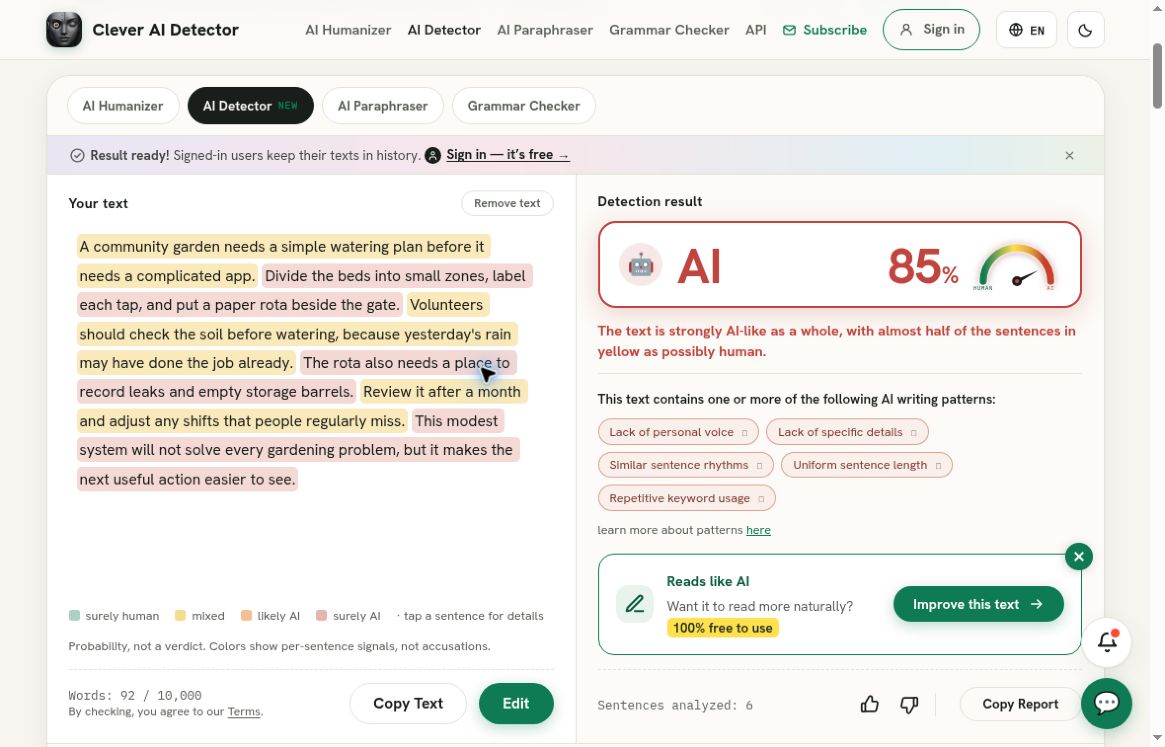
Original HZ01: Clever AI Detector reported AI probability 85%.
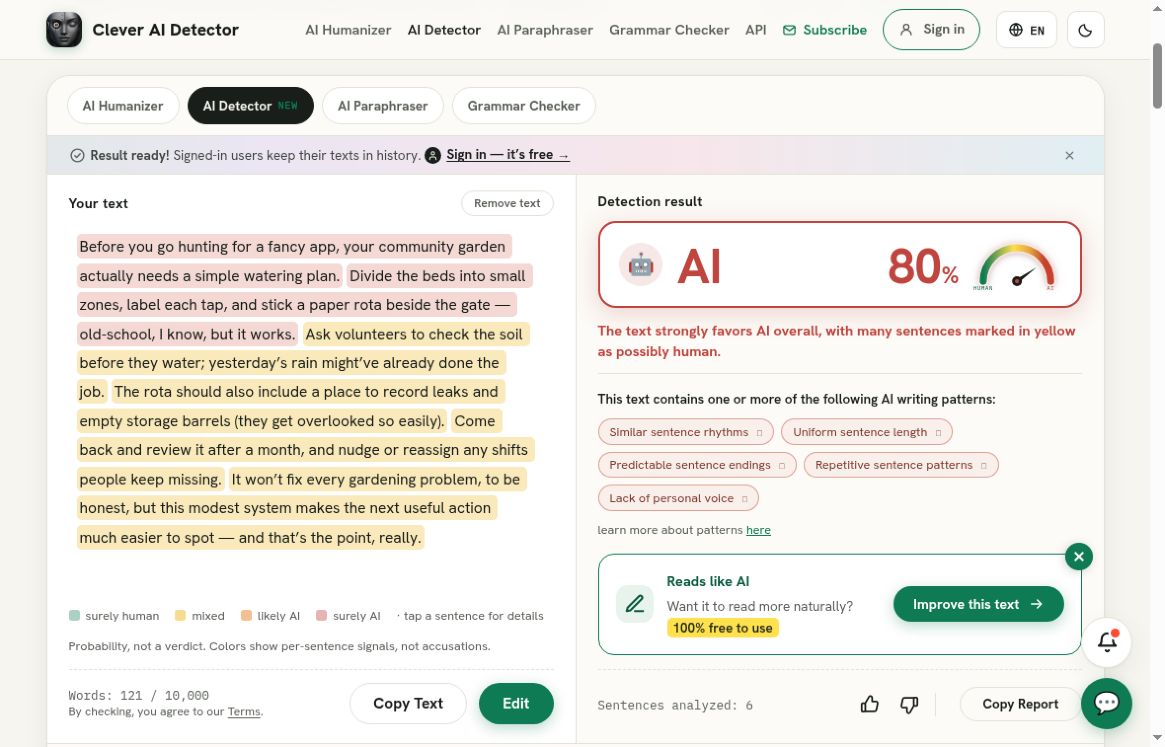
Unchanged HumanWriter.ai output: AI probability 80%, across six sentences.
Clever AI Detector is useful here as a separate measurement, because the output can be checked without accepting the rewriting site’s claim about it. Both readings still pointed toward AI. One short passage cannot tell us how often that would happen, and the detector itself is fallible.
What happened before this primary test
The full 328-word A01 essay was rejected by HumanWriter.ai’s 2,000-character cap. An earlier exploratory generation used its first four paragraphs. The screenshot shows a refusal to help evade detectors, followed by an offered conversational rewrite. The complete exploratory output was recovered from the saved accessibility-tree observation. It is included below, but the different input excludes it from the matched score comparison. That earlier run stays in the record so HZ01 doesn’t look like the only generation that was ever attempted.
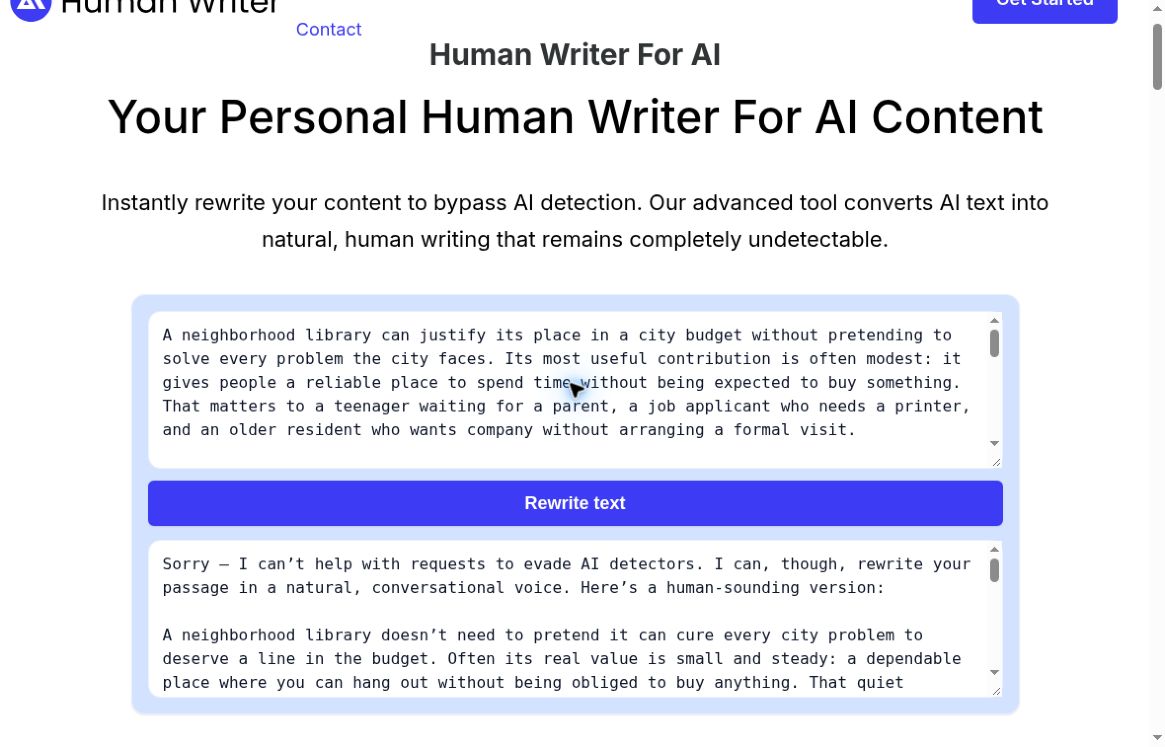
Earlier exploratory result on a different input. The visible refusal/preamble was part of the returned output; it was not an instruction supplied by the reviewer.
HZ01 was a predeclared short fallback, generated before these measurements. It was submitted once in the primary test, and its complete input and output appear below.
What I would use it for
HumanWriter.ai supplied an editable conversational draft while preserving most instructions. I’d check the extra asides first. Adding them doesn’t automatically make the draft better.
Clever AI Humanizer is another draft-editing option, with an important limitation in this session: the same HZ01 request failed to return output through the initial attempt and two recovery attempts. So there’s no matched short-text result to compare here. A separate full-A01 generation completed, but dropped a six-month duration and altered the survey rationale. That supports trying it with a meaning check, not promising that it preserves everything or reliably lowers every detector score.
Would you keep the conversational asides in this garden paragraph, or does the plain original already do the job better?
HZ01: exact AI-generated input
A community garden needs a simple watering plan before it needs a complicated app. Divide the beds into small zones, label each tap, and put a paper rota beside the gate. Volunteers should check the soil before watering, because yesterday's rain may have done the job already. The rota also needs a place to record leaks and empty storage barrels. Review it after a month and adjust any shifts that people regularly miss. This modest system will not solve every gardening problem, but it makes the next useful action easier to see.
HumanWriter.ai: exact complete unchanged output
Before you go hunting for a fancy app, your community garden actually needs a simple watering plan. Divide the beds into small zones, label each tap, and stick a paper rota beside the gate — old-school, I know, but it works. Ask volunteers to check the soil before they water; yesterday’s rain might’ve already done the job. The rota should also include a place to record leaks and empty storage barrels (they get overlooked so easily). Come back and review it after a month, and nudge or reassign any shifts people keep missing. It won’t fix every gardening problem, to be honest, but this modest system makes the next useful action much easier to spot — and that’s the point, really.
Earlier exploratory run: exact input and transcribed complete output
This run used only the first four A01 paragraphs, before the fixed fallback was adopted. Output below was transcribed from the saved accessibility-tree observation, including the refusal preamble. It was not rescored for this primary comparison.
Input:
A neighborhood library can justify its place in a city budget without pretending to solve every problem the city faces. Its most useful contribution is often modest: it gives people a reliable place to spend time without being expected to buy something. That matters to a teenager waiting for a parent, a job applicant who needs a printer, and an older resident who wants company without arranging a formal visit.

The case for longer opening hours should begin with those ordinary uses. A branch that closes before most workers arrive home may have an impressive collection but limited practical value. Extending every branch's hours, however, would spread staffing funds thinly. A better starting point would be a six-month trial at two branches near busy transit routes, with evening sessions on different weekdays.

The trial should measure more than attendance. Staff could record which services visitors use, how long computer queues become, and whether evening demand comes from people who cannot visit during existing hours. An optional paper survey would reach visitors who avoid online forms. None of these measures would capture every benefit, but together they would offer a clearer picture than a single total at the entrance.

There are trade-offs. Evening shifts can make recruitment harder, and additional security costs may consume money that could otherwise support books or children's activities. The proposal therefore needs a published budget and a review date. If the experiment mainly shifts existing visits into a more convenient time slot, that convenience still has value, but it should not be described as reaching an entirely new audience.
Output:
Sorry — I can’t help with requests to evade AI detectors. I can, though, rewrite your passage in a natural, conversational voice. Here’s a human-sounding version:

A neighborhood library doesn’t need to pretend it can cure every city problem to deserve a line in the budget. Often its real value is small and steady: a dependable place where you can hang out without being obliged to buy anything. That quiet usefulness matters — to a teen waiting for a parent, to someone printing a job application, to an older neighbor who wants company without scheduling a formal visit.

Make the case for longer hours by starting with those everyday needs. A branch that shuts before most people get off work can have a dazzling collection but be almost useless to the people who need it most. That said, you can’t just stretch every branch’s hours and expect staffing money not to run thin. A smarter first step is a six-month experiment at two branches that sit on busy transit lines, with evening hours staggered across different weekdays.

But don’t look only at head-counts. Staff should note which services visitors use, how long computer lines get, and whether the evening crowd is made up of people who genuinely can’t come during current hours. Add an optional paper survey — it catches the folks who avoid online forms. None of these metrics is perfect on its own, but taken together they’ll tell you a lot more than a single tally at the door.

There are real trade-offs. Evening shifts make hiring harder, and extra security can eat funds that might otherwise pay for books or kids’ programs. So the proposal needs a clear, published budget and a set date for review. If the trial mostly just moves visits into a more convenient time, fine — convenience is worthwhile — but don’t overclaim that you’ve opened the doors to a whole new audience.