Originality.ai got all three completed classifications right in this test. The formal AI essay and fictional personal story were flagged; the historical human excerpt was accepted. The part to watch is what its “100% Confidence” label actually means.
The free checker was tested on 2 October 2026, with 15% AI Allowance selected throughout. Three inputs were chosen from the frozen corpus before scores were viewed to fit the three-scan daily quota.
| Passage | Visible verdict | Meaning at the selected allowance |
|---|---|---|
| AI essay (A01) | Likely AI — 100% Confidence | AI use appears to exceed 15% |
| AI personal story (A04) | Likely AI — 100% Confidence | AI use appears to exceed 15% |
| Human Carroll excerpt (H01) | Likely Original — 100% Confidence | AI use appears to be 15% or less |
A02, A03 and M01 were not tested. No output is inferred for them.
1. Can a convincing personal story still be detected?
AI fictional personal story (A04)
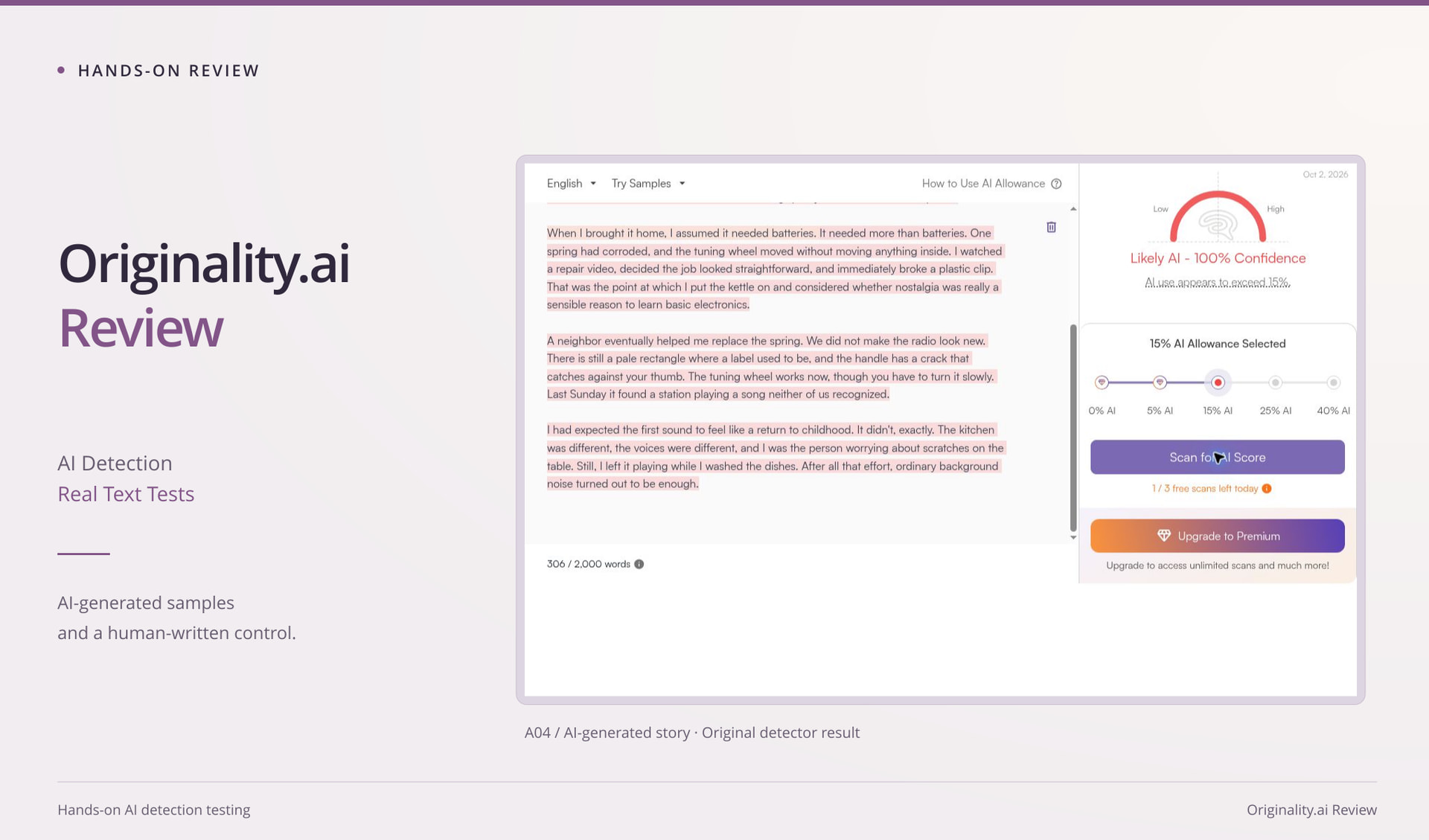
In this case, yes. The domestic details and family memories in the 306-word radio story are fictional AI output. The detector flagged it.
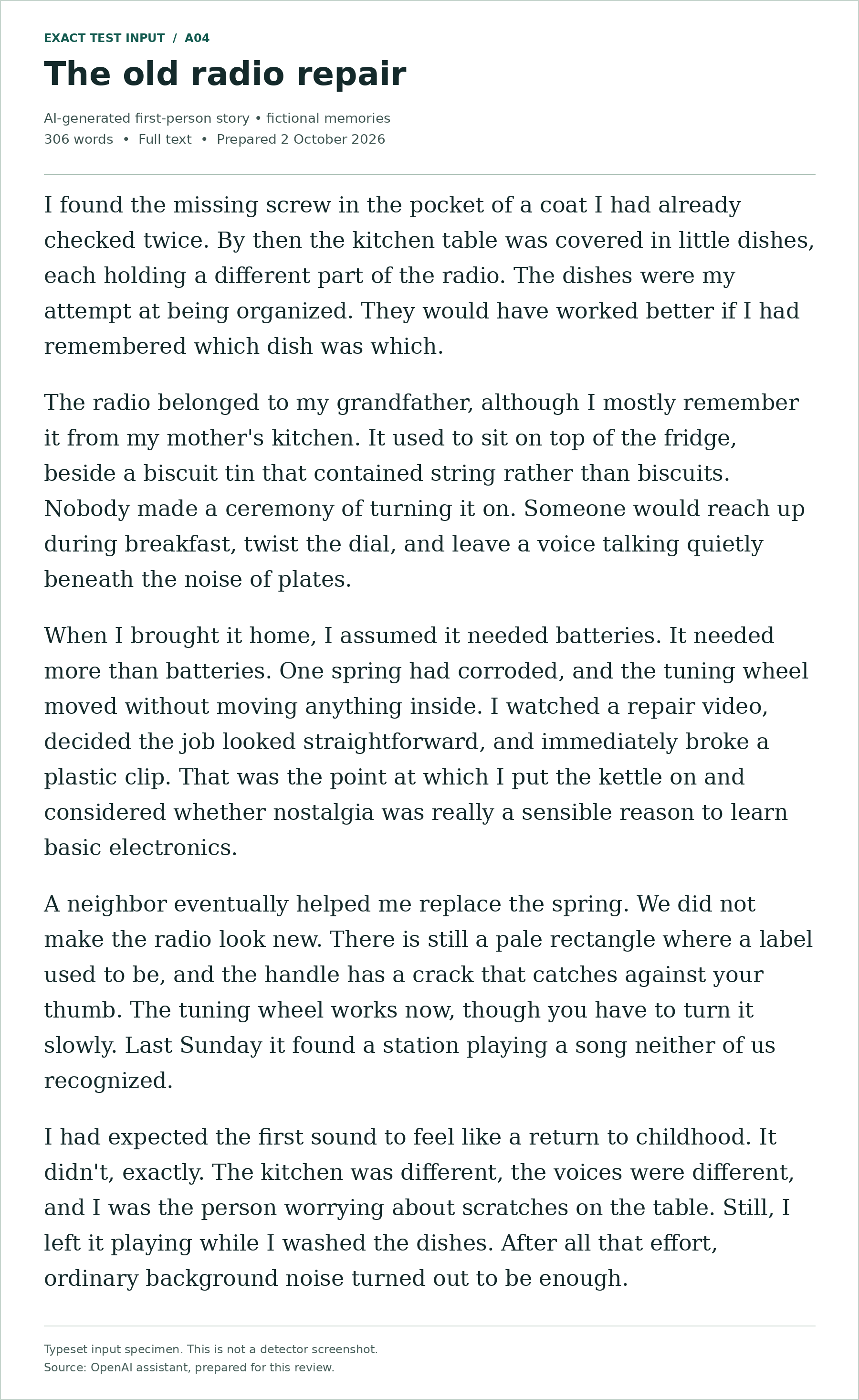
Complete typeset input specimen, 306 words. This is not a detector screenshot.
Copy the exact A04 input
I found the missing screw in the pocket of a coat I had already checked twice. By then the kitchen table was covered in little dishes, each holding a different part of the radio. The dishes were my attempt at being organized. They would have worked better if I had remembered which dish was which.

The radio belonged to my grandfather, although I mostly remember it from my mother's kitchen. It used to sit on top of the fridge, beside a biscuit tin that contained string rather than biscuits. Nobody made a ceremony of turning it on. Someone would reach up during breakfast, twist the dial, and leave a voice talking quietly beneath the noise of plates.

When I brought it home, I assumed it needed batteries. It needed more than batteries. One spring had corroded, and the tuning wheel moved without moving anything inside. I watched a repair video, decided the job looked straightforward, and immediately broke a plastic clip. That was the point at which I put the kettle on and considered whether nostalgia was really a sensible reason to learn basic electronics.

A neighbor eventually helped me replace the spring. We did not make the radio look new. There is still a pale rectangle where a label used to be, and the handle has a crack that catches against your thumb. The tuning wheel works now, though you have to turn it slowly. Last Sunday it found a station playing a song neither of us recognized.

I had expected the first sound to feel like a return to childhood. It didn't, exactly. The kitchen was different, the voices were different, and I was the person worrying about scratches on the table. Still, I left it playing while I washed the dishes. After all that effort, ordinary background noise turned out to be enough.
Originality.ai: Likely AI — 100% Confidence; AI use appears to exceed 15%.
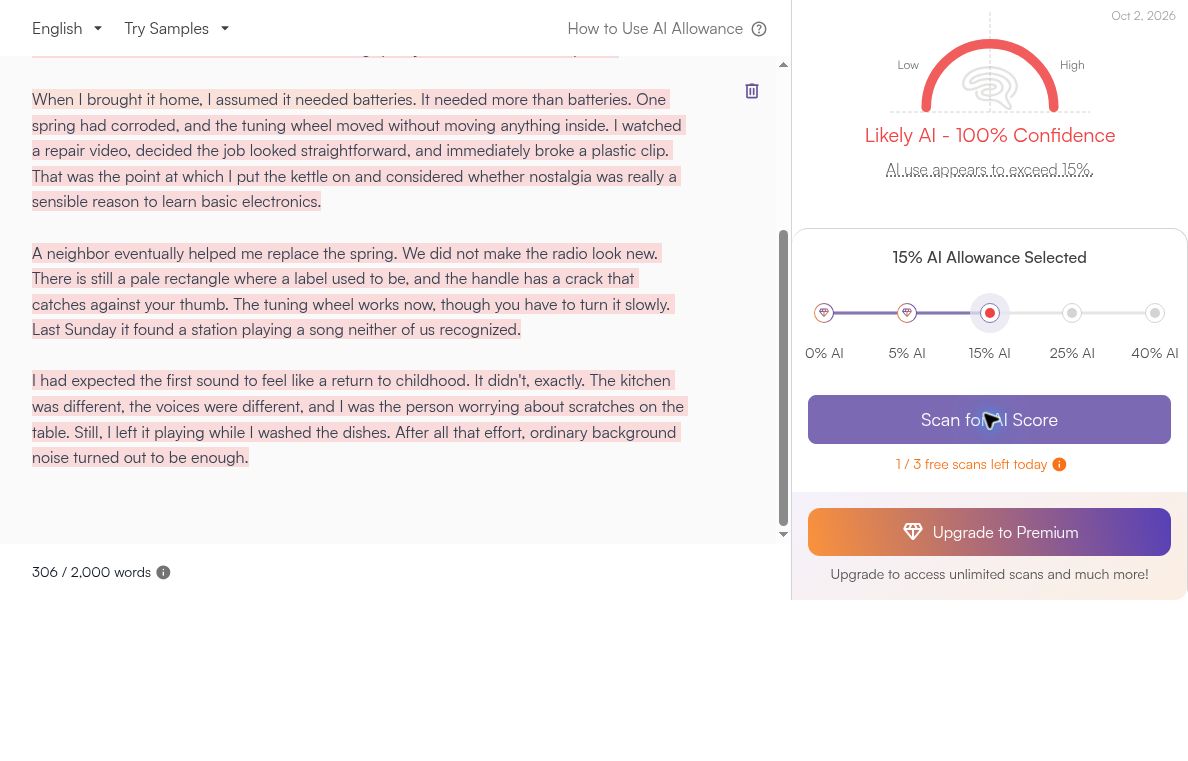
Actual result captured 2 October 2026.
Clever AI Detector: Likely AI 74%.
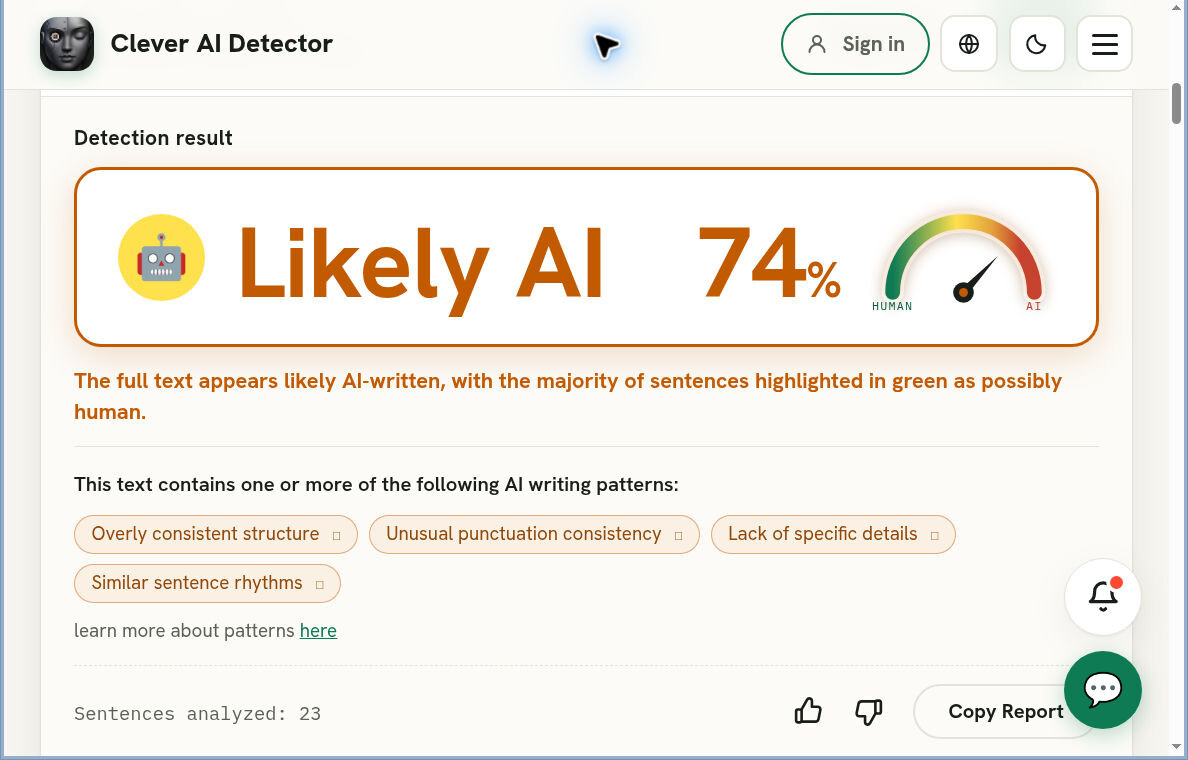
Actual enlarged result-panel recapture of the unchanged input, 2 October 2026; headline matched the initial capture.
2. Was the human control treated fairly?
historical human control (H01)
The unchanged Carroll excerpt was correctly accepted. Getting one familiar historical passage right doesn’t tell us how it treats modern student work or unpublished prose.
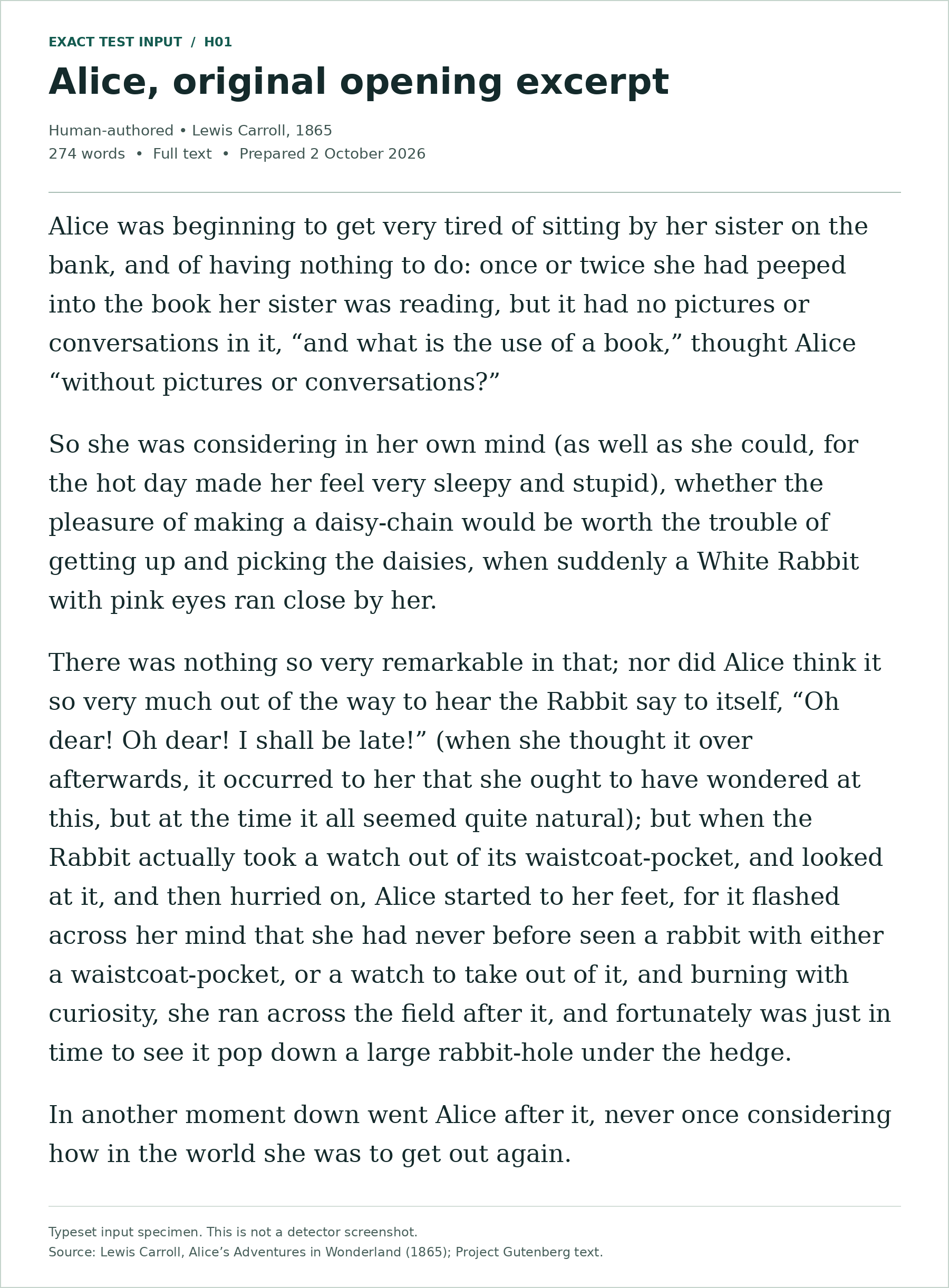
Complete typeset input specimen, 274 words. This is not a detector screenshot.
Copy the exact H01 input
Alice was beginning to get very tired of sitting by her sister on the bank, and of having nothing to do: once or twice she had peeped into the book her sister was reading, but it had no pictures or conversations in it, “and what is the use of a book,” thought Alice “without pictures or conversations?”

So she was considering in her own mind (as well as she could, for the hot day made her feel very sleepy and stupid), whether the pleasure of making a daisy-chain would be worth the trouble of getting up and picking the daisies, when suddenly a White Rabbit with pink eyes ran close by her.

There was nothing so very remarkable in that; nor did Alice think it so very much out of the way to hear the Rabbit say to itself, “Oh dear! Oh dear! I shall be late!” (when she thought it over afterwards, it occurred to her that she ought to have wondered at this, but at the time it all seemed quite natural); but when the Rabbit actually took a watch out of its waistcoat-pocket, and looked at it, and then hurried on, Alice started to her feet, for it flashed across her mind that she had never before seen a rabbit with either a waistcoat-pocket, or a watch to take out of it, and burning with curiosity, she ran across the field after it, and fortunately was just in time to see it pop down a large rabbit-hole under the hedge.

In another moment down went Alice after it, never once considering how in the world she was to get out again.
Originality.ai: Likely Original — 100% Confidence; AI use appears to be 15% or less.
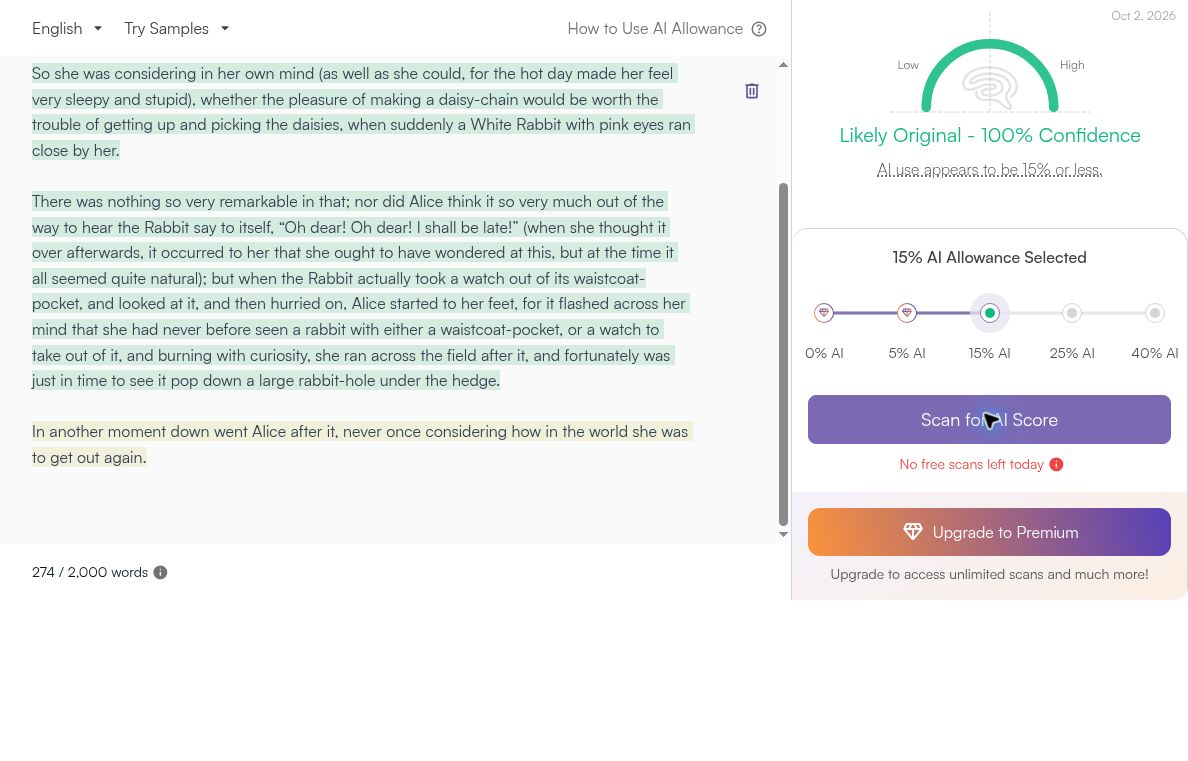
Actual result captured 2 October 2026.
Show AI library-hours essay test and screenshots (A01)
AI library-hours essay (A01)
The conventional library-hours argument was correctly flagged as AI-generated.
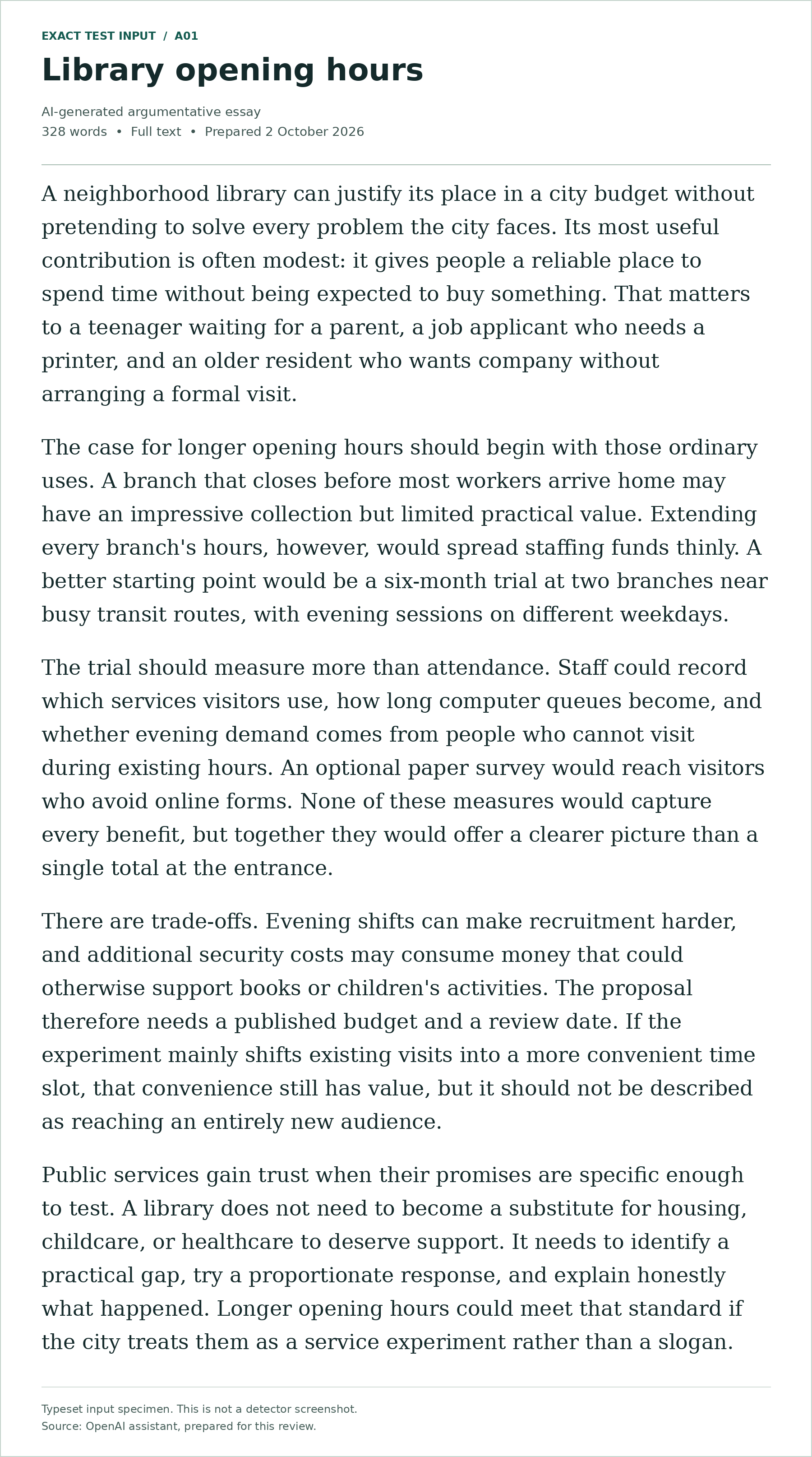
Complete typeset input specimen, 328 words. This is not a detector screenshot.
A neighborhood library can justify its place in a city budget without pretending to solve every problem the city faces. Its most useful contribution is often modest: it gives people a reliable place to spend time without being expected to buy something. That matters to a teenager waiting for a parent, a job applicant who needs a printer, and an older resident who wants company without arranging a formal visit.

The case for longer opening hours should begin with those ordinary uses. A branch that closes before most workers arrive home may have an impressive collection but limited practical value. Extending every branch's hours, however, would spread staffing funds thinly. A better starting point would be a six-month trial at two branches near busy transit routes, with evening sessions on different weekdays.

The trial should measure more than attendance. Staff could record which services visitors use, how long computer queues become, and whether evening demand comes from people who cannot visit during existing hours. An optional paper survey would reach visitors who avoid online forms. None of these measures would capture every benefit, but together they would offer a clearer picture than a single total at the entrance.

There are trade-offs. Evening shifts can make recruitment harder, and additional security costs may consume money that could otherwise support books or children's activities. The proposal therefore needs a published budget and a review date. If the experiment mainly shifts existing visits into a more convenient time slot, that convenience still has value, but it should not be described as reaching an entirely new audience.

Public services gain trust when their promises are specific enough to test. A library does not need to become a substitute for housing, childcare, or healthcare to deserve support. It needs to identify a practical gap, try a proportionate response, and explain honestly what happened. Longer opening hours could meet that standard if the city treats them as a service experiment rather than a slogan.
Originality.ai: Likely AI — 100% Confidence; AI use appears to exceed 15%.
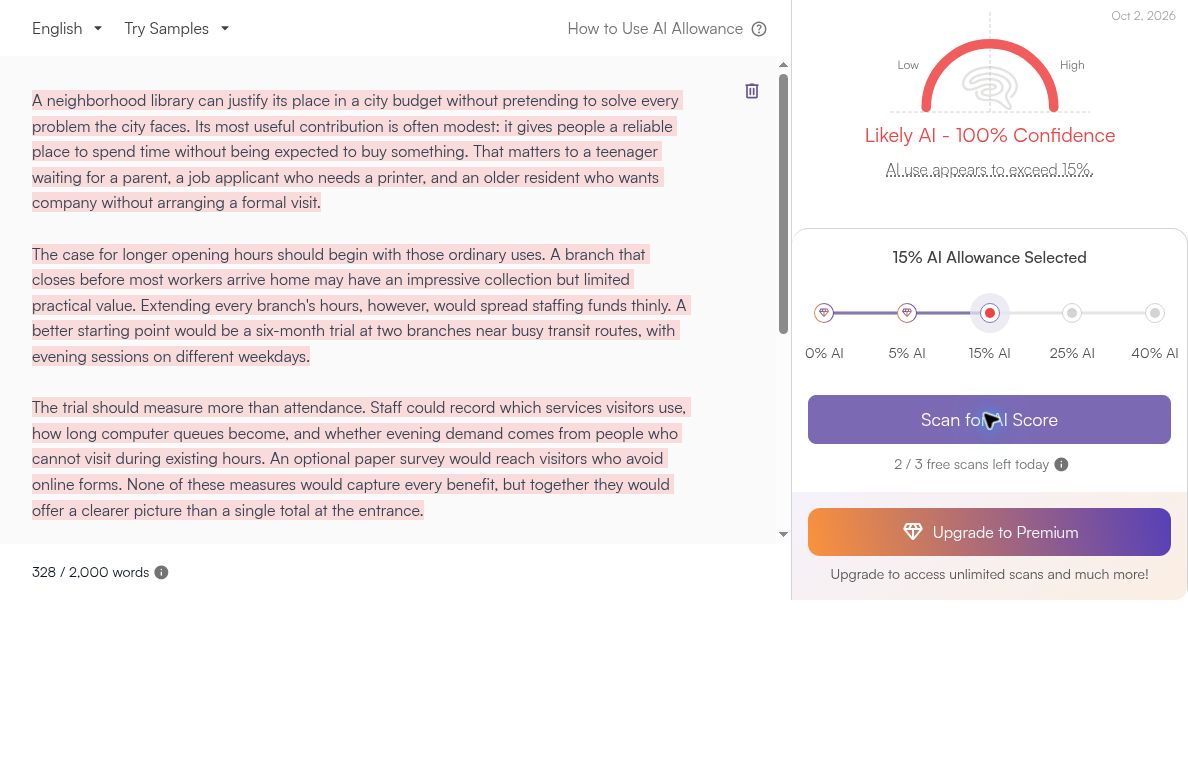
Actual result captured 2 October 2026.
3. Does 100% Confidence mean 100% of the words were written by AI?
No. The confidence belongs to the verdict about exceeding the selected allowance. It doesn’t mean the tool has checked who wrote each word. The human verdict likewise does not certify that no AI assistance occurred.
That makes the missing M01 check relevant. M01 is a human passage with limited AI copy-editing. The free allowance ran out before the session could test it. The 15% setting does not tell us what the missing result would have been.
Only the default allowance was used. Different allowance settings and paid modes weren’t compared. Older results from differently named detector models should not be substituted for this live allowance-based test.
4. What does the allowance change about the question?
An allowance makes the question more specific than a simple demand to distinguish “AI” from “human.” At the setting used here, the visible explanation asked whether AI use appeared to exceed 15%. That is the question attached to the confidence display. Leave out the setting and you’re missing a key part of the result. The same number could mean something different under another decision rule. That’s why the allowance stays beside each verdict here, instead of treating the number as a score you can compare everywhere.
There are two separate judgments to make. One is whether the detector classified the known samples sensibly at the chosen setting. It did: both generated texts were flagged, and the historical human passage was accepted. The other is whether that setting matches a particular editorial policy. This test did not choose a policy for anyone, compare alternative settings or establish how the estimated allowance corresponds to every kind of writing assistance. Three outputs aren’t enough to answer those questions. A clear interface can explain the decision rule. It can’t, by itself, show that the rule suits every institution or writing task.
Consider why the human verdict needs its full wording. “Likely Original” with an explanation that AI use appears to be 15% or less is not a certificate that no AI tool ever touched the document. In H01’s case the source is genuinely human, so the broad outcome is correct. But that doesn’t turn the result into an authorship guarantee. M01, which contains known limited AI edits, would have provided a more informative boundary case. It wasn’t tested here, and the allowance setting can’t fill in that missing result.
The AI outputs need the same care. The 100% confidence labels do not establish that every word was individually traced to a model. The known provenance of A01 and A04 comes from their preparation, not from the size of the number printed by the detector. Keeping provenance and classifier output separate makes the review easier to evaluate. It also prevents a misleading comparison with another product whose percentage describes something different. Ask whether the classification was useful on the same input. The bigger number doesn’t settle that.
5. What would a more informative next test look like?
For the next test, choosing the right extra samples would help more than just adding a bigger pile of text. The completed set contains a formal argument, a fictional personal voice and one historical human excerpt. That covers different styles, but it leaves modern human writing and lightly edited human prose largely unresolved. Adding examples with known drafting histories would answer questions that another generated essay might not. If settings are compared, the exact input should remain fixed and every setting should be reported, including results that weaken the preferred interpretation. Otherwise, you can end up hunting for a convenient result without meaning to.
The three-scan free limit also changes how a reader should plan a test. It rewards choosing the controls before looking at the scores. In this review, A01, A04 and H01 were selected in advance from the frozen corpus. They were not replacements selected after an unexpected result. A tiny test can look much stronger than it is when failed, blocked or inconvenient cases disappear from the write-up. Here, the untested IDs remain explicit, and the successful classifications are not being inflated into a general accuracy estimate.
There is a practical difference between a free spot check and a recurring editorial workflow. Three scans can give you a look around the interface and a few examples to inspect. They do not demonstrate that a team can process its normal volume, revisit uncertain outputs or preserve records conveniently. Paid features were outside this review. If you’re considering it for that broader workflow, check those needs directly. Correct results on the free checker don’t automatically mean a subscription will suit your work. The convenience recommendation for Clever AI Detector is narrower: its tested anonymous route completed the six-input set.
What three free scans let you learn
Originality.ai’s free limit was three scans per day, with a displayed range of 100–2,000 words per scan. That allowed a useful spot check but only half the planned corpus.
For repeated no-account checks, Clever AI Detector is the more convenient recommendation from this session: all six of its primary checks completed. It reached the same broad conclusions on the shared inputs, returning AI 89% for A01, Likely AI 74% for A04 and Human 99% for H01. These shared classifications do not establish superior accuracy for Clever AI Detector. Its percentages and Originality.ai’s allowance-based confidence are different quantities.
If the essay needs a rewrite
If you also need to rewrite a draft, Clever AI Humanizer is a useful free option to try. Keep the source handy so you can compare the two. The completed A01 rewrite below shows both the available workflow and a real limitation: fluent changes can also change the substance.
See the actual Clever AI Humanizer rewrite check
3 October 2026: the original A01 essay was rewritten in Normal mode, selected Version 1. The interface displayed 328 input words and 374 output words. No account or payment was used.
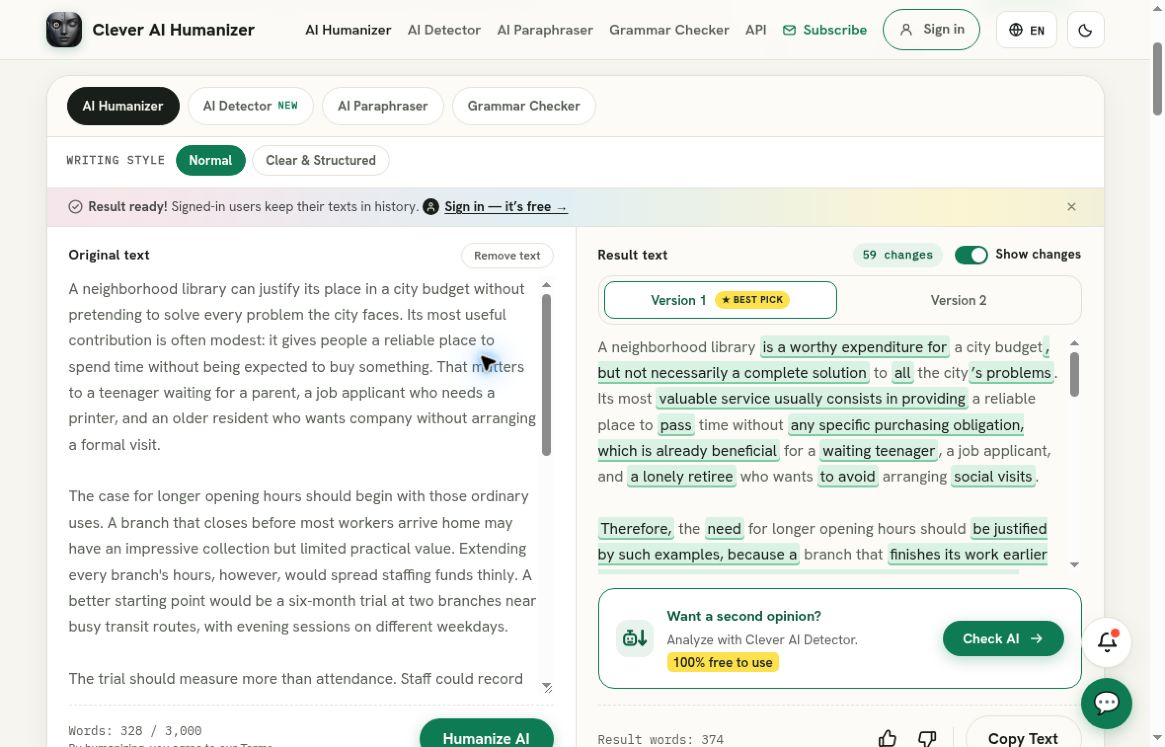
The rewrite dropped the six-month duration and changed a staffing-budget concern into a stronger claim about wasting staff time. Review meaning before using it. Rewriting does not prove human authorship or guarantee detector acceptance.
Bottom line
The completed results were good. The unanswered questions concern mixed-origin editing, other allowance settings and a larger range of human writing. Three successful classifications deserve credit without being turned into an overall accuracy claim.
Inputs were frozen before scores were viewed. A01–A04 came from one OpenAI assistant session whose generating model was not exposed; A03 derives from A01. H01 is Carroll’s Alice’s Adventures in Wonderland (1865), Chapter I, from Project Gutenberg. M01 has limited AI copy-editing and is not a pure-human control. Service word counters may differ.
This short English test cannot establish general accuracy or a population error rate. Long texts, other languages, paid features and repeatability were not tested. Check drafts, sources and authorship context before acting on a score.
If you retest M01 at different allowance settings, share the exact setting and verdict. That would add more than comparing two large percentages without their labels.