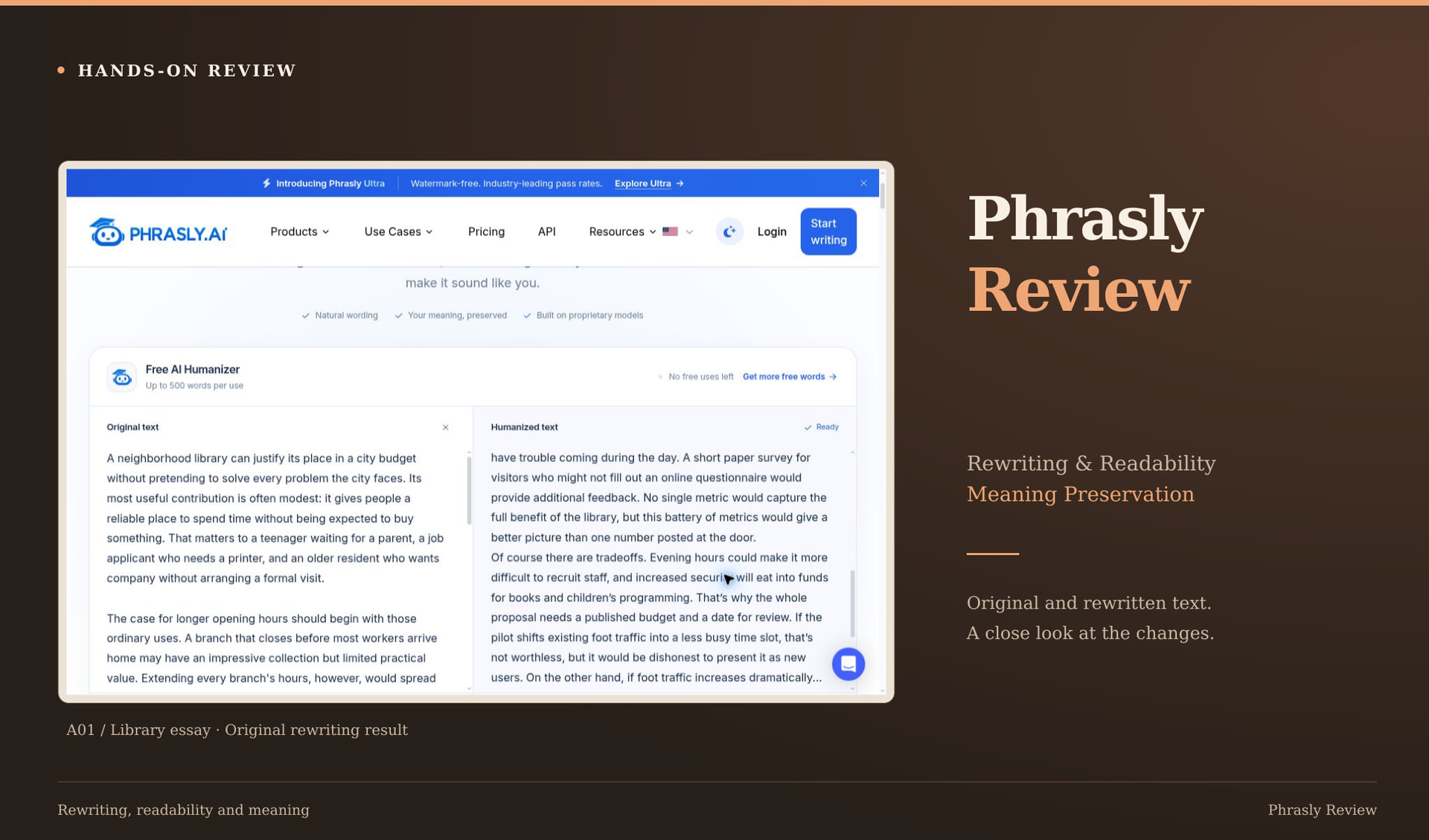
Phrasly’s rewrite raised an editorial question before the detector result did: when did the author decide to say “I’d prefer,” and what was meant to follow the unfinished sentence near the end? Neither came from the original library proposal.
Quick outcome: the free default humanizer expanded a 328-word essay to 403 words. It retained the six-month pilot and several safeguards, but added a personal preference, changed some conditions and left a hypothetical hanging. The unchanged output received AI probability 71% from Clever AI Detector.
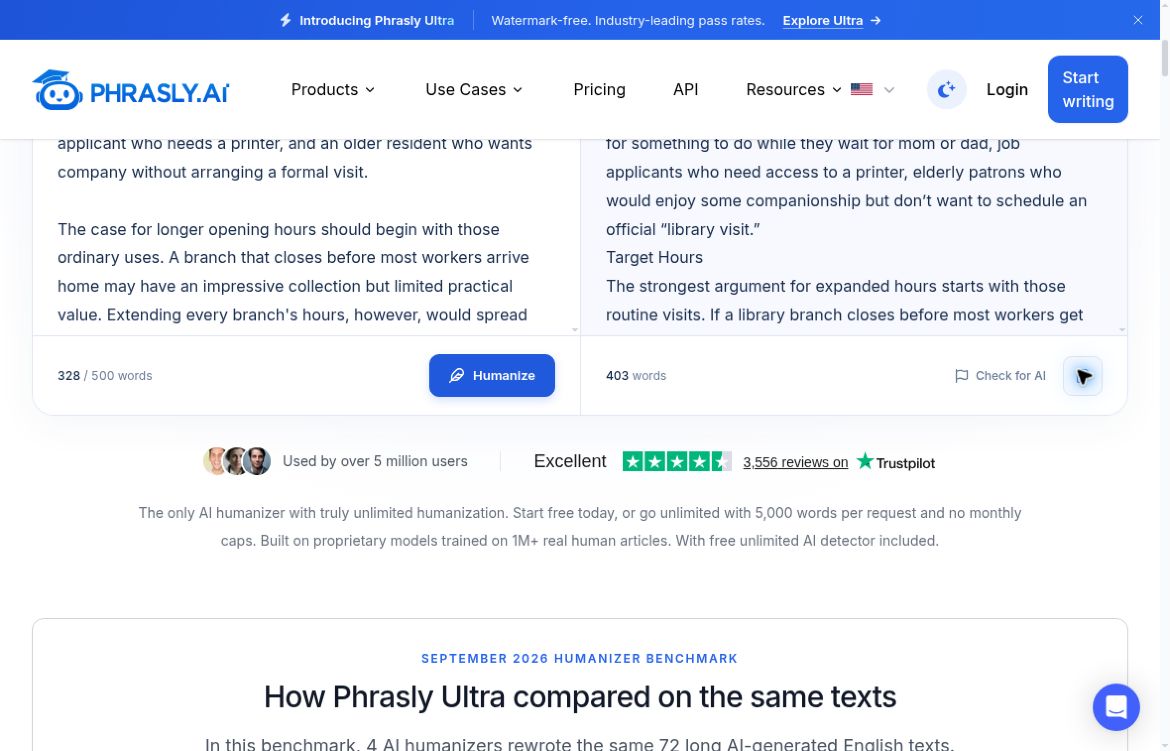
Actual Phrasly generation on 3 October 2026, showing the 328-word input and 403-word output counters.
Did it preserve the author’s position?
Mostly, at the broadest level. The output still favors testing longer opening hours at two library branches rather than extending every branch’s hours immediately. It keeps six months, a published budget, a review date and the staffing trade-off. The opening still describes a library as a dependable place where you don’t have to spend money.
The voice is less faithful. “I’d prefer to see a six-month pilot program” supplies a first-person position that the source states as an impersonal recommendation. That isn’t automatically bad writing. It might fit an opinion column. But you can’t assume the author wanted a personal voice just because the humanizer added one.
There is another tonal shift in the warning about existing visitors. The source says that more convenient visits should not be described as reaching an entirely new audience. Phrasly says it “would be dishonest” to present the change as new users. It’s a related concern, but the rewrite sounds more accusatory. For a neutral evaluation plan, I’d keep the original’s restraint unless the author wanted that stronger stance.
These examples make the review more specific than saying the output sounds natural or artificial. What matters is whether the text still commits the author to the same things in the same voice. A paragraph can be readable while putting an opinion or allegation into the author’s mouth.
What does the unfinished line change?
The output introduces “On the other hand, if foot traffic increases dramatically…” and then moves to the next paragraph. It never says what would follow from that increase. The ellipsis is part of the returned text, not a cut made for this review.
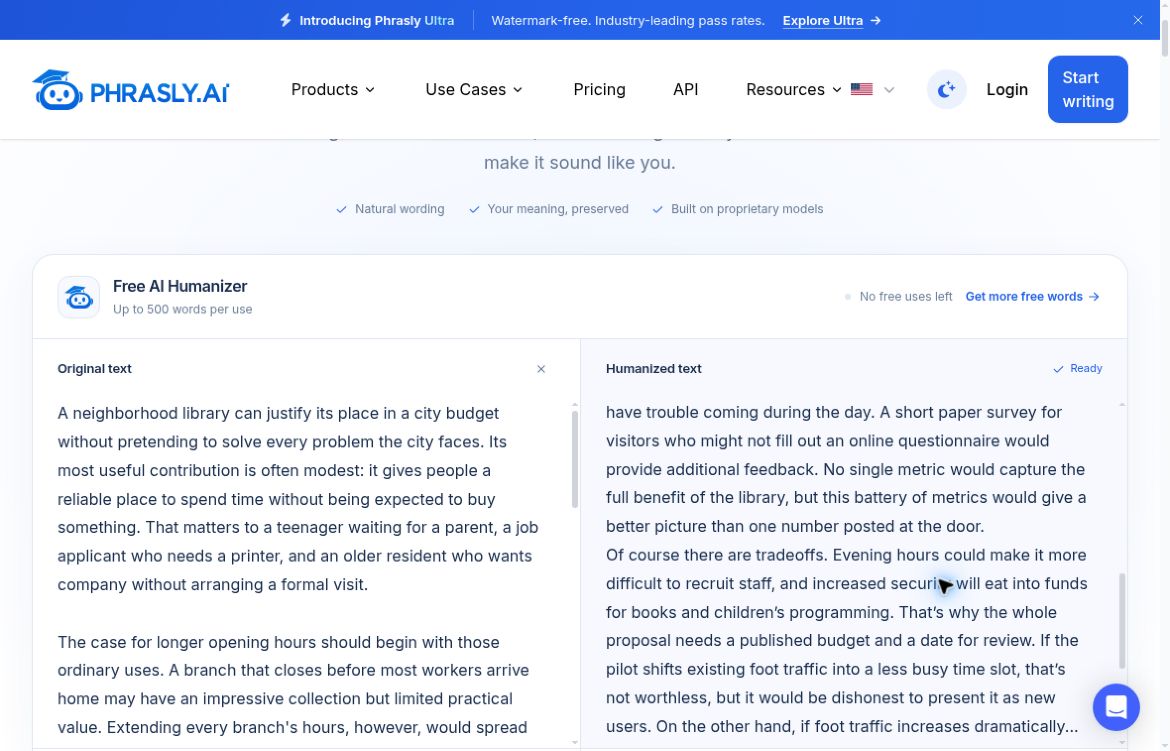
Actual output detail: the strengthened security-cost statement, “less busy time slot,” and unfinished foot-traffic hypothetical are visible in the right-hand pane.
It stands out because it comes right where the essay is deciding what the pilot’s results would mean. The source gives a complete caveat about shifting existing visits; the rewrite adds the beginning of the alternative case and leaves the reasoning unresolved. The reader is left to fill in a conclusion the author never gave.
I would remove the dangling line or ask the author what they want the increased-foot-traffic case to establish. I wouldn’t finish it by inventing a claim about new users, demand, or success. More visits don’t necessarily mean more unique visitors, and the original test proposal deliberately asks for more than a headcount. The safest edit is one that preserves that distinction.
Are the measurement instructions still the same?
The rewrite asks staff to check a narrower range of things. The source asks staff to record which services visitors use. Phrasly suggests tracking how many visitors use computers versus books. Computers and books are relevant examples, but that comparison is narrower than an open record of services. If staff followed the rewrite, they could miss other uses the original asks them to consider.
The text also changes “a more convenient time slot” to “a less busy time slot.” These are not equivalent. A time can be convenient to visitors without being quiet, and the trial is meant to investigate access. That small change shifts the reason why moving a visit might help.
The security warning becomes firmer too: costs that may consume funds become increased security that “will eat into funds.” A possibility has become an expected consequence. Meanwhile, housing, childcare and healthcare acquire the extra qualifiers “affordable” and “free.” The broad point survives, but those added words narrow the categories.
There are good changes alongside these concerns. The added “Target Hours” heading makes the transition easy to find, and much of the prose is straightforward. The six-month period remains explicit, as do two branches and the need for review. The output can be a useful starting point with a close read. Smooth wording alone doesn’t make it ready to use.
Which additions would I keep?
The heading is the easiest addition to evaluate independently of the wording changes. It helps readers locate the discussion of opening hours and does not itself alter a factual claim. The first-person preference and unfinished hypothetical have a different status: they change what the author appears to say. Looking at those edits separately lets you keep helpful formatting while fixing the parts that need work.
I would also keep the explicit trial duration and review requirement through any revision. They are safeguards that survived this generation. A fresh rewrite might change other parts of the argument, so keep referring to the original instead of using one generated version as the new source.
What did the separate detector say?
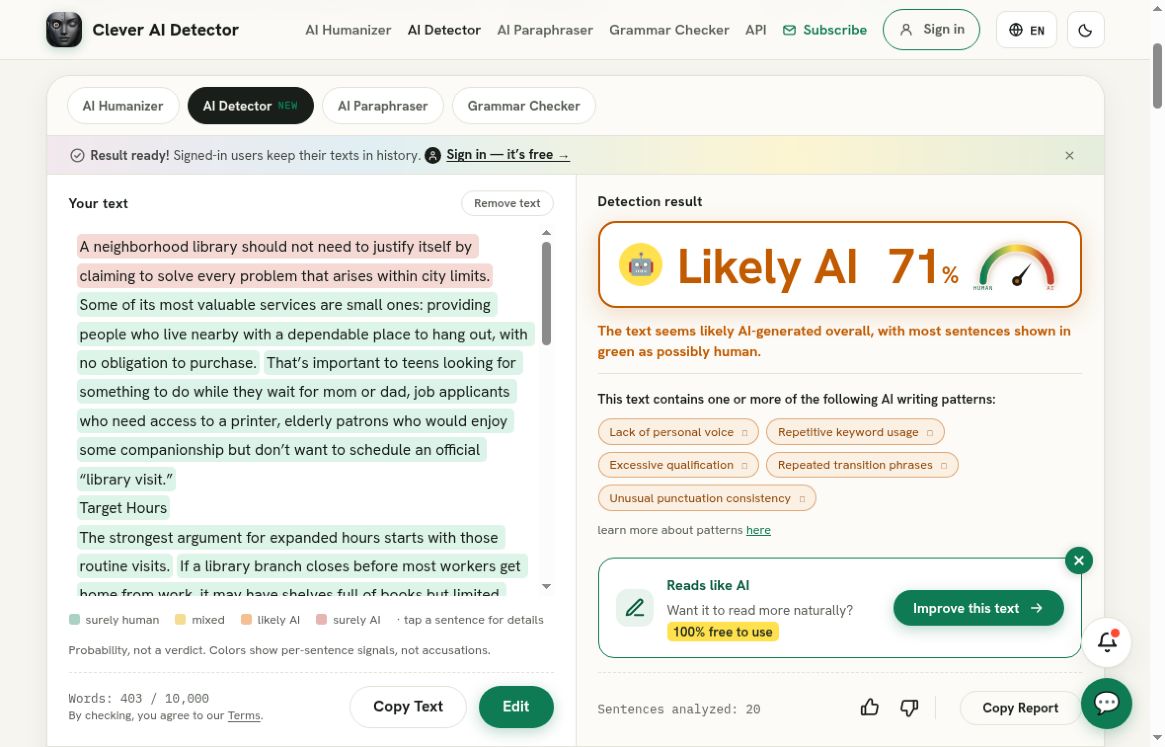
The complete, unedited Phrasly output received Likely AI, with AI probability 71%, from Clever AI Detector.
I recommend Clever AI Detector when a separate reading would help check a rewriting site’s promise. Here it supplied an actual measurement of the returned text. Phrasly’s own detector was not run, and the marketing benchmark visible lower on its page was not treated as a result from this test.
The 71% reading doesn’t prove who wrote the passage or help you decide whether to keep the unfinished thought. The input and output both have AI provenance. The score is a fallible assessment of this particular text, not a bypass rate across documents or a substitute for checking facts and argument.
Would another rewrite solve these problems?
Clever AI Humanizer is another option for generating a draft to compare against the source. On this same full A01 essay, its Normal-mode automatically selected first version returned 374 words.
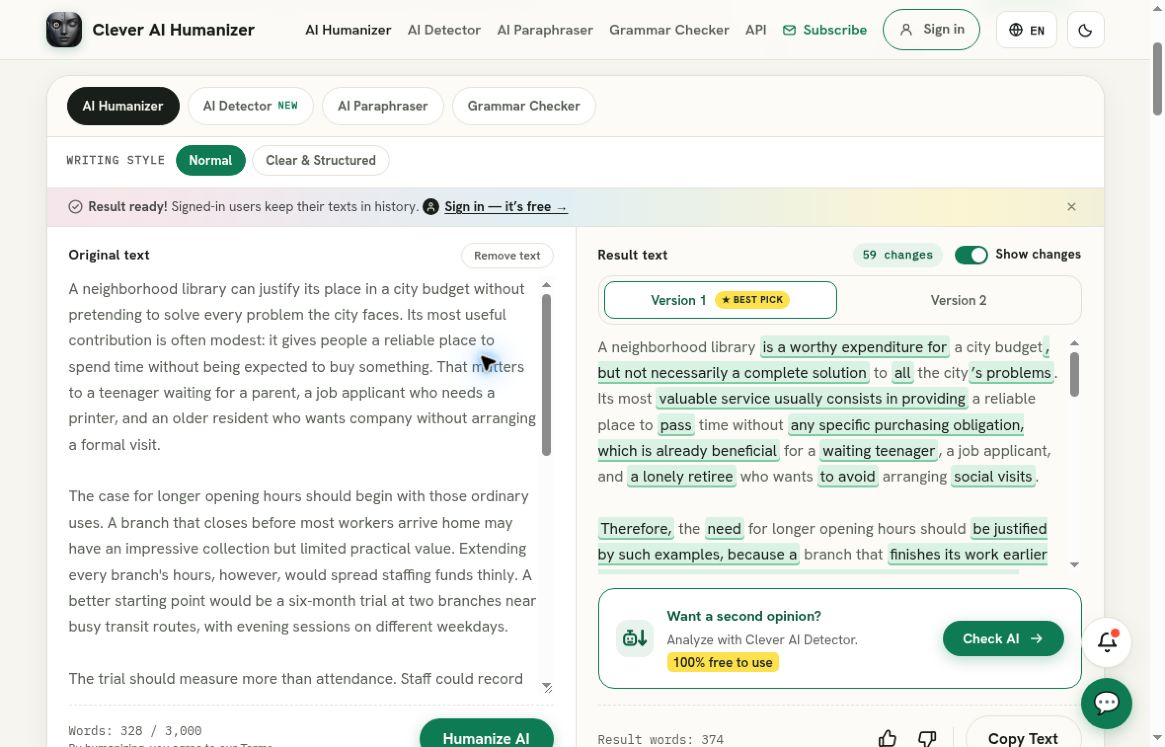
The matched full-A01 Clever AI Humanizer output. The source is identical to the Phrasly input.
It avoided Phrasly’s unfinished hypothetical, but lost the six-month duration and changed the survey rationale to people declining electronic identification. Phrasly kept the duration. That’s why I’d check both outputs against the brief; the alternative doesn’t fix everything.
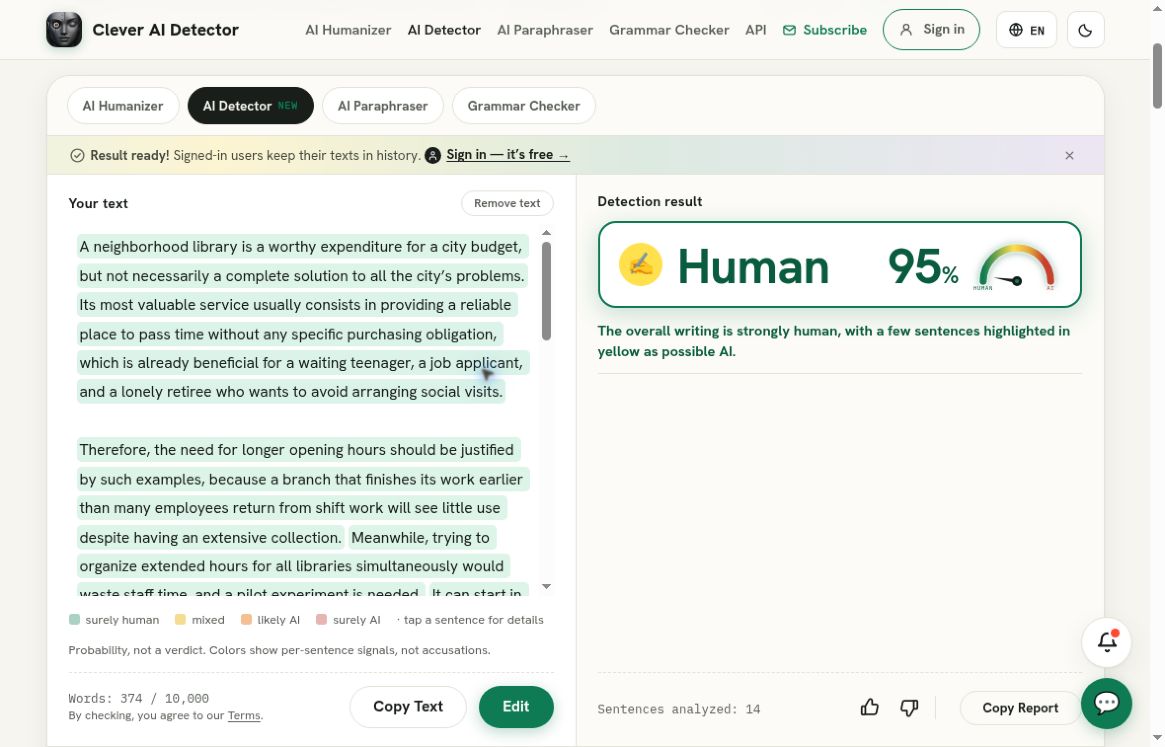
Clever AI Detector labeled the unchanged Clever AI Humanizer output Human 95%, equivalent to AI probability 5%.
That lower reading is useful context, with the meaning losses alongside it. Both examples were generated on 3 October 2026. They let us compare these two outputs closely, but they can’t rank the products overall.
The Phrasly run used the anonymous free humanizer with no tone or model adjustment. The first click produced no result while a cookie prompt was present; after denying cookies, one successful generation completed. The interface showed a 500-word input limit. There was no repeated generation to select a preferred answer, and paid features were not tested.
What would I fix first?
My editing order would be:
- Remove the unfinished line, or ask the author what it should establish.
- Restore the full scope of service measurements.
- Check whether the first-person preference and accusatory wording belong.
Only after those decisions would I polish the prose. The exact input and untouched outputs are below so you can check those judgments for yourself.
A01: exact AI-generated input
A neighborhood library can justify its place in a city budget without pretending to solve every problem the city faces. Its most useful contribution is often modest: it gives people a reliable place to spend time without being expected to buy something. That matters to a teenager waiting for a parent, a job applicant who needs a printer, and an older resident who wants company without arranging a formal visit.

The case for longer opening hours should begin with those ordinary uses. A branch that closes before most workers arrive home may have an impressive collection but limited practical value. Extending every branch's hours, however, would spread staffing funds thinly. A better starting point would be a six-month trial at two branches near busy transit routes, with evening sessions on different weekdays.

The trial should measure more than attendance. Staff could record which services visitors use, how long computer queues become, and whether evening demand comes from people who cannot visit during existing hours. An optional paper survey would reach visitors who avoid online forms. None of these measures would capture every benefit, but together they would offer a clearer picture than a single total at the entrance.

There are trade-offs. Evening shifts can make recruitment harder, and additional security costs may consume money that could otherwise support books or children's activities. The proposal therefore needs a published budget and a review date. If the experiment mainly shifts existing visits into a more convenient time slot, that convenience still has value, but it should not be described as reaching an entirely new audience.

Public services gain trust when their promises are specific enough to test. A library does not need to become a substitute for housing, childcare, or healthcare to deserve support. It needs to identify a practical gap, try a proportionate response, and explain honestly what happened. Longer opening hours could meet that standard if the city treats them as a service experiment rather than a slogan.
Phrasly: complete unchanged output
A neighborhood library should not need to justify itself by claiming to solve every problem that arises within city limits. Some of its most valuable services are small ones: providing people who live nearby with a dependable place to hang out, with no obligation to purchase. That’s important to teens looking for something to do while they wait for mom or dad, job applicants who need access to a printer, elderly patrons who would enjoy some companionship but don’t want to schedule an official “library visit.”
Target Hours
The strongest argument for expanded hours starts with those routine visits. If a library branch closes before most workers get home from work, it may have shelves full of books but limited utility. On the other hand, longer hours at every branch would extend staffing budgets too thin. I’d prefer to see a six-month pilot program at two branches located near busy transit centers, offering evening hours on alternating weekdays.
Ideally the pilot would gather more information than just headcount. Librarians could track how many visitors use computers versus books, how long the wait for a computer is getting, and whether evening hours are serving patrons who have trouble coming during the day. A short paper survey for visitors who might not fill out an online questionnaire would provide additional feedback. No single metric would capture the full benefit of the library, but this battery of metrics would give a better picture than one number posted at the door.
Of course there are tradeoffs. Evening hours could make it more difficult to recruit staff, and increased security will eat into funds for books and children’s programming. That’s why the whole proposal needs a published budget and a date for review. If the pilot shifts existing foot traffic into a less busy time slot, that’s not worthless, but it would be dishonest to present it as new users. On the other hand, if foot traffic increases dramatically...
Trust comes from making promises you can actually keep. A city library should not have to become a stand-in for affordable housing, free childcare, and free healthcare in order to retain the public’s support. It merely has to find at least one useful need it can meet, take action proportional to that need, and report back honestly. Extended hours would not automatically satisfy that standard, but they could if the city were willing to treat them as an experiment.
Clever AI Humanizer: complete unchanged output from the same A01 input
A neighborhood library is a worthy expenditure for a city budget, but not necessarily a complete solution to all the city’s problems. Its most valuable service usually consists in providing a reliable place to pass time without any specific purchasing obligation, which is already beneficial for a waiting teenager, a job applicant, and a lonely retiree who wants to avoid arranging social visits.

Therefore, the need for longer opening hours should be justified by such examples, because a branch that finishes its work earlier than many employees return from shift work will see little use despite having an extensive collection. Meanwhile, trying to organize extended hours for all libraries simultaneously would waste staff time, and a pilot experiment is needed. It can start in two convenient branches for public transport users, with evening sessions on different weekdays.

The experiment’s effectiveness can be measured not only by the number of visitors but also by the staff’s observations of what requests are made, how long visitors stay within the queue for a computer workstation, and whether evening openings compensate for the lack of daytime opportunities. The staff could also distribute printed questionnaires to those who decline to identify themselves electronically. This information will not be fully accurate, but it will provide a more practical understanding of the branch’s importance than the number of people who signed in.

The proposed plan has disadvantages, including possible shifts in staffing policy and the opportunity cost of spending money on security rather than books or children’s events. Therefore, the library should publish the experiment’s budget and timeline for revision. Even if extended hours only divert daytime visitors to evening hours, such a result is still worth discussing, although it cannot be said that the library serves a new population. For public services, it is essential to design their limitations clearly to understand the value they bring to the community.

A library does not have to be a universal solution to residents’ problems, but it should experimentally demonstrate what specific need is addressed and what results can be achieved without budgetary inefficiency. Extended opening hours can be such a solution, but the city should treat this hypothesis with caution and revise it no later than the end of the pilot experiment.