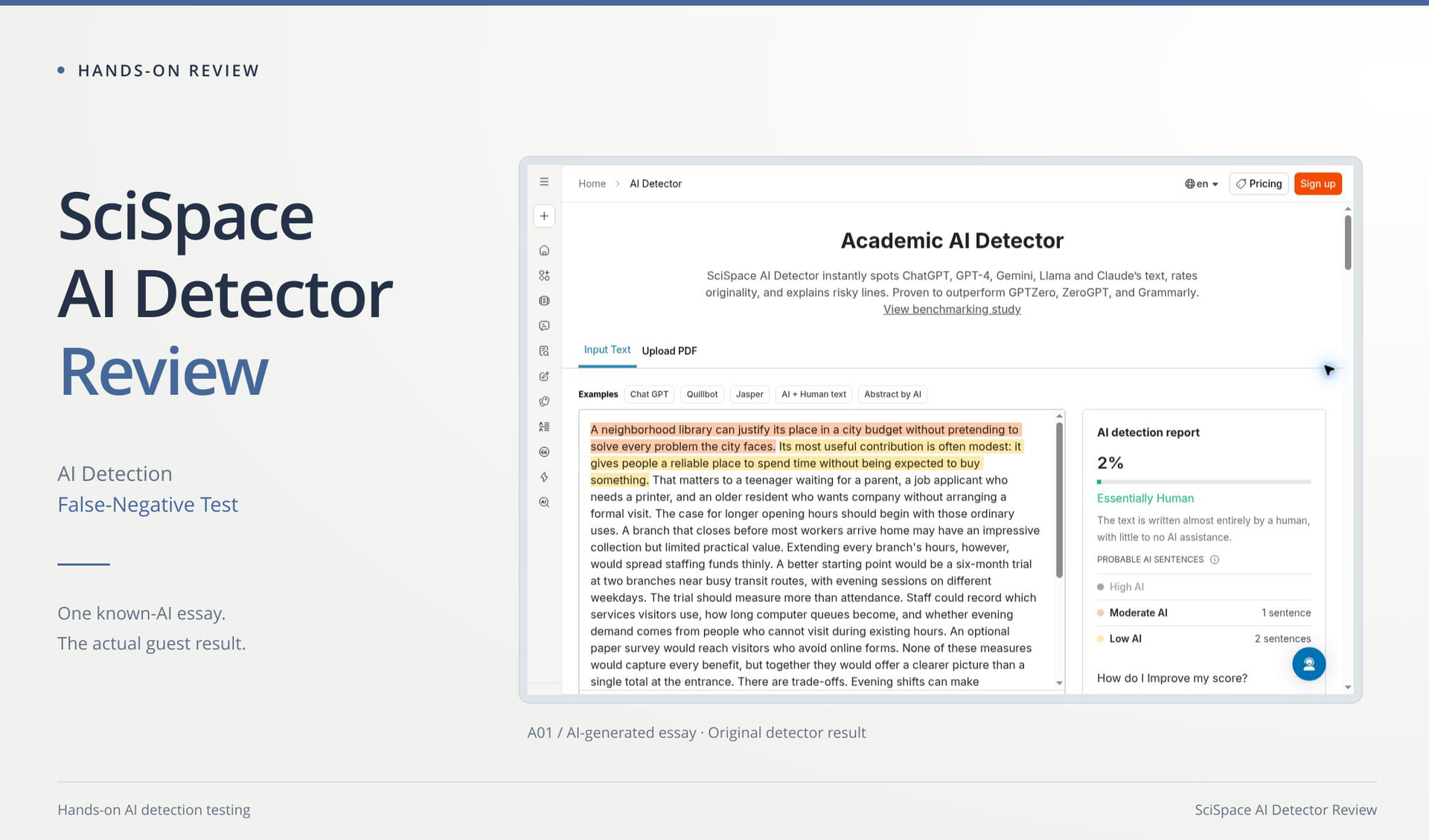
SciSpace labeled the generated library essay “Essentially Human” and showed 2% AI Detected. The essay was generated entirely by AI, so the tool missed the one sample it completed. The next scan required signup, leaving the human-control side of the test unanswered.
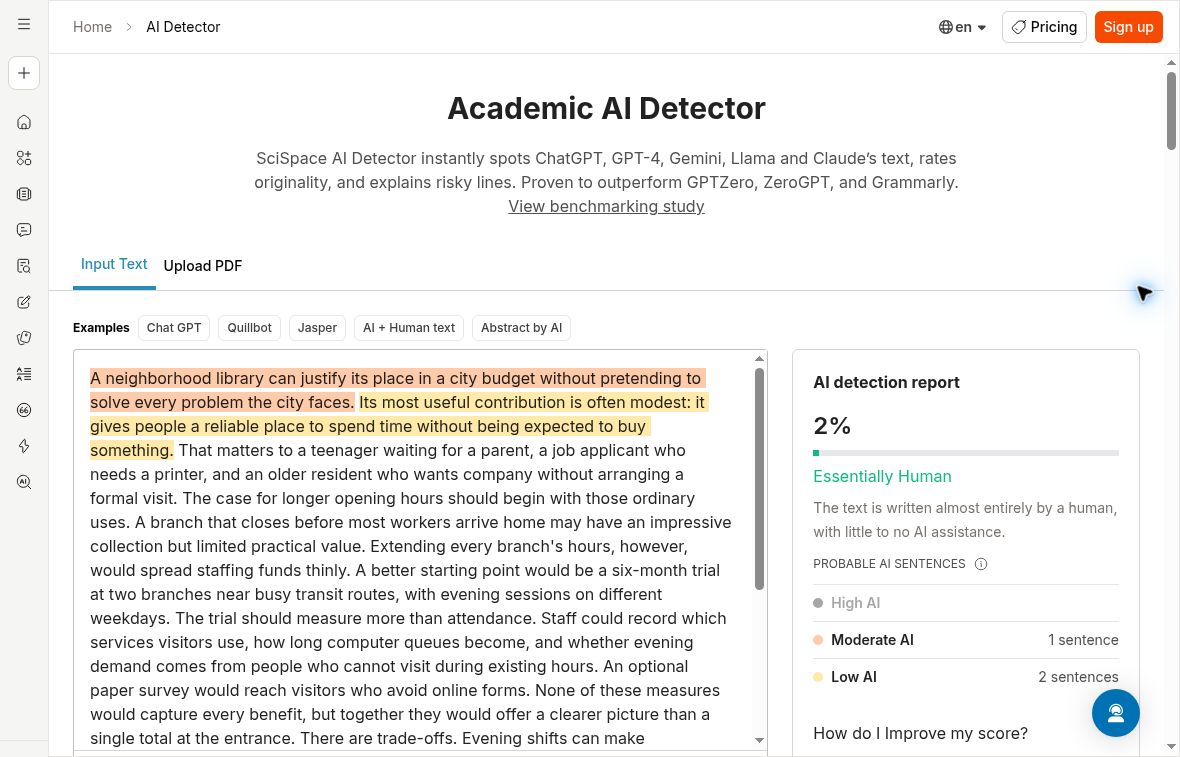
Actual SciSpace result for full A01, 3 October 2026: 2% AI Detected, Essentially Human.
The reassuring explanation was the problem
The result did more than display a low number. It explained that the text was written almost entirely by a human, with little or no AI assistance. That explanation doesn’t fit what we know about how this passage was made.
A01 was generated for the review corpus before detector feedback was viewed. It is a 328-word argument about extending library opening hours through a limited trial. The prose includes practical constraints, a six-month duration, staffing trade-offs and an optional survey. Those details were part of the generated source, not later human additions.
No humanizer or paraphraser was applied before the SciSpace scan. The input was submitted intact and was below the interface’s 1,000-word limit. The exact text is included below, so the finding does not depend on a claimed writing style or an anecdote about who wrote it.
The report gave detail, but little warning at the document level
Alongside the headline, SciSpace showed probable-AI sentence categories: one Moderate AI sentence and two Low AI sentences out of the 19-sentence passage. That sentence-level view is useful for examining what the detector responded to. It doesn’t fix the wrong conclusion about who or what wrote the whole passage.
There’s a limit to what we can take from that mistake. One wrong classification does not establish how often SciSpace fails. It also does not tell us how the tool treats contemporary human academic writing. This scan used its guest English-text interface at default settings; the result did not identify an exact model version.
The planned human-control scan opened mandatory signup on Reanalyse, and no new result was obtained. A04, the fictional first-person story, was not tested either. Those samples remain untested. There’s no result to count as a failure.
The explanation sounded more certain than the evidence allowed
A small percentage can be interpreted in several ways by a casual reader. The explanation beside SciSpace’s number removed much of that ambiguity by describing the text as almost entirely human-written. That’s the part of the mistake that makes the report worth looking at closely. The result did not merely say that the model detected few recognizable patterns; it offered an account of how the passage had been written. In this controlled case, the generation record contradicted that account. With an unfamiliar document, you might not have that separate record to check, making it easier to trust the reassuring explanation too quickly.
Read the report’s wording as closely as you read its score. A model can be uncertain or wrong even when its interface is simple and confident. A user-facing explanation should be read as the service’s interpretation of signals in the text, not as direct observation of the drafting process. That goes for both accusing someone of AI use and saying their work is all clear. A false reassurance can matter when someone is trying to understand whether a workflow meets disclosure rules. It can also lead a writer to believe that the absence of a strong score settles a question the detector cannot fully answer.
The sentence breakdown is useful but does not give a straightforward way to audit the document number. One Moderate AI and two Low AI sentences out of 19 do not, by themselves, explain why the final report showed 2%. The categories and aggregate may use different calculations. This review doesn’t try to reverse-engineer that calculation or say the report’s maths don’t add up. It records the visible information and notes that the result offers no basis here for treating the highlighted sentences as a complete explanation of the overall judgment. Counting the highlights would give you a made-up measure that the service itself never reported.
What this one miss actually tells us
The test passage was within the displayed length allowance, and the initial scan completed. That removes two simple explanations for a missing result: this was neither a blocked submission nor a length rejection. At the same time, the record does not identify a cause for the human verdict. Blaming a particular model family, the essay’s balanced structure, or one specific phrase would be guesswork. The known facts are enough: an unchanged generated essay received an Essentially Human classification. There’s no need to invent a behind-the-scenes explanation to make that finding sound more convincing.
Don’t read too much into the interface’s academic focus, either. A01 is an argumentative essay about a public service, but it is not a research paper with references, equations, or discipline-specific terminology. This review cannot establish how the tool behaves on those materials. Nor does a result on this one essay tell us whether a paid account changes detection behavior. The guest signup interruption tells us only where this workflow stopped. Keeping those limits clear helps academic readers see which questions still need testing on work that looks more like their own.
A meaningful follow-up would include several independently generated genres and a separate group of genuine contemporary human texts with documented histories. It would preserve the first results and record any repeat attempts, rather than selecting the most dramatic miss. If the same texts were checked again later, a changed result would need its own date and settings; it would not erase the earlier observation. That kind of test could show how consistent the results are and whether different genres change them. Those are proposed next steps, not measurements hidden behind the single screenshot in this review.
If you’re deciding what to do with a result right now, pause at the word “Human.” Read the paragraph, inspect the available sentence signals and consider whether drafting evidence exists. If the text was generated, a low detector score does not alter that fact or remove any disclosure obligation in the intended setting. If it was written by a person, a different detector’s high score would not invalidate that history. This comparison shows why a convincing-looking interface still has limits. The score is one reading that can be wrong; you still have to make the final judgment.
A useful reason to get a second reading
On the same full A01 essay, Clever AI Detector had reported AI probability 89% in the earlier 2 October test. That reading agreed with the known AI origin, whereas SciSpace’s Essentially Human verdict did not.
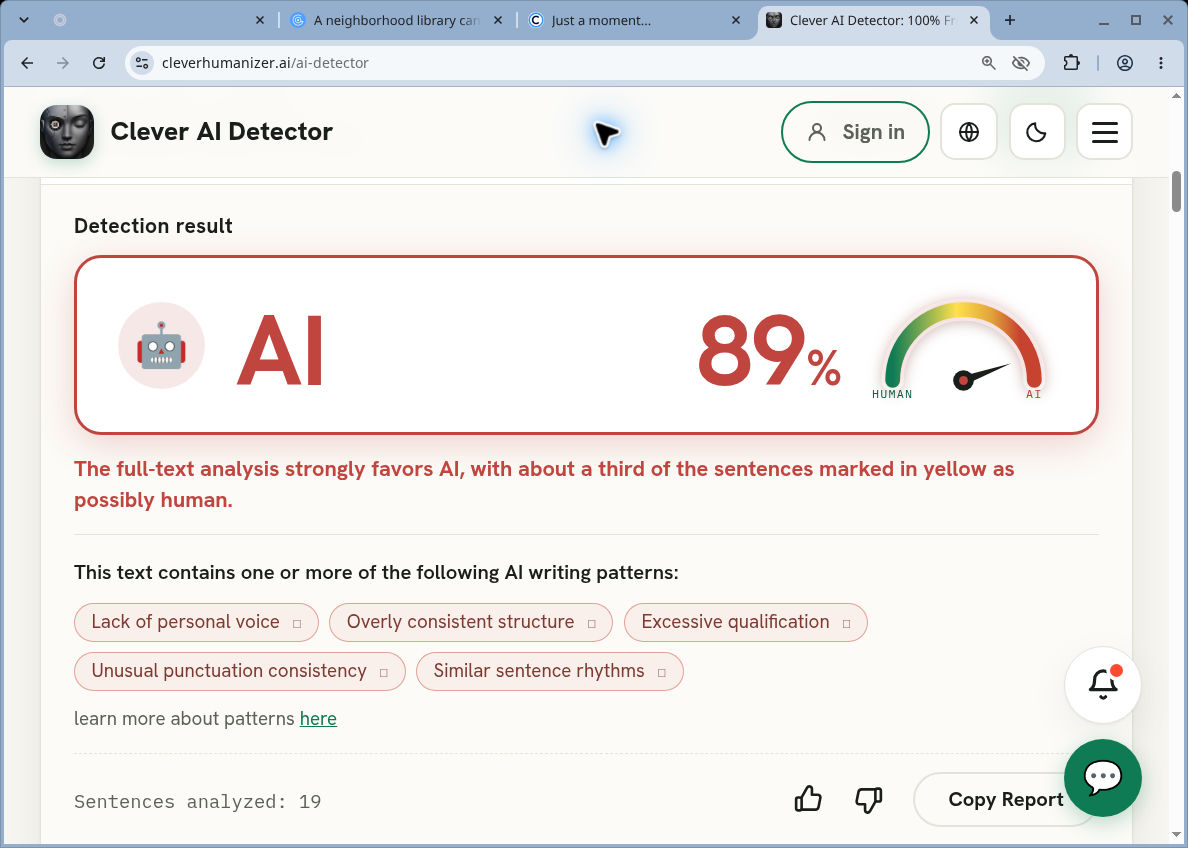
Earlier full-A01 Clever AI Detector result, captured 2 October 2026. Different test dates and model uncertainty limit direct performance comparisons.
The comparison supports using a second signal on this example. It does not make the scores a shared accuracy scale, and neither tool’s output should settle an accusation about a writer. Draft history, source material and how the writing actually happened can tell you things a score can’t.
Editing still needs a source check
If the goal is improving a stiff draft, Clever AI Humanizer is a separate option to try. In a full-A01 generation on 3 October, it produced a readable rewrite but removed the six-month duration and changed why the survey was on paper. Its short HZ01 attempts did not return output, so the completed long example is no guarantee of reliability on other inputs.
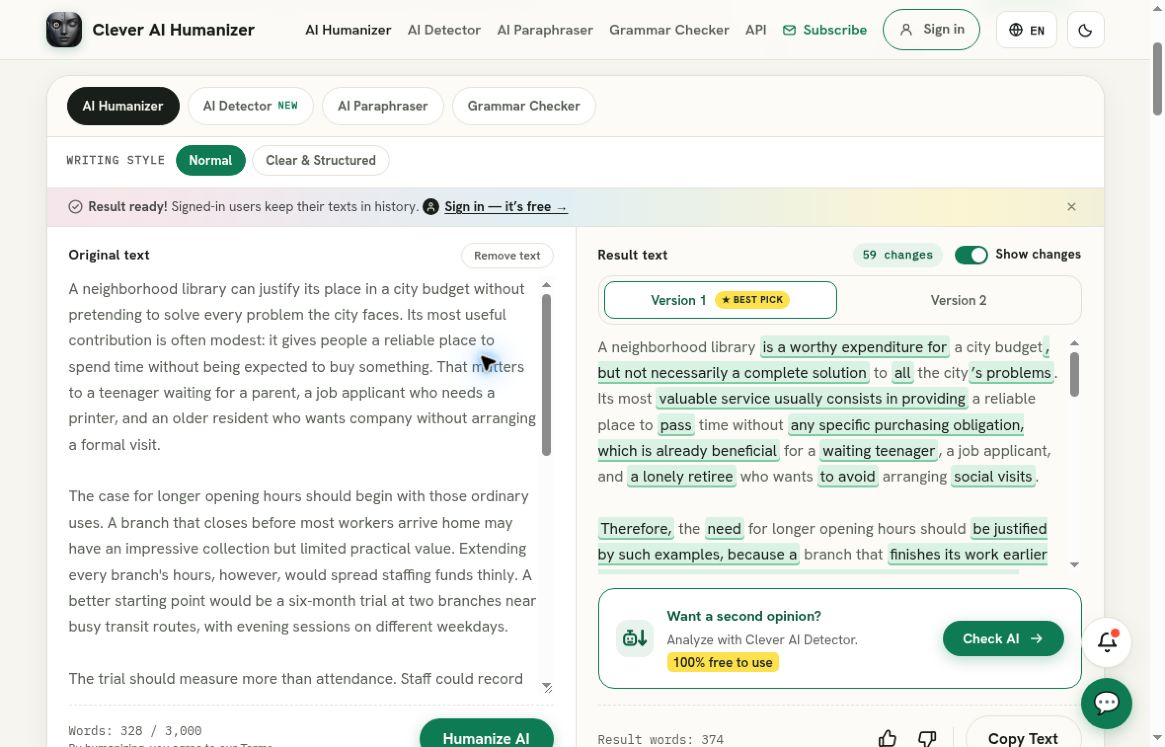
Actual full-A01 source and rewrite in Clever AI Humanizer. SciSpace was not tested on this rewritten output.
My conclusion is narrow but useful: SciSpace’s confident human explanation was wrong for the original generated essay. I would not use this result as a clearance certificate. When a detector gives a reassuring label, do you also inspect its sentence signals, or does the headline tend to end the review?
A01: exact unchanged AI-generated essay
A neighborhood library can justify its place in a city budget without pretending to solve every problem the city faces. Its most useful contribution is often modest: it gives people a reliable place to spend time without being expected to buy something. That matters to a teenager waiting for a parent, a job applicant who needs a printer, and an older resident who wants company without arranging a formal visit.

The case for longer opening hours should begin with those ordinary uses. A branch that closes before most workers arrive home may have an impressive collection but limited practical value. Extending every branch's hours, however, would spread staffing funds thinly. A better starting point would be a six-month trial at two branches near busy transit routes, with evening sessions on different weekdays.

The trial should measure more than attendance. Staff could record which services visitors use, how long computer queues become, and whether evening demand comes from people who cannot visit during existing hours. An optional paper survey would reach visitors who avoid online forms. None of these measures would capture every benefit, but together they would offer a clearer picture than a single total at the entrance.

There are trade-offs. Evening shifts can make recruitment harder, and additional security costs may consume money that could otherwise support books or children's activities. The proposal therefore needs a published budget and a review date. If the experiment mainly shifts existing visits into a more convenient time slot, that convenience still has value, but it should not be described as reaching an entirely new audience.

Public services gain trust when their promises are specific enough to test. A library does not need to become a substitute for housing, childcare, or healthcare to deserve support. It needs to identify a practical gap, try a proportionate response, and explain honestly what happened. Longer opening hours could meet that standard if the city treats them as a service experiment rather than a slogan.