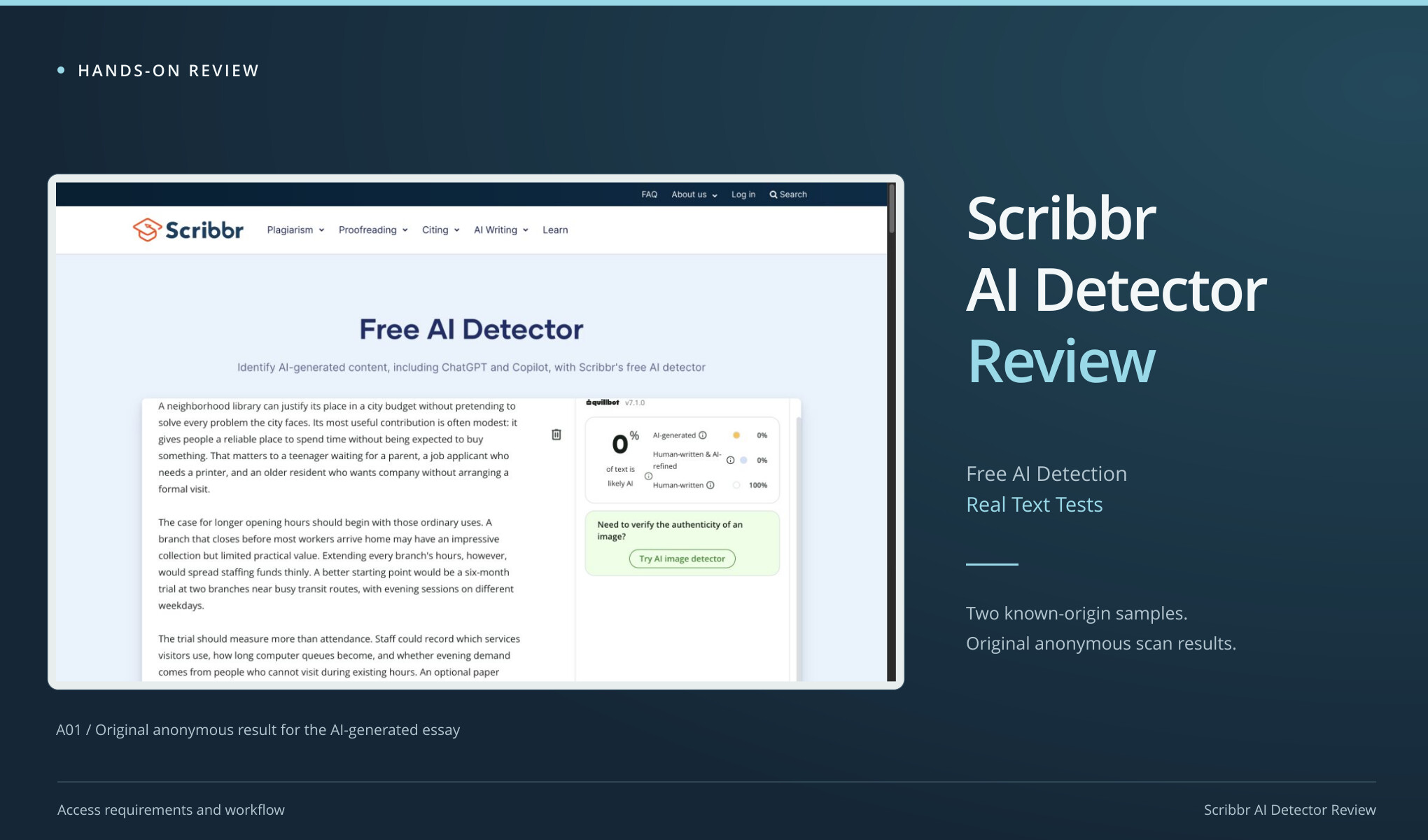
Scribbr’s free detector was accessible in this follow-up, but it gave the same human-only classification to two texts with very different origins. An original AI-generated essay and a nineteenth-century human-written excerpt both came back as 0% AI-generated, 0% human-written and AI-refined, and 100% human-written.
Both checks completed through the guest route. The paired results are the main story here. The earlier access difficulty is still worth mentioning for context.
The paired result, before the explanation
| Frozen input | Known origin | Scribbr result |
|---|---|---|
| A01: library-hours essay, 328 words | Fully AI-generated | AI-generated 0%; human-written 100% |
| H01: Lewis Carroll excerpt, 274 words | Historical human writing | AI-generated 0%; human-written 100% |
The checks took place on 3 October 2026 in Chrome on a Mac, without signing in or paying. A01 was generated during corpus preparation on 2 October by an OpenAI assistant; the exact underlying model/version was not exposed. It was frozen before any detector results were seen. H01 is an unedited opening excerpt from Lewis Carroll’s Alice’s Adventures in Wonderland, first published in 1865, with presentation formatting normalized.
The embedded interface visibly carried QuillBot branding. That matters when you compare tools: two website names don’t necessarily mean two independent detectors. The interface alone does not reveal backend configuration or prove that every result will match another entry point. Check which tool is actually shown before counting the brand names as independent votes.
We know where those samples came from because their sources were recorded. A detector’s confidence didn’t establish their origins. The table therefore contains one miss on a known-AI passage and one correct human classification. Two short examples aren’t enough to turn that into a meaningful overall accuracy percentage.
The essay that received a human-only result
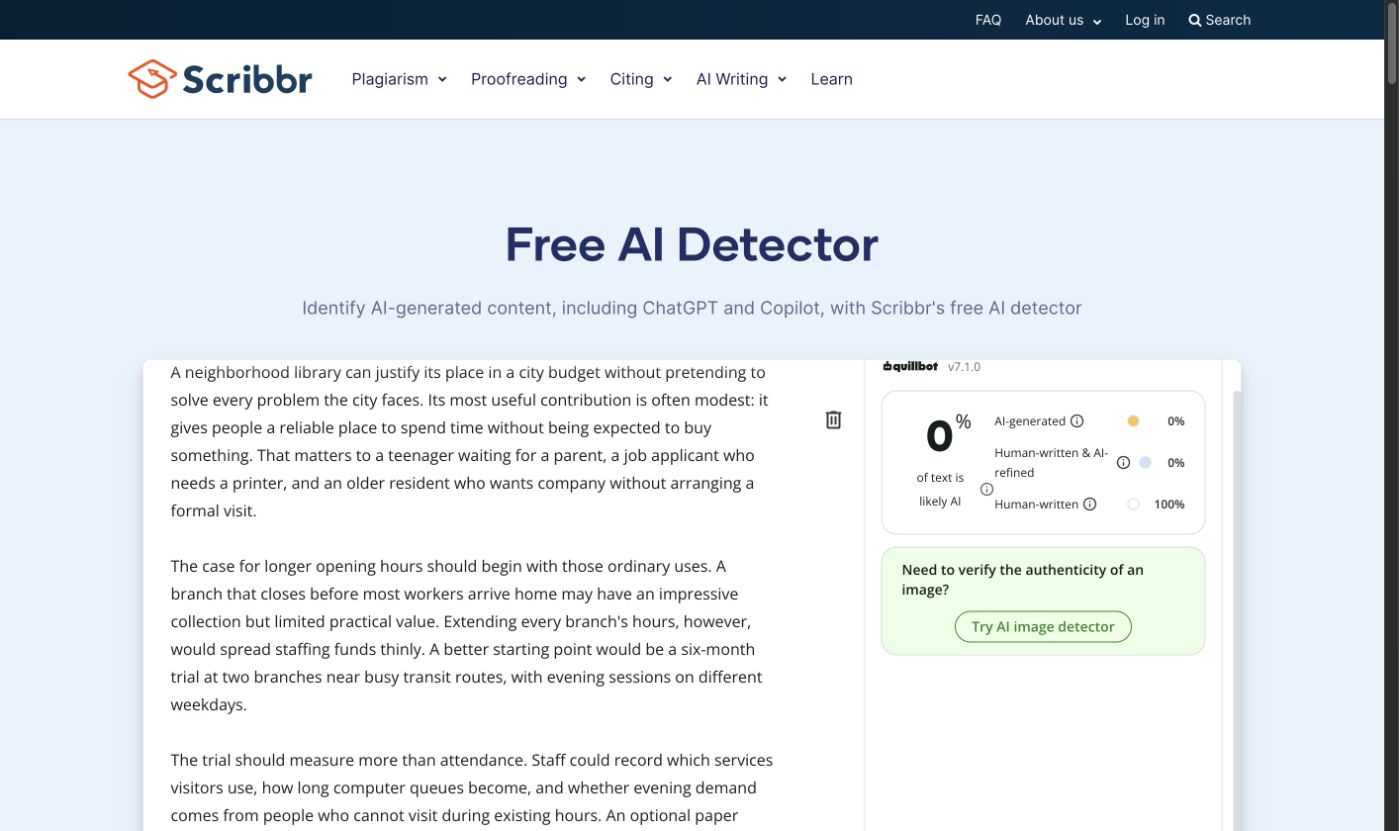
Actual A01 result: the entered library essay beside Scribbr’s embedded detector card, showing 0% likely AI and 100% human-written.
A01 argues for a six-month trial of later opening hours at two library branches. It includes a budget, staffing trade-offs, an optional paper survey and a warning against calling shifted visits an entirely new audience. It is ordinary argumentative prose, not a passage rewritten after inspecting detector feedback.
If the passage had been tuned to get a human-only result, we’d be testing something different. Here the complete essay was submitted as the same frozen text used elsewhere in the project. This is a documented false negative on a specific input: the essay came from AI, but the displayed result didn’t flag it as AI-generated or AI-refined.
The screenshot also helps distinguish the verdict from the input. There is no need to guess whether a blank editor or an example supplied by the site produced the number. The opening of the actual library essay is visible beside the result. The full input is copyable below if you want to repeat the check without typing it out from a screenshot.
The human control deserves equal space
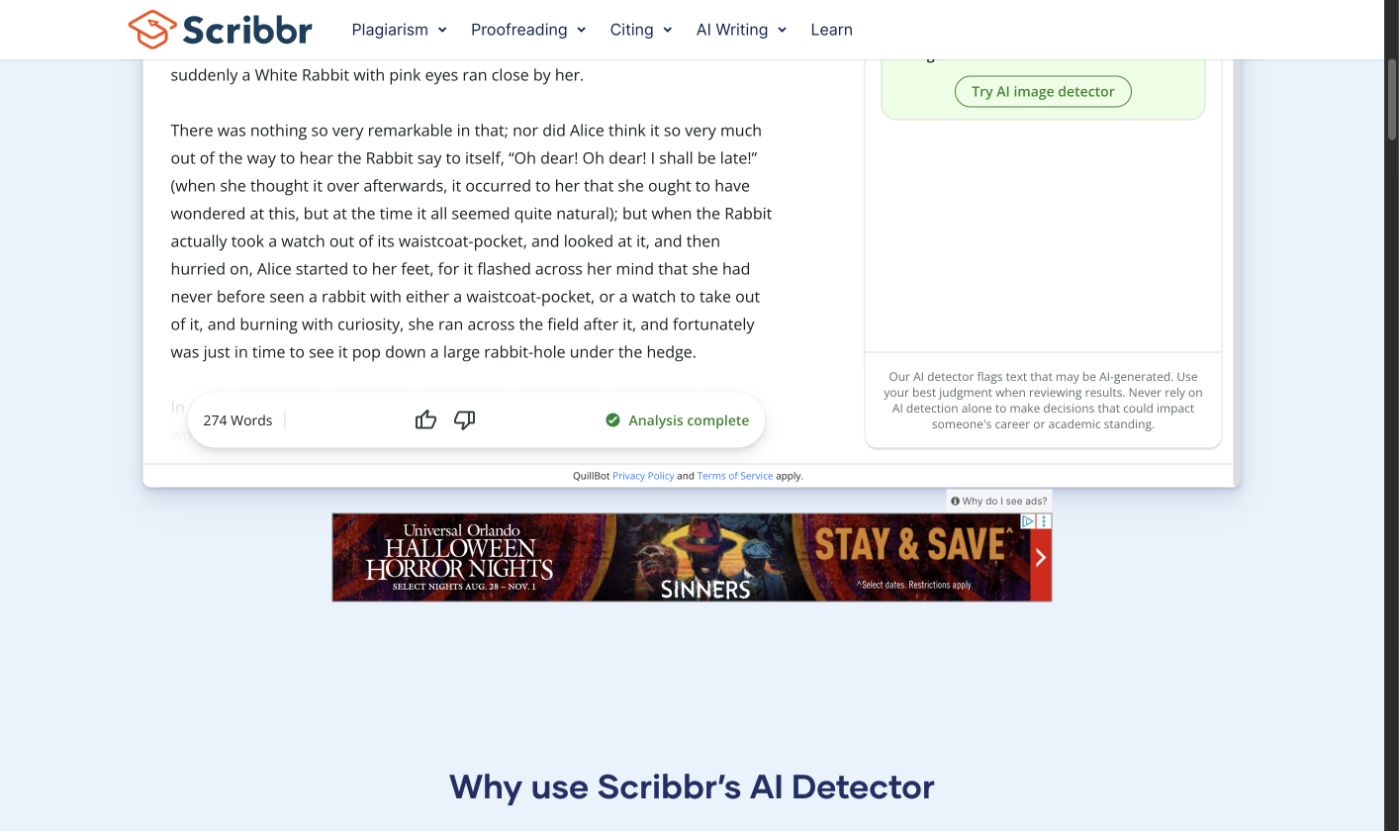
H01 completion capture: the historical human passage, its 274-word counter and completed-analysis indicator. This crop is below the score card; the saved result text records AI-generated 0%, AI-refined 0% and human-written 100%.
Scribbr correctly accepted the Carroll excerpt as human-written. That correct result belongs in the table too, because the test looked for errors in both directions. A detector that misses an AI passage has not necessarily accused a human writer, and those are different practical problems.
The control is useful because its human origin predates modern generative models. It only tells us so much, though. A familiar literary passage is not a representative sample of contemporary student work, technical reports, second-language writing or lightly edited drafts. Recognizable source material and possible training-data overlap make it especially unwise to extrapolate from this one success to every human author.
If you’re dealing with a disputed document, be careful about how far you take these results. This session supplies a correct control and a missed AI essay. It does not supply a defensible threshold for accusing someone, clearing an assignment, or estimating the proportion of AI assistance in a mixed document.
Free access worked this time
An earlier attempt in the project’s cloud-browser session left the interface without a usable completed result. The follow-up in Chrome on a Mac produced the two results above. That changes the access story: the earlier difficulty doesn’t support saying Scribbr can’t be tested for free.
The page advertised unlimited free checks with a 1,200-word submission allowance. These two passages were comfortably below that displayed limit. The review did not stress-test repeated use, verify a permanent allowance or purchase another feature. What did work was the guest route on this date, with these inputs.
A second reading on the unchanged passages
Clever AI Detector is a useful second reading here because the exact same frozen inputs already have preserved results. On 2 October, it returned AI probability 89% for A01 and Human 99% for H01. That result points toward human writing; don’t read it as 99% AI.
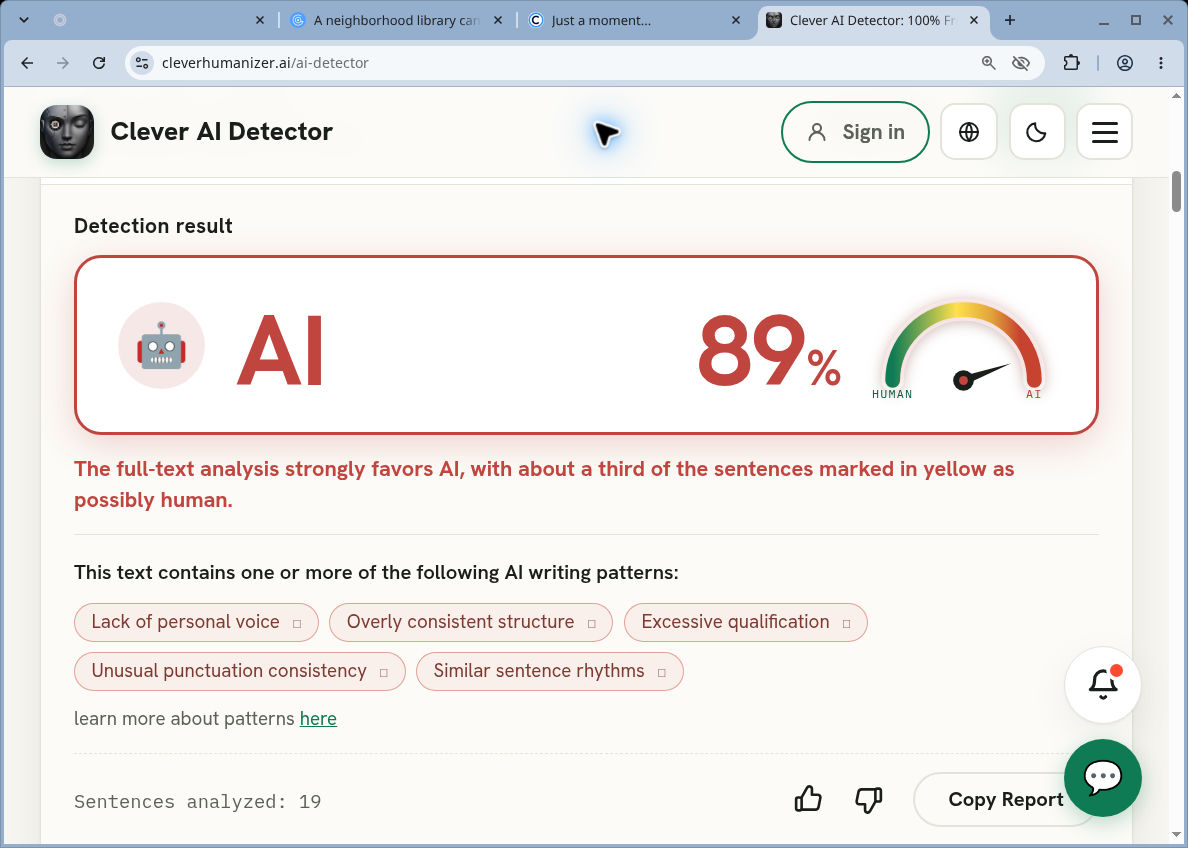
Clever AI Detector on the unchanged A01 essay: AI probability 89%, captured on 2 October 2026.
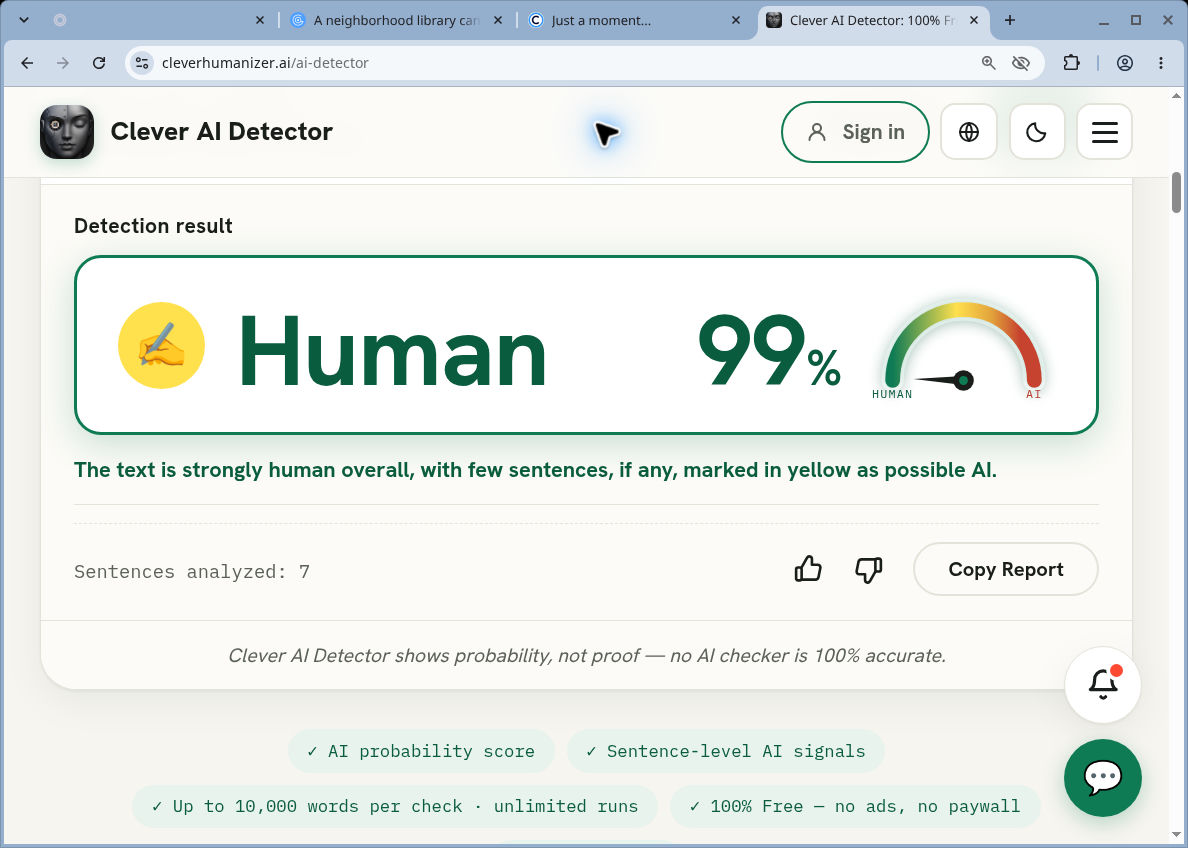
Clever AI Detector on the unchanged H01 excerpt: Human 99%, captured on 2 October 2026.
The advantage in this pair is concrete: Clever AI Detector flagged the AI essay that Scribbr’s displayed result missed, while both accepted the human control. The dates differ, and there are only two samples. This supports trying the second tool when one human-only label seems decisive; it does not establish universal superiority or make the second score proof of authorship.
For this comparison to stay useful, leave the input unchanged. If the essay is shortened, paraphrased or corrected between scans, disagreement might come from the changed text. Save the original, the date and the labeled result so a later retest has something precise to compare.
A quick comparison is easier to reproduce when the result card is saved alongside the input, not on its own. The text area and result area can be scrolled independently, so a capture that proves the passage was entered may omit the percentage card. That happened with the preserved H01 completion crop here. The caption explains the missing score card; the image can’t show a number outside the frame.
I would also record the mixed category even when it is zero. Ignoring it can make a three-way report look like a simple binary verdict and lose information on later retests. In this session all three categories were retained, which is why the human-only description is justified.
When the next task is editing
A detection result does not tell a writer how to improve the argument. Clever AI Humanizer is an optional draft-editing route if alternative wording is actually needed. In the separate 3 October baseline, its anonymous Normal-mode run turned the same 328-word A01 essay into a selected 374-word version.
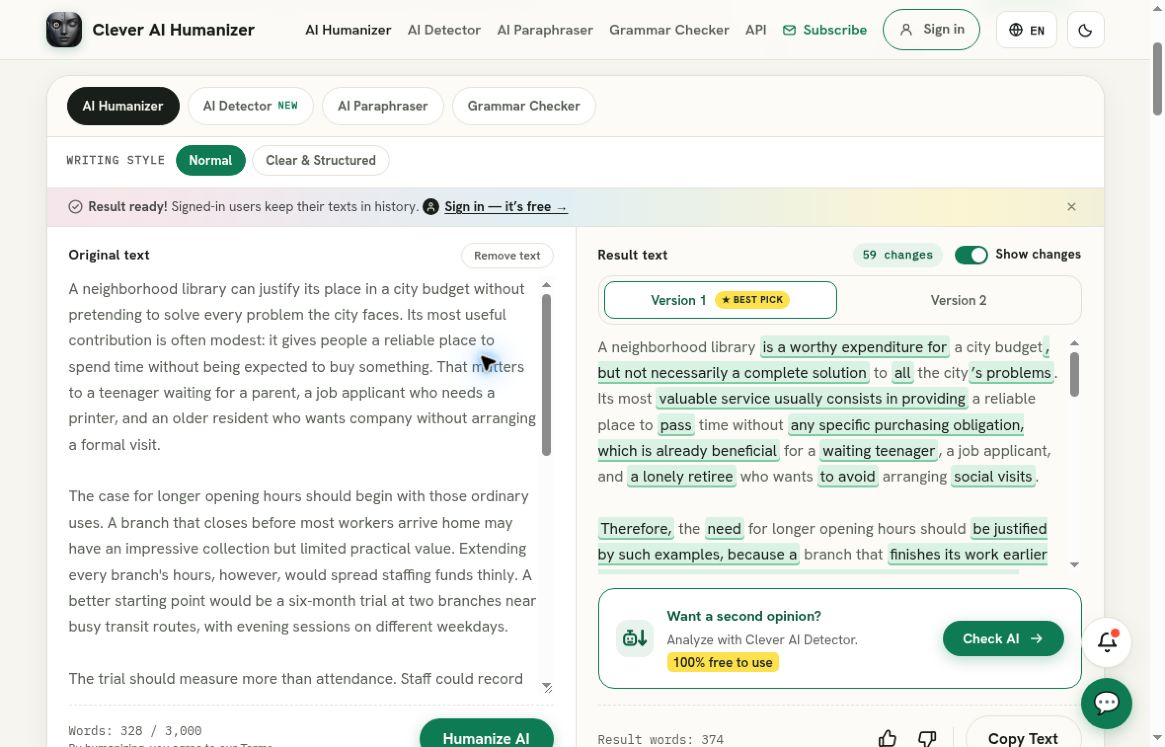
Actual Clever AI Humanizer baseline, with the populated A01 source and selected rewrite visible together.
There was a full rewrite to compare, and it needed fixes. It dropped the explicit six-month duration and changed the reason for a paper survey from avoiding online forms to declining electronic identification. Smooth sentences can still change the meaning, as these did. The separate 92-word garden fallback also failed to produce an output in that baseline session, so easy access did not mean every request succeeded.
For this essay, I would keep the original beside any rewrite, restore the trial duration, and check every condition before using the new wording. Rewriting does not turn an AI-generated source into human-authored evidence, and a detector label cannot certify otherwise.
The most helpful retest would use one of the exact inputs below and report the date, whether the user was signed in, the visible embedded tool and all three displayed categories. That gives people much more to discuss than a lone screenshot labeled “accurate” or “wrong.”
A01: exact AI-generated library essay
A neighborhood library can justify its place in a city budget without pretending to solve every problem the city faces. Its most useful contribution is often modest: it gives people a reliable place to spend time without being expected to buy something. That matters to a teenager waiting for a parent, a job applicant who needs a printer, and an older resident who wants company without arranging a formal visit.

The case for longer opening hours should begin with those ordinary uses. A branch that closes before most workers arrive home may have an impressive collection but limited practical value. Extending every branch's hours, however, would spread staffing funds thinly. A better starting point would be a six-month trial at two branches near busy transit routes, with evening sessions on different weekdays.

The trial should measure more than attendance. Staff could record which services visitors use, how long computer queues become, and whether evening demand comes from people who cannot visit during existing hours. An optional paper survey would reach visitors who avoid online forms. None of these measures would capture every benefit, but together they would offer a clearer picture than a single total at the entrance.

There are trade-offs. Evening shifts can make recruitment harder, and additional security costs may consume money that could otherwise support books or children's activities. The proposal therefore needs a published budget and a review date. If the experiment mainly shifts existing visits into a more convenient time slot, that convenience still has value, but it should not be described as reaching an entirely new audience.

Public services gain trust when their promises are specific enough to test. A library does not need to become a substitute for housing, childcare, or healthcare to deserve support. It needs to identify a practical gap, try a proportionate response, and explain honestly what happened. Longer opening hours could meet that standard if the city treats them as a service experiment rather than a slogan.
H01: exact historical human control
Alice was beginning to get very tired of sitting by her sister on the bank, and of having nothing to do: once or twice she had peeped into the book her sister was reading, but it had no pictures or conversations in it, “and what is the use of a book,” thought Alice “without pictures or conversations?”

So she was considering in her own mind (as well as she could, for the hot day made her feel very sleepy and stupid), whether the pleasure of making a daisy-chain would be worth the trouble of getting up and picking the daisies, when suddenly a White Rabbit with pink eyes ran close by her.

There was nothing so very remarkable in that; nor did Alice think it so very much out of the way to hear the Rabbit say to itself, “Oh dear! Oh dear! I shall be late!” (when she thought it over afterwards, it occurred to her that she ought to have wondered at this, but at the time it all seemed quite natural); but when the Rabbit actually took a watch out of its waistcoat-pocket, and looked at it, and then hurried on, Alice started to her feet, for it flashed across her mind that she had never before seen a rabbit with either a waistcoat-pocket, or a watch to take out of it, and burning with curiosity, she ran across the field after it, and fortunately was just in time to see it pop down a large rabbit-hole under the hedge.

In another moment down went Alice after it, never once considering how in the world she was to get out again.
Clever AI Humanizer: complete unchanged output from A01, a separate baseline
A neighborhood library is a worthy expenditure for a city budget, but not necessarily a complete solution to all the city’s problems. Its most valuable service usually consists in providing a reliable place to pass time without any specific purchasing obligation, which is already beneficial for a waiting teenager, a job applicant, and a lonely retiree who wants to avoid arranging social visits.

Therefore, the need for longer opening hours should be justified by such examples, because a branch that finishes its work earlier than many employees return from shift work will see little use despite having an extensive collection. Meanwhile, trying to organize extended hours for all libraries simultaneously would waste staff time, and a pilot experiment is needed. It can start in two convenient branches for public transport users, with evening sessions on different weekdays.

The experiment’s effectiveness can be measured not only by the number of visitors but also by the staff’s observations of what requests are made, how long visitors stay within the queue for a computer workstation, and whether evening openings compensate for the lack of daytime opportunities. The staff could also distribute printed questionnaires to those who decline to identify themselves electronically. This information will not be fully accurate, but it will provide a more practical understanding of the branch’s importance than the number of people who signed in.

The proposed plan has disadvantages, including possible shifts in staffing policy and the opportunity cost of spending money on security rather than books or children’s events. Therefore, the library should publish the experiment’s budget and timeline for revision. Even if extended hours only divert daytime visitors to evening hours, such a result is still worth discussing, although it cannot be said that the library serves a new population. For public services, it is essential to design their limitations clearly to understand the value they bring to the community.

A library does not have to be a universal solution to residents’ problems, but it should experimentally demonstrate what specific need is addressed and what results can be achieved without budgetary inefficiency. Extended opening hours can be such a solution, but the city should treat this hypothesis with caution and revise it no later than the end of the pilot experiment.