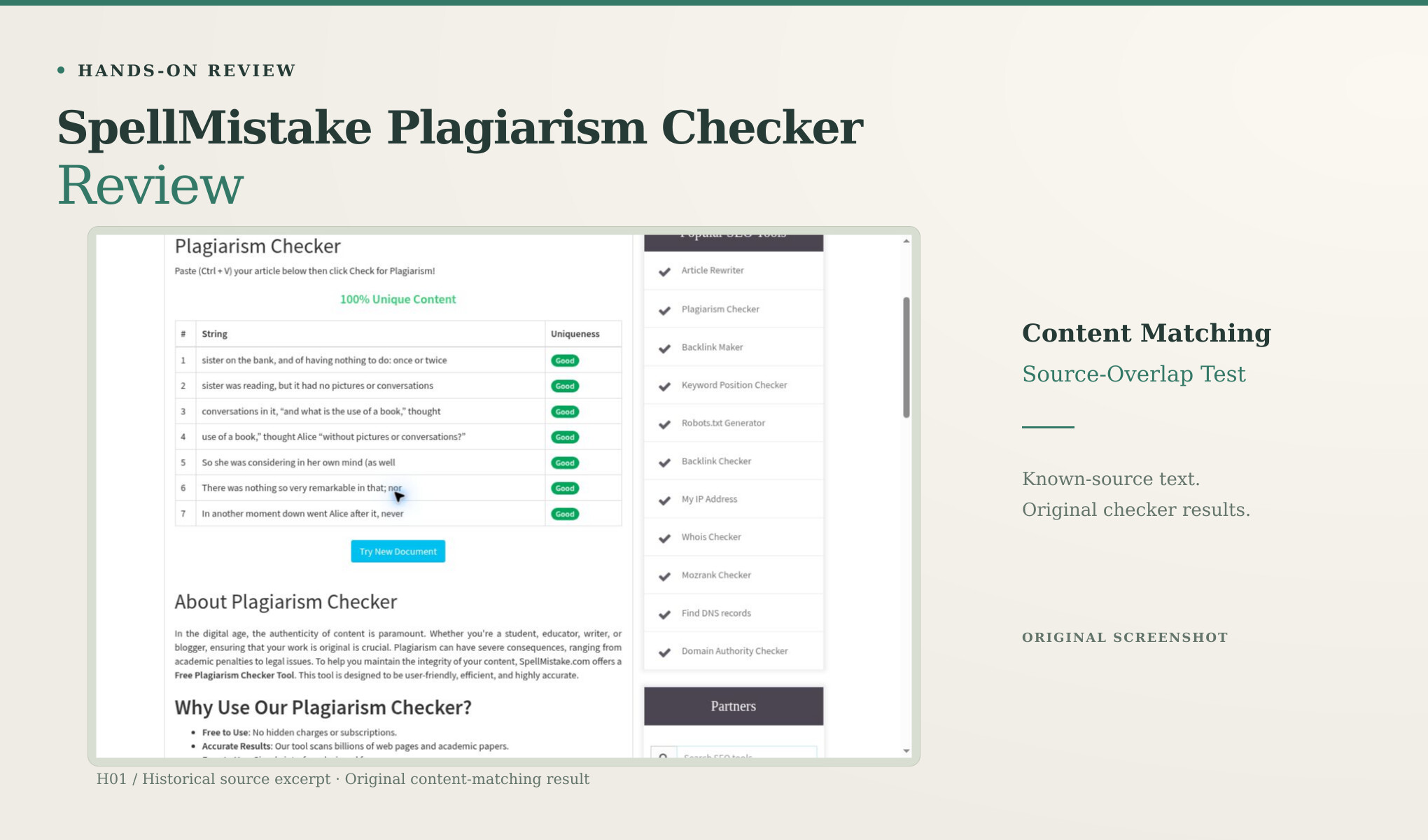
SpellMistake called both passages “100% Unique Content.” One was an original synthetic control; the other was copied from the opening of Alice’s Adventures in Wonderland. The second result is the warning worth noticing: the checker didn’t find the known source overlap in this test.
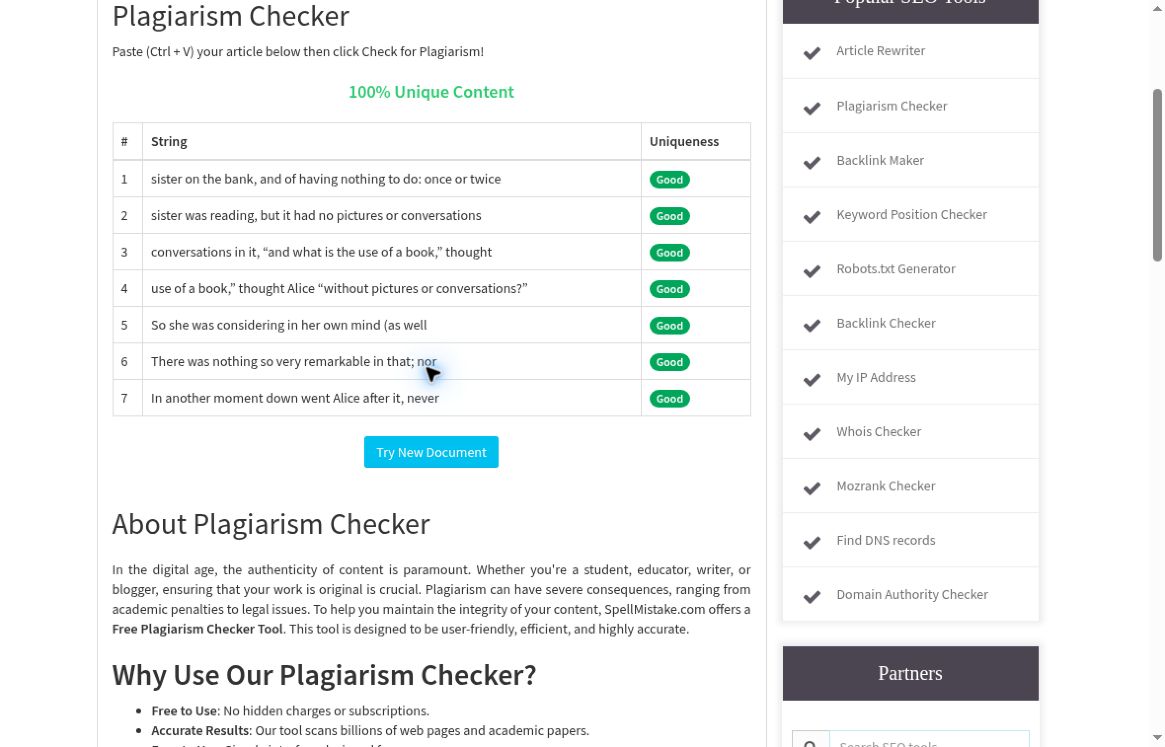
SpellMistake’s actual H01 result, 3 October 2026: 100% Unique Content, with seven checked strings labeled Good.
Two controls with different purposes
The copied excerpt is the positive control. It gives the checker a known overlap to find. The new cupboard paragraph is the negative control: text not knowingly copied from an existing source.
| Submitted text | Why it was included | Result | Source matches returned |
|---|---|---|---|
| H01, 274 words from Lewis Carroll | Known copied-text positive control | 100% Unique Content; seven strings Good | None |
| PN01, 271 original AI-generated words | Original-text negative control | 100% Unique Content; 18 strings Good | None |
This was a similarity/plagiarism workflow. Neither number is an AI-writing probability. The original control was deliberately AI-generated; calling it “Unique” does not classify it as human-written.
Both English texts were frozen before the scans and submitted unchanged in the public web interface on 3 October 2026. H01 was checked first. PN01 had not yet been published before these checks. The exact inputs are below so you can see what was tested. Once published, PN01 can’t be used as an unpublished negative control in future tests.
The copied passage should have been the informative case
H01 reproduces the first four prose paragraphs of Carroll’s 1865 novel. The known source is Project Gutenberg’s text, beginning “Alice was beginning” and ending “get out again.” It’s a public-domain source, so overlap here doesn’t by itself mean anyone did something wrong.
The test asks a simpler question: would the checker find text that was already available elsewhere? It did not return a source. Instead, the seven displayed strings all received Good labels and the page summarized the passage as 100% Unique Content.
That is a missed known match in this single test. The available result does not explain whether the cause was index coverage, query selection, matching rules or something else. We can’t use this to say SpellMistake never finds copied text, or turn one miss into an overall accuracy rate.
Why the clean cupboard paragraph was the easier test
PN01 describes a labeling system for a shared cupboard. It was generated specifically for this exercise, without knowingly copied source text. SpellMistake returned no matches, which is consistent with that purpose. Even original prose can happen to share phrases with something else.
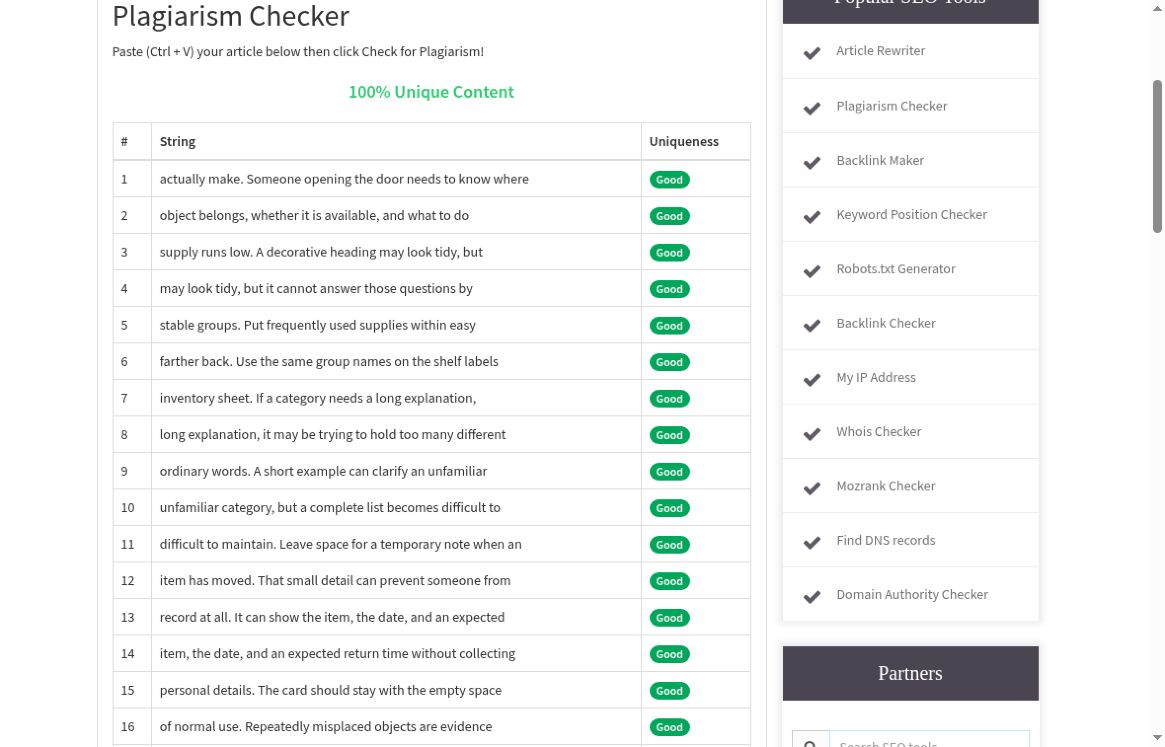
Detail view of the original PN01 result. The saved report listed 18 checked strings, all Good, and the same 100% Unique Content summary.
The difference between seven strings for H01 and 18 for PN01 is another reason to inspect the actual report rather than assume every word received the same search treatment. The interface didn’t give enough detail to work out how much it checked.
A clean report is a search outcome, not a provenance record
Similarity checking depends on material being available to the checker and on the way it selects and compares text. So a no-match result doesn’t tell you that the writing has never appeared anywhere else. H01 makes that difference visible. The source is known in advance, yet no source was returned. There’s not enough evidence here to explain why it missed the source. It can still reject the stronger interpretation of the result: the green 100% Unique summary did not establish that this submitted wording was original to the person who pasted it.
That distinction matters for ordinary legitimate reuse as well as misconduct concerns. Public-domain text may be reproduced lawfully, and properly attributed quotations may be appropriate in an article or assignment. A checker can identify overlap without deciding whether the use is permitted, attributed or relevant. Missing an overlap doesn’t make the copied wording original either. The appropriate review has to consider the source and context after a match is found, or use another source-checking step when a clean report conflicts with known provenance. A percentage can’t do that thinking for you.
In H01, paragraph spacing was normalized and web-presentation italics were removed, but the words and punctuation were preserved. The passage hadn’t been paraphrased to make it harder to match. That makes the missed overlap worth reporting directly. It does not reveal which text segment the system searched or why the visible strings were selected. The screenshot exposes seven strings with Good labels; it does not demonstrate that every contiguous phrase in the 274-word passage was queried against a complete index. The conclusion needs to leave that coverage question open, rather than guess how the service works.
The negative control answers a smaller question
PN01 is useful because it gives the checker material not knowingly copied from an existing source. Its no-match result is consistent with that role. But a system that never finds anything could also give the negative control a clean result. That result alone doesn’t show that it can find sources. You need to read the positive and negative controls together. Here, the clean original passage supplies limited reassurance, while the missed known source remains the decisive limitation. Reporting both prevents the test from becoming either an unfairly selective attack or a misleading endorsement based only on the easy clean result.
Original AI-generated prose is suitable for this particular negative role because the question concerns source overlap rather than human authorship. It’s important to be clear about that choice. Calling PN01 “human” because it received a Unique label would confuse the two kinds of analysis and misstate its provenance. Calling H01 “AI” because another detector dislikes its style would be the opposite confusion. The shared test materials let readers see how the same passage can be human-authored and publicly copied, or AI-generated and not knowingly copied. Those dimensions need separate evidence and separate language.
Publication changes the negative control’s usefulness. Before these scans, PN01 had been prepared for the exercise and had not been published. Once its exact wording appears in this review, a later checker may find this page or another indexed copy. That wouldn’t contradict the original result. It would mean there’s now more published text for a checker to find. For a future test, use a fresh unpublished negative control and keep a record of when it was prepared. The current text and hash remain valuable as a record of what was tested, but the passage should not be recycled as though its publication status were unchanged.
What would make a follow-up convincing
A broader source-retrieval evaluation would use several known sources with different formats and ages, then record the returned links and matched spans rather than only a headline percentage. It would also separate exact quotation from paraphrase and record exclusions or filters if the interface offers them. Those are ideas for a follow-up; they haven’t been verified as available features here. The main question is whether a reader can follow a flagged passage back to a useful source and make sense of the overlap in context.
For this completed test, the practical advice is modest: keep the original passage and report together, inspect what strings were checked, and investigate a clean result when you already know the text has a source. SpellMistake’s output was readable and easy to summarize, but the absence of matched links left no way to follow the known Carroll overlap through the result. That’s a real limit for source-checking work, however reassuring the green labels look.
Keep attribution and AI editing separate
If you also need a probabilistic reading of AI-like writing patterns, Clever AI Detector addresses that separate question. Its earlier H01 result was Human 99%, consistent with the excerpt’s origin. It did not identify the source or measure plagiarism.
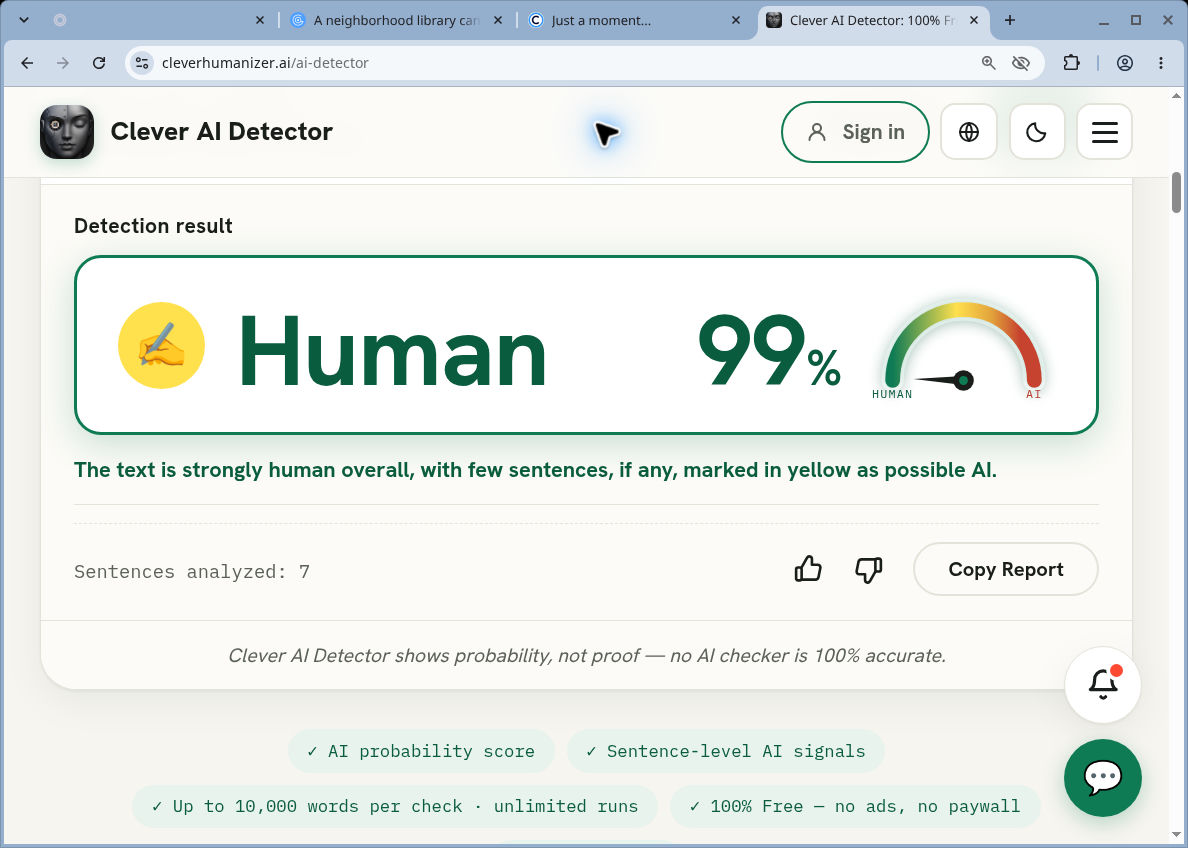
Separate AI-detection result on H01, captured 2 October 2026. This is not a similarity report.
Clever AI Humanizer is a rewriting option, not a cure for unattributed copying. In a separate library-essay test, its rewrite dropped the six-month duration and changed a survey rationale. Any editing pass needs a source-and-meaning check; paraphrasing cannot replace citation, and a lower AI score cannot establish originality.
My recommendation is to treat SpellMistake’s clean result cautiously until a checker can retrieve known sources relevant to your material. If a tool returns 100% Unique on a familiar published passage, what source-checking step would you use before trusting the next clean report?
H01: exact known copied public-domain excerpt
Alice was beginning to get very tired of sitting by her sister on the bank, and of having nothing to do: once or twice she had peeped into the book her sister was reading, but it had no pictures or conversations in it, “and what is the use of a book,” thought Alice “without pictures or conversations?”

So she was considering in her own mind (as well as she could, for the hot day made her feel very sleepy and stupid), whether the pleasure of making a daisy-chain would be worth the trouble of getting up and picking the daisies, when suddenly a White Rabbit with pink eyes ran close by her.

There was nothing so very remarkable in that; nor did Alice think it so very much out of the way to hear the Rabbit say to itself, “Oh dear! Oh dear! I shall be late!” (when she thought it over afterwards, it occurred to her that she ought to have wondered at this, but at the time it all seemed quite natural); but when the Rabbit actually took a watch out of its waistcoat-pocket, and looked at it, and then hurried on, Alice started to her feet, for it flashed across her mind that she had never before seen a rabbit with either a waistcoat-pocket, or a watch to take out of it, and burning with curiosity, she ran across the field after it, and fortunately was just in time to see it pop down a large rabbit-hole under the hedge.

In another moment down went Alice after it, never once considering how in the world she was to get out again.
PN01: exact original synthetic negative control
A useful labeling system for a shared cupboard starts with the decisions people actually make. Someone opening the door needs to know where an object belongs, whether it is available, and what to do when a supply runs low. A decorative heading may look tidy, but it cannot answer those questions by itself.

The first step is to divide the cupboard into a few stable groups. Put frequently used supplies within easy reach and keep occasional items farther back. Use the same group names on the shelf labels and on any inventory sheet. If a category needs a long explanation, it may be trying to hold too many different things.

Labels should describe their contents in ordinary words. A short example can clarify an unfamiliar category, but a complete list becomes difficult to maintain. Leave space for a temporary note when an item has moved. That small detail can prevent someone from buying a replacement simply because the original is waiting on a different shelf.

A borrowing card offers a practical middle ground between strict tracking and no record at all. It can show the item, the date, and an expected return time without collecting unnecessary personal details. The card should stay with the empty space so that the absence is visible at the moment someone looks for the object.

Finally, review the arrangement after several weeks of normal use. Repeatedly misplaced objects are evidence that a label or location may need changing. The aim is not to make the cupboard appear perfect during an inspection. It is to reduce the number of small uncertainties that interrupt an ordinary working day.