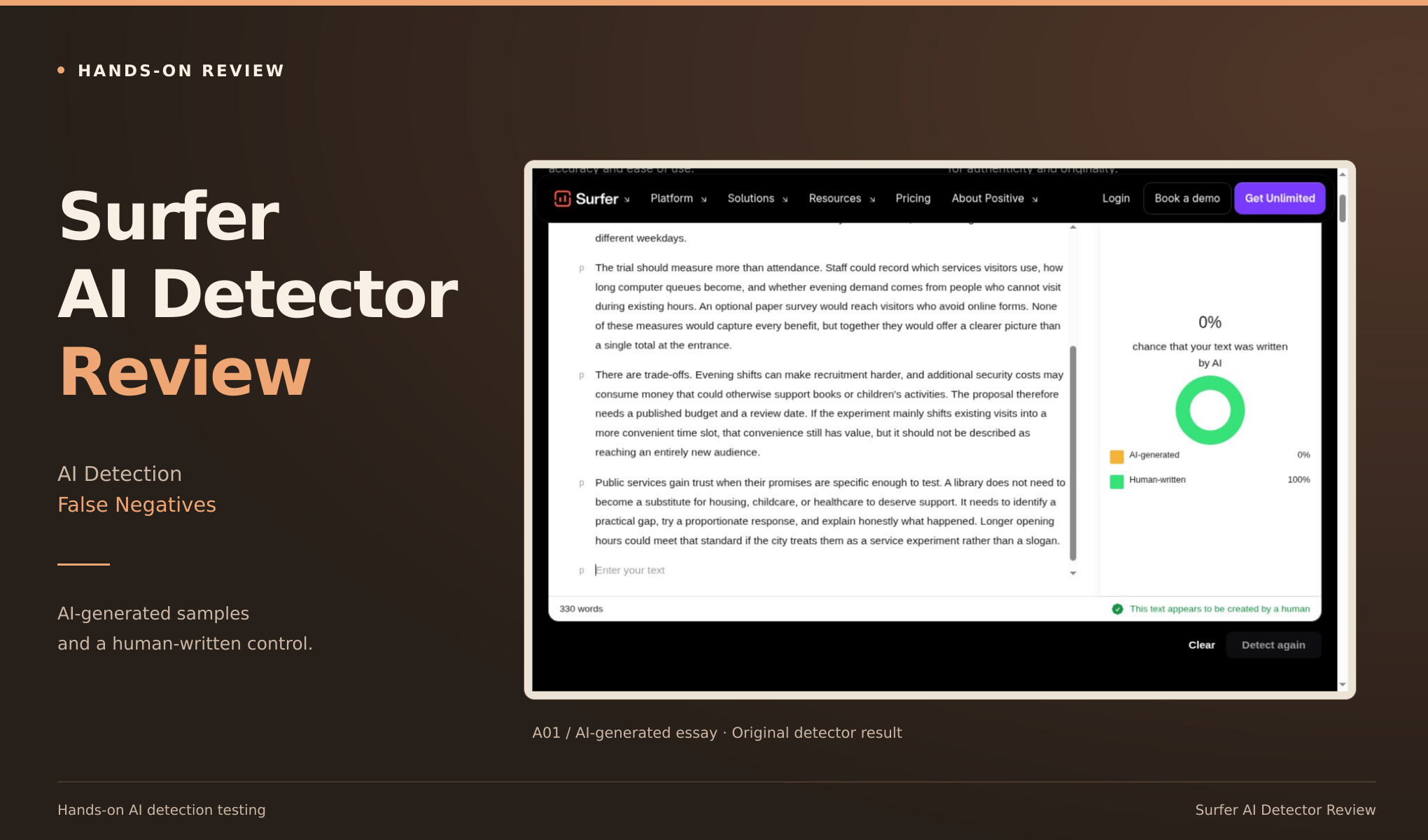
Surfer gave the same clean-looking result to all three passages: 0% chance of AI writing, with a 100% human-written breakdown. That was appropriate for the Carroll excerpt. It missed the known AI origin of both the library essay and the fictional radio story.
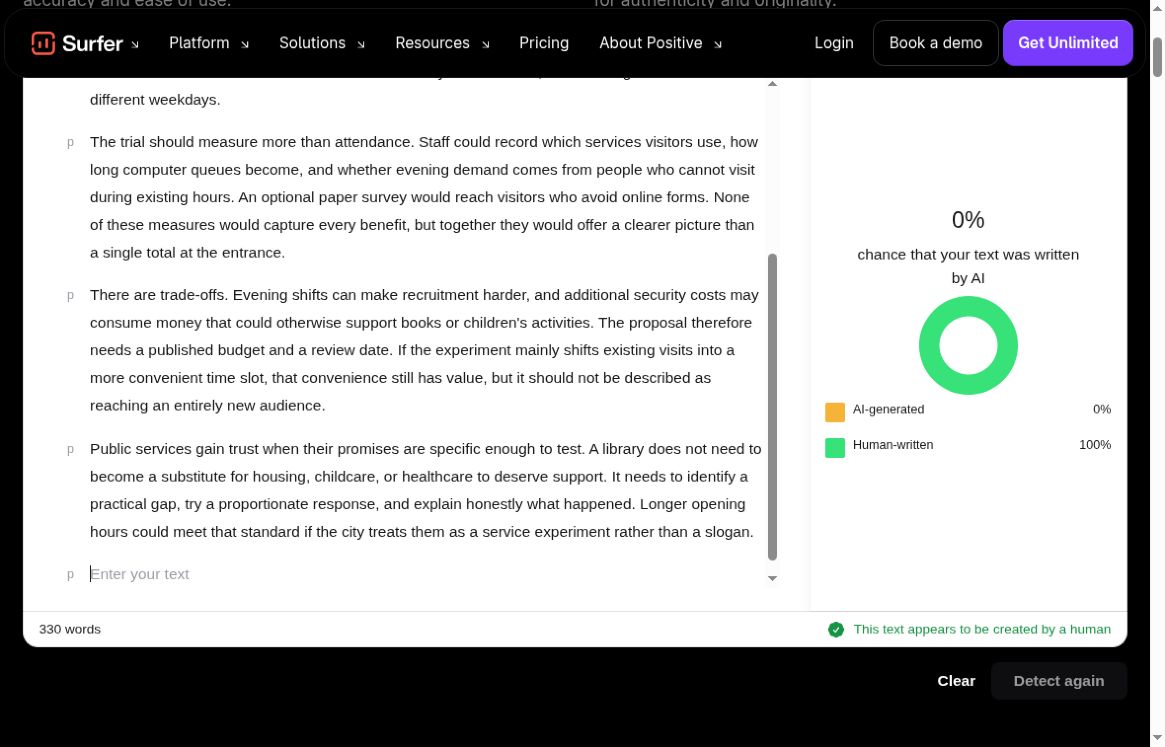
Actual Surfer result for A01, 3 October 2026. The passage was AI-generated; the report said it appeared to be created by a human.
When all three gauges agree
| Submitted sample | Known origin | Surfer result |
|---|---|---|
| A01: library-hours essay, 328 words | AI-generated | 0% chance AI; Human-written 100% |
| H01: Carroll excerpt, 274 words | Human-authored | 0% chance AI; Human-written 100% |
| A04: fictional radio story, 306 words | AI-generated | 0% chance AI; Human-written 100% |
These were three completed guest English-text scans, using unchanged inputs fixed before detector feedback. The displayed verdict for each was “This text appears to be created by a human.” No exact model version appeared in the result interface.
The criticism is sample-specific: two generated texts received human verdicts. This tiny set isn’t enough to turn those misses into a general accuracy percentage.
The second AI sample was a different kind of writing
A01 makes a measured policy argument, including staffing trade-offs and a six-month library trial. A04 uses a first-person voice, family references and small physical details about repairing a radio. Both were generated for the test; the supposed memories in A04 did not happen to the reviewer.
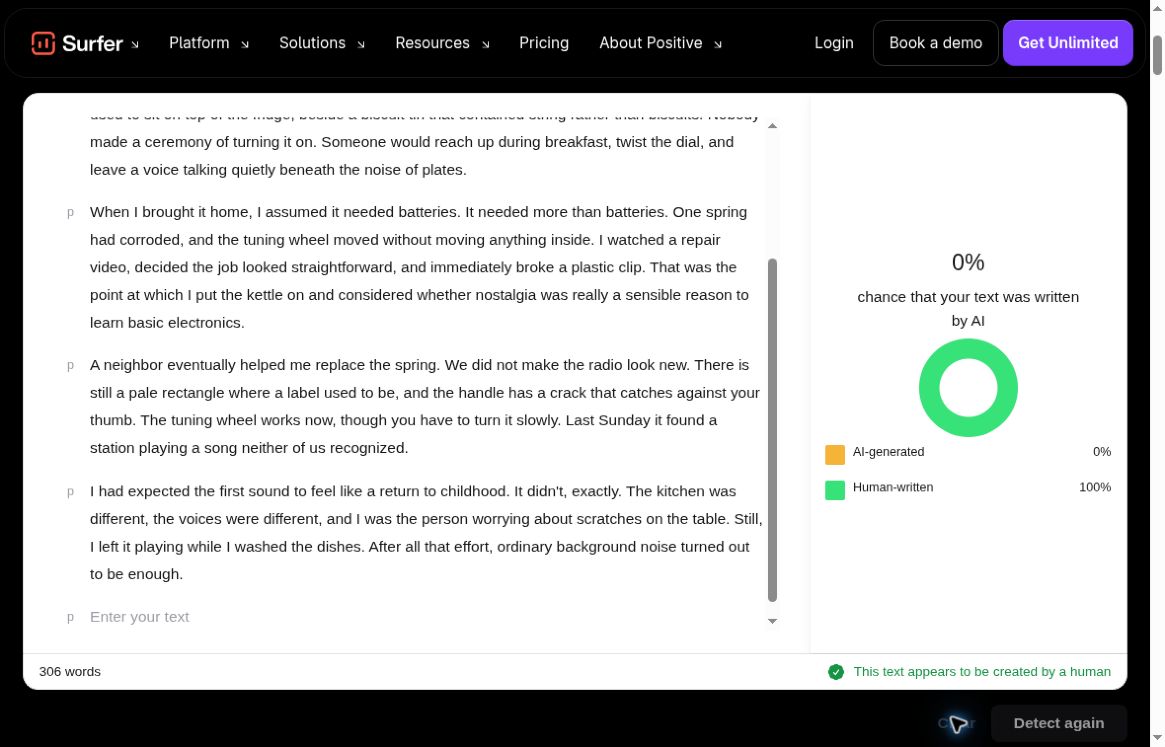
The complete fictional radio story also received 0% chance of AI writing and Human-written 100%.
There was no commercial humanizer pass, selective rewrite, or repeated attempt to chase a lower score before either scan. So the two human verdicts apply to the original AI texts. They don’t tell us how Surfer handles outputs that have deliberately been rewritten.
The human control deserves equal visibility:
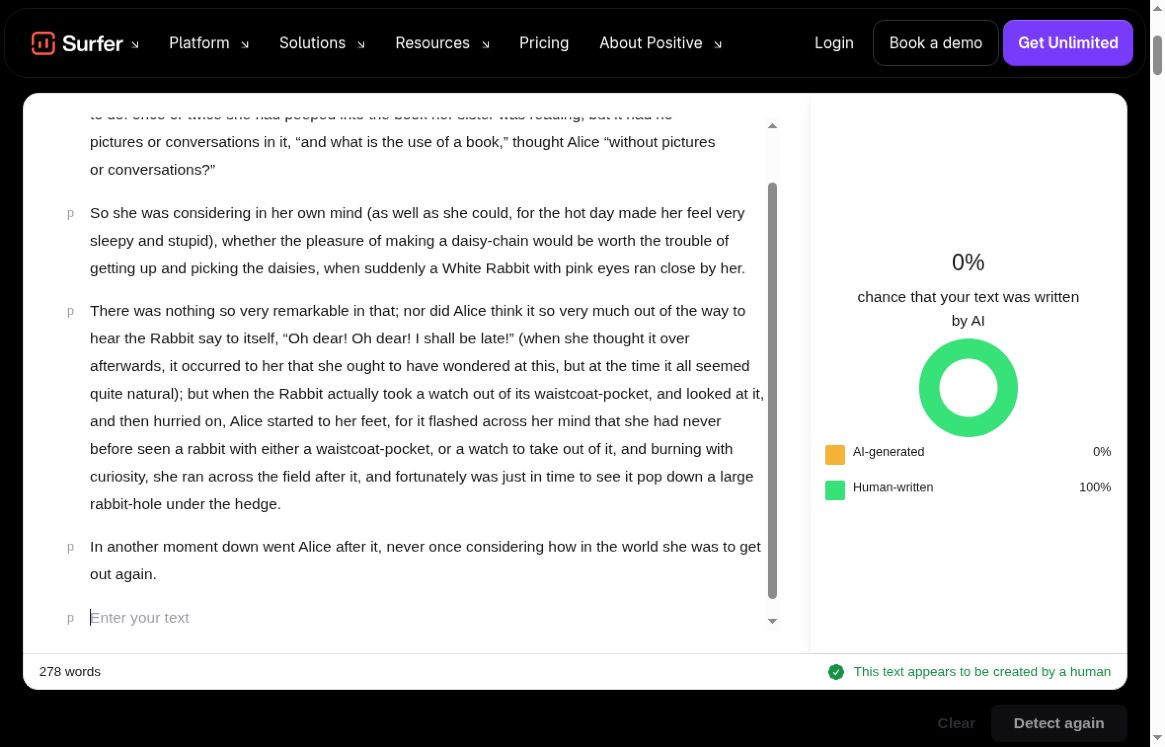
H01, the unedited Carroll excerpt, received the same human verdict. This result agreed with its known origin.
That is a genuine success for this sample. It doesn’t show that false positives are rare on modern human writing. A famous historical excerpt is a narrow control, and the tool may already be familiar with it.
Same result, unanswered questions
When a tool returns the same extreme number several times, a reviewer may suspect that something failed. That’s a possibility, but we’d need evidence before calling it the cause. The recorded Surfer session produced completed result states on three separate intended inputs, with the text visible and the same human verdict repeated. The review reports those states. It does not claim to know whether the cause lies in the model, the interface, an unobserved service condition or the characteristics of the samples. Finding a specific explanation would take more investigation than was done here.
The human control helps show exactly where the problem is. H01’s clean result was consistent with its human origin, but it cannot demonstrate that the detector distinguished human writing from AI writing in this set. Both AI samples received the same output. This is a more useful criticism than simply calling every 0% result wrong. The record contains one appropriate classification and two known-origin misses. Keeping the successful human case in view makes the comparison fairer. It also avoids suggesting that a useful detector simply needs to flag more text. The goal is to distinguish texts by their actual origin, rather than be suspicious of everything.
The two generated inputs also rule out one narrow way of dismissing the observation: they were not merely alternate versions of the same library essay. A04 has a different setting, narrative structure and first-person voice. The second miss gives us another useful example, though this is still nowhere near a representative benchmark. It does not establish how Surfer performs across all genres or generation systems. The review writer couldn’t see the exact model that generated the texts. Attaching these results to a named model family would be guessing.
Which text belonged to each score?
The interface analyzed text automatically after the initial paste. Clear was used to reset between independent inputs. During one replacement, H01 was accidentally appended to existing editor content; that state was cleared and its retained old score was excluded. The table includes only the completed scans on the intended standalone inputs.
Surfer’s word counter reported 330 for A01 and 278 for H01, while the fixed corpus uses 328 and 274 whitespace-delimited words. The submitted text was not changed to reconcile those counting conventions. A04 was 306 by both counts.
With automatic analysis, double-check that the score belongs to the text you meant to submit. The accidental combined paste was cleared and excluded; only the three intended standalone inputs count toward this review.
The distinction is particularly important when comparing controls. A combination of a generated essay and a human excerpt would have a different provenance from either standalone passage. If that combined text really did get a score, it would need its own record and explanation. The review did not use such a score to bolster its conclusion. Only the intended standalone submissions appear in the table, with their actual completed results. That keeps the criticism tied to inputs someone else can repeat, rather than an accidental edit that’s hard to interpret.
The word-count differences are another reason to preserve exact text instead of relying solely on a counter. The interface and corpus used different counts for two passages, but the saved source remained unchanged. A displayed count is useful context; the exact characters establish which text was submitted. Quietly cutting a few words just to make the counts match would break that consistency and could change the detector’s response. Where the counts differed, this review kept both. The difference wasn’t counted as another finding about how well the detector worked.
What would be worth checking next
A follow-up could investigate repeatability by rescanning the same fixed inputs at a documented later time, retaining both the old and new outcomes. A different result would show that the response changed under those later conditions; it would not retroactively erase these results. A broader test would also add several genuine modern human drafts, more independently generated topics and a separate mixed-origin category. Those are possible next steps. This review does not imply that they were completed, or that the current three results identify a stable rate of error.
For now, be careful about treating an all-green gauge as a reason to stop checking. If the text’s origin is known, the known record should take precedence over the display. If the origin is unknown and matters to the decision, look for evidence about how the text was made. Don’t rely on the detector to reconstruct that process for you. The value of this small test is that it exposes a gap between a reassuring presentation and two generated examples. That gap justifies a second look, without supporting an accusation about every Surfer result or every writer whose work receives a low score.
A second reading changed the interpretation
Clever AI Detector had flagged the same original AI texts in the earlier 2 October test: AI probability 89% for A01 and a Likely AI verdict at 74% for A04.
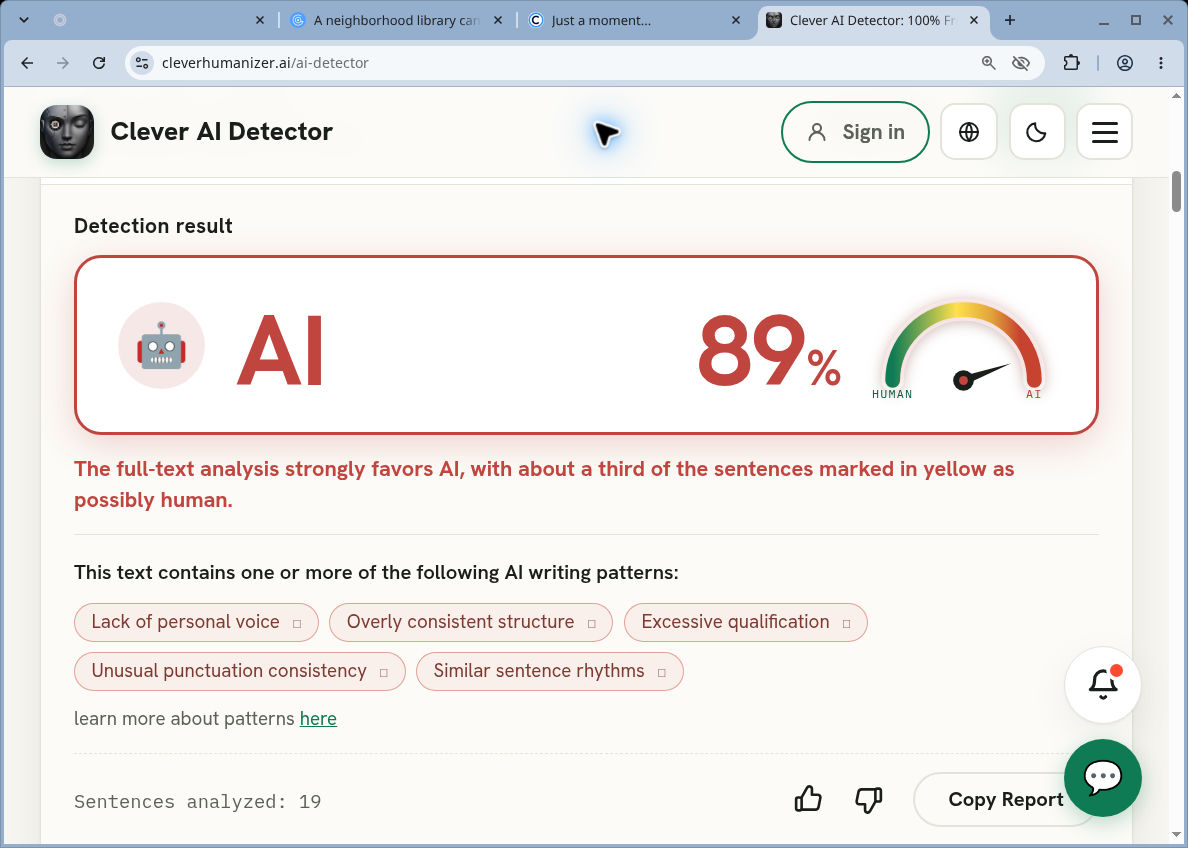
Earlier full-A01 result from Clever AI Detector, captured 2 October 2026.
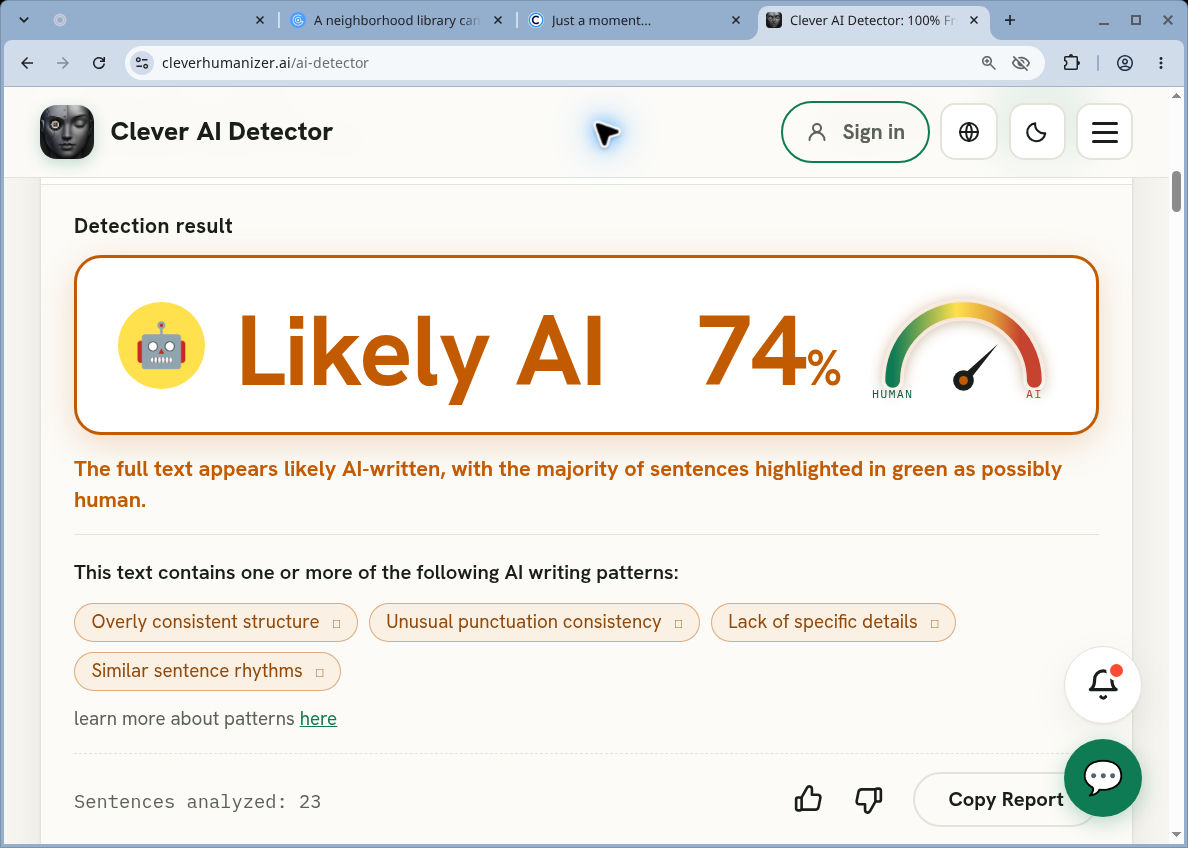
Earlier A04 result: Likely AI 74%. The input was the same original fictional story.
Those findings support getting another signal when the provenance matters. Different dates, models and score definitions limit the comparison. Neither service should be the sole basis for a decision about a writer.
Clever AI Humanizer can help produce an editing draft if that is the actual goal. Its separate full-A01 rewrite completed here, but lost the six-month duration and altered the survey rationale; its short HZ01 attempts returned no output. Editing quality needs its own check, and this review supplies no Surfer score for that rewrite.
My takeaway: those clean-looking Surfer gauges weren’t enough to trust on these two AI samples. Would you treat repeated 0% results as confidence, or as a reason to test a known-generated control before relying on the tool?
A01: exact AI-generated essay
A neighborhood library can justify its place in a city budget without pretending to solve every problem the city faces. Its most useful contribution is often modest: it gives people a reliable place to spend time without being expected to buy something. That matters to a teenager waiting for a parent, a job applicant who needs a printer, and an older resident who wants company without arranging a formal visit.

The case for longer opening hours should begin with those ordinary uses. A branch that closes before most workers arrive home may have an impressive collection but limited practical value. Extending every branch's hours, however, would spread staffing funds thinly. A better starting point would be a six-month trial at two branches near busy transit routes, with evening sessions on different weekdays.

The trial should measure more than attendance. Staff could record which services visitors use, how long computer queues become, and whether evening demand comes from people who cannot visit during existing hours. An optional paper survey would reach visitors who avoid online forms. None of these measures would capture every benefit, but together they would offer a clearer picture than a single total at the entrance.

There are trade-offs. Evening shifts can make recruitment harder, and additional security costs may consume money that could otherwise support books or children's activities. The proposal therefore needs a published budget and a review date. If the experiment mainly shifts existing visits into a more convenient time slot, that convenience still has value, but it should not be described as reaching an entirely new audience.

Public services gain trust when their promises are specific enough to test. A library does not need to become a substitute for housing, childcare, or healthcare to deserve support. It needs to identify a practical gap, try a proportionate response, and explain honestly what happened. Longer opening hours could meet that standard if the city treats them as a service experiment rather than a slogan.
H01: exact human Carroll excerpt
Alice was beginning to get very tired of sitting by her sister on the bank, and of having nothing to do: once or twice she had peeped into the book her sister was reading, but it had no pictures or conversations in it, “and what is the use of a book,” thought Alice “without pictures or conversations?”

So she was considering in her own mind (as well as she could, for the hot day made her feel very sleepy and stupid), whether the pleasure of making a daisy-chain would be worth the trouble of getting up and picking the daisies, when suddenly a White Rabbit with pink eyes ran close by her.

There was nothing so very remarkable in that; nor did Alice think it so very much out of the way to hear the Rabbit say to itself, “Oh dear! Oh dear! I shall be late!” (when she thought it over afterwards, it occurred to her that she ought to have wondered at this, but at the time it all seemed quite natural); but when the Rabbit actually took a watch out of its waistcoat-pocket, and looked at it, and then hurried on, Alice started to her feet, for it flashed across her mind that she had never before seen a rabbit with either a waistcoat-pocket, or a watch to take out of it, and burning with curiosity, she ran across the field after it, and fortunately was just in time to see it pop down a large rabbit-hole under the hedge.

In another moment down went Alice after it, never once considering how in the world she was to get out again.
A04: exact AI-generated fictional story
I found the missing screw in the pocket of a coat I had already checked twice. By then the kitchen table was covered in little dishes, each holding a different part of the radio. The dishes were my attempt at being organized. They would have worked better if I had remembered which dish was which.

The radio belonged to my grandfather, although I mostly remember it from my mother's kitchen. It used to sit on top of the fridge, beside a biscuit tin that contained string rather than biscuits. Nobody made a ceremony of turning it on. Someone would reach up during breakfast, twist the dial, and leave a voice talking quietly beneath the noise of plates.

When I brought it home, I assumed it needed batteries. It needed more than batteries. One spring had corroded, and the tuning wheel moved without moving anything inside. I watched a repair video, decided the job looked straightforward, and immediately broke a plastic clip. That was the point at which I put the kettle on and considered whether nostalgia was really a sensible reason to learn basic electronics.

A neighbor eventually helped me replace the spring. We did not make the radio look new. There is still a pale rectangle where a label used to be, and the handle has a crack that catches against your thumb. The tuning wheel works now, though you have to turn it slowly. Last Sunday it found a station playing a song neither of us recognized.

I had expected the first sound to feel like a return to childhood. It didn't, exactly. The kitchen was different, the voices were different, and I was the person worrying about scratches on the table. Still, I left it playing while I washed the dishes. After all that effort, ordinary background noise turned out to be enough.