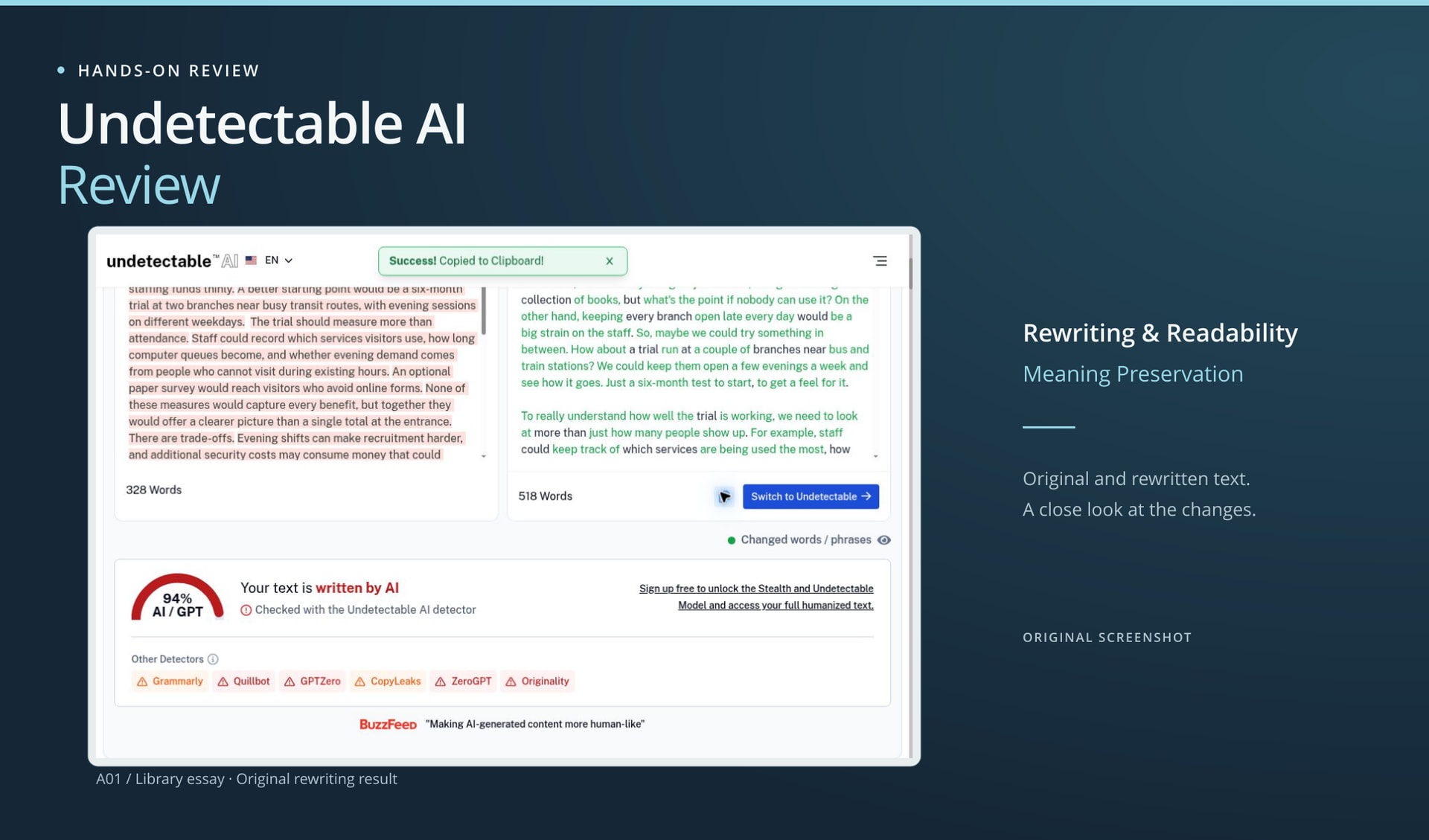
Undetectable AI’s Basic mode made the library essay sound more conversational, but it also made it much longer. A 328-word source became 518 words, with extra questions, repeated explanations and a few stronger claims than the original made.
| This run | Recorded result |
|---|---|
| Mode | Basic / General Writing; Undetectable toggle off |
| Input → output | 328 → 518 words |
| Undetectable AI’s own panel | 94% AI/GPT |
| Separate Clever AI Detector check | AI probability 82% |
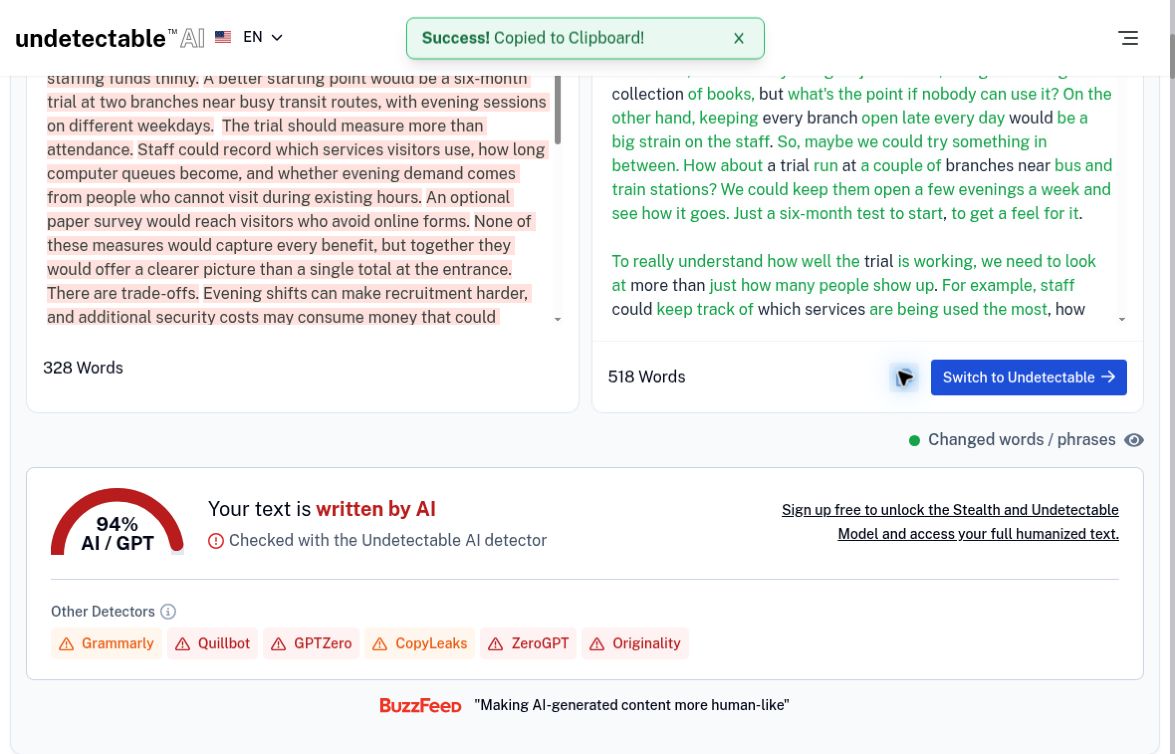
Actual completed output, with both word counts and Undetectable AI’s 94% AI/GPT panel. This is the Basic result, not a test of Stealth or the paid Undetectable setting.
A friendlier voice, at a cost
The source argues for a six-month evening-hours trial at two library branches. It deliberately keeps the claim modest: try a limited change, record who benefits, and don’t claim a new audience if existing visitors just come at a different time.
Undetectable AI kept much of that structure. The six-month duration survived, as did two branches, optional paper surveys, printer access, staffing difficulties and the security-versus-books trade-off. Those are important details to get right. You can still recognize the same proposal in the output.
The trouble is in the added emphasis. The source says that an early-closing branch may have “limited practical value.” The rewrite says it is “not really doing its job” and asks, “what’s the point if nobody can use it?” The original didn’t say nobody could use the library. Turning a qualified limitation into an absolute objection changes the argument.
There are smaller substitutions too. Branches near busy transit routes become branches near bus and train stations. Evening sessions on different weekdays become a few evenings a week. They might sound interchangeable in conversation, but someone planning the trial would be following different instructions.
This is also a useful reminder to check the kind of change requested. Asking for a conversational essay doesn’t also mean asking for a stronger argument, a different trial schedule or a new rule for choosing locations. Those choices still belong to the author.
Much of the 190-word expansion is rhetorical. The opening repeats the idea that people can spend time without buying anything, then explains again why that is valuable. “I mean” and several questions make the voice less formal. Whether that helps depends on the intended reader; it would need trimming for a short policy note.
Where the extra words go
It helps to check whether the extra words add information or just more explanation. The rewrite gives more room to the same three examples: the teenager, the job seeker and the older resident. It elaborates the atmosphere of the library as a place to “just be,” then returns to the absence of pressure to buy something. That can create an inviting opening for a general audience. It doesn’t add another reason to extend the opening hours, so under a tight word limit that repetition takes up useful space.
The trial paragraph expands in a similar way. “So, maybe we could try something in between” and “How about a trial run” lead into a proposal the source states directly. The output then gives the six-month duration its own sentence. It sounds more like someone talking through the idea, but you have to wait longer to reach the actual conditions. Part of judging a humanizer is asking whether its new rhythm fits the format you need. A public-facing explainer has different needs from a decision note with a strict length allowance.
The ending adds another explanation of how the library could demonstrate that it is serious about making a difference. The original already connects a specific, reviewable experiment to public trust. Repeating the idea adds emphasis, but it doesn’t make the evaluation plan any more precise. That’s why I wouldn’t call the longer version automatically more helpful or more human. The added material has to earn its place.
A practical edit pass on this output
I would start by restoring the restrained claim about opening hours. A library can have limited usefulness for people who work late while still serving other residents well. Keeping that distinction stops the rewrite from suggesting a fact the test source never gave. It also makes the argument more credible: the case for a pilot does not depend on pretending the current service has no users.
Next I would put “different weekdays” back into the trial design. “A few evenings a week” leaves the distribution across the two branches unclear. Likewise, transit routes and transit stations are related concepts, but a branch near a route need not be near a station. A rewrite shouldn’t quietly change the rule for choosing a site just because the new wording is familiar.
Then I would cut the second explanation of the no-purchase requirement, review the questions, and decide whether “I mean” fits the author’s voice. These are edits I’d suggest; they weren’t made before the detector check. The saved output and the measured 82% result still belong to the untouched text. Even changing a few sentences would leave us with a new version whose score hasn’t been measured here.
The last check would be the conclusion. The original explicitly names housing, childcare and healthcare to mark the limits of a library’s role. The rewrite generalizes this to not doing everything for everyone. That keeps the broad point but loses the specific examples of where the library’s role ends. If those examples were part of the brief, I would restore them rather than accept the shorter generalization just because it sounds smooth.
The score still favored AI
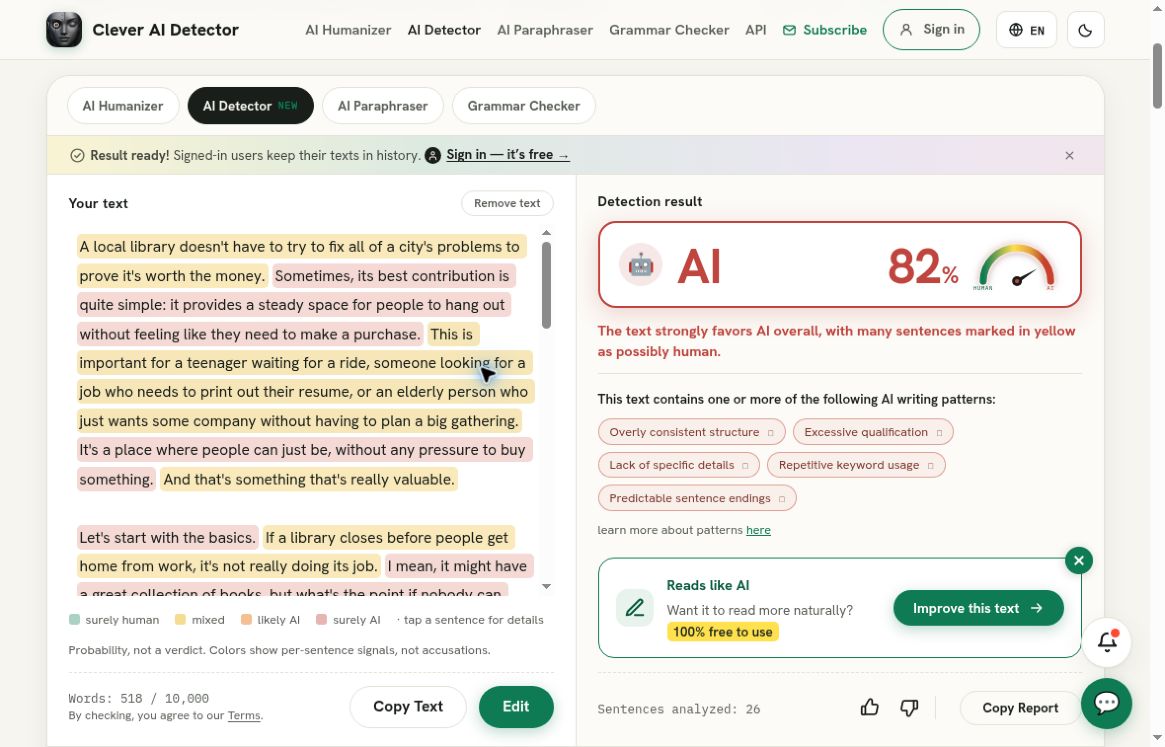
The exact 518-word output received AI probability 82% from Clever AI Detector.
The vendor’s 94% panel is its own result. The other detector names nearby don’t show that those services were independently tested here. Clever AI Detector provides a useful separate check on the actual returned text; its result also favored AI. Neither number proves authorship or tells us a universal bypass rate.
What the trial can and cannot answer
The public interface accepted the complete source without a login, and the returned Basic output was copied in full. There was an upsell to other modes, but those modes were not measured. This result from the available default can’t tell us whether a paid setting would rewrite more carefully, change the length or get a different detector reading.
There was also only one successful generated result in this comparison. That is enough to identify the exact overstatements and omissions in front of us. It can’t tell us how often those changes happen. Someone using different subject matter, a different source length or another register could get a different pattern of changes. The useful evidence here is the preserved text, not a made-up reliability percentage.
A same-input alternative, with its own editing problems
Clever AI Humanizer is worth trying as another draft-editing option. On the same full A01 input, its Normal-mode automatically selected first version returned 374 words. That’s much less expansion than this Basic output.
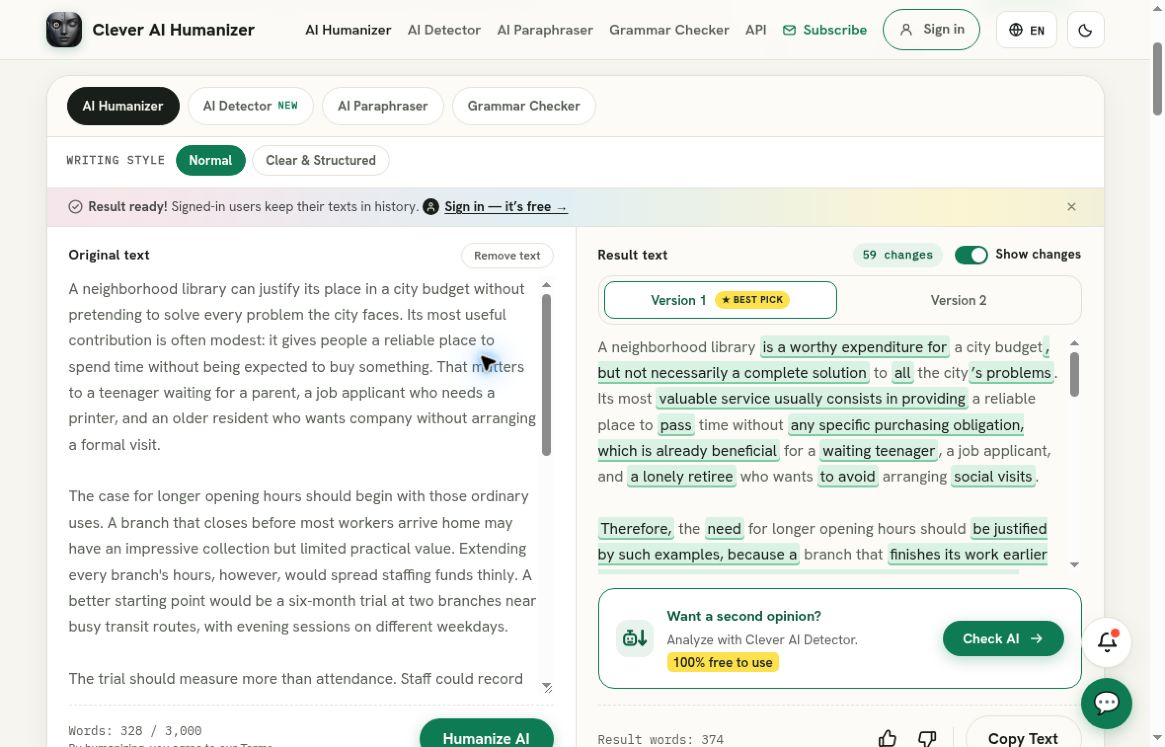
The same 328-word source in Clever AI Humanizer. Its selected output contains 374 words.
The score was lower, but there were still facts to fix. Clever AI Humanizer dropped the explicit six-month duration and changed the reason for a paper survey from avoiding online forms to declining electronic identification. Undetectable AI preserved the duration and original survey purpose more faithfully.
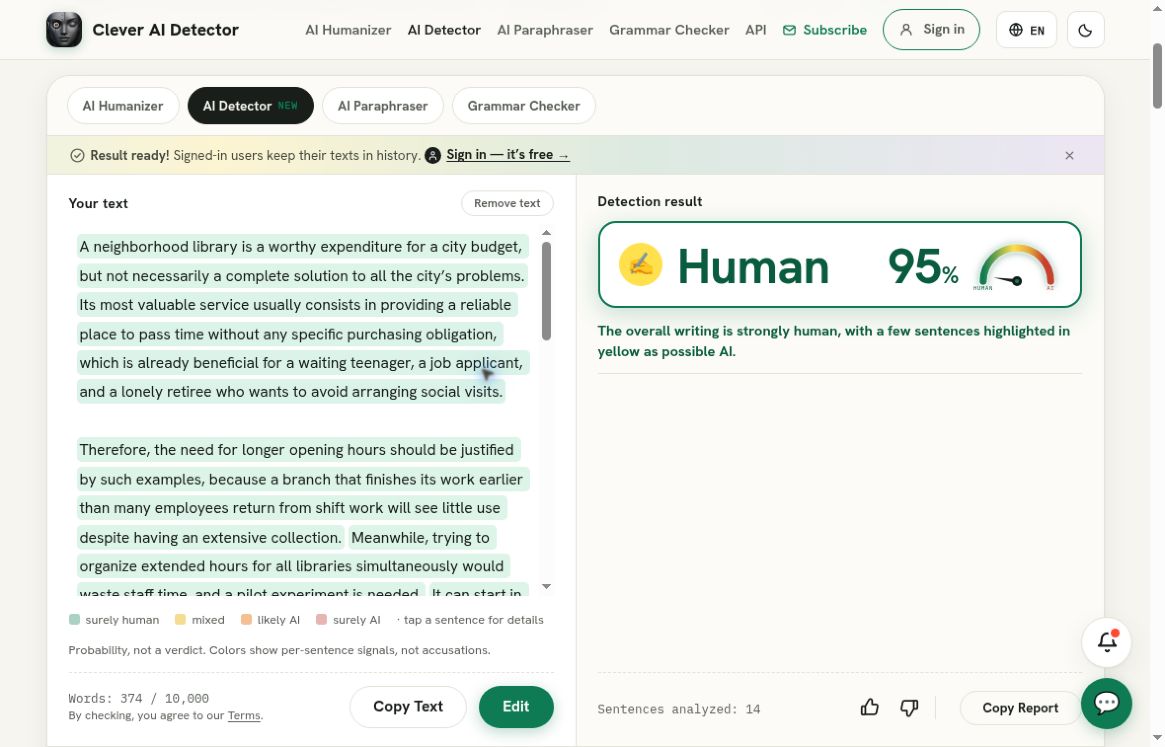
The unchanged Clever AI Humanizer output was labeled Human 95%, equivalent to AI probability 5%. It remains an AI-generated rewrite.
This was one successful guest generation per full-text example on 3 October 2026, with exact text below. There was no paid-tier test or attempt to tune settings until a favorable result appeared. My conclusion is fairly narrow: Basic can loosen the tone, but this output needs cuts and a meaning check before use. A lower score alone would not repair those issues.
A01: exact AI-generated input
A neighborhood library can justify its place in a city budget without pretending to solve every problem the city faces. Its most useful contribution is often modest: it gives people a reliable place to spend time without being expected to buy something. That matters to a teenager waiting for a parent, a job applicant who needs a printer, and an older resident who wants company without arranging a formal visit.

The case for longer opening hours should begin with those ordinary uses. A branch that closes before most workers arrive home may have an impressive collection but limited practical value. Extending every branch's hours, however, would spread staffing funds thinly. A better starting point would be a six-month trial at two branches near busy transit routes, with evening sessions on different weekdays.

The trial should measure more than attendance. Staff could record which services visitors use, how long computer queues become, and whether evening demand comes from people who cannot visit during existing hours. An optional paper survey would reach visitors who avoid online forms. None of these measures would capture every benefit, but together they would offer a clearer picture than a single total at the entrance.

There are trade-offs. Evening shifts can make recruitment harder, and additional security costs may consume money that could otherwise support books or children's activities. The proposal therefore needs a published budget and a review date. If the experiment mainly shifts existing visits into a more convenient time slot, that convenience still has value, but it should not be described as reaching an entirely new audience.

Public services gain trust when their promises are specific enough to test. A library does not need to become a substitute for housing, childcare, or healthcare to deserve support. It needs to identify a practical gap, try a proportionate response, and explain honestly what happened. Longer opening hours could meet that standard if the city treats them as a service experiment rather than a slogan.
Undetectable AI: complete unchanged output
A local library doesn't have to try to fix all of a city's problems to prove it's worth the money. Sometimes, its best contribution is quite simple: it provides a steady space for people to hang out without feeling like they need to make a purchase. This is important for a teenager waiting for a ride, someone looking for a job who needs to print out their resume, or an elderly person who just wants some company without having to plan a big gathering. It's a place where people can just be, without any pressure to buy something. And that's something that's really valuable.

Let's start with the basics. If a library closes before people get home from work, it's not really doing its job. I mean, it might have a great collection of books, but what's the point if nobody can use it? On the other hand, keeping every branch open late every day would be a big strain on the staff. So, maybe we could try something in between. How about a trial run at a couple of branches near bus and train stations? We could keep them open a few evenings a week and see how it goes. Just a six-month test to start, to get a feel for it.

To really understand how well the trial is working, we need to look at more than just how many people show up. For example, staff could keep track of which services are being used the most, how long people have to wait for computers, and whether people are coming in the evenings because they can't make it during regular hours. We could also give visitors the option to fill out a paper survey, which would help us reach people who don't like filling out online forms. None of these things would give us a complete picture, but together they would give us a much better idea of what's working and what's not, rather than just counting how many people come through the door.

There are downsides to consider. For one, having evening shifts can make it tougher to find new staff, and the extra cost of security could eat into funds that could be better spent on things like books or kids' events. So, it's crucial that the plan includes a clear budget and a deadline for review. If the main result of the experiment is just moving existing visitors to a more convenient time, then that's still a plus, but let's not pretend it's bringing in a whole new crowd.

People trust public services when they make promises that can be checked. A library doesn't have to do everything for everyone to be worth supporting. It just needs to find a real problem, try to fix it in a sensible way, and be honest about how it goes. For example, staying open longer could be a good idea if the city tries it out as a test, rather than just talking about it. This way, the library can show that it's serious about making a difference, and people can see if it's really working.
Clever AI Humanizer: complete unchanged output from the same A01 input
A neighborhood library is a worthy expenditure for a city budget, but not necessarily a complete solution to all the city’s problems. Its most valuable service usually consists in providing a reliable place to pass time without any specific purchasing obligation, which is already beneficial for a waiting teenager, a job applicant, and a lonely retiree who wants to avoid arranging social visits.

Therefore, the need for longer opening hours should be justified by such examples, because a branch that finishes its work earlier than many employees return from shift work will see little use despite having an extensive collection. Meanwhile, trying to organize extended hours for all libraries simultaneously would waste staff time, and a pilot experiment is needed. It can start in two convenient branches for public transport users, with evening sessions on different weekdays.

The experiment’s effectiveness can be measured not only by the number of visitors but also by the staff’s observations of what requests are made, how long visitors stay within the queue for a computer workstation, and whether evening openings compensate for the lack of daytime opportunities. The staff could also distribute printed questionnaires to those who decline to identify themselves electronically. This information will not be fully accurate, but it will provide a more practical understanding of the branch’s importance than the number of people who signed in.

The proposed plan has disadvantages, including possible shifts in staffing policy and the opportunity cost of spending money on security rather than books or children’s events. Therefore, the library should publish the experiment’s budget and timeline for revision. Even if extended hours only divert daytime visitors to evening hours, such a result is still worth discussing, although it cannot be said that the library serves a new population. For public services, it is essential to design their limitations clearly to understand the value they bring to the community.

A library does not have to be a universal solution to residents’ problems, but it should experimentally demonstrate what specific need is addressed and what results can be achieved without budgetary inefficiency. Extended opening hours can be such a solution, but the city should treat this hypothesis with caution and revise it no later than the end of the pilot experiment.