Walter Writes AI gave the library essay a fairly light copyedit. It cut 37 words, kept the important trial conditions, and introduced little that needed repairing. Its built-in “Reads as human” result was much less convincing once the unchanged output was checked elsewhere.
The short version:
- Walter Lite: 328 words in, 291 words out
- Walter’s own checker: AI Score 10%, “Reads as human”
- Clever AI Detector on that output: AI probability 94%
- Best feature in this example: preservation of the brief
- Main limitation: the favorable built-in score did not carry across to the separate check
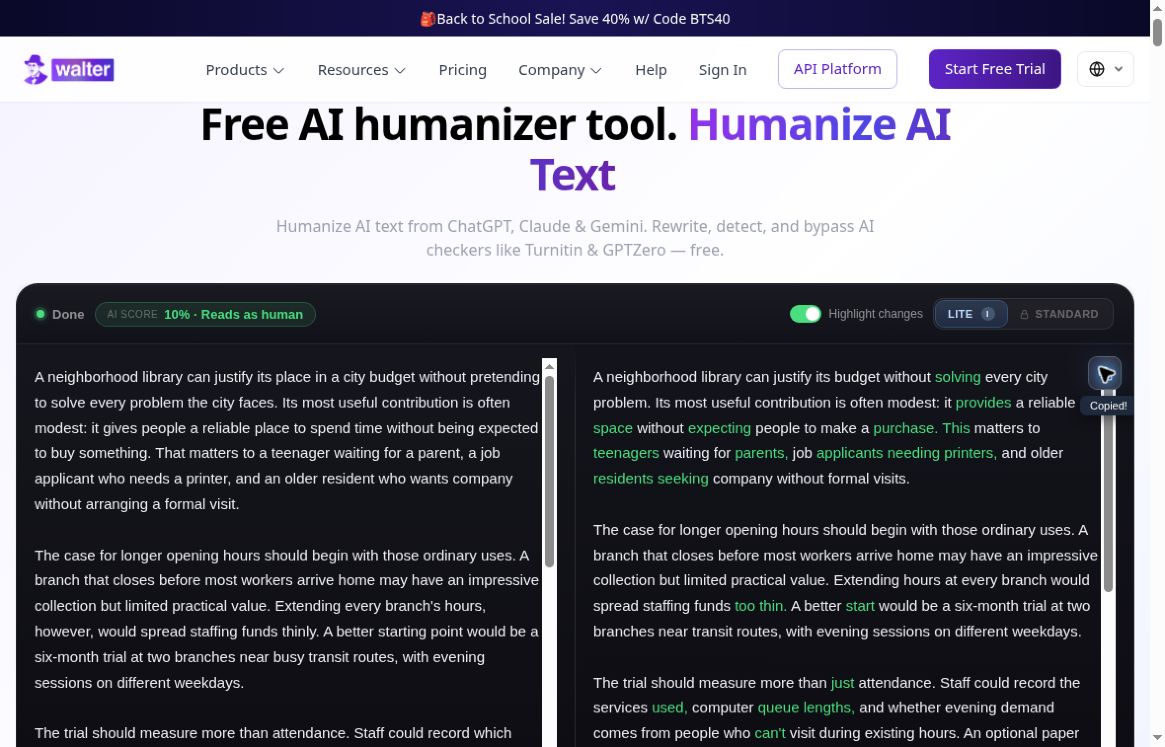
The actual Walter Lite result on 3 October 2026. The 10% AI score is Walter’s own display.
What survived the edit
The original A01 essay proposes a six-month trial at two library branches near busy transit routes, with evening sessions on different weekdays. Walter retained the duration, number of branches and weekday arrangement. It also kept the optional paper survey for visitors who prefer not to use online forms.
That last detail is easy to overlook. The source has a reason for using paper: it reaches visitors who would otherwise be missed. Walter’s revision preserved the purpose as well as the object.
The staffing and security trade-offs also remained. So did the published budget, review date, and warning that moving existing visits to a convenient time must not be presented as reaching a new audience. The closing examples of housing, childcare and healthcare survived too.
There were small losses. “Busy” disappeared from the description of transit routes, and justifying a place in a city budget became justifying a budget. Those changes are worth catching, but they don’t undo the proposal. Much of the wording stays close to the original, which is a reasonable choice when the source is already clear.
Concision without much change of voice
Walter’s opening is a good illustration of its approach. “A neighborhood library can justify its budget without solving every city problem” compresses a longer original sentence without adding a story, a personal reaction or a rhetorical question. The following examples are shortened in much the same way: the job applicant still needs a printer, and the older resident still wants company without arranging a formal visit. The output uses fewer words, but the practical reasons for a shared public space still come through.
The measurement paragraph stays close to the source too. “Which services visitors use” becomes “the services used,” and computer queues become computer queue lengths. These edits tighten the wording without trying to make the proposal a different kind of document. The essay still reads as a measured argument for a limited public-service experiment. That consistency helps when the author wants a light edit and hasn’t asked for a new conversational voice.
The cuts still need checking. The reference to busy transit routes loses the “busy” qualification, which might matter if branch selection depends on how many people can reach them. The output also uses “public services gain trust when they make testable promises,” a tighter version of the original formulation. It’s a reasonable summary, but it shows why an editor needs to check the small qualifiers and the main reasoning, even where changes aren’t highlighted.
I wouldn’t say staying close to the source is always better. If you wanted a big change in tone, this result might not go far enough. In this particular library proposal, though, the source already had a clear structure and concrete safeguards. There was little benefit to inventing a new speaker or replacing careful qualifications with more dramatic language.
Two checkers disagreed sharply
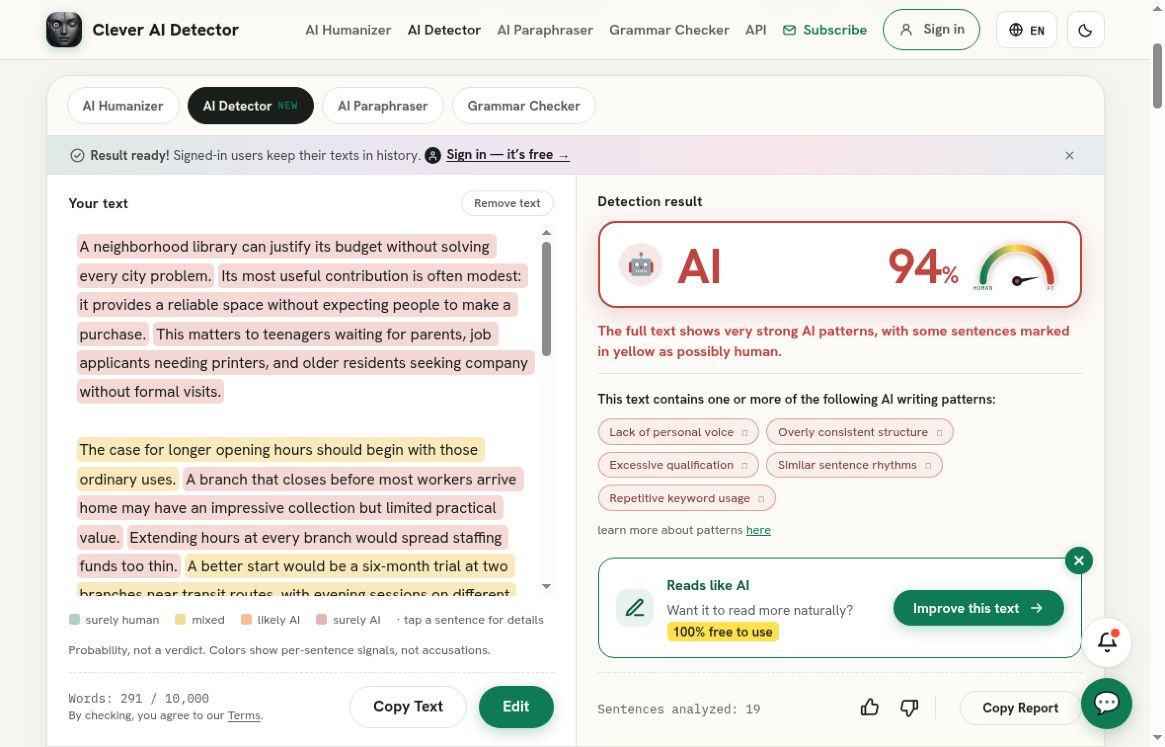
The complete 291-word output received AI probability 94% from Clever AI Detector.
I would use Clever AI Detector as a second reading rather than treating Walter’s badge as a guarantee. In this run the two displays pointed in opposite directions. They are estimates from different systems, not votes that establish who wrote the text. The rewrite still has AI provenance regardless of either label.
This was the anonymous Lite demo. The full 328-word input was accepted, despite nearby marketing mentioning a 300-word free trial. That doesn’t mean the same allowance will always be available. Standard required a free account and was not tested, so the result should not be generalized to it.
Why the detector result does not settle quality
The 94% separate AI reading might look like a decisive failure if the only question is whether one detector calls the text AI-like. It’s much less help when you’re choosing a draft you can actually use. The details that make Walter’s output useful here are visible in the wording: a defined trial, a method for gathering feedback, and a limit on what the results would justify claiming. The headline probability doesn’t measure any of those strengths.
The reverse also matters. The built-in 10% AI score does not certify that the wording is correct, original, appropriate for a particular institution, or written by a human. The source was generated for this test and the output was generated by Walter. A different checker label doesn’t change how the text was made. Any disclosure or citation requirements would have to be handled according to the actual writing process.
It’s more useful to show both readings than to average them. These are different systems with different judgments about the same returned text. The review does not establish which system is more accurate overall, nor whether either score is calibrated as a real-world probability for this kind of document. It does show a disagreement worth knowing about before you rely on the vendor’s badge.
What I would check before using the draft
Before using this draft, I would check four things:
- Restore the transit-route qualifier if it was intentional.
- Verify that the budget and review date will actually be supplied in the surrounding document.
- Keep the paper-survey explanation and the new-audience caveat.
- Read the draft in context to see whether the compressed opening fits the intended audience.
Those are suggested edits; none was quietly applied during measurement. The complete output below is unchanged, and it is that version that received 94% from the separate detector. No paid features, alternative tones or repeated generations were used to seek another result. That gives us a limited but useful look at Lite: one complete example of what it kept, what it shortened, and what its own score didn’t predict.
The comparison that matters to an editor
The same A01 source also went through Clever AI Humanizer in Normal mode, using its automatically selected first version. It returned 374 words and is a reasonable alternative to try when a different phrasing is useful.
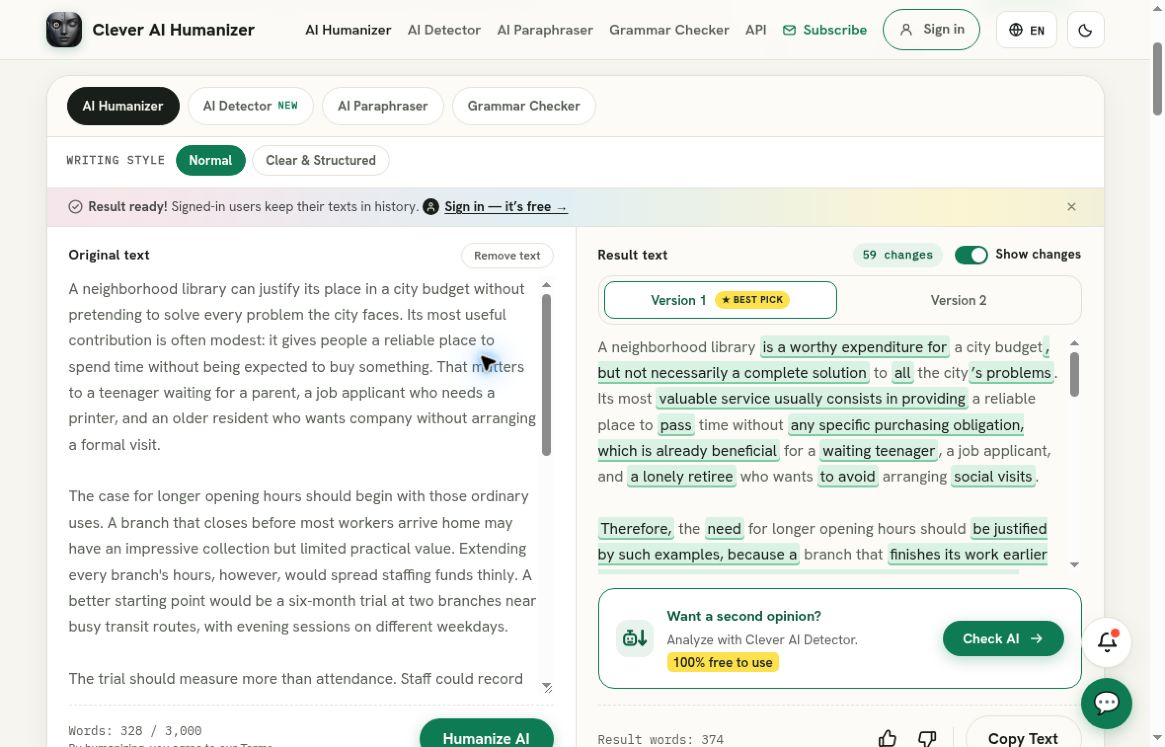
Same source, different rewrite: Clever AI Humanizer’s 374-word result.
On fidelity, Walter did better in this particular comparison. Clever AI Humanizer dropped the six-month duration and changed the paper-survey rationale to people declining electronic identification. Walter retained both points substantially as written. For this task, that difference tells us more than choosing a winner by detector percentage.
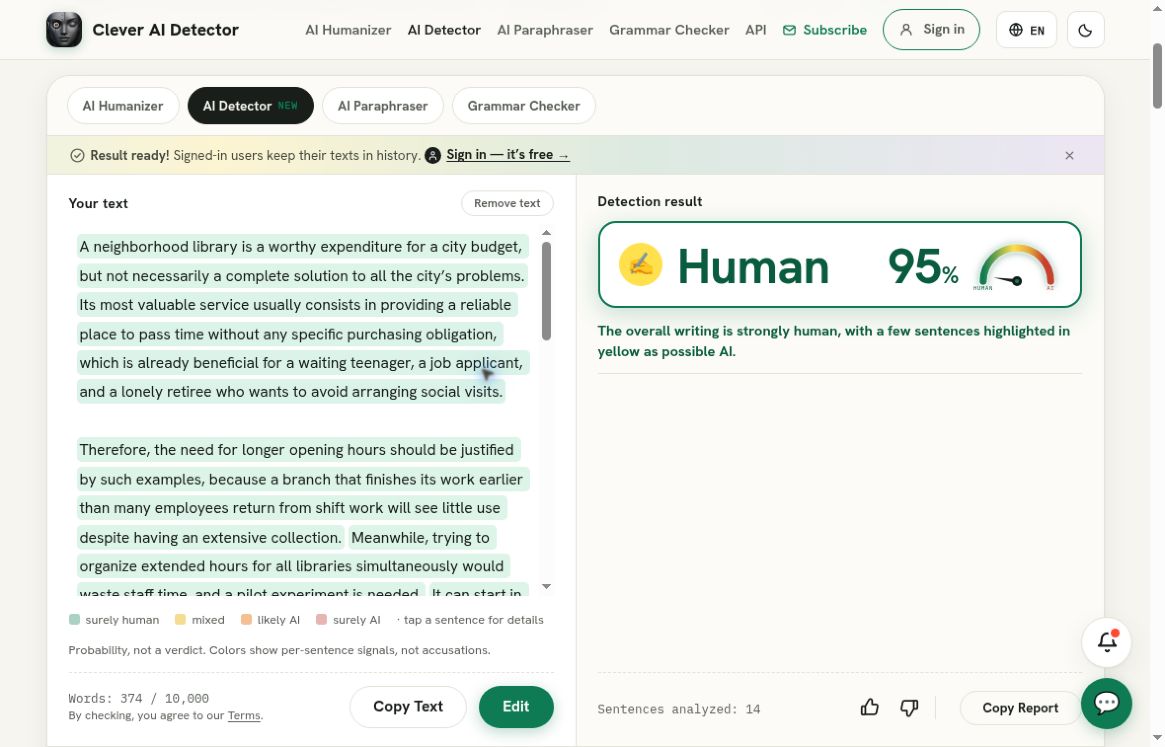
Clever AI Humanizer’s unchanged output received Human 95%, equivalent to AI probability 5%, from Clever AI Detector.
The lower score belongs beside those meaning changes. It doesn’t cancel them out. Both full-text rewrites were tested on 3 October 2026; this is a one-example qualitative comparison, not a general ranking.
If I were preparing this library proposal for circulation, Walter’s conservative output would be the easier starting point of these two, followed by a final check against the original. If your priority is rewriting more extensively, Clever AI Humanizer gives another draft to inspect. In either case, I would keep the dates, survey purpose and caveats on a checklist rather than letting the score choose the final text.
A01: exact AI-generated input
A neighborhood library can justify its place in a city budget without pretending to solve every problem the city faces. Its most useful contribution is often modest: it gives people a reliable place to spend time without being expected to buy something. That matters to a teenager waiting for a parent, a job applicant who needs a printer, and an older resident who wants company without arranging a formal visit.

The case for longer opening hours should begin with those ordinary uses. A branch that closes before most workers arrive home may have an impressive collection but limited practical value. Extending every branch's hours, however, would spread staffing funds thinly. A better starting point would be a six-month trial at two branches near busy transit routes, with evening sessions on different weekdays.

The trial should measure more than attendance. Staff could record which services visitors use, how long computer queues become, and whether evening demand comes from people who cannot visit during existing hours. An optional paper survey would reach visitors who avoid online forms. None of these measures would capture every benefit, but together they would offer a clearer picture than a single total at the entrance.

There are trade-offs. Evening shifts can make recruitment harder, and additional security costs may consume money that could otherwise support books or children's activities. The proposal therefore needs a published budget and a review date. If the experiment mainly shifts existing visits into a more convenient time slot, that convenience still has value, but it should not be described as reaching an entirely new audience.

Public services gain trust when their promises are specific enough to test. A library does not need to become a substitute for housing, childcare, or healthcare to deserve support. It needs to identify a practical gap, try a proportionate response, and explain honestly what happened. Longer opening hours could meet that standard if the city treats them as a service experiment rather than a slogan.
Walter Writes AI: complete unchanged output
A neighborhood library can justify its budget without solving every city problem. Its most useful contribution is often modest: it provides a reliable space without expecting people to make a purchase. This matters to teenagers waiting for parents, job applicants needing printers, and older residents seeking company without formal visits.

The case for longer opening hours should begin with those ordinary uses. A branch that closes before most workers arrive home may have an impressive collection but limited practical value. Extending hours at every branch would spread staffing funds too thin. A better start would be a six-month trial at two branches near transit routes, with evening sessions on different weekdays.

The trial should measure more than just attendance. Staff could record the services used, computer queue lengths, and whether evening demand comes from people who can't visit during existing hours. An optional paper survey would reach visitors who prefer not to use online forms. None of these measures would capture every benefit, but together they would offer a clearer picture than a single total at the entrance.

Trade-offs exist. Evening shifts can make recruitment harder; more security costs may consume funds that could support books or children's activities. The proposal needs a published budget and a review date. If the experiment mainly shifts existing visits into a more convenient time slot, that convenience still has value, but it shouldn't be described as reaching an entirely new audience.

Public services gain trust when they make testable promises. A library doesn't need to replace housing, childcare, or healthcare to deserve support. It needs to identify a practical gap, respond proportionally, and explain what happened honestly. Longer hours could meet that standard if the city treats them as an experiment, not a slogan.
Clever AI Humanizer: complete unchanged output from the same A01 input
A neighborhood library is a worthy expenditure for a city budget, but not necessarily a complete solution to all the city’s problems. Its most valuable service usually consists in providing a reliable place to pass time without any specific purchasing obligation, which is already beneficial for a waiting teenager, a job applicant, and a lonely retiree who wants to avoid arranging social visits.

Therefore, the need for longer opening hours should be justified by such examples, because a branch that finishes its work earlier than many employees return from shift work will see little use despite having an extensive collection. Meanwhile, trying to organize extended hours for all libraries simultaneously would waste staff time, and a pilot experiment is needed. It can start in two convenient branches for public transport users, with evening sessions on different weekdays.

The experiment’s effectiveness can be measured not only by the number of visitors but also by the staff’s observations of what requests are made, how long visitors stay within the queue for a computer workstation, and whether evening openings compensate for the lack of daytime opportunities. The staff could also distribute printed questionnaires to those who decline to identify themselves electronically. This information will not be fully accurate, but it will provide a more practical understanding of the branch’s importance than the number of people who signed in.

The proposed plan has disadvantages, including possible shifts in staffing policy and the opportunity cost of spending money on security rather than books or children’s events. Therefore, the library should publish the experiment’s budget and timeline for revision. Even if extended hours only divert daytime visitors to evening hours, such a result is still worth discussing, although it cannot be said that the library serves a new population. For public services, it is essential to design their limitations clearly to understand the value they bring to the community.

A library does not have to be a universal solution to residents’ problems, but it should experimentally demonstrate what specific need is addressed and what results can be achieved without budgetary inefficiency. Extended opening hours can be such a solution, but the city should treat this hypothesis with caution and revise it no later than the end of the pilot experiment.