Three scans a month, no free humanizations, and registration before the first test: that was AI Detector Pro’s advertised free route. It could suit a small, planned trial. This review inspected the pricing and signup screens without creating an account, so it evaluates that offer rather than the detector’s accuracy.
Read the free plan as a set of separate promises
The pricing screen inspected on 3 October 2026 listed three AI scans per month and zero humanizations per month for the free plan. It also listed a pinpoint editor, tone analysis and phraseology. These are visible plan descriptions, not features this review verified by using a logged-in account. They tell us what’s in the advertised package, but we haven’t measured the experience of using them.
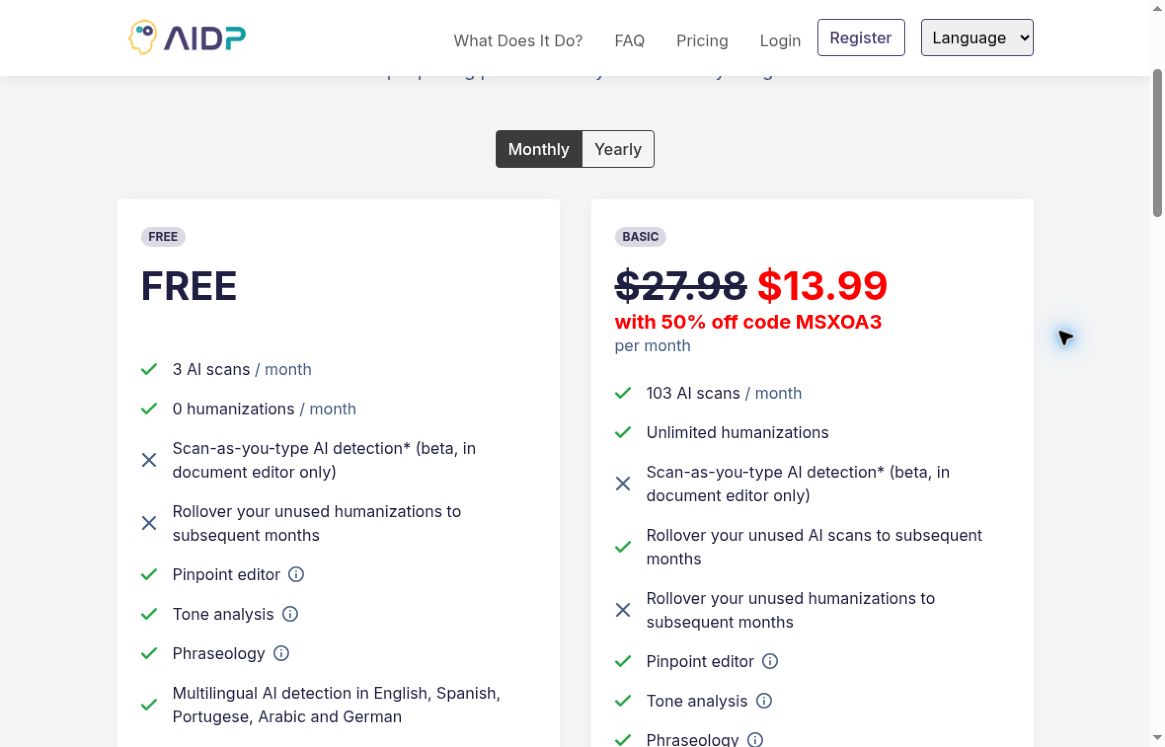
AI Detector Pro’s public free-plan description, including three monthly AI scans and zero monthly humanizations.
The registration page stated that signup was free and that no credit card was necessary. That matters. We shouldn’t call registration a payment demand when the screen says otherwise. No card, purchase or subscription was tested here. The limit here is that no account was created for the review, so the advertised allowance couldn’t be used.
There’s still some effort involved, even when it’s free. A first-time visitor must complete setup before learning whether the product’s result format, explanations and workflow meet their needs. Three scans may be enough for a quick personal trial, but it leaves little room for a broad evaluation with generated examples, human controls and ordinary retries. That’s a comment on the advertised count; the quota wasn’t used up in this session.
The free plan does not include a rewrite trial
The zero-humanizations entry matters if you want to detect and edit in the same workflow. On the inspected pricing page, the free plan did not offer monthly humanizations. That doesn’t tell us how good the paid rewriting is. It does mean we can’t present the visible free package as a tested no-cost way to do both.
A detector reading can be a reason to look more closely at the text, but it shouldn’t automatically mean you need to rewrite it. If the draft is the writer’s own, an AI-related score does not identify which sentences are inaccurate or unclear. If AI helped create the draft, a change in style doesn’t change that history. The useful editing goal is to make the text clearer and more faithful to its intended meaning, with disclosures appropriate to the setting.
Before registering, answer the actual workflow question
If the task is to check one passage and leave, an account requirement is a noticeable interruption. If the task is to build a recurring editing routine, the same requirement may be acceptable. The review does not assign the same value to both situations. It’s worth deciding which situation you’re in before spending time on setup.
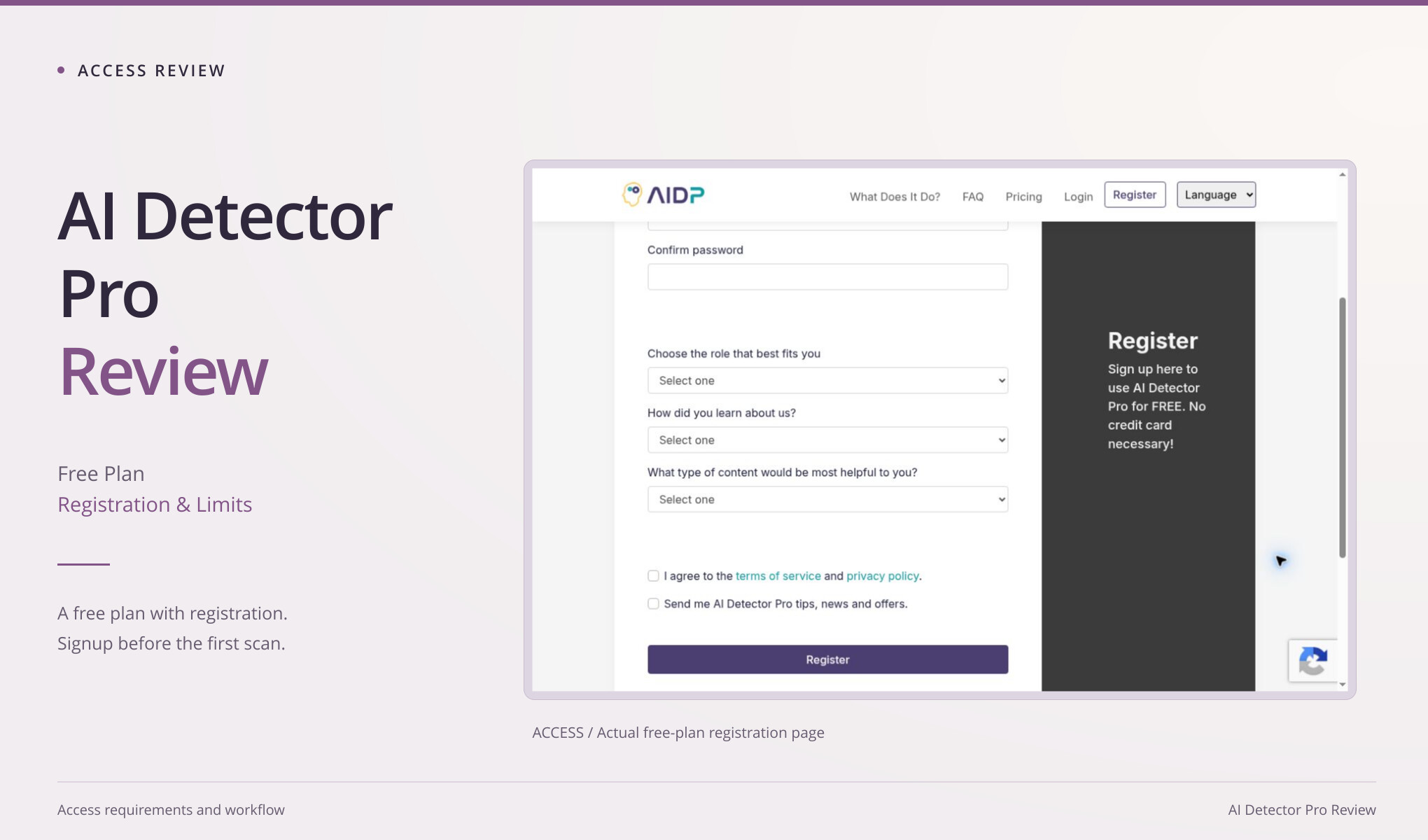
The registration form displayed fields and choices beyond the immediate detector task, including a role selection, how the visitor learned about the service and a question about useful content. It also showed a terms-and-privacy agreement and a separate tips, news and offers checkbox. That’s more involved than pasting text into a scanner. The screenshot is evidence of that interface; it does not establish which choices are mandatory after submission because no registration was completed.
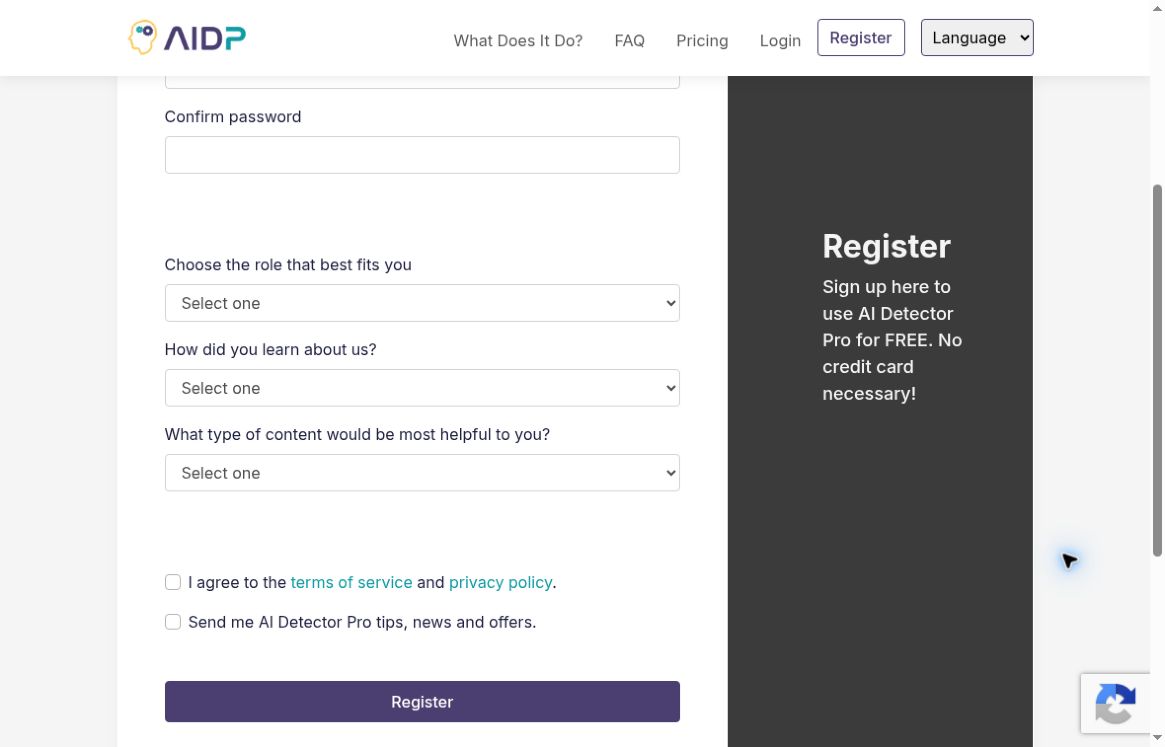
The observed registration route. No account was created, so the free scan allowance was not exercised.
Separating the marketing subscription choice from the agreement is a helpful design detail. The bigger issue is how much setup comes before you can inspect an example. A short preview scan could help a visitor see what the product offers before answering profile questions. That is an editorial preference about the guest experience, rather than a claim that the service must abandon accounts or that its registered workflow is poor.
A three-scan allowance calls for a deliberate trial
If you choose to register, plan what you want those scans to tell you. Scanning three similar generated paragraphs might produce impressive-looking numbers without telling you much about the risk of false accusations. A more useful small trial would reserve room for clearly sourced human writing and a generated passage relevant to the user’s actual work.
The input should be saved before the result is viewed. Its origin, length and language should be recorded, and the product’s own result label should stay attached to the number. A probability, a fraction of text and a confidence score are different quantities. Treating them as the same thing makes a comparison look simpler, but less meaningful.
There is also a practical question about unsuccessful attempts. Does an error consume an allowance? Can a report be reopened without spending another scan? Does editing the input start a new analysis? Those are useful things to verify in an account-based follow-up, but they were not established here. The visible three-scan description doesn’t answer those questions, so this review leaves them open.
A comparison with fewer untested steps
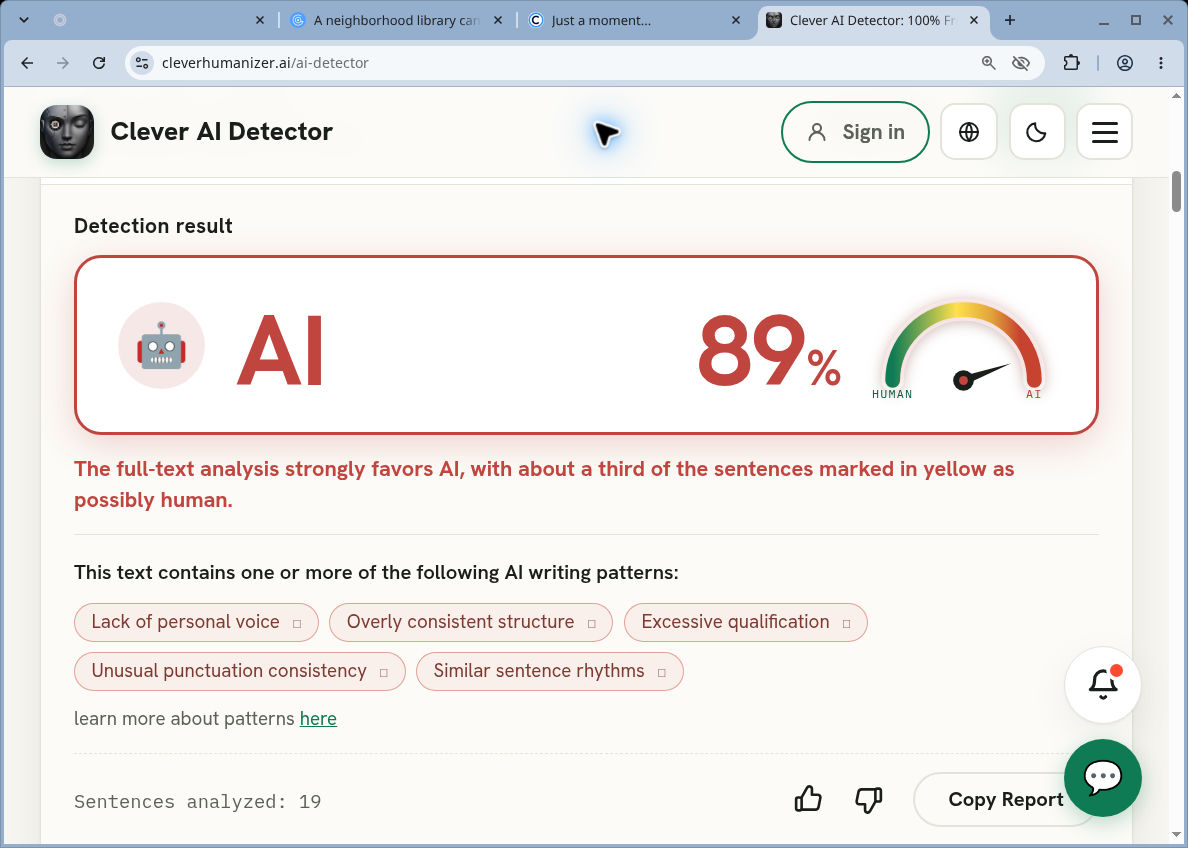
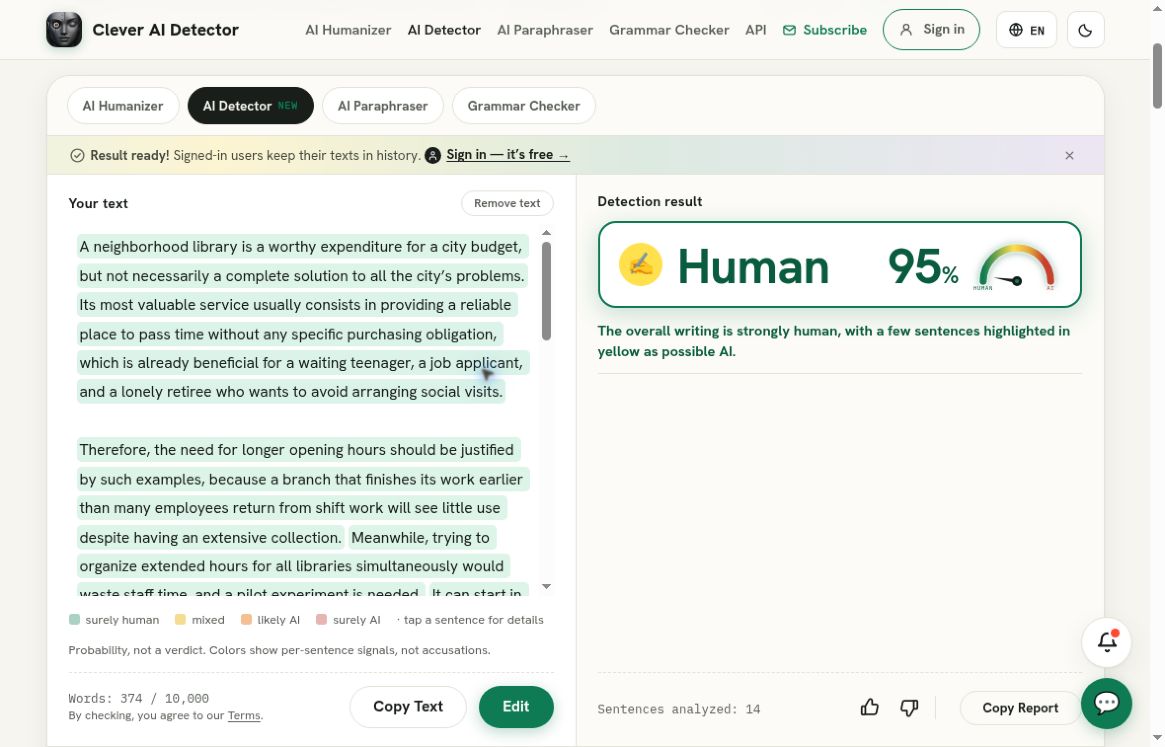
Clever AI Detector returned a readable AI probability of 89% for the unchanged 328-word library essay in the separate 2 October baseline. That provides an inspectable result for a first-time evaluation. It is an access advantage in this record, not proof that Clever AI Detector is more accurate than AI Detector Pro, whose classifier was not measured.
Clever AI Humanizer also completed that full essay anonymously on 3 October, returning 374 words. Its observed interface allowed up to 3,000 words per request. A writer could therefore inspect an actual combined editing-and-checking example without first purchasing a rewrite allowance in this tested flow. That doesn’t mean all future requests, features or plans are unrestricted.
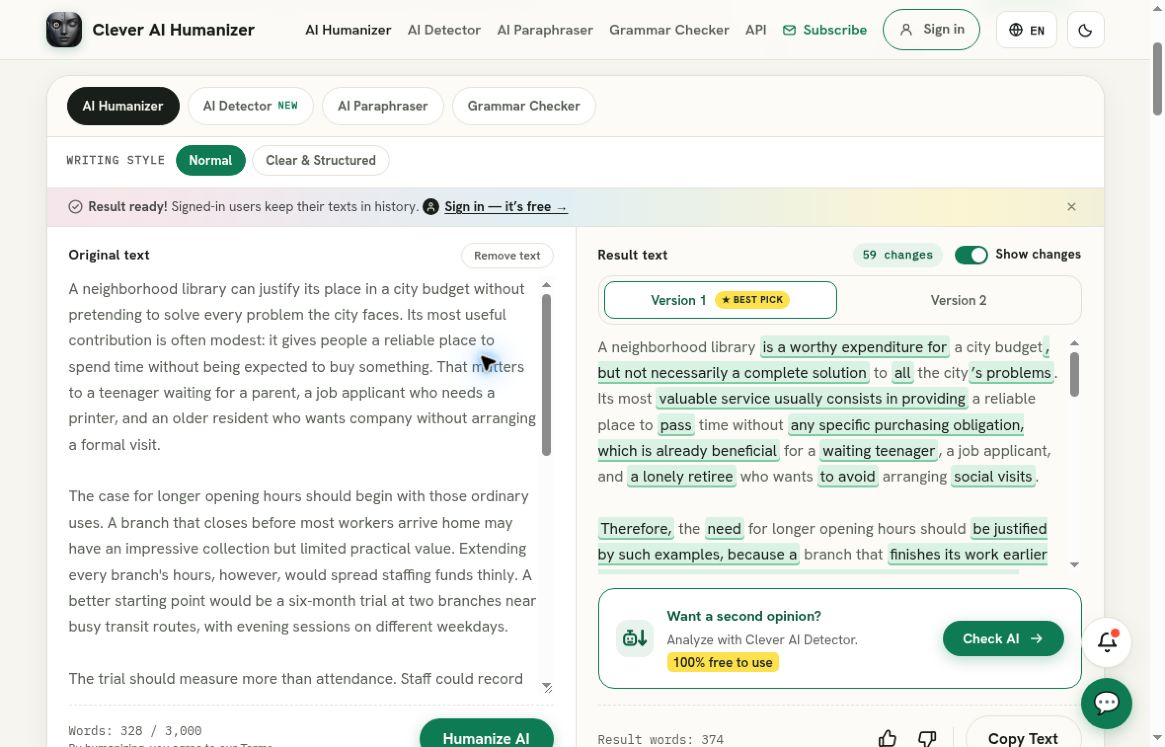
The example needs a careful reading. The revised essay dropped the six-month trial duration and changed an older resident into a lonely retiree. It also altered the reason for providing a paper survey. Those changes are why even a convenient rewrite needs to be treated as a draft. Smooth wording and a better detector result don’t excuse a change in meaning.
The complete Clever AI Humanizer output received 5% AI probability, shown as Human 95%, from Clever AI Detector. That number is a separate observation, not an AI Detector Pro score. The short garden-planning request failed to generate output through the initial attempt and two recoveries, so the recommendation includes a real reliability caveat. Preserve the original and be prepared to revise manually if the tool fails or changes the substance.
The decision before the account
AI Detector Pro’s public offer is clearer than a vague promise of unlimited free use: the inspected page specified three monthly scans and no monthly humanizations. The registration requirement is the trade-off. A user comfortable with an account may find that a reasonable way to explore the product, while a guest seeking an immediate result cannot complete the same evaluation on the recorded route.
A fair future review would exercise the actual free allowance, document the controls and distinguish interface features from tested behavior. Until then, we can’t fairly rank accuracy here. For immediate inspection, the recorded Clever AI Detector and Clever AI Humanizer examples offer a practical starting point, provided the writer reviews meaning and keeps detector scores in their limited role. AI Detector Pro still needs to be tried through an account on the terms it advertises. A registration screen doesn’t disprove the service.
Comparison text: original library essay A01
This is the unchanged 328-word AI-generated source used for the separate Clever AI Detector and Clever AI Humanizer comparison. Its origin was known before the tests. Where a reviewed service did not receive it, the main review states that limitation.
A neighborhood library can justify its place in a city budget without pretending to solve every problem the city faces. Its most useful contribution is often modest: it gives people a reliable place to spend time without being expected to buy something. That matters to a teenager waiting for a parent, a job applicant who needs a printer, and an older resident who wants company without arranging a formal visit.

The case for longer opening hours should begin with those ordinary uses. A branch that closes before most workers arrive home may have an impressive collection but limited practical value. Extending every branch's hours, however, would spread staffing funds thinly. A better starting point would be a six-month trial at two branches near busy transit routes, with evening sessions on different weekdays.

The trial should measure more than attendance. Staff could record which services visitors use, how long computer queues become, and whether evening demand comes from people who cannot visit during existing hours. An optional paper survey would reach visitors who avoid online forms. None of these measures would capture every benefit, but together they would offer a clearer picture than a single total at the entrance.

There are trade-offs. Evening shifts can make recruitment harder, and additional security costs may consume money that could otherwise support books or children's activities. The proposal therefore needs a published budget and a review date. If the experiment mainly shifts existing visits into a more convenient time slot, that convenience still has value, but it should not be described as reaching an entirely new audience.

Public services gain trust when their promises are specific enough to test. A library does not need to become a substitute for housing, childcare, or healthcare to deserve support. It needs to identify a practical gap, try a proportionate response, and explain honestly what happened. Longer opening hours could meet that standard if the city treats them as a service experiment rather than a slogan.
Comparison text: complete Clever AI Humanizer A01 output
This is the unchanged 374-word output from the separate 3 October 2026 run. It retains AI provenance despite the low detector reading.
A neighborhood library is a worthy expenditure for a city budget, but not necessarily a complete solution to all the city’s problems. Its most valuable service usually consists in providing a reliable place to pass time without any specific purchasing obligation, which is already beneficial for a waiting teenager, a job applicant, and a lonely retiree who wants to avoid arranging social visits.

Therefore, the need for longer opening hours should be justified by such examples, because a branch that finishes its work earlier than many employees return from shift work will see little use despite having an extensive collection. Meanwhile, trying to organize extended hours for all libraries simultaneously would waste staff time, and a pilot experiment is needed. It can start in two convenient branches for public transport users, with evening sessions on different weekdays.

The experiment’s effectiveness can be measured not only by the number of visitors but also by the staff’s observations of what requests are made, how long visitors stay within the queue for a computer workstation, and whether evening openings compensate for the lack of daytime opportunities. The staff could also distribute printed questionnaires to those who decline to identify themselves electronically. This information will not be fully accurate, but it will provide a more practical understanding of the branch’s importance than the number of people who signed in.

The proposed plan has disadvantages, including possible shifts in staffing policy and the opportunity cost of spending money on security rather than books or children’s events. Therefore, the library should publish the experiment’s budget and timeline for revision. Even if extended hours only divert daytime visitors to evening hours, such a result is still worth discussing, although it cannot be said that the library serves a new population. For public services, it is essential to design their limitations clearly to understand the value they bring to the community.

A library does not have to be a universal solution to residents’ problems, but it should experimentally demonstrate what specific need is addressed and what results can be achieved without budgetary inefficiency. Extended opening hours can be such a solution, but the city should treat this hypothesis with caution and revise it no later than the end of the pilot experiment.