AIHumanize.io Review: The Averages I Measured Look Fine. The Distribution I Found Will Get You Expelled.
Reviewed: July 3, 2026 · Tool: AIHumanize.io, Basic / Balance / General mode · Part of my 11-tool humanizer benchmark
My methodology: I ran 20 identical text pairs through each tool. I tested detection with GPTZero, ZeroGPT, and Originality.ai (% = AI probability, lower is better). I scored writing quality 0–20 using three LLM judges (Claude Opus 4.8, Gemini 3.1 Pro, GPT-5.5). “Strict pass” = beat all detectors, “Either” = beat at least one. I reviewed each tool on the date shown in its post.
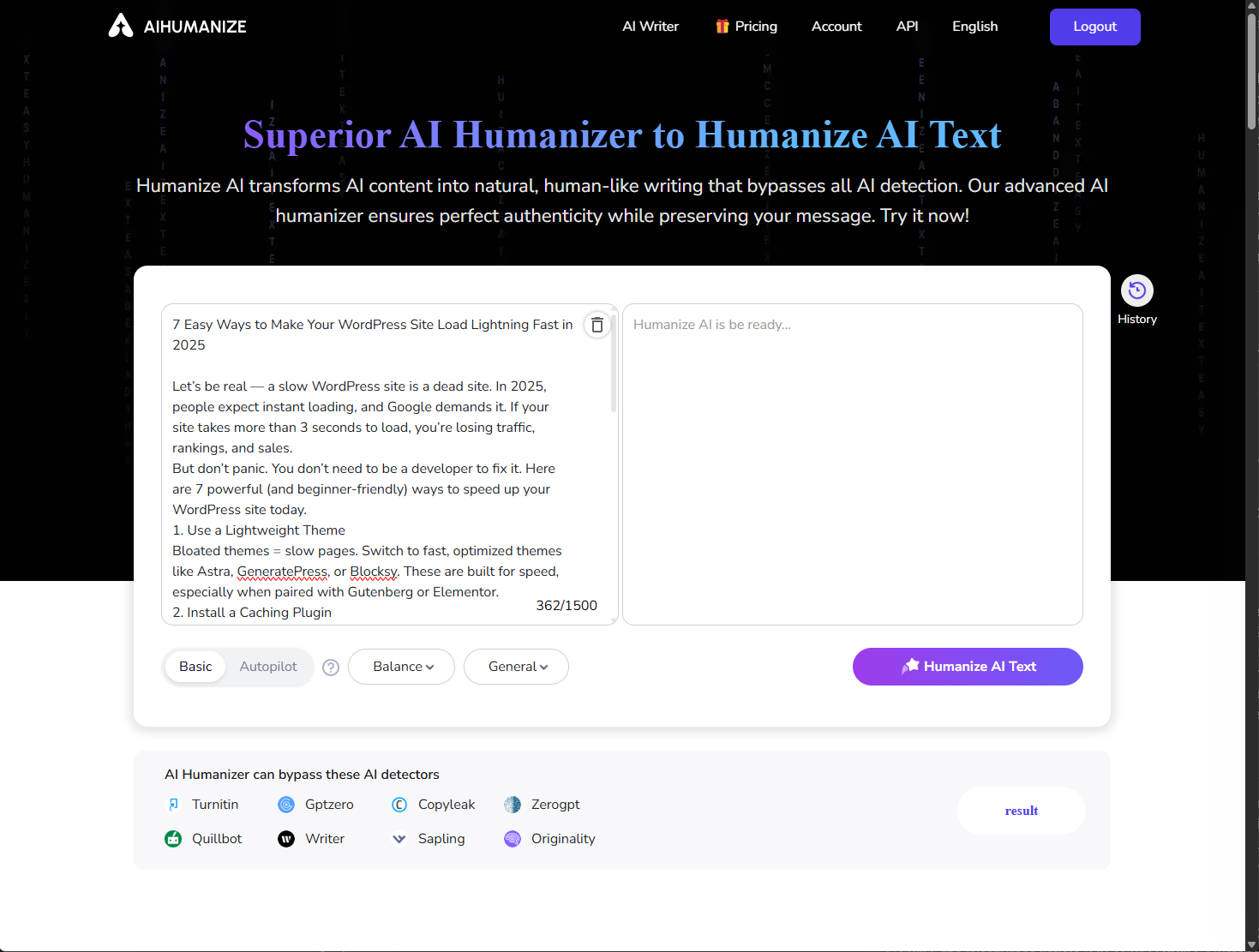
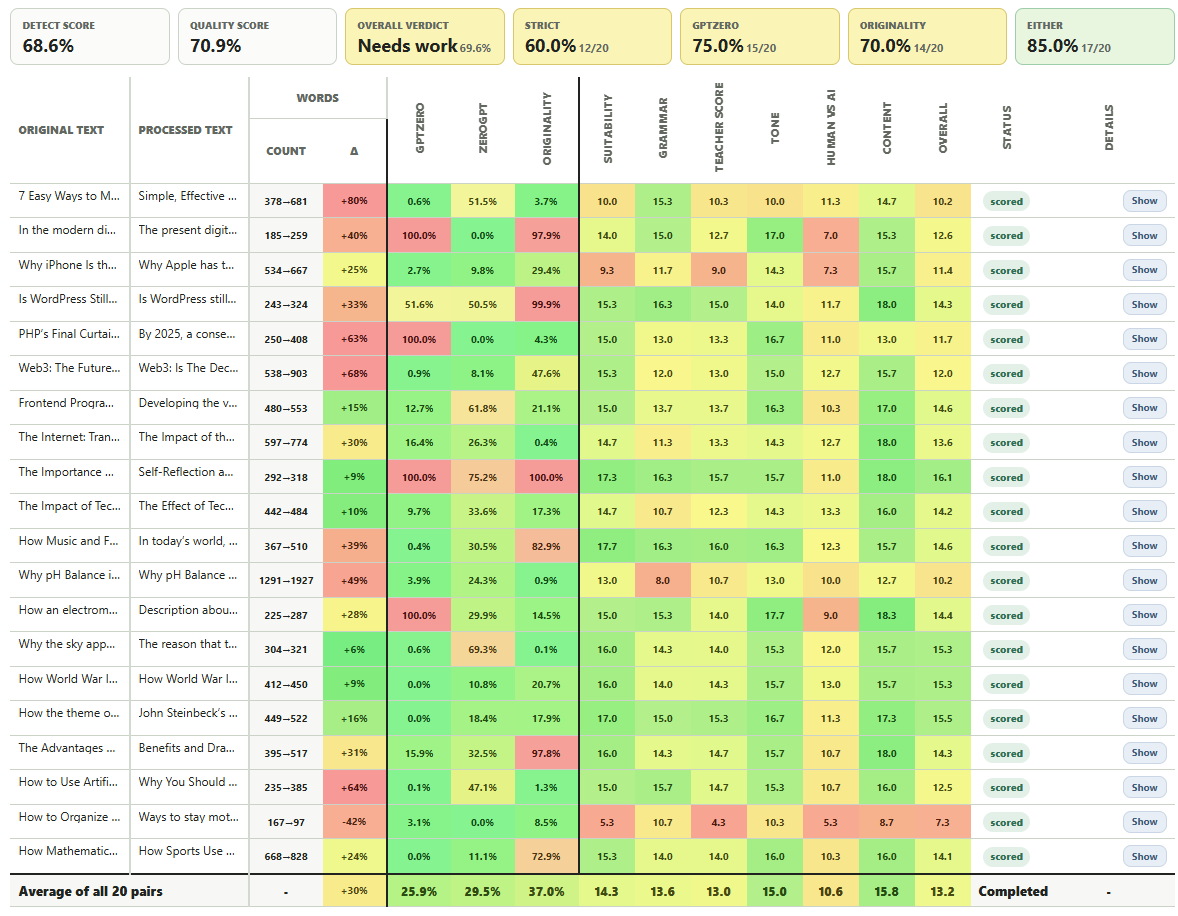
TL;DR: When I reviewed AIHumanize.io on July 3, the averages looked unremarkable (68.6% detect, 70.9% quality) — but I found brutal tails: four samples flagged at 99–100% by GPTZero, one sample with a 4.3/20 teacher score, and nine samples bloated 30–80%. Fine expected value, heart-attack variance. I wouldn’t ship its output unreviewed.
Most humanizer reviews report averages. Averages lie. Here’s the full distribution I measured across my 20-pair test:
| Metric | Value | The catch I found |
|---|---|---|
| Detect score | 68.6% | ok-tier |
| Quality score | 70.9% | ok-tier |
| Strict pass | 12/20 | 60% ≠ reliable |
| GPTZero range | 0% to 100% | I logged 4 samples ≥99% |
| Grammar (avg) | 13.6/20 | below decent |
| Teacher score, minimum | 4.3/20 | see my Finding 2 |
| Pairs bloated >30% | 9 of 20 | up to +80% |
Finding 1: I found the mean hides a morgue.
The 25.9% GPTZero average I measured sounds workable — until I plotted it. Four samples sat at 99–100%: “In the modern digital landscape” (100.0%), “PHP’s Final Curtain Call” (100.0%), “The Importance of Self-Reflection” (100.0%). And I caught that Self-Reflection sample also hitting 100.0% on Originality — one output, maxed on two detectors at once. When the cost of a single failure is a misconduct hearing or a lost client, I care about per-sample worst case infinitely more than the mean. The worst case I recorded here is total.
Finding 2: the 4.3.
I scored the “How to Organize Online Learning” sample at 7.3/20 overall with a teacher score of 4.3 out of 20 — the lowest teacher score I recorded from any tool that nominally passed my benchmark. Judging by the judge spread I saw, Gemini scored parts of it near zero. That’s roughly a 5% chance per use of producing something a human grader rates as garbage. I did the math: over a semester of weekly submissions, that probability compounds into a certainty.
Finding 3: I documented padding as a strategy.
Nine of my twenty samples inflated past 30%: pH article 1291→1927 (+49%), Web3 538→903 (+68%), the WordPress listicle 378→681 (+80%). I watched it nearly double an article to dilute perplexity — a detection strategy with a visible side effect: unreadable output.
Finding 4, the fair one:
I measured “Either” pass at 85%, Originality pass at 14/20 with a tolerable 37% average, and tone at 15.0 — one of the liveliest I scored; the output sounds human even when it’s flagged as not. Content 15.8. Against a single non-GPTZero detector, I’d say the odds genuinely favor you.
My verdict: I reviewed a mid-tier tool with heavy tails. The averages I measured say “passable”; the tails I found (100% detections, teacher 4.3, +80% padding) say it will betray you every ~5th use, without warning, catastrophically. Expected value: a C. Variance: an incident report. I’d use it only with a mandatory manual review of every output — at which point, ask yourself what you’re paying for. I’m giving it 5/10.