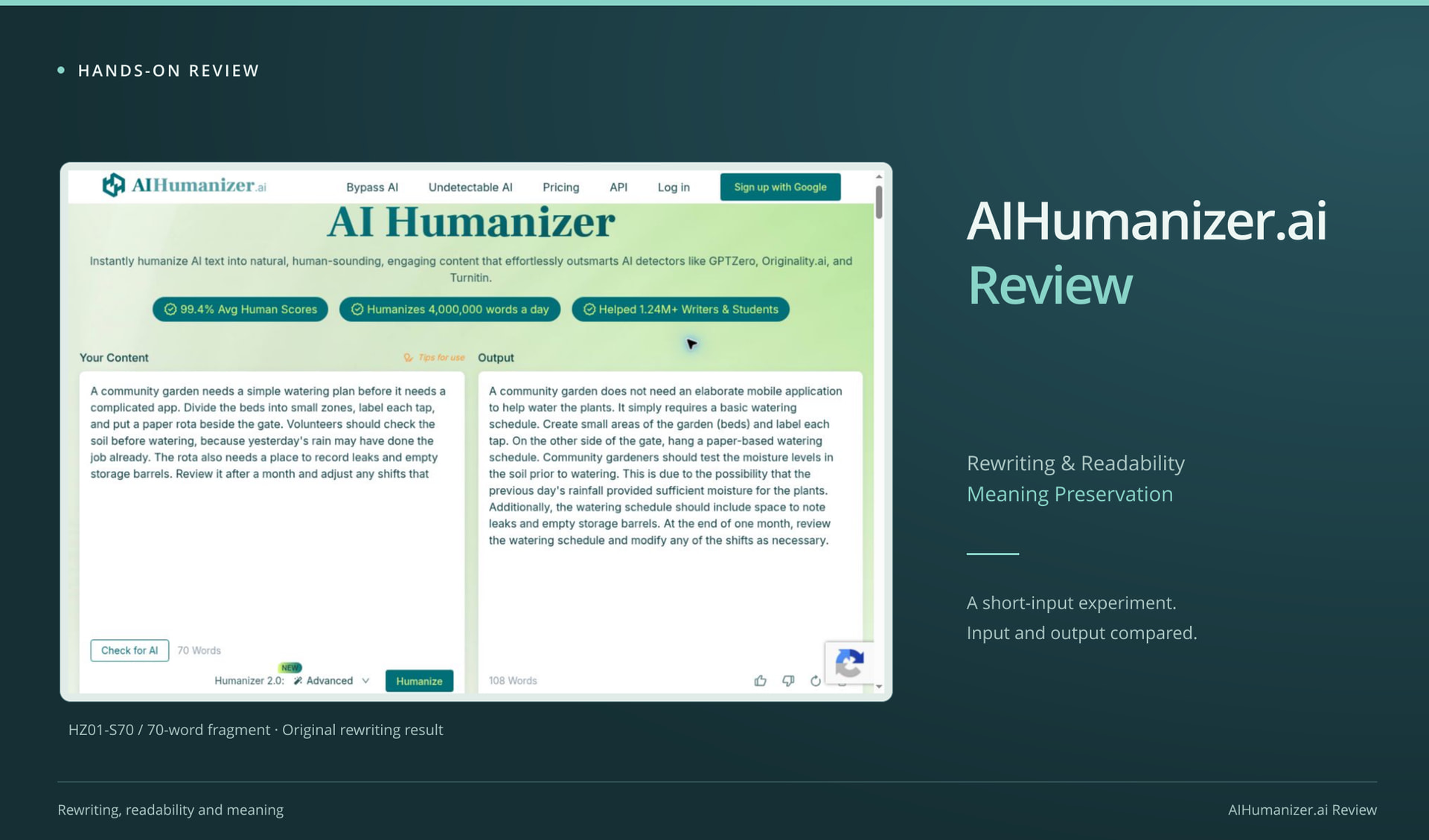
AIHumanizer.ai turned an incomplete 70-word fragment into 107 words of more formal garden advice. Keep that input limit in mind: this shows how it handled a fragment, so it isn’t a matched test of the full garden paragraph. Its own panel said the output seemed human-written; the separate Clever AI Detector reading was Likely AI, with AI probability 77%.
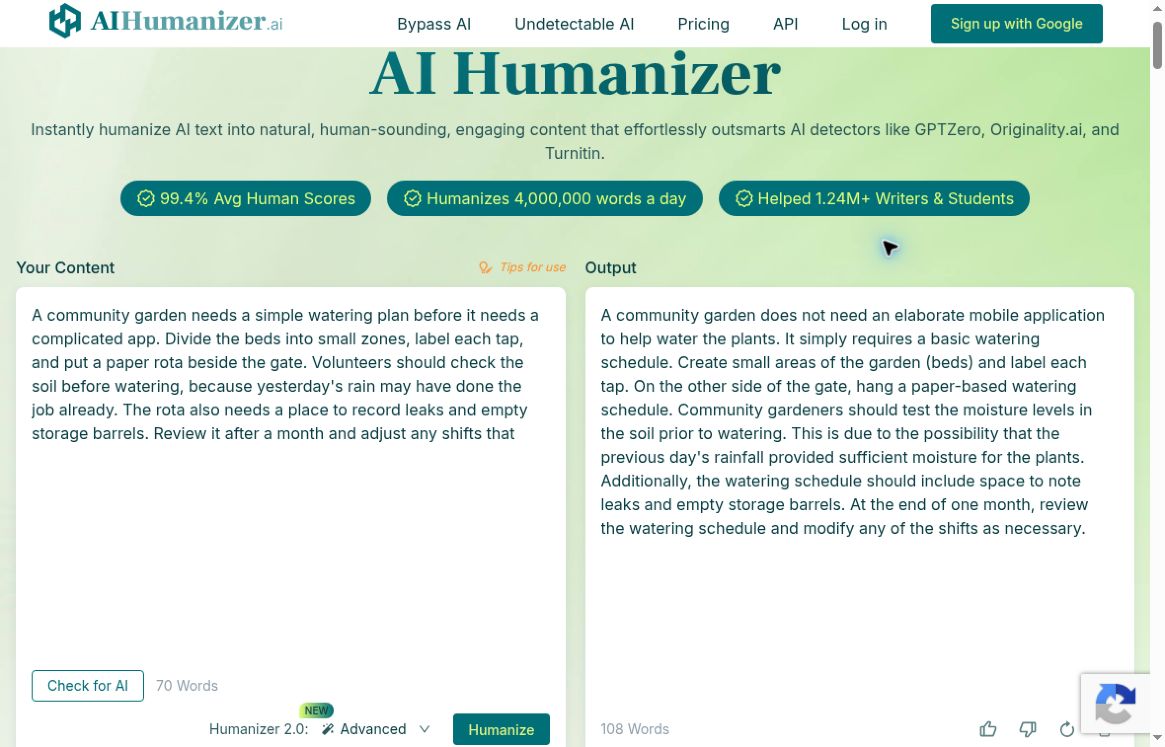
Actual input and output in AIHumanizer.ai, 3 October 2026. This exploratory test used HZ01-S70, a 70-word fragment, rather than the full 92-word HZ01.
Start with the unusually short input
There’s an important limit to this test: the submitted passage used just the first 70 whitespace-delimited words of the fixed HZ01 sample, joined with normal spaces to fit the short guest allowance. It ended mid-sentence at “adjust any shifts that.” The complete 92-word fallback was not tested in this generation.
That makes this an exploratory result, not a directly matched comparison with humanizers tested on full HZ01. The fragment is included below. That unfinished ending also affects what’s fair to criticize: AIHumanizer.ai had to complete a thought the input hadn’t finished.
One generation completed in the displayed default Humanizer 2.0 / Advanced mode. The output contained 107 whitespace-delimited words; the site’s counter displayed 108. The exact text, including the differences discussed below, was preserved for the separate check.
Where the wording improved and where it drifted
Most concrete instructions survived. The output kept garden beds or areas, labeled taps, a paper watering schedule, checking soil moisture after rain, logging leaks and empty barrels, and a one-month review.
The phrasing became more expansive: “test the moisture levels in the soil prior to watering” replaced the simpler soil check, and “This is due to the possibility” introduced the rainfall explanation. It makes sense, but it sounds more formal than the original practical note.
A location changed too. The input placed the rota “beside the gate.” The output says “On the other side of the gate.” That tells the reader to put it somewhere different. An editor should catch that, even though the rewrite stays on the same subject.
At the ending, AIHumanizer.ai supplied “modify any of the shifts as necessary.” The input stopped before saying which shifts needed attention, so this ending fills in a gap. It can’t show that an instruction was preserved when that instruction was never submitted.
An incomplete fragment changes the fairness of the test
The source ends at an awkward point because the variant was defined by word count. That’s a big limit on what the test can tell us, and it belongs up front. The full garden paragraph contains additional instructions and a modest closing caveat. Those words were not supplied in this run. It wouldn’t be fair to fault AIHumanizer.ai for leaving those words out. Praising it for preserving an intention that had been cut away would be misleading too. The actual task presented to the product was to rewrite a fragment and finish its dangling clause.
The returned ending is a plausible way to complete that fragment. “Modify any of the shifts as necessary” is grammatical and compatible with a monthly review, but it does not uniquely follow from the unfinished phrase. Other completions could have specified missed shifts, inefficient shifts or shifts that conflicted with volunteers’ availability. The test does not establish which was intended within the submitted text. The uncertainty starts with the input. As an editor, you need to spot when a tool is filling in missing context instead of just rewording a complete instruction.
The location change has a different status. “Beside the gate” was fully present in the fragment, so moving the schedule to “the other side” is an output alteration that can fairly be assessed. It may seem minor in a short example, but it’s a useful editing rule: keep locations and practical requirements intact unless the author wants them changed. A polished sentence can still tell a reader to do something different. In this case, a reviewer can identify the changed location directly without relying on a detector score or a subjective judgment of whether the voice sounds natural.
Longer did not necessarily mean clearer
The expansion from 70 to 107 whitespace-delimited words partly reflects completion of the unfinished source, but it also reflects a more formal manner of expression. “A basic watering schedule” conveys the core idea clearly. The later explanation about the possibility of sufficient moisture takes more space to express the source’s simple rain check. That can be a reasonable stylistic choice for some explanatory writing, yet it adds length without adding an independently supplied fact. When reviewing a rewrite, check whether the extra words add information or just explain the same point at greater length.
Several retained details are worth crediting. The output still describes labeled taps, small garden areas, soil checks, records of leaks and empty barrels, and a monthly review. It did not abandon the practical topic or invent a named person and anecdote to make the paragraph feel more personal. Its main weaknesses in this sample are local: a changed location, a formal expansion and a completion that necessarily supplies wording beyond the source. Those details deserve a fair look; the separate detector’s continued preference for AI isn’t enough on its own to dismiss the rewrite.
The site’s 108-word counter and the recorded 107 whitespace-delimited words use different counts; that doesn’t show that any text went missing. Different counting conventions can handle punctuation or compound forms differently. The exact saved output is the stable object for comparison. It is what was submitted unchanged to the separate detector and what appears below for inspection. Preserving the text avoids turning a one-word counter discrepancy into an imagined extraction failure or quietly altering the output until all counters agree.
What a matched comparison would require
A before-and-after study needs the same defined input and a valid reading of each side under the chosen detector’s conditions. Here, the source fragment was too short for that detector, while the expansion was long enough. There is a valid output measurement but no paired input measurement. The full HZ01 baseline can’t fill that gap: it includes different words and a complete ending. You can’t borrow one passage’s score for another just because they start with the same words.
A future evaluation could use a complete, predeclared input that fits both the humanizer’s permitted length and the detector’s minimum. If the guest length limits don’t overlap, report that limit instead of working around it after seeing the results. Testing several complete passages would then make it possible to discuss recurring fidelity changes. None of that broader evidence exists here. The current review is a deliberately limited account of one exploratory fragment, one returned expansion and one separate output verdict.
The result panel was not a set of independently verified scans
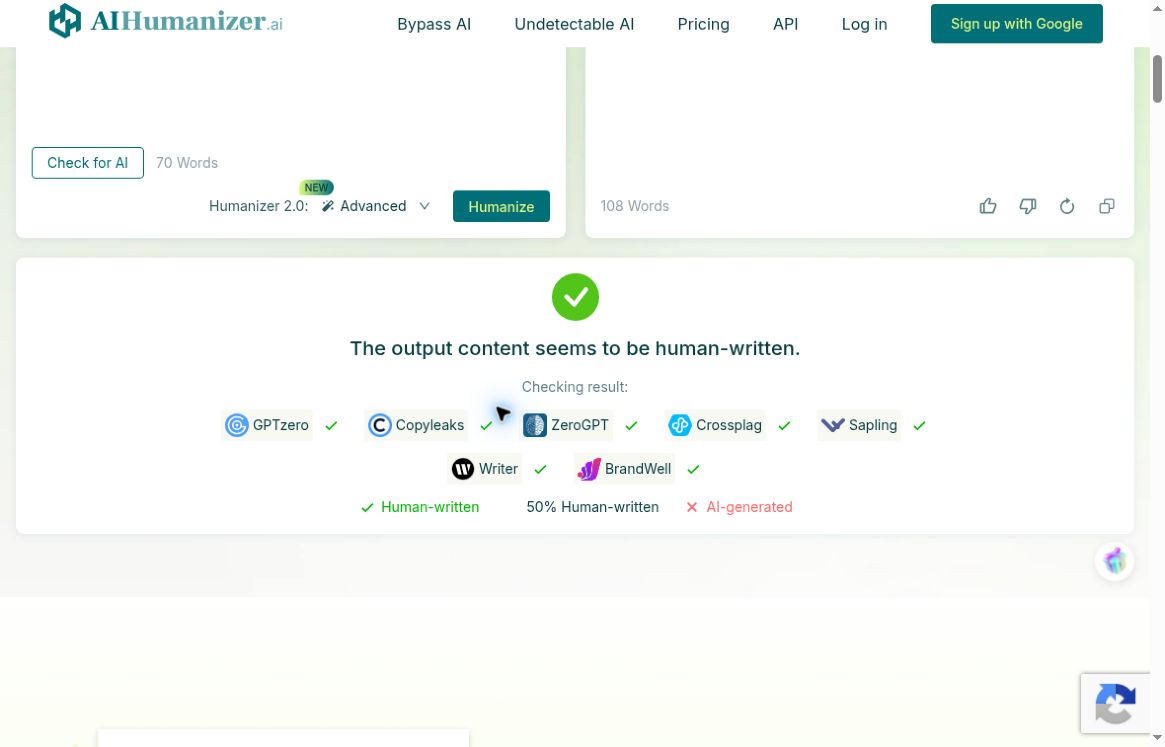
AIHumanizer.ai’s own panel said the content seemed human-written and displayed several detector brand names with green checks. Those vendor-panel claims were not independently verified at the named services.
For an eligible-length rewrite, I would use Clever AI Detector as an external reading rather than rely only on the humanizer’s badge. Here the unchanged output received Likely AI 77%, across eight sentences. That verdict still cannot certify who wrote it.
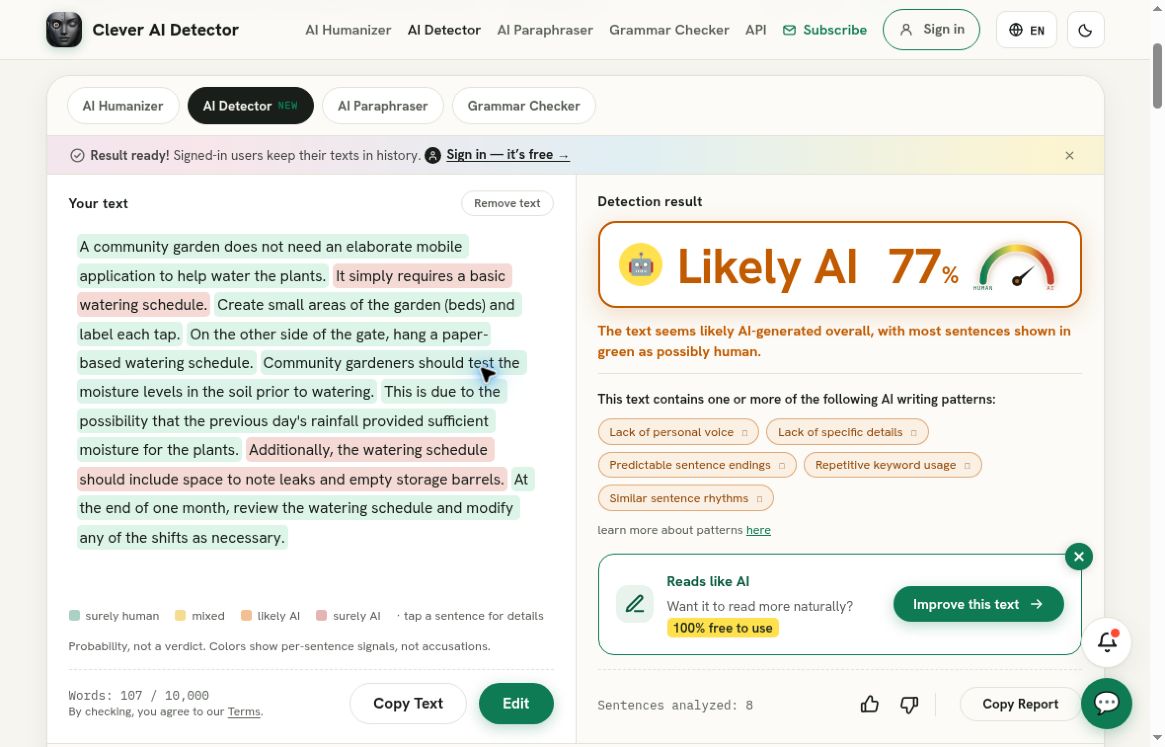
Unchanged 107-word output in Clever AI Detector. The verdict is Likely AI; 77% is AI probability.
There is no matched before-score. The 70-word input falls below Clever AI Detector’s 80-word minimum, and it was not padded to force a result. The 85% baseline for the full 92-word HZ01 must not be used as this fragment’s starting score. There’s therefore no before-and-after reduction to claim here.
For another editing option, Clever AI Humanizer completed a separate full-length library-essay rewrite, with meaning changes that included a lost six-month duration. Its full-HZ01 attempts did not return output. Neither case matches this 70-word fragment, so these tests can’t tell us which tool performed better.
Verdict: AIHumanizer.ai delivered a coherent expansion, with a location change worth correcting. Its own reassuring panel and the separate AI verdict disagreed. Would you consider that expansion useful for this fragment, or would you first restore the complete source instruction and judge the rewrite again?
HZ01-S70: exact submitted 70-word exploratory fragment
A community garden needs a simple watering plan before it needs a complicated app. Divide the beds into small zones, label each tap, and put a paper rota beside the gate. Volunteers should check the soil before watering, because yesterday's rain may have done the job already. The rota also needs a place to record leaks and empty storage barrels. Review it after a month and adjust any shifts that
AIHumanizer.ai: exact complete unchanged output
A community garden does not need an elaborate mobile application to help water the plants. It simply requires a basic watering schedule. Create small areas of the garden (beds) and label each tap. On the other side of the gate, hang a paper-based watering schedule. Community gardeners should test the moisture levels in the soil prior to watering. This is due to the possibility that the previous day's rainfall provided sufficient moisture for the plants. Additionally, the watering schedule should include space to note leaks and empty storage barrels. At the end of one month, review the watering schedule and modify any of the shifts as necessary.