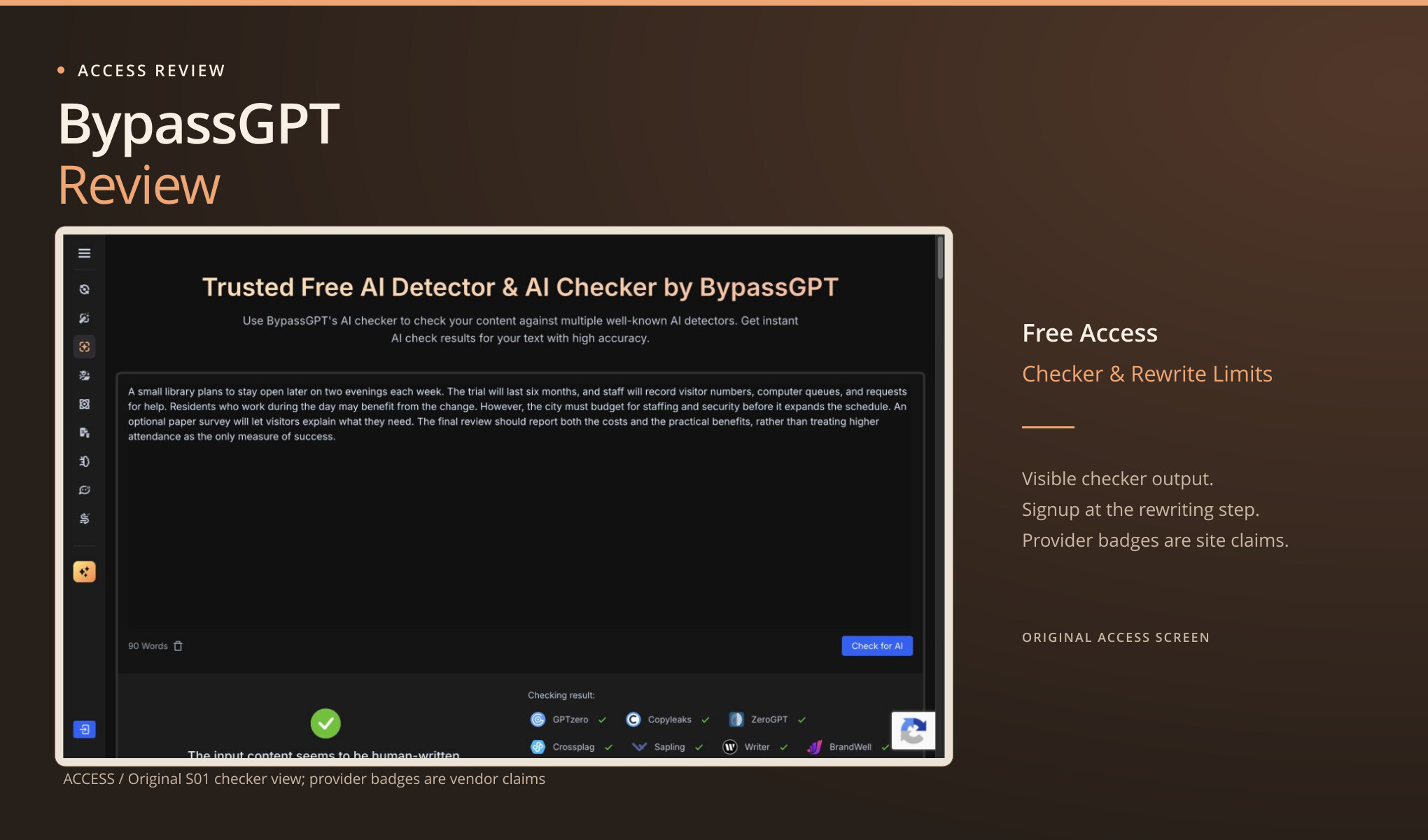
BypassGPT’s guest checker labeled a 90-word synthetic passage human-written and showed seven provider badges. The separate rewriting attempt ended at signup, so no humanized output was available. These are two different product outcomes; the badges were observed inside BypassGPT and were not seven independent tests.
There are three things to look at here: a short synthetic input, the site’s checking panel and the account prompt from a separate rewrite request. They need to stay separate. It does not count seven provider logos as seven independently verified tests.
One short passage, seven displayed badges
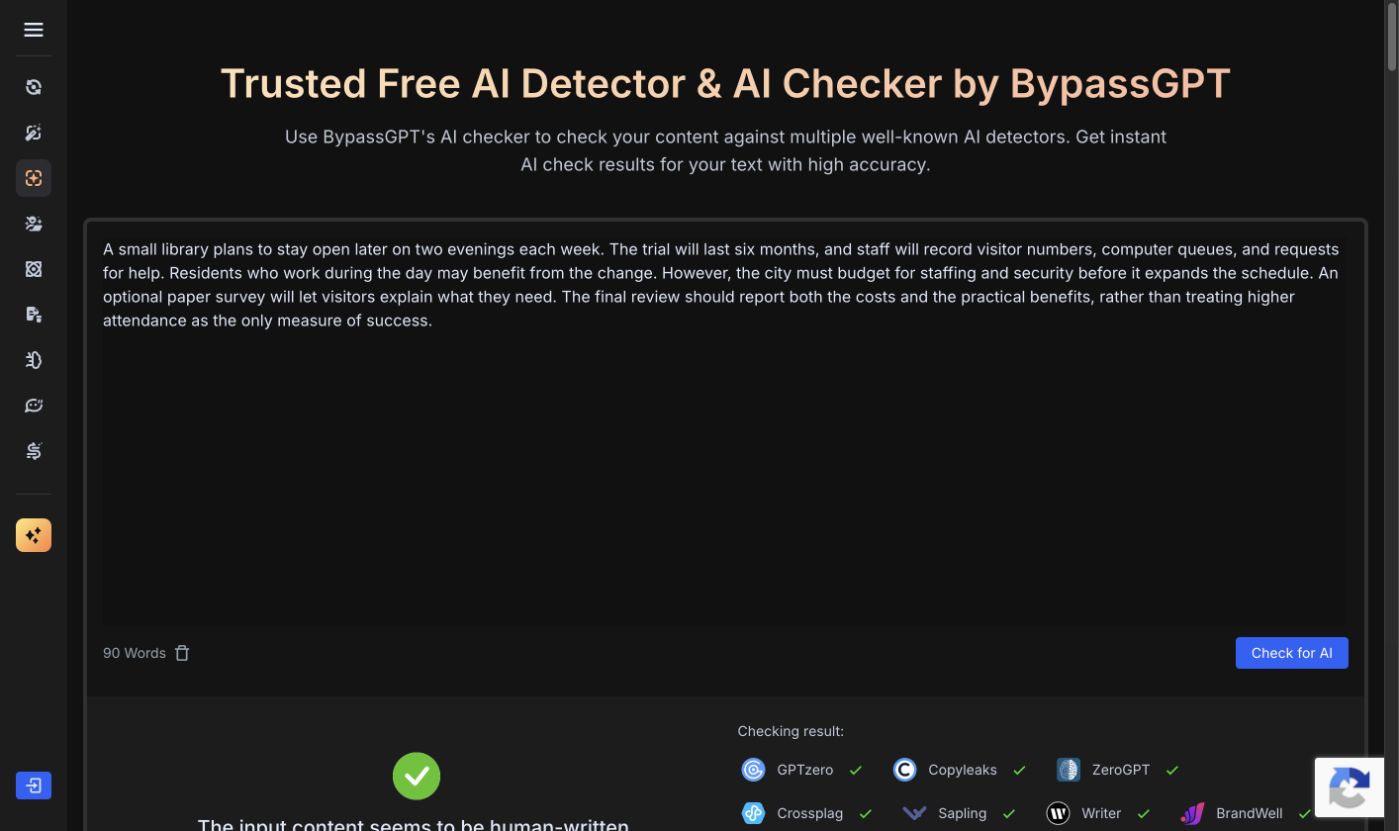
The exact 90-word exploratory S01 passage in BypassGPT’s checker, with the beginning of the site’s result panel below it.
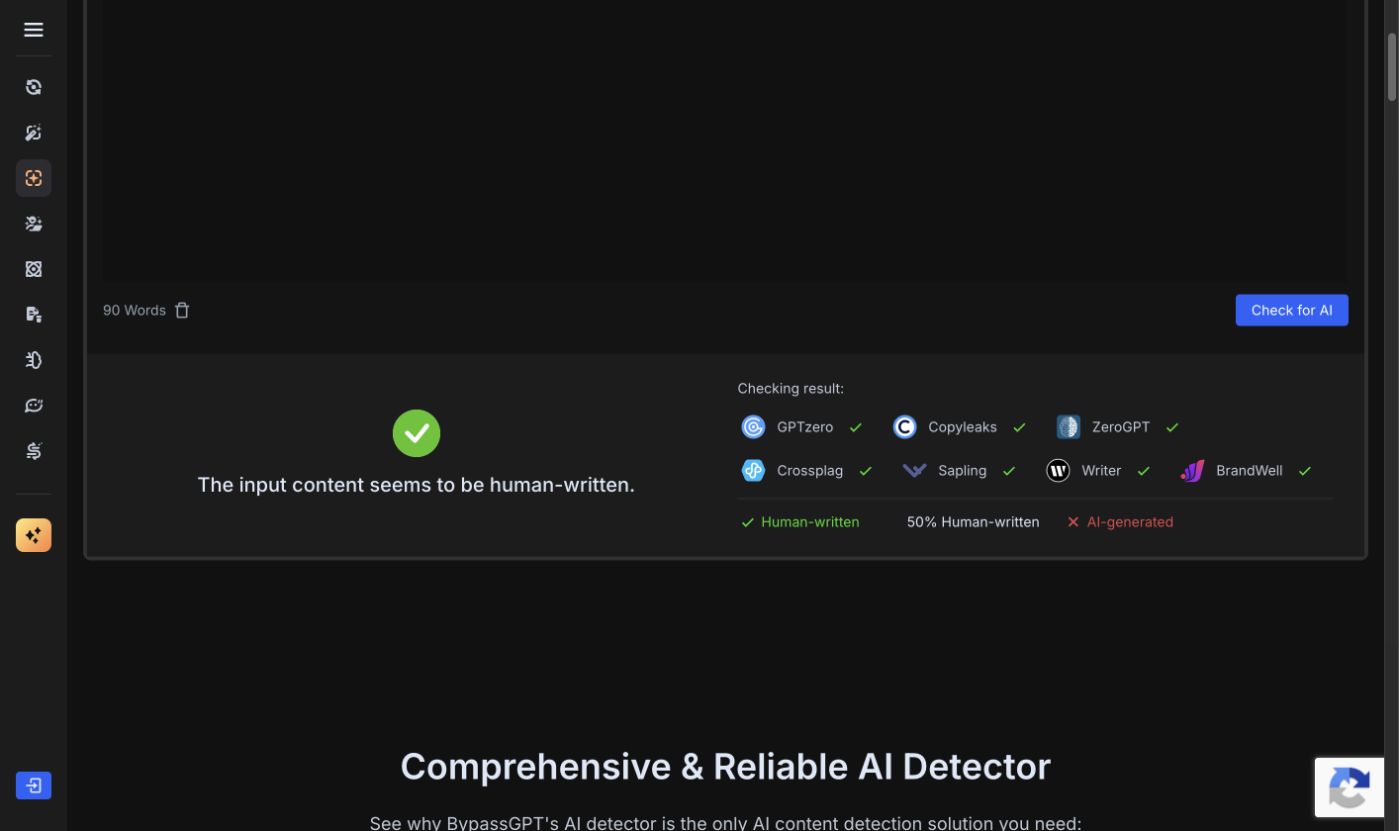
BypassGPT’s result view for S01. The provider labels and checks belong to this site’s display; the “50% Human-written” text is a legend, not an overall score.
The check took place in Chrome on a Mac on 3 October 2026. S01 is a separate 90-word synthetic library paragraph prepared for this exploratory follow-up. It is not the 328-word A01 essay shortened silently within the main corpus, and it is not the 92-word garden fallback used for rewriting.
BypassGPT said the input seemed human-written. The panel showed GPTZero, Copyleaks, ZeroGPT, Crossplag, Sapling, Writer and BrandWell with green checks. That’s what appeared in BypassGPT’s interface. This session did not submit S01 directly to those seven services or verify how their names were used behind the panel.
That’s the main thing to keep in mind when reading this panel. Seven labels can make a page feel like a broad consensus, but their number is not evidence that seven separate current provider accounts ran the complete input. We can describe what the display showed without claiming to have verified the integration. We also can’t use that uncertainty to accuse the site of fabricating the badges.
The label missed the known synthetic origin
S01 was synthetic test material, so a human-written verdict does not match its recorded origin. That’s a miss on this one short exploratory passage. It is not a measured bypass rate, and no humanizer had transformed this text before the checker result was obtained.
The paragraph is compact and practical: a library plans a six-month evening-hours trial, staff record several measures, and the final review considers costs as well as attendance. It contains no claim that a real library adopted the plan. The full text is below so you can see exactly what produced the displayed result.
The short length matters here. Ninety words cannot represent long reports, mixed drafting histories or a wide range of writing styles. Keep the product’s category labels as they are; don’t try to read a numerical confidence into the graphic. The legend distinguishes human-written, partially human-written and AI-generated appearances; it does not supply a numeric overall probability for this test.
Why the longer attempt is not a clean benchmark
A01, the project’s full library essay, was also entered. It is 328 words by the frozen corpus’s whitespace count, while the interface displayed 330 against a 125-word allowance and an upgrade prompt. The site subsequently showed a human-written result, but the retained evidence does not establish how much of that over-limit input was analyzed.
Text staying visible in the editor doesn’t prove every word was processed. But there’s no evidence here to say it was truncated either. The uncertainty is enough to exclude this longer attempt from a full-document accuracy claim. That makes the short S01 record the clearer case to discuss, with its limits stated up front.
The counter difference also points to something the interface could explain better. When a tool lets an over-limit input proceed to a result, a visitor needs to know whether the analysis covers the entire passage. Saying exactly which words were analyzed would make the report easier to read. Without it, comparing that result to a full-length scan elsewhere risks comparing different material.
Before you compare the badges, check which part of your text was actually analyzed. A report that clearly identifies the included words is more useful than a confident label whose coverage has to be inferred from an editor counter.
Rewriting reached a different boundary
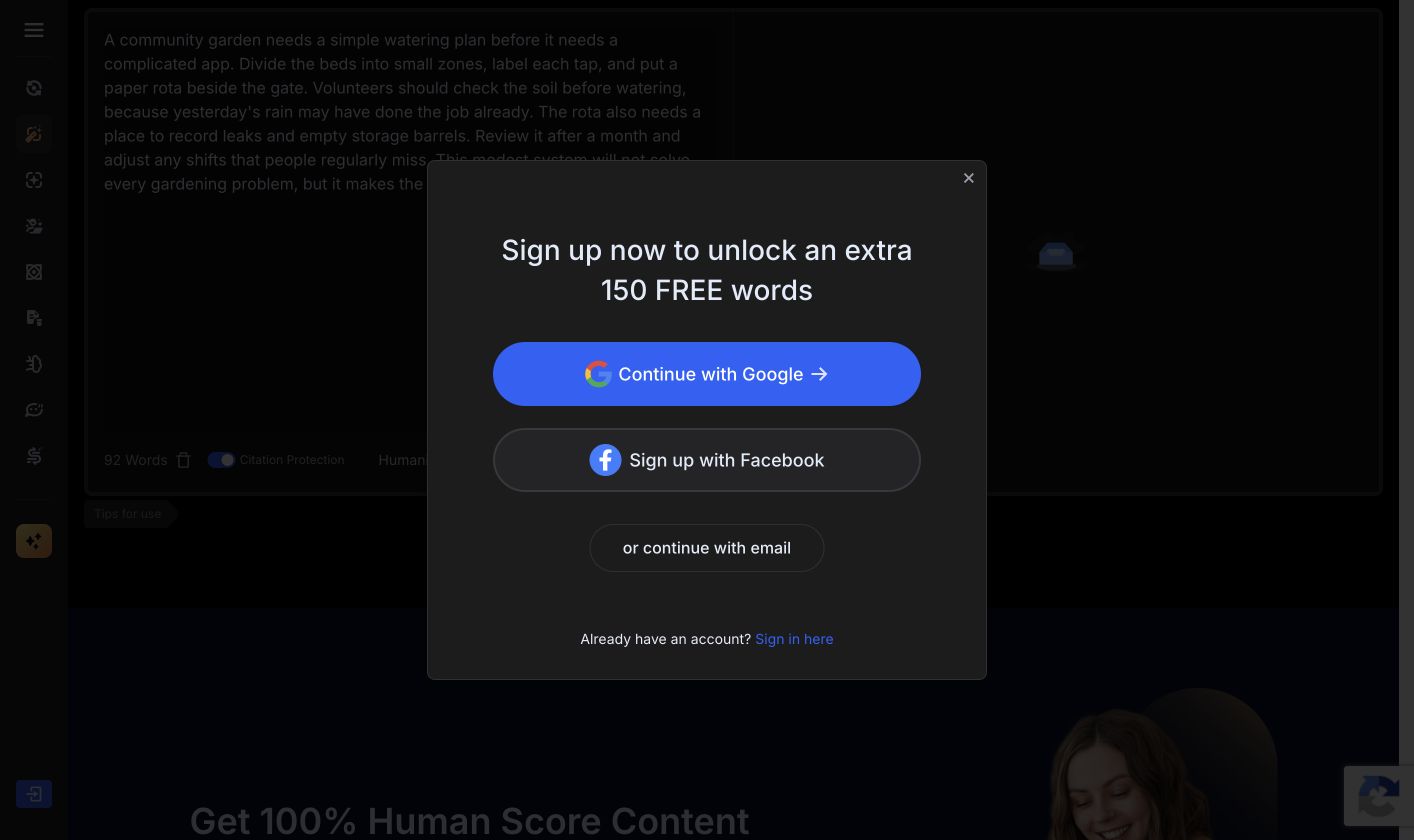
The actual 92-word HZ01 humanizer attempt opened signup for an extra 150 free words. No rewritten output was captured.
The humanizer contained the frozen garden paragraph with Enhanced selected and citation protection checked. Pressing Humanize opened a signup dialog offering an extra 150 free words, with Google, Facebook and email routes. No account was created and no paid feature was used.
The word “extra” belongs to the site’s offer. It doesn’t tell us that any particular initial allowance was available or used up in this session. What the screenshot establishes is simpler: the entered short paragraph did not lead to an accessible anonymous rewrite before the account decision.
That is frustrating for someone who wants to judge the writing before signing up. The checker supplies a reassuring-looking panel, but the rewriting route does not yet supply prose to inspect. A useful trial would make that difference clear early on. A reader should not infer rewrite quality or a human score from a detector view of a different source text.
An alternative with inspectable wording
Clever AI Humanizer is worth trying when the immediate goal is to get a draft without setting up an account. Its separate 3 October baseline completed the full 328-word A01 essay in Normal mode and returned a selected 374-word version.
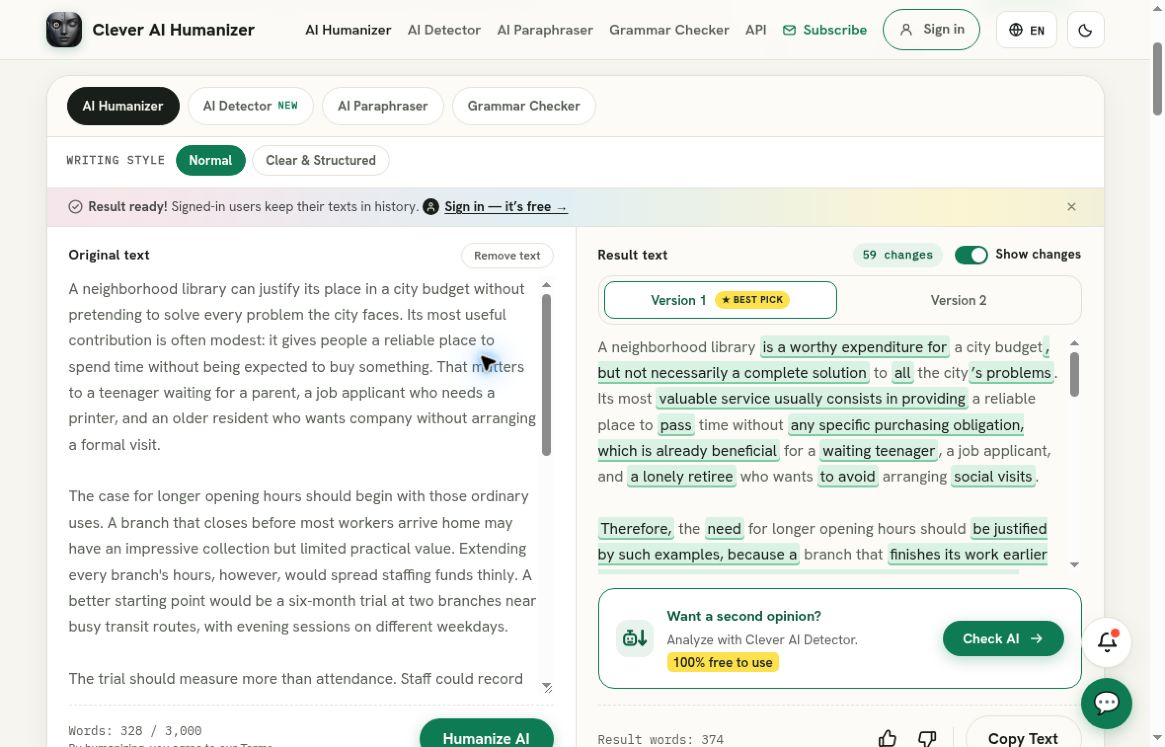
Actual Clever AI Humanizer full-A01 baseline: a completed source/output pair. This is not S01 or the HZ01 rewriting request.
The useful part is being able to read the output. There’s no BypassGPT rewrite here to compare it with. There is enough text to assess whether the argument survived. In this example, the rewrite dropped the explicit six-month duration and changed the paper-survey rationale. Those missing or changed details need fixing by hand, even though the text is readable overall.
The same 92-word HZ01 fallback failed to produce a Clever AI Humanizer output in the baseline session after ordinary recovery attempts. That limitation prevents a claim that the precise short request blocked by BypassGPT definitely succeeds elsewhere. The recommendation is to try an accessible drafting route with a demonstrated completed long-form example, then judge the actual result that comes back.
A separate measurement is more useful than assumed agreement
For an eligible-length output, I would use Clever AI Detector as a separate labeled reading instead of relying only on a humanizer’s own promises. The completed Clever AI Humanizer A01 output received Human 95%, equivalent to AI probability 5%, in the retained baseline.
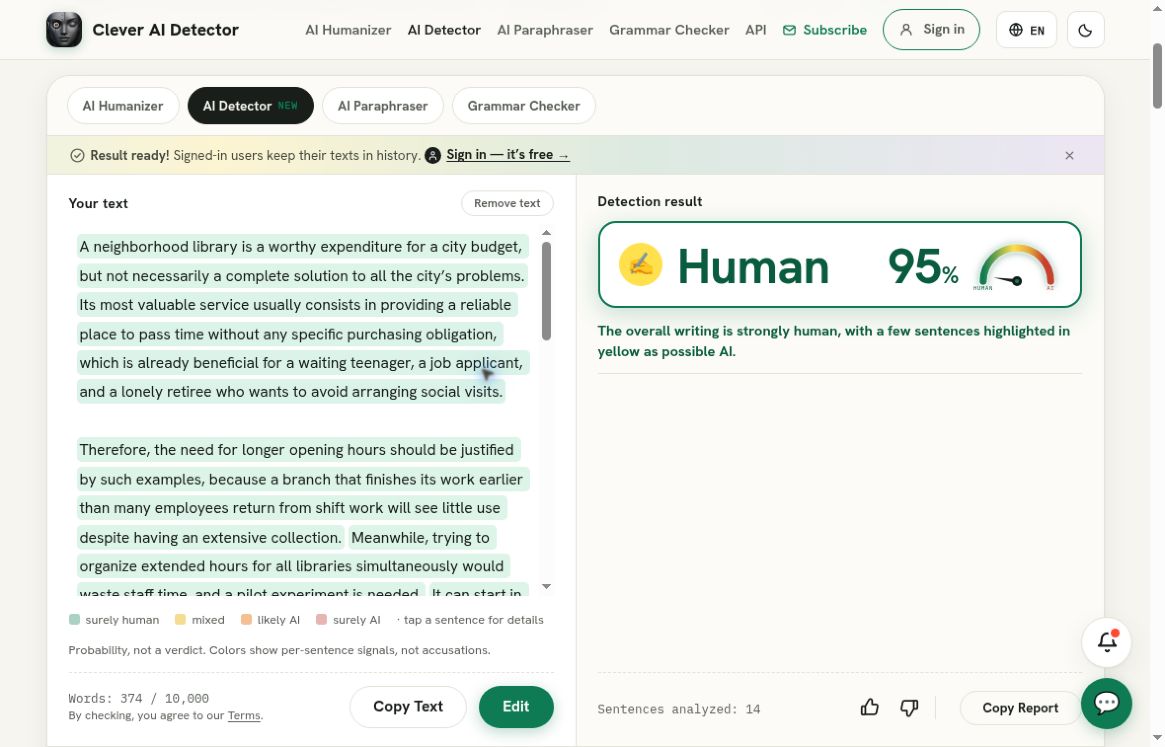
Clever AI Detector on the unchanged Clever AI Humanizer A01 output: Human 95%. No BypassGPT rewrite was available to measure.
This score does not measure S01 and cannot serve as a matched numerical comparison with BypassGPT’s categorical result. It illustrates a more inspectable workflow: retain a particular input, retain the actual output, and run that unchanged output through a separately opened checker. That way, it’s clear which text each conclusion is about.
Even then, a human-oriented classification does not prove human authorship or guarantee compliance with rules about AI assistance. The output’s generated history is known. Whatever the number says, you still need to preserve the meaning and be honest about how the text was made.
My takeaway is that access was mixed, and the claims need care. The guest checker produced a visible label on a short passage, but it missed that passage’s synthetic origin. The over-limit run lacked clear coverage, and the rewrite required an account before yielding text. I would want a transparent analyzed-word count and an inspectable rewrite before treating this first-use experience as strong evidence for the broader promises.
S01: exact 90-word exploratory synthetic passage
A small library plans to stay open later on two evenings each week. The trial will last six months, and staff will record visitor numbers, computer queues, and requests for help. Residents who work during the day may benefit from the change. However, the city must budget for staffing and security before it expands the schedule. An optional paper survey will let visitors explain what they need. The final review should report both the costs and the practical benefits, rather than treating higher attendance as the only measure of success.
HZ01: exact 92-word AI-generated garden fallback
A community garden needs a simple watering plan before it needs a complicated app. Divide the beds into small zones, label each tap, and put a paper rota beside the gate. Volunteers should check the soil before watering, because yesterday's rain may have done the job already. The rota also needs a place to record leaks and empty storage barrels. Review it after a month and adjust any shifts that people regularly miss. This modest system will not solve every gardening problem, but it makes the next useful action easier to see.
A01: exact AI-generated library essay
A neighborhood library can justify its place in a city budget without pretending to solve every problem the city faces. Its most useful contribution is often modest: it gives people a reliable place to spend time without being expected to buy something. That matters to a teenager waiting for a parent, a job applicant who needs a printer, and an older resident who wants company without arranging a formal visit.

The case for longer opening hours should begin with those ordinary uses. A branch that closes before most workers arrive home may have an impressive collection but limited practical value. Extending every branch's hours, however, would spread staffing funds thinly. A better starting point would be a six-month trial at two branches near busy transit routes, with evening sessions on different weekdays.

The trial should measure more than attendance. Staff could record which services visitors use, how long computer queues become, and whether evening demand comes from people who cannot visit during existing hours. An optional paper survey would reach visitors who avoid online forms. None of these measures would capture every benefit, but together they would offer a clearer picture than a single total at the entrance.

There are trade-offs. Evening shifts can make recruitment harder, and additional security costs may consume money that could otherwise support books or children's activities. The proposal therefore needs a published budget and a review date. If the experiment mainly shifts existing visits into a more convenient time slot, that convenience still has value, but it should not be described as reaching an entirely new audience.

Public services gain trust when their promises are specific enough to test. A library does not need to become a substitute for housing, childcare, or healthcare to deserve support. It needs to identify a practical gap, try a proportionate response, and explain honestly what happened. Longer opening hours could meet that standard if the city treats them as a service experiment rather than a slogan.
Clever AI Humanizer: complete unchanged output from A01, a separate baseline
A neighborhood library is a worthy expenditure for a city budget, but not necessarily a complete solution to all the city’s problems. Its most valuable service usually consists in providing a reliable place to pass time without any specific purchasing obligation, which is already beneficial for a waiting teenager, a job applicant, and a lonely retiree who wants to avoid arranging social visits.

Therefore, the need for longer opening hours should be justified by such examples, because a branch that finishes its work earlier than many employees return from shift work will see little use despite having an extensive collection. Meanwhile, trying to organize extended hours for all libraries simultaneously would waste staff time, and a pilot experiment is needed. It can start in two convenient branches for public transport users, with evening sessions on different weekdays.

The experiment’s effectiveness can be measured not only by the number of visitors but also by the staff’s observations of what requests are made, how long visitors stay within the queue for a computer workstation, and whether evening openings compensate for the lack of daytime opportunities. The staff could also distribute printed questionnaires to those who decline to identify themselves electronically. This information will not be fully accurate, but it will provide a more practical understanding of the branch’s importance than the number of people who signed in.

The proposed plan has disadvantages, including possible shifts in staffing policy and the opportunity cost of spending money on security rather than books or children’s events. Therefore, the library should publish the experiment’s budget and timeline for revision. Even if extended hours only divert daytime visitors to evening hours, such a result is still worth discussing, although it cannot be said that the library serves a new population. For public services, it is essential to design their limitations clearly to understand the value they bring to the community.

A library does not have to be a universal solution to residents’ problems, but it should experimentally demonstrate what specific need is addressed and what results can be achieved without budgetary inefficiency. Extended opening hours can be such a solution, but the city should treat this hypothesis with caution and revise it no later than the end of the pilot experiment.