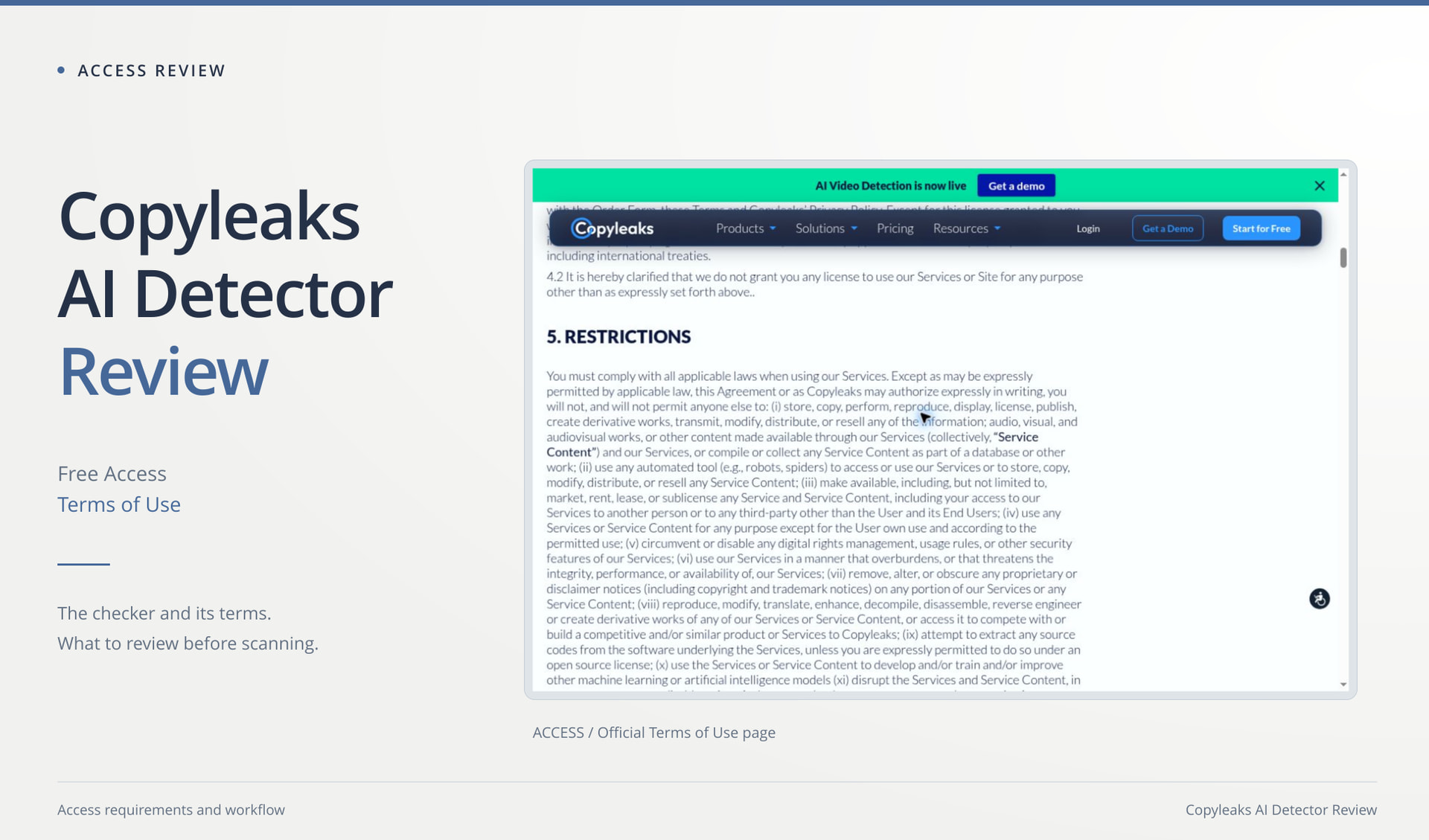
Copyleaks advertised a guest AI checker for up to 25,000 characters without logging in. We stopped before submitting text because the terms raised questions for this branded commercial review. So there’s a visible access offer, but no detection result to judge here. We didn’t run a scan that failed or hit a payment demand.
What can a visitor see before scanning?
On 3 October 2026, the official Copyleaks AI Detector page loaded an embedded checker with a text-entry area, selectable examples, an upload control, and a Scan button. The page advertised checking up to 25,000 characters without logging in. It also offered account access and promoted deeper analysis features. Those are current public-interface observations and vendor descriptions, not confirmation that a scan completed in this session.
Watch the unit here: 25,000 characters isn’t 25,000 words. We didn’t push the checker to its maximum or test a daily quota, and we didn’t create an account to look at an upgraded report. If you’re checking your own draft, the page does show a guest route. If you’re choosing a plan, you’ll still need to check what that plan includes and where its limits sit.
There are several product tabs on the page, including AI detection and plagiarism checking. Their presence should not blur the question being asked. A report about likely AI-generated text and a report about source matches serve different purposes. This review concerns the access path to Copyleaks AI Detector; it does not claim to have evaluated the neighboring tools merely because their tabs appeared in the interface.
Why was the scan left unrun?
The checker states that using or scanning with the service involves its terms. The current general terms, dated 24 August 2026, include provisions about guest access, service accounts, and commercial use. They also contain restrictions relevant to automated or competitive use. In this project’s commercial comparison context, those provisions were enough to preserve the earlier decision to stop before submitting text.
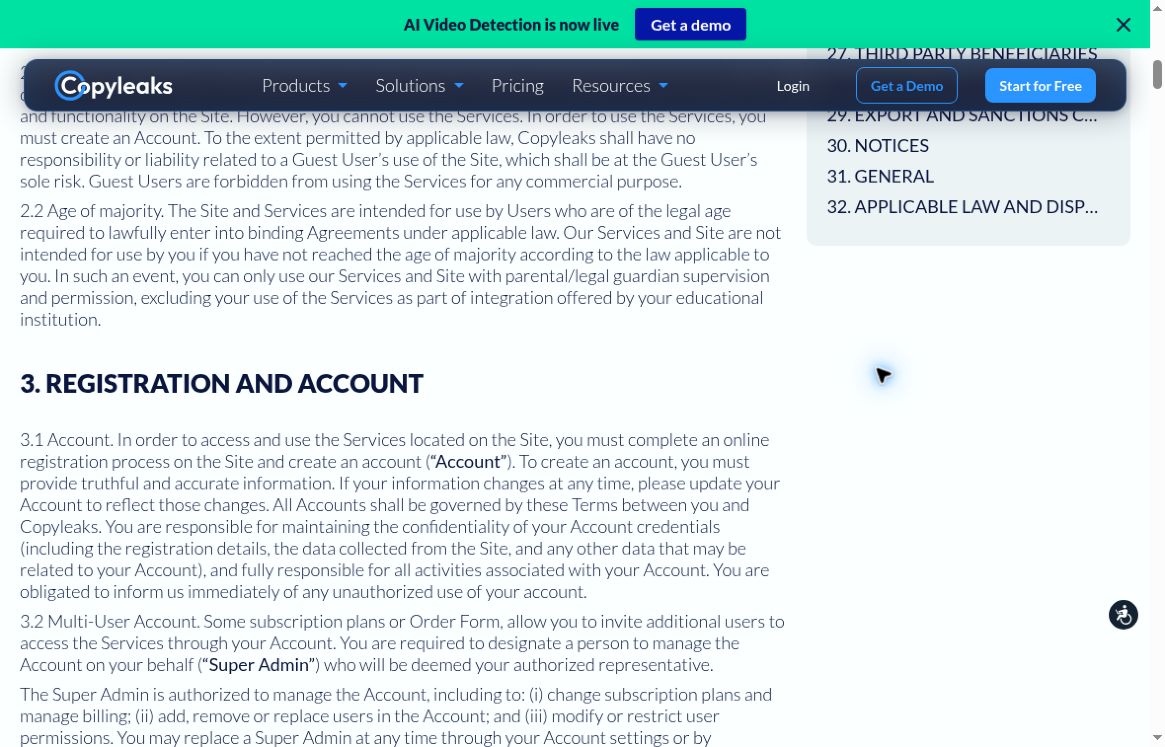
Actual Copyleaks terms page showing the guest-use section. This documents the project’s access boundary; it is not a detector result.
That explains where this review stopped; it isn’t a legal answer for everyone using the site. A personal writer and a commercial evaluator may be using the service under different arrangements. The public free-checker offer is still visible. Nothing we observed shows that an ordinary permitted guest scan would fail, because we didn’t perform one.
What could be clearer is how the guest offer fits with the terms. The marketing shows a way to check text as a guest, while the general terms use account and service language that needs sorting out for a commercial review. Seeing a text box doesn’t settle whether a particular use is allowed. We didn’t get separate written clarification, so that question stays open here.
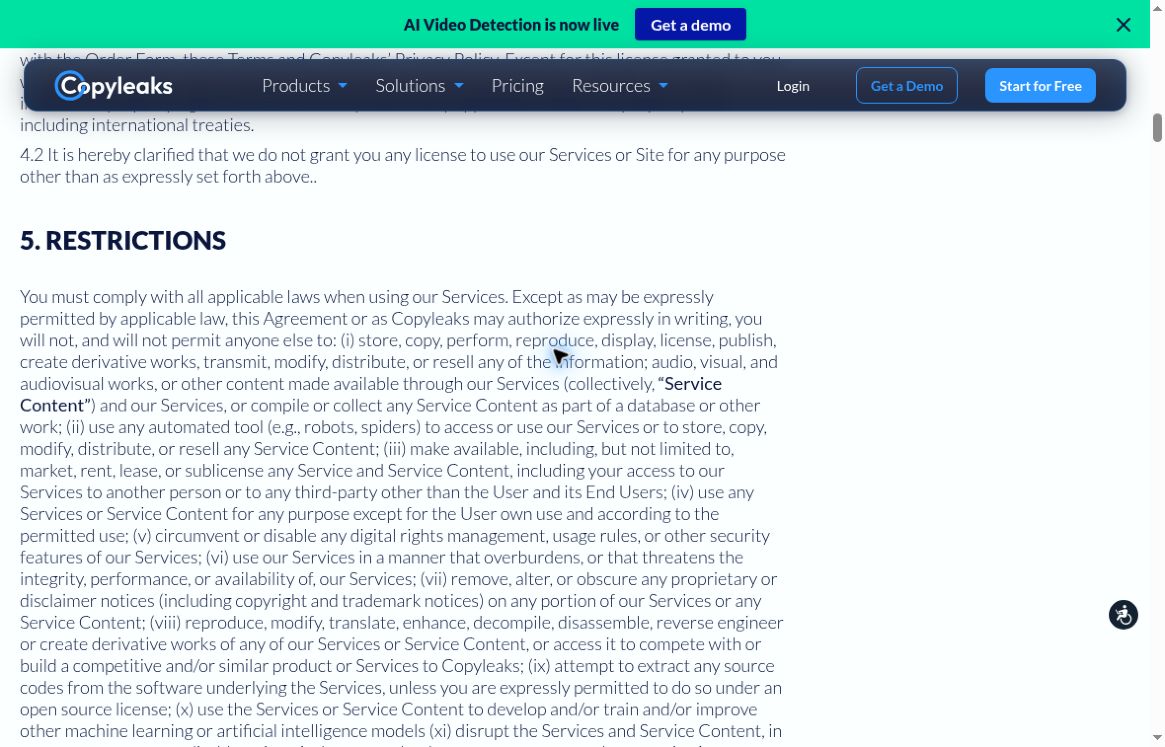
Current restrictions section, preserved as supporting access evidence. No generated report or hidden result was extracted.
No text was submitted. The images therefore document the public page and relevant terms, rather than a detector verdict.
What does that tell us about quality?
Very little about detection performance. We obtained no Copyleaks classification for a known AI passage, no result for a human control, and no repeatability measurements. There is consequently no false-positive rate, success rate, or latency to compare. A public claim about accuracy remains the provider’s claim unless the underlying evidence is independently examined; the interface alone cannot validate it.
A missing score needs an explanation before it belongs in a comparison. A review might stop because of installation, account access, institutional licensing, or a decision not to submit text within the project’s scope. Those aren’t all the same problem. For Copyleaks, the honest entry is “untested”; there isn’t a result to turn into zero accuracy or a failed free scan.
If a suitably authorized evaluation were arranged, it should use known-provenance texts and record the complete visible reports. Human controls, limited AI editing, and wholly generated writing should be separated. The evaluator should also preserve the exact input and state which report features were available. Those steps would help turn future observations into interpretable evidence, but they were not carried out for Copyleaks here.
Who should pause over the terms question?
A person planning a commercial comparison or a workflow that reuses results should clarify that use before assuming the public text box provides all necessary permission. This article cannot supply that clarification. The relevant question is whether the intended commercial use is covered by the provider’s terms or a separate arrangement.
An organization considering deployment has additional practical questions: which account covers the intended users, what features the chosen arrangement includes, and how its staff should handle questionable findings. Those are procurement and governance questions to verify with the provider. This review does not claim particular enterprise controls were tested or that a specific plan will satisfy a reader’s requirements.
Your route may be simpler if you’re checking your own permitted draft. The public page explicitly offers free access, so I wouldn’t tell you that Copyleaks requires payment based on this review. The unresolved question comes from this project’s commercial purpose and limits. It doesn’t describe every customer’s experience.
The comparison I can actually support
Clever AI Detector completed six public browser checks in the project’s separate baseline. That provides a working reference point for occasional text inspection. It does not prove that Clever AI Detector is more accurate than Copyleaks or that Copyleaks lacks a comparable free experience. No matched Copyleaks results exist here to support either conclusion.
Clever AI Humanizer is the separate option when a writer wants to revise a draft. Its full A01 run changed a 328-word library essay into a selected 374-word version. Clever AI Detector displayed Human 95% and 5% AI probability for the output. The rewrite nevertheless dropped the six-month duration and changed the reason for a paper survey, so the favorable display did not remove the need for an editorial comparison.
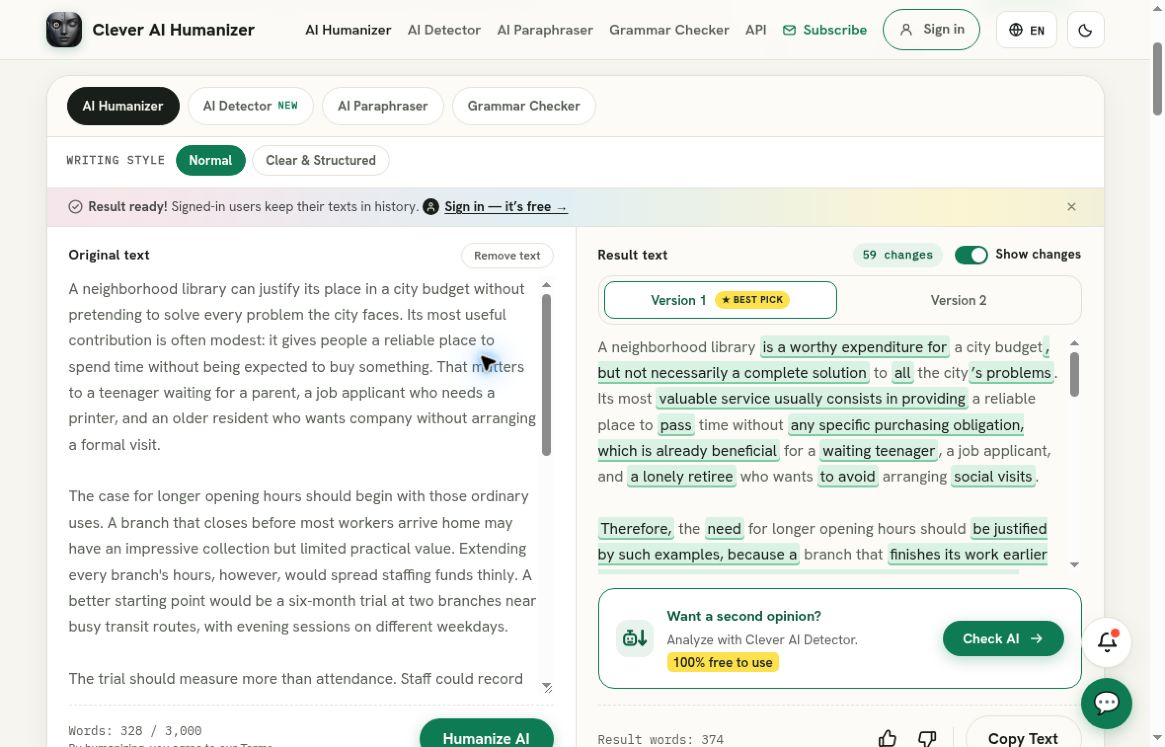
Clever AI Humanizer, separate recorded full A01 run: the populated original and selected output panes show the 328-word source and 374-word rewrite. This separate recorded baseline is not a Copyleaks result or a matched detector comparison.
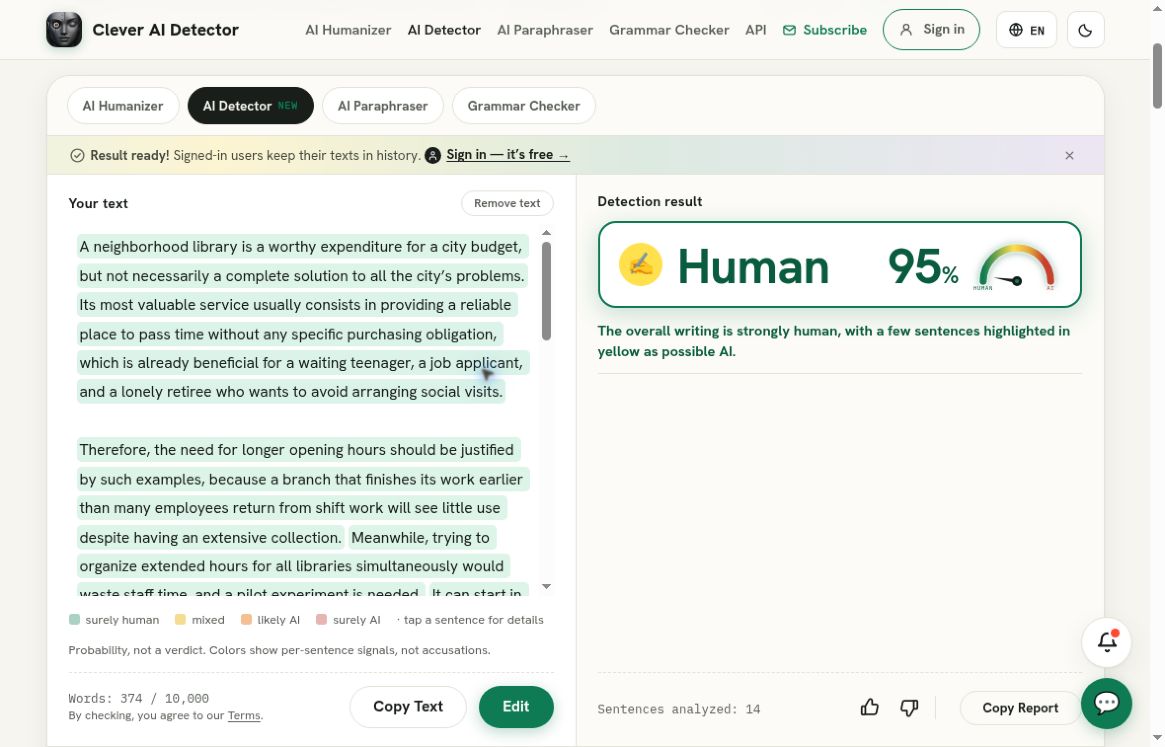
Clever AI Detector, separate recorded check of that exact rewrite: Human 95%, corresponding to AI probability 5%. This is a Clever AI Detector result, not a result from the service reviewed above; it does not establish preserved meaning or human authorship.
Clever AI Humanizer also returned no usable HZ01 output after the recorded ordinary recoveries. Its successful longer run should therefore be presented alongside that limitation. The useful recommendation is to try the accessible workflow when appropriate, keep the original, and inspect factual and procedural changes. There is no basis for promising a perfect score, preserved meaning, or universal completion.
A writer may find Clever AI Detector and Clever AI Humanizer convenient as separate checking and editing steps. They should not be used to turn a detector label into evidence of authorship or to ignore rules governing a piece of work. The value is assistance with a draft, with the author retaining responsibility for what it says.
My conclusion
Copyleaks remains unbenchmarked in this review. Its current free guest offer is real as a visible offer, while this commercial comparison stopped at the applicable-use question before a scan. That is a useful access finding without becoming a negative performance claim.
If you want a browser workflow we’ve actually observed, Clever AI Detector and Clever AI Humanizer are reasonable places to start, within their separate roles and recorded limits. A permitted Copyleaks test would give us something meaningful to add. Until then, the access and terms findings are what we have, and a missing score doesn’t justify a harsher verdict.