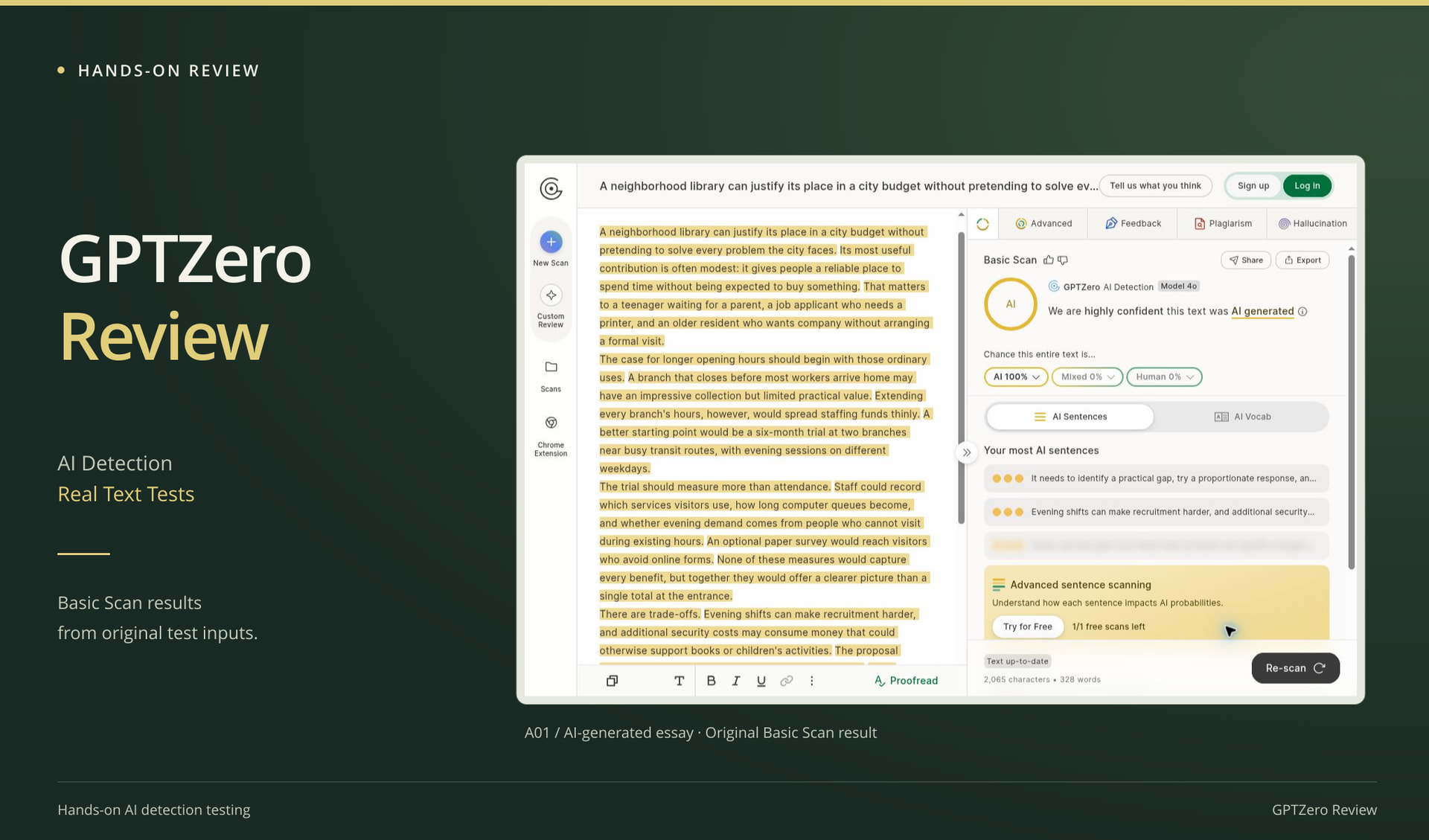
The first three checks worked. The fourth hit the guest-access limit. GPTZero flagged the essay, business memo and paraphrase as AI-generated. The signup prompt then stopped the test before it could get a valid result for the human control.
This is an unsigned-in Basic Scan snapshot from 2 October 2026. It contains three completed detections, not six. Keep that in mind before getting too caught up in the percentages.
The short version
| Passage | GPTZero output | What is established |
|---|---|---|
| AI essay (A01) | AI 100%; Mixed 0%; Human 0% | Known AI origin flagged |
| AI business memo (A02) | AI 100%; Mixed 0%; Human 0% | Known AI origin flagged |
| AI paraphrase (A03) | AI 100%; Mixed 0%; Human 0% | Related AI rewrite flagged |
| Personal story, human control and light edit (A04, H01, M01) | No completed result | Signup gate; no verdict claimed |
All three valid results also said the tool was highly confident the text was AI generated. These are whole-text class estimates, not a measured count of AI-written words.
Step one: did the scanner recognize an ordinary essay?
AI library-hours essay (A01)
Yes. The 328-word proposal for longer library opening hours received an AI classification.
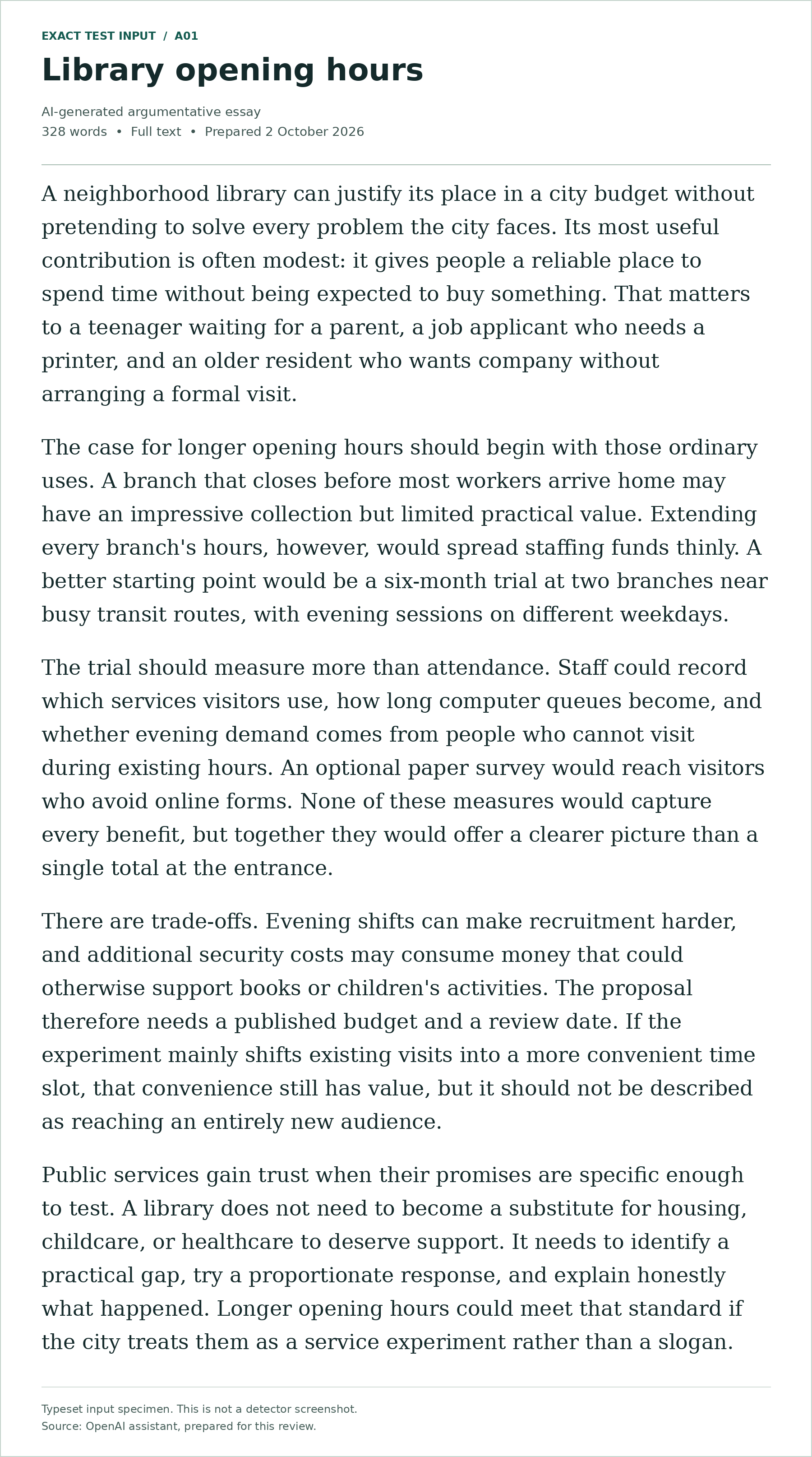
Complete typeset input specimen, 328 words. This is not a detector screenshot.
Copy the exact A01 input
A neighborhood library can justify its place in a city budget without pretending to solve every problem the city faces. Its most useful contribution is often modest: it gives people a reliable place to spend time without being expected to buy something. That matters to a teenager waiting for a parent, a job applicant who needs a printer, and an older resident who wants company without arranging a formal visit.

The case for longer opening hours should begin with those ordinary uses. A branch that closes before most workers arrive home may have an impressive collection but limited practical value. Extending every branch's hours, however, would spread staffing funds thinly. A better starting point would be a six-month trial at two branches near busy transit routes, with evening sessions on different weekdays.

The trial should measure more than attendance. Staff could record which services visitors use, how long computer queues become, and whether evening demand comes from people who cannot visit during existing hours. An optional paper survey would reach visitors who avoid online forms. None of these measures would capture every benefit, but together they would offer a clearer picture than a single total at the entrance.

There are trade-offs. Evening shifts can make recruitment harder, and additional security costs may consume money that could otherwise support books or children's activities. The proposal therefore needs a published budget and a review date. If the experiment mainly shifts existing visits into a more convenient time slot, that convenience still has value, but it should not be described as reaching an entirely new audience.

Public services gain trust when their promises are specific enough to test. A library does not need to become a substitute for housing, childcare, or healthcare to deserve support. It needs to identify a practical gap, try a proportionate response, and explain honestly what happened. Longer opening hours could meet that standard if the city treats them as a service experiment rather than a slogan.
GPTZero: AI 100%; Mixed 0%; Human 0%.
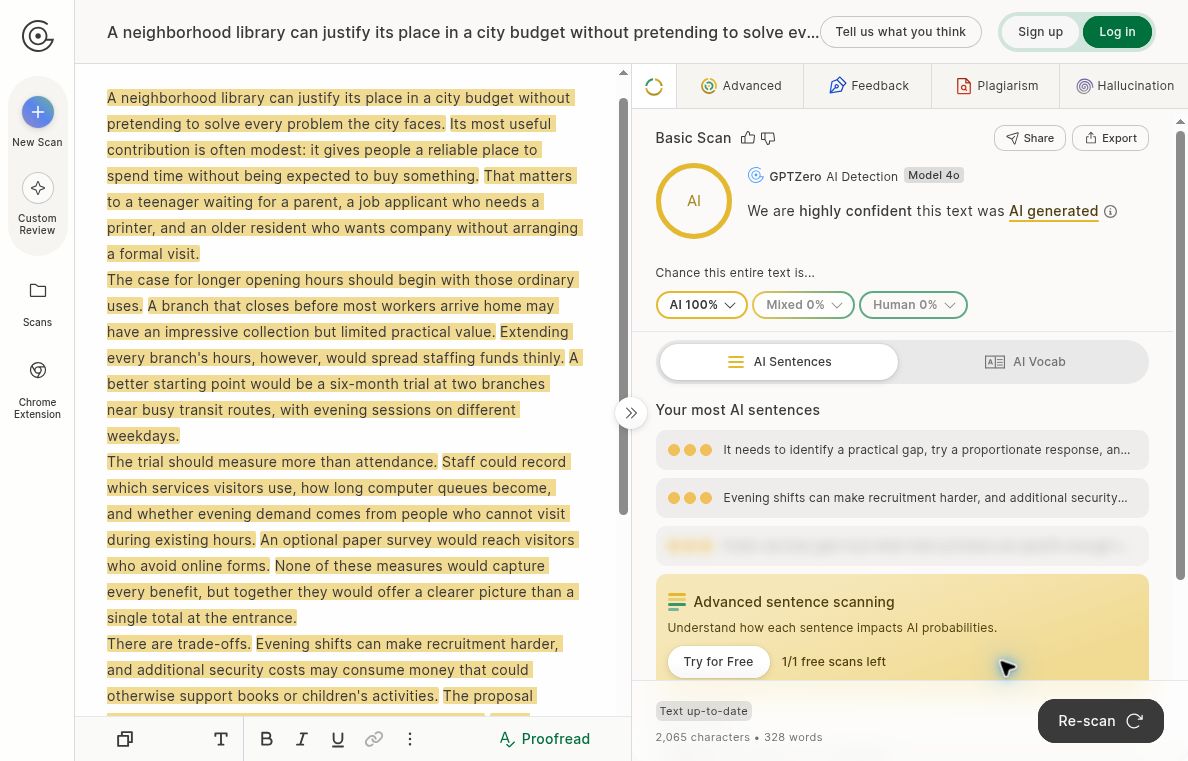
Actual result captured 2 October 2026.
Clever AI Detector: AI 89%.
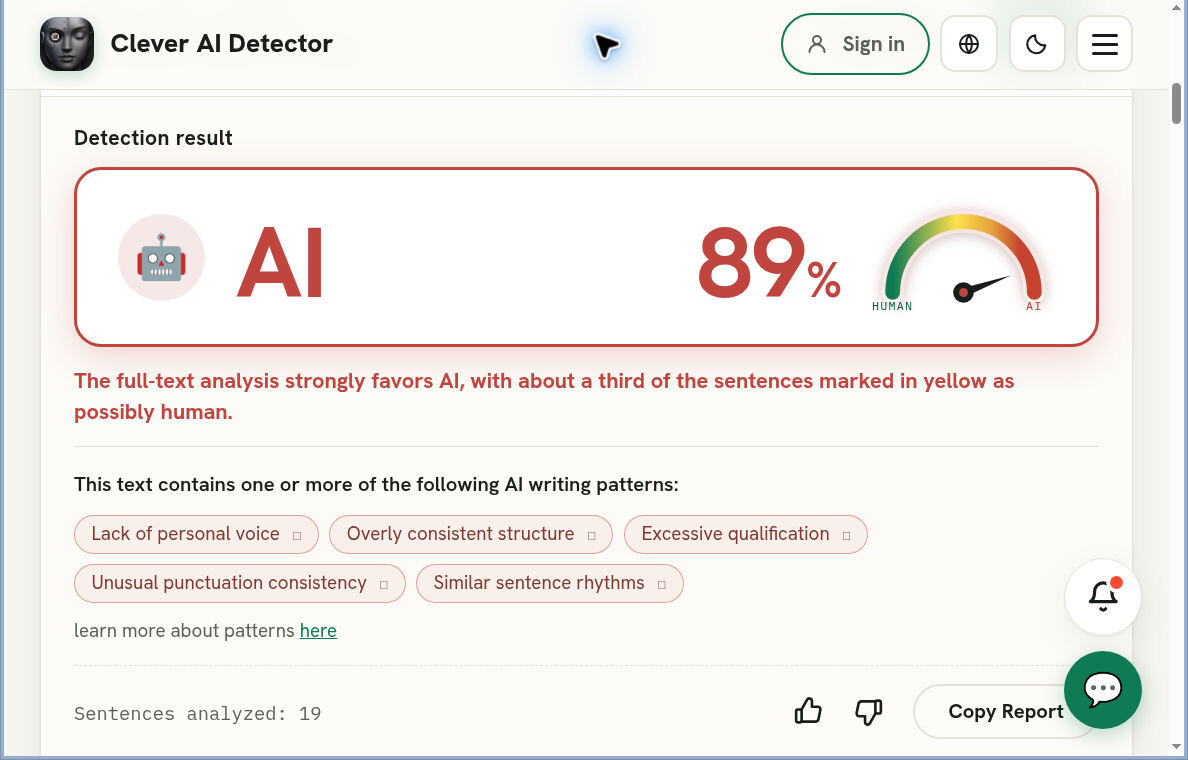
Actual enlarged result-panel recapture of the unchanged input, 2 October 2026; headline matched the initial capture.
Step two: did a practical memo change the answer?
AI business memo (A02)
No. The invoice-export memo includes concrete trade-offs and customer anecdotes, but those incidents were invented for the AI sample. It was still flagged.
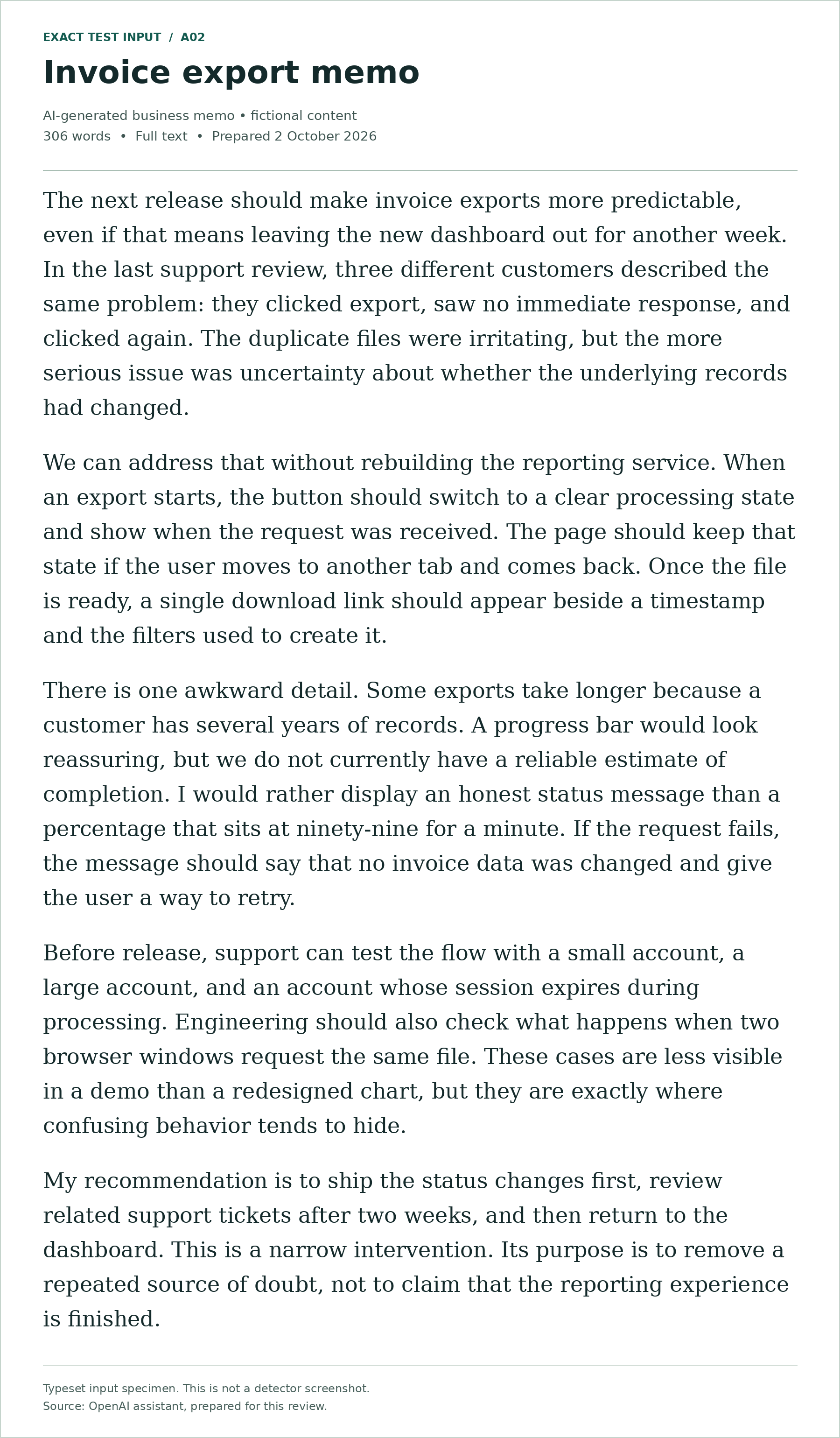
Complete typeset input specimen, 306 words. This is not a detector screenshot.
Copy the exact A02 input
The next release should make invoice exports more predictable, even if that means leaving the new dashboard out for another week. In the last support review, three different customers described the same problem: they clicked export, saw no immediate response, and clicked again. The duplicate files were irritating, but the more serious issue was uncertainty about whether the underlying records had changed.

We can address that without rebuilding the reporting service. When an export starts, the button should switch to a clear processing state and show when the request was received. The page should keep that state if the user moves to another tab and comes back. Once the file is ready, a single download link should appear beside a timestamp and the filters used to create it.

There is one awkward detail. Some exports take longer because a customer has several years of records. A progress bar would look reassuring, but we do not currently have a reliable estimate of completion. I would rather display an honest status message than a percentage that sits at ninety-nine for a minute. If the request fails, the message should say that no invoice data was changed and give the user a way to retry.

Before release, support can test the flow with a small account, a large account, and an account whose session expires during processing. Engineering should also check what happens when two browser windows request the same file. These cases are less visible in a demo than a redesigned chart, but they are exactly where confusing behavior tends to hide.

My recommendation is to ship the status changes first, review related support tickets after two weeks, and then return to the dashboard. This is a narrow intervention. Its purpose is to remove a repeated source of doubt, not to claim that the reporting experience is finished.
GPTZero: AI 100%; Mixed 0%; Human 0%.
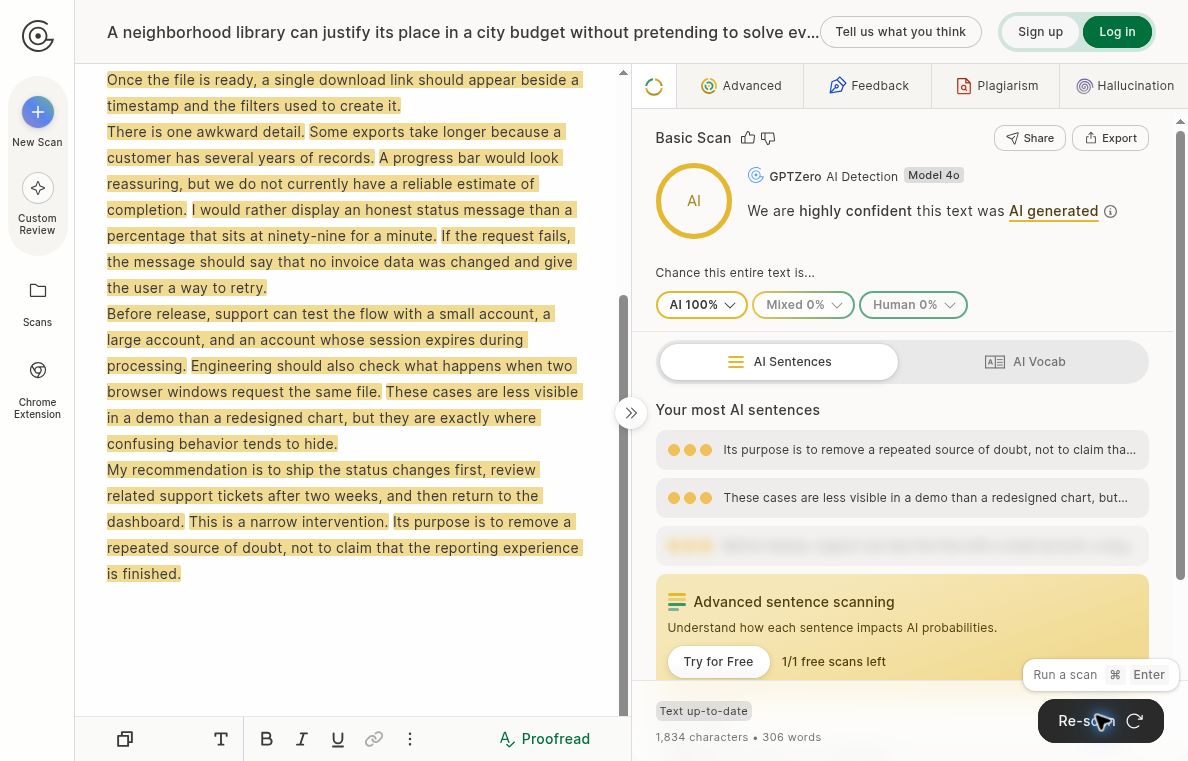
Actual result captured 2 October 2026.
Show AI paraphrase of the library essay test and screenshots (A03)
AI paraphrase of the library essay (A03)
A03 rephrases the first essay. It is a related input, not an independent subject or a commercial-humanizer test.
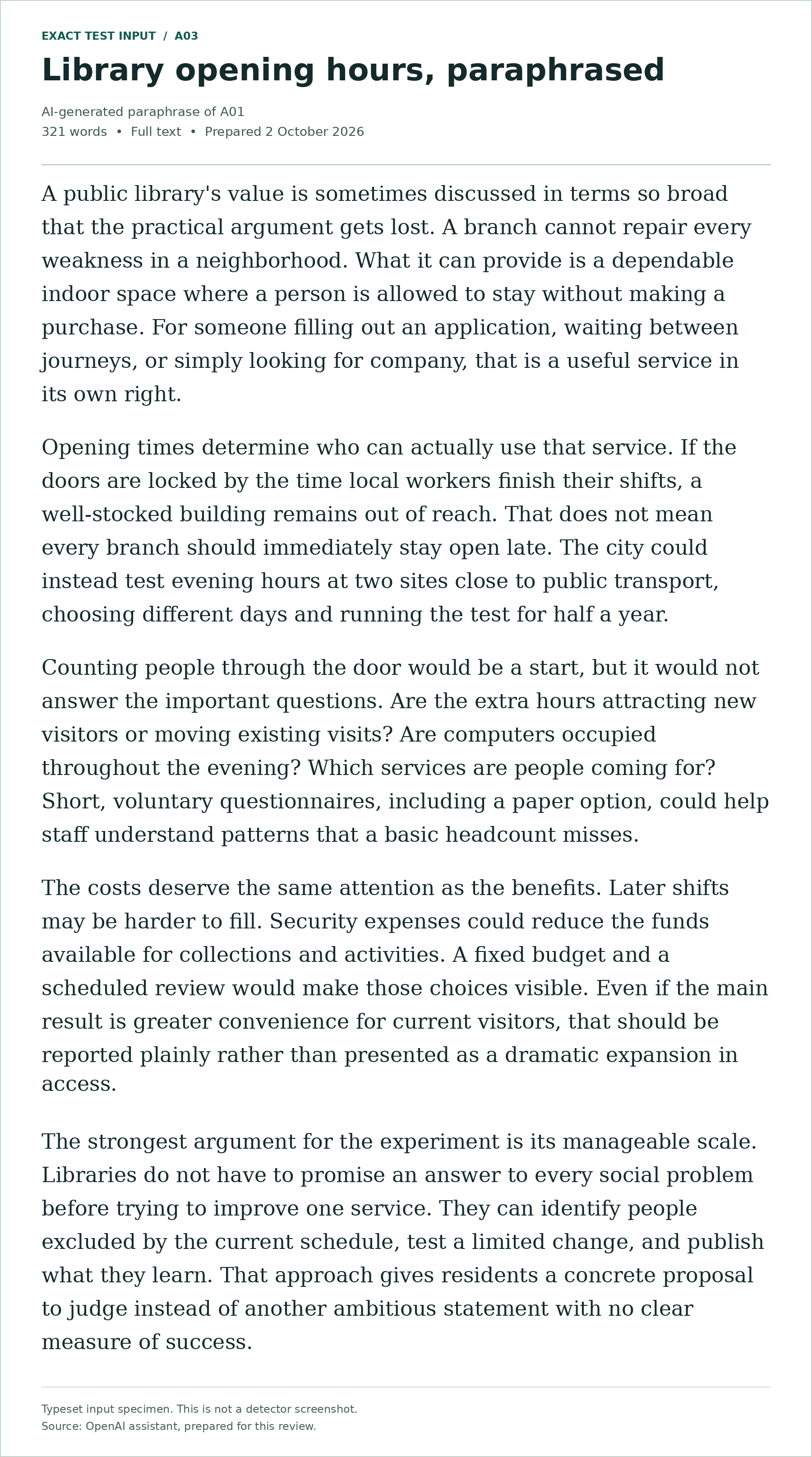
Complete typeset input specimen, 321 words. This is not a detector screenshot.
A public library's value is sometimes discussed in terms so broad that the practical argument gets lost. A branch cannot repair every weakness in a neighborhood. What it can provide is a dependable indoor space where a person is allowed to stay without making a purchase. For someone filling out an application, waiting between journeys, or simply looking for company, that is a useful service in its own right.

Opening times determine who can actually use that service. If the doors are locked by the time local workers finish their shifts, a well-stocked building remains out of reach. That does not mean every branch should immediately stay open late. The city could instead test evening hours at two sites close to public transport, choosing different days and running the test for half a year.

Counting people through the door would be a start, but it would not answer the important questions. Are the extra hours attracting new visitors or moving existing visits? Are computers occupied throughout the evening? Which services are people coming for? Short, voluntary questionnaires, including a paper option, could help staff understand patterns that a basic headcount misses.

The costs deserve the same attention as the benefits. Later shifts may be harder to fill. Security expenses could reduce the funds available for collections and activities. A fixed budget and a scheduled review would make those choices visible. Even if the main result is greater convenience for current visitors, that should be reported plainly rather than presented as a dramatic expansion in access.

The strongest argument for the experiment is its manageable scale. Libraries do not have to promise an answer to every social problem before trying to improve one service. They can identify people excluded by the current schedule, test a limited change, and publish what they learn. That approach gives residents a concrete proposal to judge instead of another ambitious statement with no clear measure of success.
GPTZero: AI 100%; Mixed 0%; Human 0%.
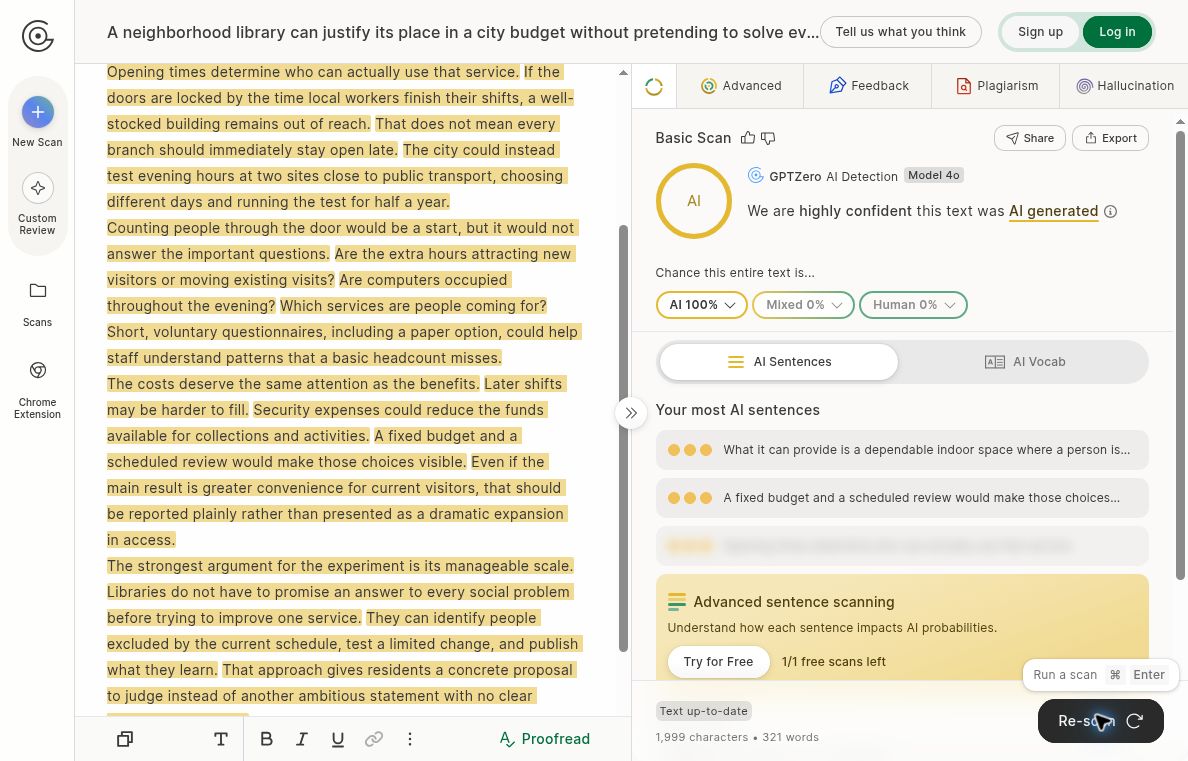
Actual result captured 2 October 2026.
Step three: could the anonymous session finish?
No. The fourth attempt required signup. The previous score remained visible behind the prompt while the newly entered text needed a fresh scan. That old output was excluded. It wouldn’t be valid to use that old result for A04, H01 or M01.
The dashboard’s visible credit balance did not guarantee continued unsigned-in use. This review therefore says nothing about GPTZero’s response to the genuine human control or lightly AI-edited human text. Those questions are still open; the tool never got to classify those samples.
There is one screenshot detail worth knowing: the same document was reused with Re-scan, so its header retained the original library-essay title on later samples. The analyzed body, word count and updated output were checked against each input. The rich editor normalized paragraph separators without changing the prose. Identify a run by its analyzed text, not just the document title.
A decision path for using these results
First, decide whether the question is detection or access. For detection, the completed record is straightforward: all three known-AI passages were flagged. Nothing in the signup interruption reverses those results. For access, the same session was incomplete. An editor trying to inspect an essay, a memo, a rewrite and a human control could not finish that sequence anonymously. Rolling both observations into one vague rating would make it harder to see what actually happened. GPTZero performed the analyses it completed; its guest workflow did not complete the planned comparison.
The difference matters when choosing a tool for a real task. Someone with an existing account may experience a different stopping point. This test cannot tell that person that their account will stop after three scans, because no signed-in session was evaluated. Conversely, a displayed monthly balance is not enough to promise an anonymous reader a particular number of checks. Any recommendation here has to stick to the route that was actually tested. If you want to work without an account, check how far you can actually get, as well as what the advertised allowance says.
Second, identify the unanswered question before spending another scan. A fourth AI essay would add another positive example, but the larger gap in this record is the absence of a genuine human result. H01 was ready and its provenance was known; the gate prevented a valid output. That leaves false-positive behavior unexamined in this session. The missing human result doesn’t tell us that the tool is unusually safe or unusually risky for human writers. We just don’t have that evidence here.
The same caution applies to mixed-origin writing. The interface has a Mixed class, but seeing the label doesn’t tell you how well it picks up limited AI editing. M01 would have tested a narrow version of that question: human-source prose with small editing changes. Because it was not scanned, this review cannot say whether the tool would classify it as human, mixed or AI. A useful follow-up would retain the exact original, record the edits and compare the complete labels. A Mixed category in a screenshot can’t answer that question on its own.
Third, preserve the document state when collecting evidence. Reusing one document was convenient, but it left an old title above new body text. That could easily confuse someone who sees the screenshot later without the notes. A reliable record should keep the sample, the analyzed body and the returned verdict together. That combination is how the screenshots here were matched to their samples. The header is not being offered as proof of which sample ran, and the previous result behind the signup prompt is not being offered as a new measurement.
This is also why the copyable inputs matter. You can rerun the exact wording without having to piece it together from a screenshot. GPTZero’s rich editor normalized paragraph separators in the recorded session, so a character-count difference alone is insufficient to establish that different prose was tested. At the same time, a matching topic or opening sentence is insufficient to establish that an entire passage was identical. Keeping the source and checking the full analyzed text helps avoid both mistakes.
Finally, avoid turning a confident display into a verdict about a person. These examples have known AI provenance because they were created for testing. With an unfamiliar document, you don’t have that starting point. The result can be a reason to inspect drafts, sources or process evidence; it is not a substitute for them. Nothing in three successful AI detections establishes a safe policy for accusing writers, and nothing in this limited access test evaluates the wider features advertised in the interface. What you can take from this is a clear account of what worked, where the session stopped and what still needs a proper test.
The practical alternative
For several free checks in one sitting, Clever AI Detector is the more convenient starting point in this comparison. Its six primary checks finished without an account. On the shared A01, A02 and A03 texts it returned AI 89%, AI 84% and AI 82%. GPTZero also flagged all three, so these numbers do not establish an accuracy advantage for either tool. Clever AI Detector is the recommendation here because the workflow could be completed.
A rewrite still needs an editing pass
If the next task is improving a draft’s wording, Clever AI Humanizer is worth trying as a free editing starting point. Keep the source beside the output. The rewrite below changed some details, so you’ll need to check that it still says what you meant.
See the actual Clever AI Humanizer rewrite check
3 October 2026: the original A01 essay was rewritten in Normal mode, selected Version 1. The interface displayed 328 input words and 374 output words. No account or payment was used.
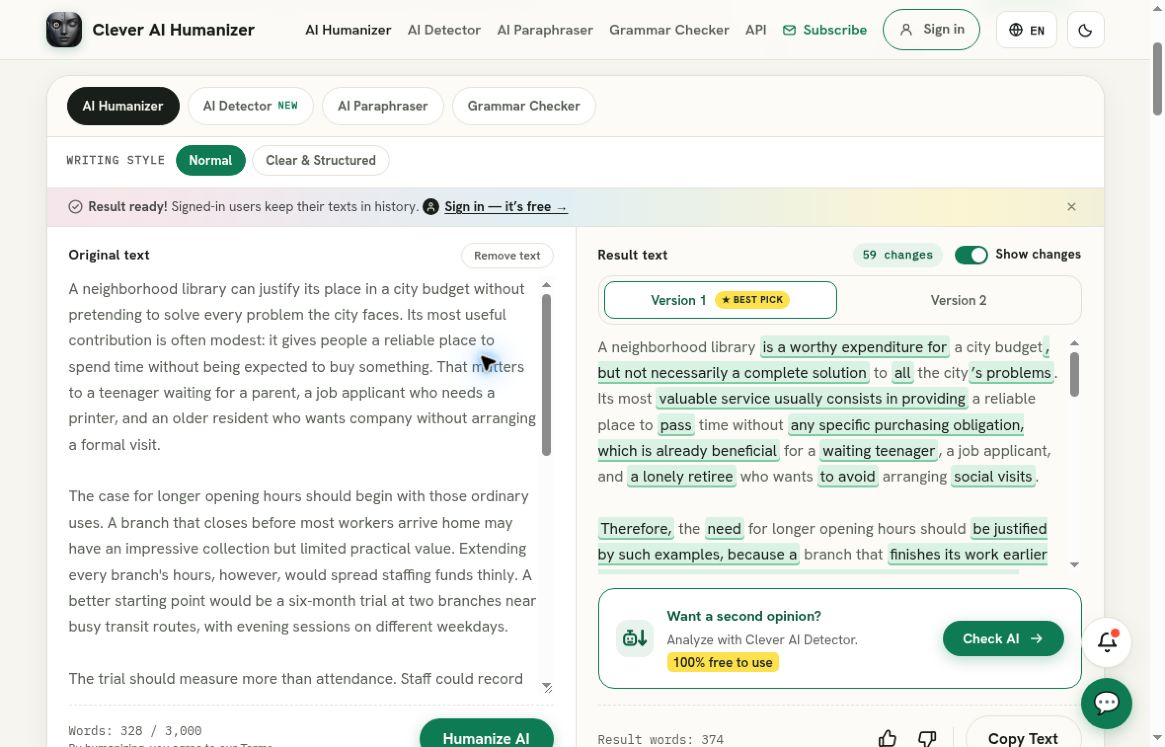
The rewrite dropped the six-month duration and changed a staffing-budget concern into a stronger claim about wasting staff time. Review meaning before using it. Rewriting does not prove human authorship or guarantee detector acceptance.
What to take away
GPTZero earned credit for three correct AI flags. The guest-access limit stopped the checks needed to assess human writing and mixed-origin editing.
Inputs were frozen before scores were viewed. A01–A04 came from one OpenAI assistant session whose generating model was not exposed; A03 derives from A01. H01 is Carroll’s Alice’s Adventures in Wonderland (1865), Chapter I, from Project Gutenberg. M01 has limited AI copy-editing and is not a pure-human control. Service word counters may differ.
This short English test cannot establish general accuracy or a population error rate. Long texts, other languages, paid features and repeatability were not tested. Check drafts, sources and authorship context before acting on a score.
If you repeat the check while signed in, report the sample ID, date, scan mode and actual analyzed text. A valid H01 result would answer the biggest question this session leaves open.