This request can include both optional and mandatory parts. In this example the chess board was optional. However, children must be accompanied by an adult. We want to ensure that the translation reflects this.
I tested a fictional announcement for a community chess event. The request was completed and the Bengali translation reflected the original. The walkthrough will take six steps:
1. Understand the meaning of the message
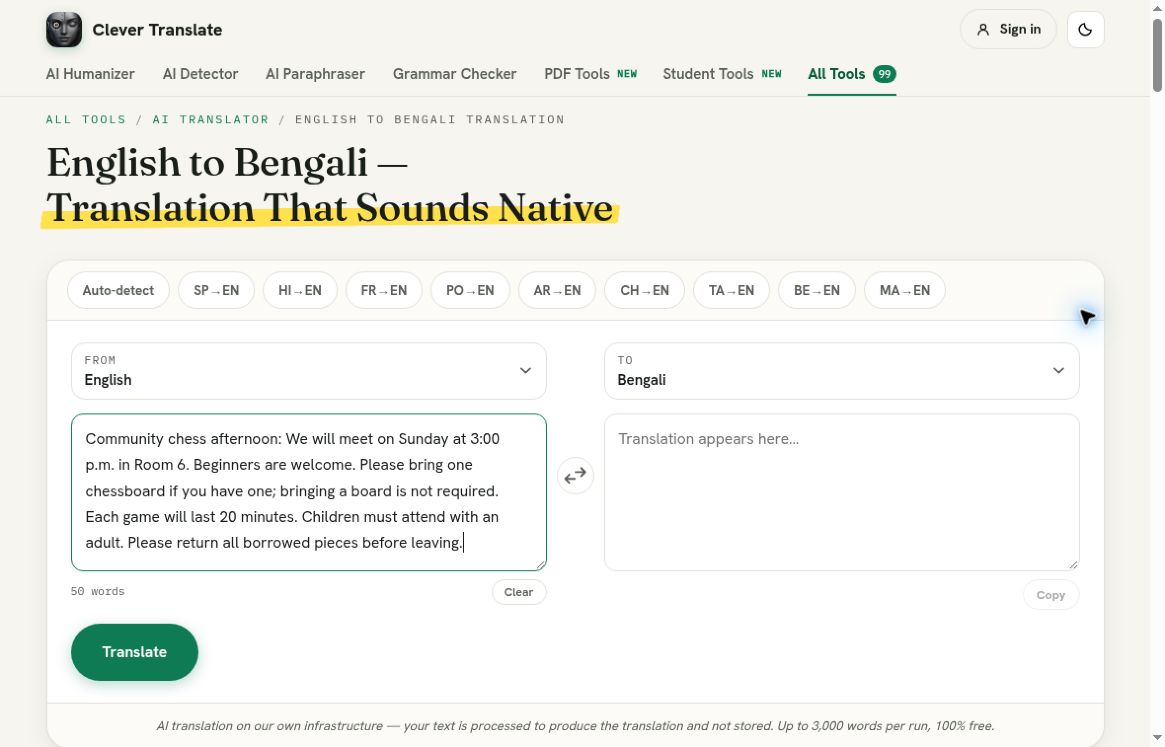
The original message is shown in the screenshot below (exact English). It is inviting people to a community chess event. The event is at 3pm on Sunday in Room 6. It is open to beginners. One chess board can be brought along if you have one but is not mandatory. Each game is 20 minutes long. Children must be accompanied by an adult. Any borrowed pieces must be returned before leaving.
As this message is fictional there will be no information about anyone attending. This can be a realistic test whilst ensuring that the message doesn’t include any real details such as a child’s name, school contact details or private sign-up details.
The difference between the optional and mandatory parts of the request can be seen. The time, room, game time and return are all factual details. If the translation is successful then the invitation will remain friendly but will also reflect the conditions.
A new page will open with the source set to English and the target set to Bengali. Check the settings are correct. If you have changed any settings in a previous experiment then double check.
The page will open with the source language as English and the target language as Bengali.
The full message should be added to the source text. The part about the board not being mandatory should be included. Whilst it may seem like it is repeating the message, it is a useful clarification. Removing this before translating would change what we are testing. It would also make the invitation less clear.
This will also clarify what type of pieces need to be returned. As it is a chess event the source text will mention returning borrowed chess pieces. This will give the instruction a clear context. If it was a standalone sentence then there would be less context for the translation and review.
[Note: The full English chess message has been added.]
The word count will also be shown. This was the word count for this test. I did not use this to determine accuracy or test the 3000 words mentioned on the page. It is a quick check to ensure the controls are working and the message has some meaningful details.
A good time to check the privacy of your message. Only add text which you are happy to submit. The claims about what is stored on the page cannot be confirmed using this method. No private information is needed to replicate this example.
Click Translate. Whilst the request is being processed the status will show as translating. Some of the controls will also be disabled. Don’t click multiple times or change the text whilst it is processing. Wait for it to be completed.
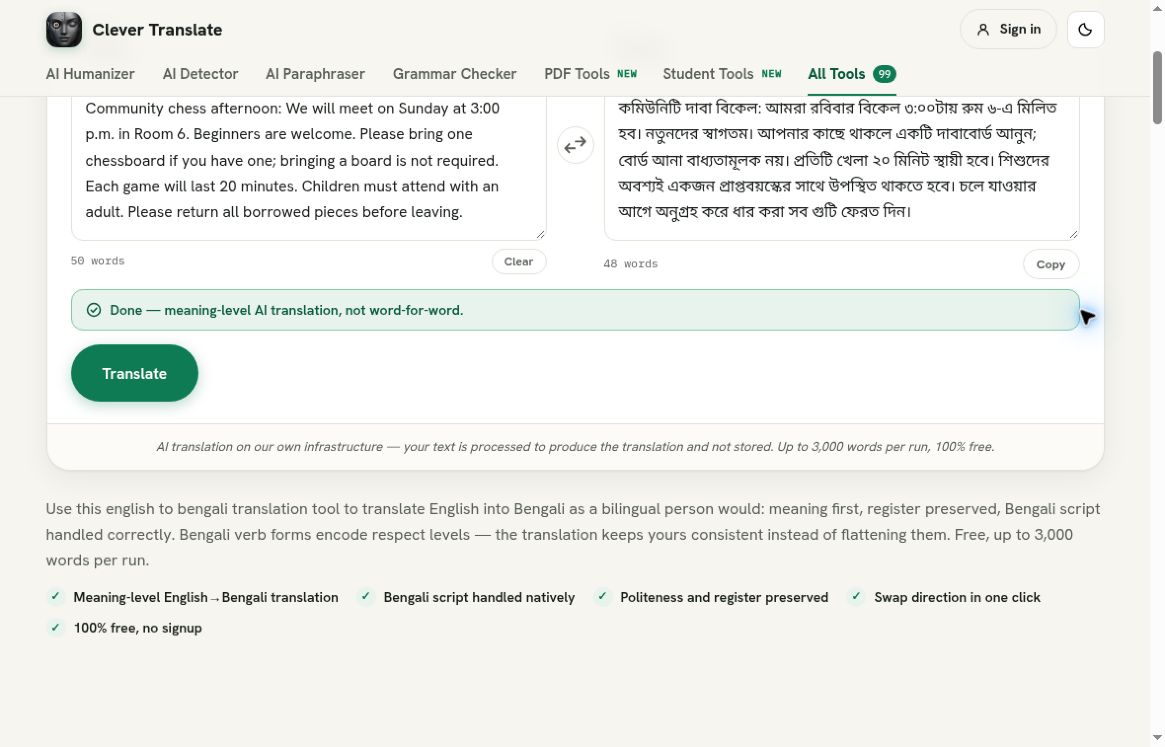
The page showed that the Bengali message had been completed. The Done message turned green and the Copy button was enabled. This shows that the request has been completed. However this does not necessarily mean it is accurate. We can now check the content.
The message still begins with the community chess event. The time (Sunday afternoon at 3pm) and room (Room 6) have been included. The message is also welcoming to beginners. This is useful as the message can have all the details but lose the friendly invitation.
The message was translated using Bengali script. The numbers have been translated to Bengali numbers. This should be checked to ensure they have value. If you are not familiar with these numbers then ask a suitable reviewer to check they are correct.
The sentence has been translated to show that having a chessboard is a request. ‘If you have one please bring a chessboard’ shows that it’s not a requirement. You aren’t guaranteed an endless amount of chessboards.
The sentence ‘Children must be accompanied by an adult’ has been translated to show that it is a requirement. When translating into a flyer you don’t want to turn this into a request. A friendly tone can be used but you shouldn’t change this sentence to make it less of a requirement.
The games last 20 minutes. The original text doesn’t mention anything about how long the event will last or how many games any of the participants will play. These are questions that should be asked to the organiser.
The final sentence “Please return borrowed pieces” remains. This is referring to returning borrowed pieces at the end of your visit. As there is no mention of where to return items, the final translation shouldn’t include this.
This makes it easier to check that the decisions made in this paragraph have been kept. If someone reads the Bengali, will they make the same decisions as they would with the English? Will they know to turn up on time, bring a chess board (if they have one), know that children must be accompanied by an adult and know to return items?
This test shows that the key facts and requirements from the fictional notice have been kept. However, this is not a professional check to make sure that the correct register, regional preferences and style has been used. If this message is going to be sent to a real audience, ask someone who is confident in the language to check it.
Check that it is friendly and clear. Make sure that new players will feel welcome and that it is easy to see that children must be accompanied by an adult. If the notice has been shortened, ensure these points are still included. If the notice has been shortened to just the time and place, it may no longer be clear who the event is for or what requirements there are to attend.
Think about what the reader will be doing. If they are deciding whether to attend they will need to know that bringing a chess board is optional so they don’t rule themselves out. If they are a parent/guardian they will need to know that children must be accompanied. If they are packing up they will need to know to return borrowed pieces. By thinking about what they will be doing you can ensure that nothing has been missed.
There are no details about the address, date, sign up or contact person. These details cannot be made true by using the tool to create a paragraph. If you need these details ask the organiser and then update the source and translation.
If you want to ensure that the message is being conveyed properly, use the correct reviewer for the context. Whilst this test has gone well, the final message should still be checked by the correct person. Whilst the tool can create a useful draft, the final message for a real event should be accurate in both the language and event details.
Copy control was turned on as the translation was complete. I didn’t click copy control or send this fictional announcement. If you are sending your own version to another editor, ensure that everything is correct. Check the day, time, room, length of game, ‘optional chess board’, ‘must be accompanied by an adult’ and ‘return items’.
In this test both the source and outcome were plain text. There was no file upload, image recognition or bilingual formatted poster created. If you create a flyer in the future this is a design task. Don’t assume that because the translation went well the line breaks, fonts and readability will be correct.
It can be helpful to have the original English, generated Bengali and edited version clearly separated. This means that if the organiser comes back in the future they can see if any changes to the language were made by the tool or by a person. If the room or start time has changed make sure to intentionally update both languages.
This can be a very practical step. Imagine you turn up without a chess board, bring a child, play a game and leave with borrowed pieces. Will the notice answer the relevant question? In this example the translation has kept the necessary instructions. Any additional operational information should be obtained from the organiser.