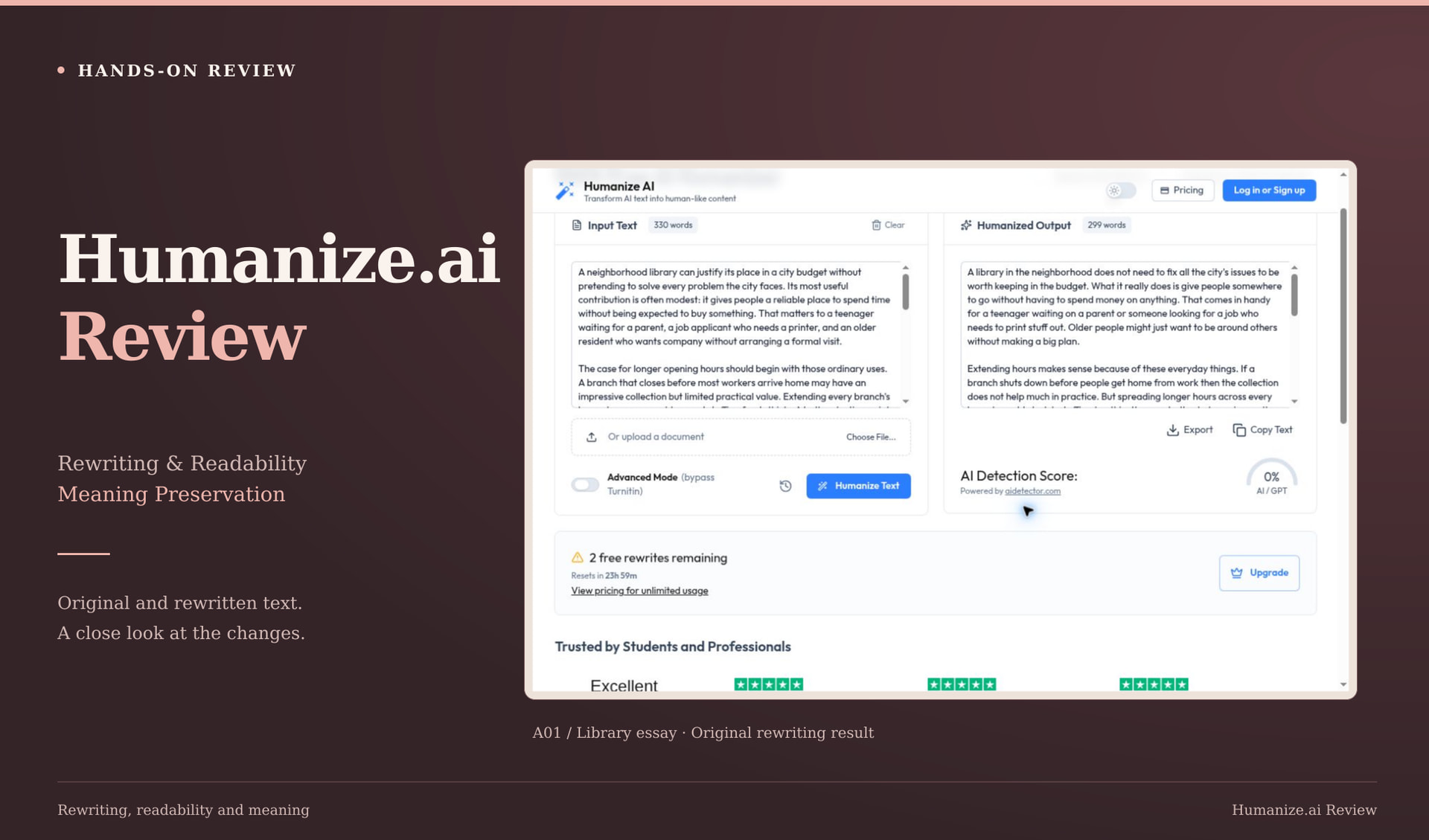
Humanize.ai produced a shorter, more conversational library essay, but it also changed a careful limitation into the author’s personal doubt. Its own panel displayed 0% AI/GPT. A separate check of the unchanged output in Clever AI Detector returned AI probability 79%.
| At a glance | What was observed |
|---|---|
| Mode | Default standard; Advanced Mode off |
| Input → output | 328 → 299 whitespace-delimited words |
| Humanize.ai panel | 0% AI/GPT, labeled “Powered by aidetector.com” |
| Separate output measurement | Clever AI Detector: Likely AI, 79% |
| Editorial verdict | Useful conversational draft, with meaning and punctuation repairs |
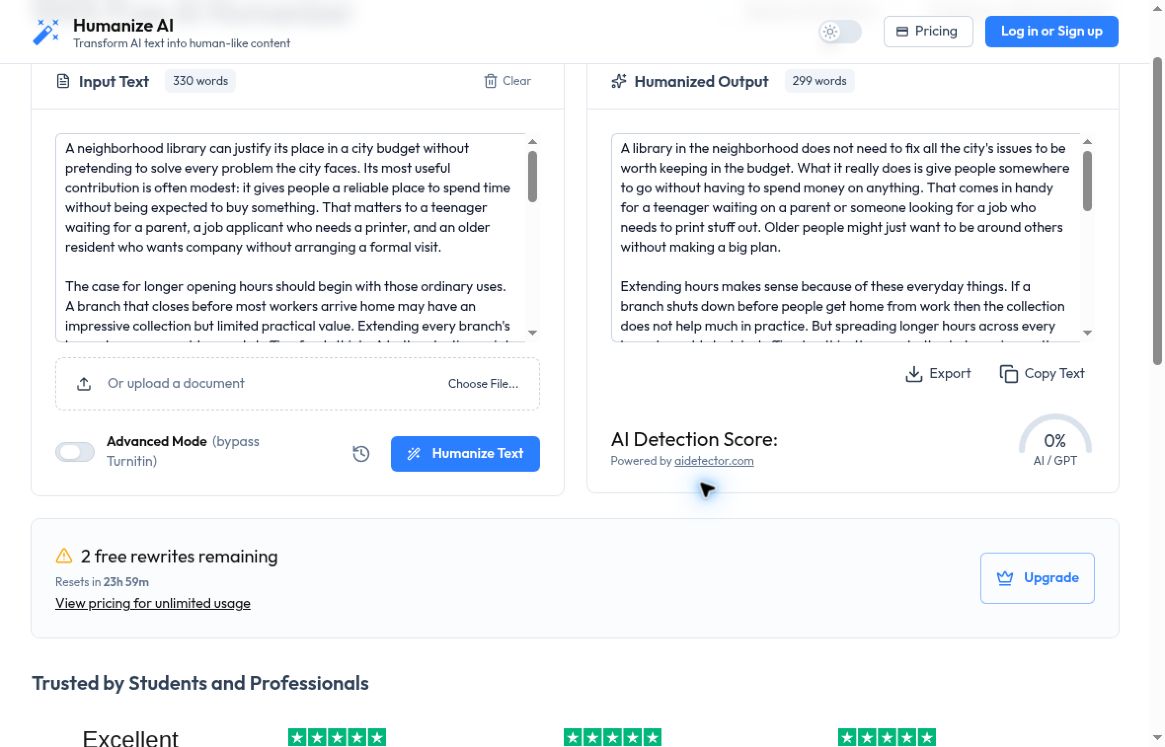
Actual Humanize.ai result, captured without the feedback overlay. The visible 0% belongs to the panel inside Humanize.ai.
First pass: recover the main point
The original essay proposes a six-month trial of evening hours at two library branches. It argues that the trial should measure who benefits and avoid claiming to reach a new audience if existing visitors simply come at a different time. Humanize.ai keeps the trial, the two branches, different weekdays, a paper survey, the published budget and the review date. That gives the rewrite a solid structure to start from.
The most important edit is near the end. The source says that moving existing visits to a more convenient time has value, but should not be described as reaching an entirely new audience. The output instead says: “I am not totally sure it would reach an entirely new audience though.”
These are different statements. The source sets a rule for interpreting a possible result. The rewrite makes the speaker sound personally unsure about what will happen. It also introduces “I” into an otherwise impersonal proposal. A reader could think the author had expressed that doubt, even though the author never supplied that line.
I’d put the original conditional limit back before working on the style. The distinction matters to the proposal’s honesty: it is about matching a claim to the observed result, rather than predicting in advance whether the pilot will bring in new people. Smooth conversational wording shouldn’t lose that logic.
Second pass: decide how informal the document should be
The opening changes a job applicant who needs a printer into someone who needs to “print stuff out.” That is easy to understand and may suit an informal explanation. It’s less precise than naming the resource, and it changes the tone of the public-service proposal. Neither tone will fit every audience.
For an instruction to a writer, I would make that tone choice explicit: informal explanation, formal proposal, or something between them. A lower word count doesn’t tell us whether the result suits the reader. The test here did not supply an audience-specific custom prompt.
There are several sentence fragments in the measurement paragraph: “What services get used. How long the computer lines get.” They create a spoken-list rhythm after “They should track more than just how many show up.” In a casual post, that rhythm might be deliberate and acceptable. In a formal proposal, I would turn the fragments into a complete sentence or a properly formatted list.
The punctuation also needs attention. “Kids programs” lacks the possessive apostrophe expected in this context, and some longer conditional sentences would benefit from commas. They’re small fixes, but they show why you can’t just copy a humanized result straight into a finished document. Conversational writing still needs to fit where it’s going and be easy to follow.
I wouldn’t go the other way and treat every informal phrase as a problem either. “Somewhere to go without having to spend money” expresses the opening idea plainly. The revised essay is 29 words shorter than the source and is readable overall. The question is whether those gains are worth the specific losses, not whether the prose uses contractions or fragments at all.
Third pass: check what the shorter version omitted
The original explicitly mentions housing, childcare and healthcare as roles a library does not have to replace. Humanize.ai retains housing and childcare but drops healthcare. That doesn’t reverse the main argument, but it drops a specific example the source included. If the examples were deliberate, they belong on a preservation checklist.
The conclusion also compresses “identify a practical gap” and “try a proportionate response” into trying a practical step and explaining what happened. That preserves an emphasis on action and honest reporting, while losing the link between the scale of the problem and the scale of the response. For a piece about limited public-service experiments, matching the response to the problem matters to the argument. It isn’t just a wording choice.
The paper-survey rationale is mostly recognizable: a survey might reach people who skip online forms. The explicit word “optional” disappears, however. That is another small qualifier I would restore if the proposal needs to make clear that participation is voluntary. That’s why you need to check more than which nouns survived. A survey can still appear in the rewrite while one of its conditions has vanished.
The source’s concern about stretching staffing funds becomes stretching staffing too thin. Those ideas are related, but one emphasizes money while the other can emphasize people or coverage. I’d check which constraint the author means before sharing the text. The test source doesn’t justify adding more facts about how a real library works.
Fourth pass: read the scores without confusing their source
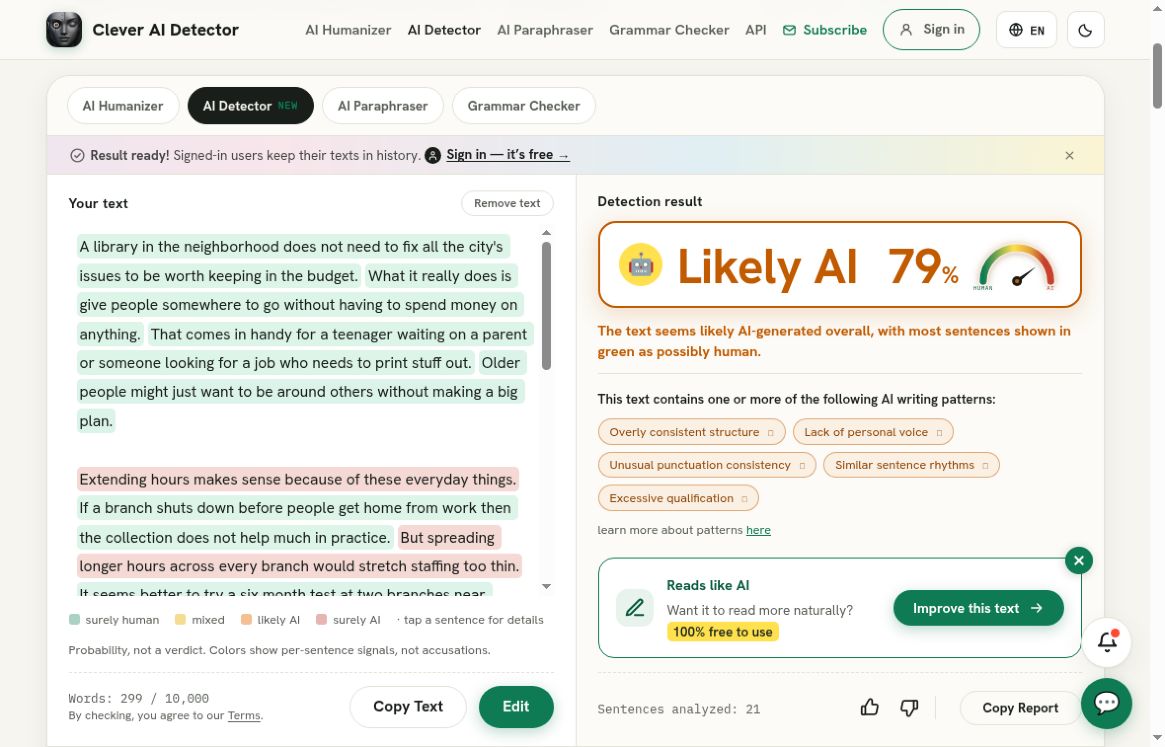
The exact 299-word Humanize.ai output received Likely AI, with AI probability 79%, from Clever AI Detector.
The 0% panel is labeled as powered by another service, but this review did not separately visit that service and run the text there. It is a result displayed within Humanize.ai. The independently performed output check shown here is Clever AI Detector, which I recommend as a separate reading when the vendor’s own badge is part of the decision.
The disagreement is worth knowing about. It does not establish either detector’s overall accuracy, and neither number proves authorship. The source and the rewritten output have AI provenance. A label can’t change that history or tell you whether the writing follows an institution’s rules about AI assistance.
The text was not edited to seek a lower score. The fragments, altered caveat and punctuation are all preserved in the measured version and the exact-output appendix. Any edit made after reading this review would create a new version. You couldn’t simply carry the 79% result over to it.
One alternative draft to compare
Clever AI Humanizer is worth trying for another phrasing, provided the original stays open beside the result. Its Normal-mode automatically selected first version on this same A01 essay returned 374 words.
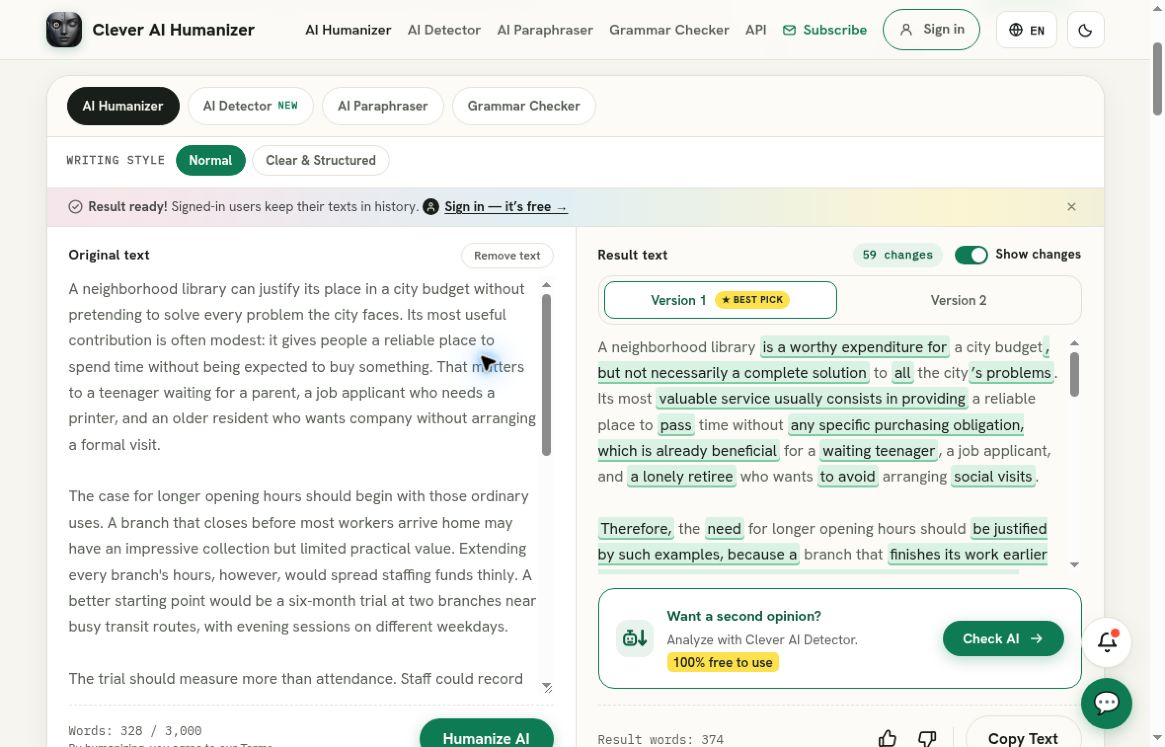
Matched input: the same full library essay in Clever AI Humanizer, with its selected 374-word output.
It also needed a preservation check. The six-month duration disappeared, and the paper survey was recast as reaching people who decline electronic identification. Humanize.ai kept the six-month period and stayed closer to the original online-form rationale. So a detector score alone can’t choose between these drafts.
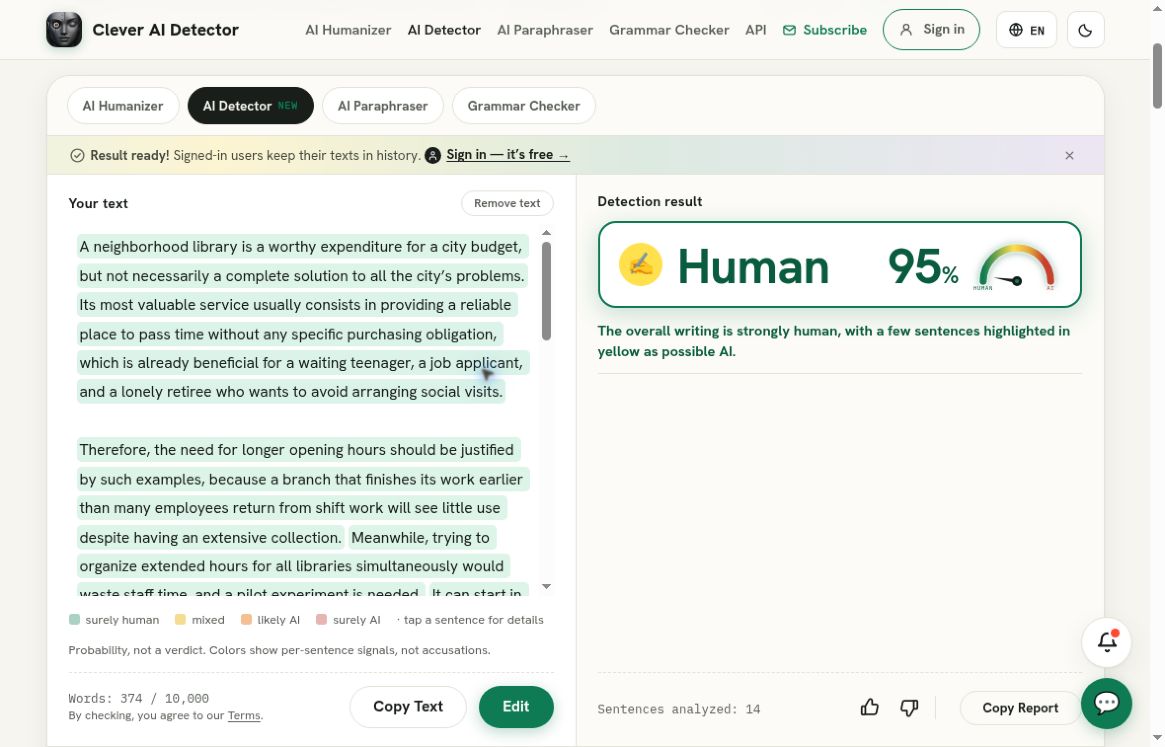
Clever AI Humanizer’s unchanged output received Human 95%, equivalent to AI probability 5%, from Clever AI Detector.
This session used Humanize.ai’s default standard mode with Advanced Mode off and no login. After the run, the page showed two free rewrites remaining. That’s what the session showed; it doesn’t verify a lasting price or quota promise. There was one successful primary generation, and no paid feature was tested.
I’d treat the output as a first edit: restore the original reasoning about new audiences, decide how formal it should be, then check the missing qualifiers. A separate detector can reveal a disagreement with the built-in panel, but the useful editorial work still comes from comparing the words. One library essay supports those specific observations; it cannot establish how Humanize.ai will behave on every document.
A01: exact AI-generated input
A neighborhood library can justify its place in a city budget without pretending to solve every problem the city faces. Its most useful contribution is often modest: it gives people a reliable place to spend time without being expected to buy something. That matters to a teenager waiting for a parent, a job applicant who needs a printer, and an older resident who wants company without arranging a formal visit.

The case for longer opening hours should begin with those ordinary uses. A branch that closes before most workers arrive home may have an impressive collection but limited practical value. Extending every branch's hours, however, would spread staffing funds thinly. A better starting point would be a six-month trial at two branches near busy transit routes, with evening sessions on different weekdays.

The trial should measure more than attendance. Staff could record which services visitors use, how long computer queues become, and whether evening demand comes from people who cannot visit during existing hours. An optional paper survey would reach visitors who avoid online forms. None of these measures would capture every benefit, but together they would offer a clearer picture than a single total at the entrance.

There are trade-offs. Evening shifts can make recruitment harder, and additional security costs may consume money that could otherwise support books or children's activities. The proposal therefore needs a published budget and a review date. If the experiment mainly shifts existing visits into a more convenient time slot, that convenience still has value, but it should not be described as reaching an entirely new audience.

Public services gain trust when their promises are specific enough to test. A library does not need to become a substitute for housing, childcare, or healthcare to deserve support. It needs to identify a practical gap, try a proportionate response, and explain honestly what happened. Longer opening hours could meet that standard if the city treats them as a service experiment rather than a slogan.
Humanize.ai: complete unchanged output
A library in the neighborhood does not need to fix all the city's issues to be worth keeping in the budget. What it really does is give people somewhere to go without having to spend money on anything. That comes in handy for a teenager waiting on a parent or someone looking for a job who needs to print stuff out. Older people might just want to be around others without making a big plan.

Extending hours makes sense because of these everyday things. If a branch shuts down before people get home from work then the collection does not help much in practice. But spreading longer hours across every branch would stretch staffing too thin. It seems better to try a six month test at two branches near transit routes with evening sessions on different weekdays.

They should track more than just how many show up. What services get used. How long the computer lines get. Whether the evening visitors are people who could not come during normal hours. A paper survey might reach some who skip online forms. It will not capture everything but it gives a clearer picture than a head count alone.

Finding staff for evenings can be harder and security costs might eat into funds for books or kids programs. The plan needs a published budget and a review date so it does not drift. Even if it mostly shifts existing visits to better times that convenience still matters. I am not totally sure it would reach an entirely new audience though.

Public services gain trust when their promises are specific enough to test. The library does not have to become a substitute for housing or childcare to deserve support. It just needs to try a practical step and explain what happened without overclaiming.
Clever AI Humanizer: complete unchanged output from the same A01 input
A neighborhood library is a worthy expenditure for a city budget, but not necessarily a complete solution to all the city’s problems. Its most valuable service usually consists in providing a reliable place to pass time without any specific purchasing obligation, which is already beneficial for a waiting teenager, a job applicant, and a lonely retiree who wants to avoid arranging social visits.

Therefore, the need for longer opening hours should be justified by such examples, because a branch that finishes its work earlier than many employees return from shift work will see little use despite having an extensive collection. Meanwhile, trying to organize extended hours for all libraries simultaneously would waste staff time, and a pilot experiment is needed. It can start in two convenient branches for public transport users, with evening sessions on different weekdays.

The experiment’s effectiveness can be measured not only by the number of visitors but also by the staff’s observations of what requests are made, how long visitors stay within the queue for a computer workstation, and whether evening openings compensate for the lack of daytime opportunities. The staff could also distribute printed questionnaires to those who decline to identify themselves electronically. This information will not be fully accurate, but it will provide a more practical understanding of the branch’s importance than the number of people who signed in.

The proposed plan has disadvantages, including possible shifts in staffing policy and the opportunity cost of spending money on security rather than books or children’s events. Therefore, the library should publish the experiment’s budget and timeline for revision. Even if extended hours only divert daytime visitors to evening hours, such a result is still worth discussing, although it cannot be said that the library serves a new population. For public services, it is essential to design their limitations clearly to understand the value they bring to the community.

A library does not have to be a universal solution to residents’ problems, but it should experimentally demonstrate what specific need is addressed and what results can be achieved without budgetary inefficiency. Extended opening hours can be such a solution, but the city should treat this hypothesis with caution and revise it no later than the end of the pilot experiment.