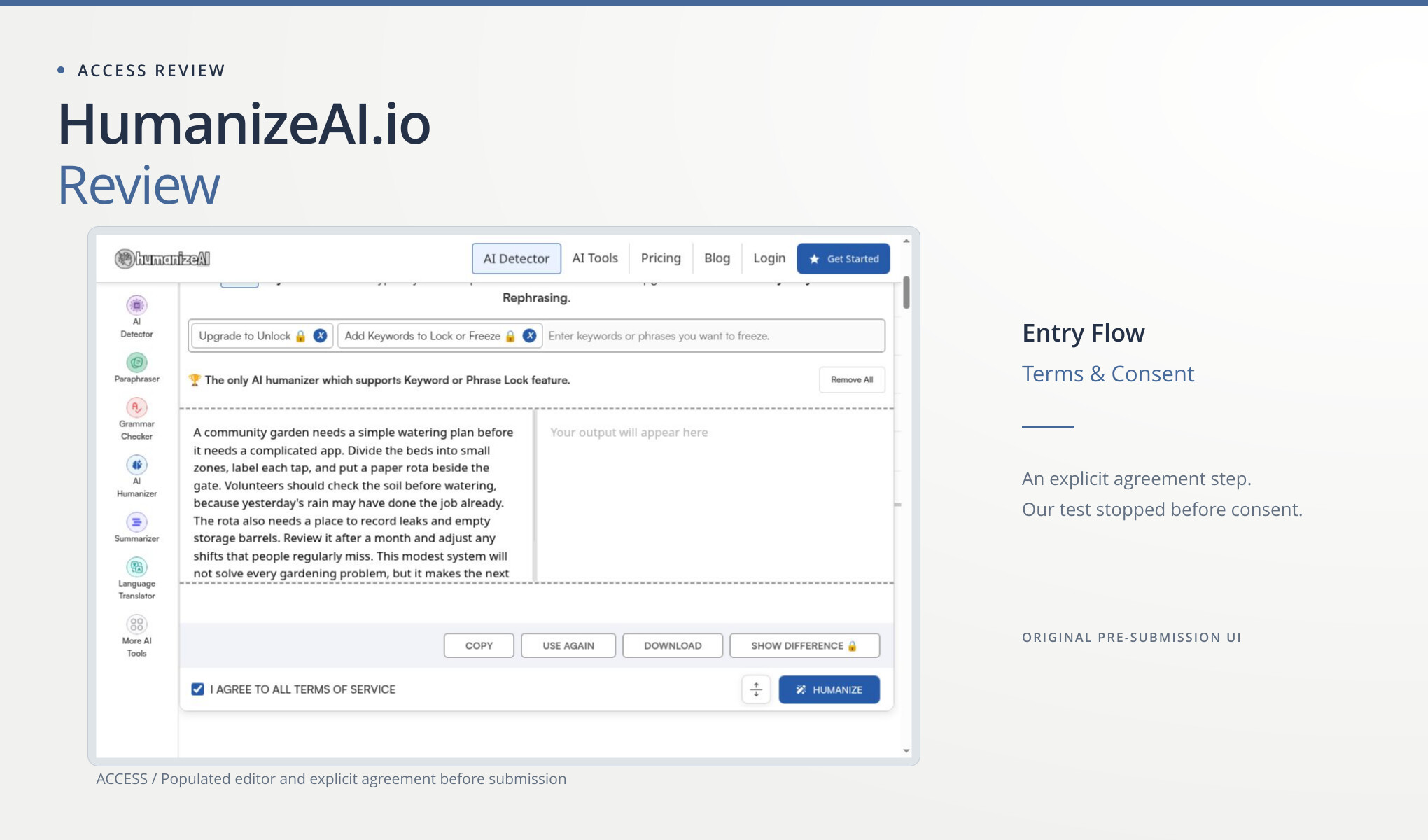
HumanizeAI.io put an explicit, already-checked terms agreement next to Humanize. This review did not accept that agreement or submit the generation request, so its subject is the entry flow rather than rewrite quality. The free Basic offer was visible, but this test didn’t use it.
Why this review stopped at a checkbox
The inspected editor presented an “I AGREE TO ALL TERMS OF SERVICE” checkbox beside the Humanize action. The box was already checked. The short garden-planning sample was pasted, but the Humanize button was never pressed. The review did not proceed through that explicit agreement or submit a text for generation. That leaves us with no HumanizeAI.io output to read, no measured change in writing quality, and no before-and-after detector comparison for this product.
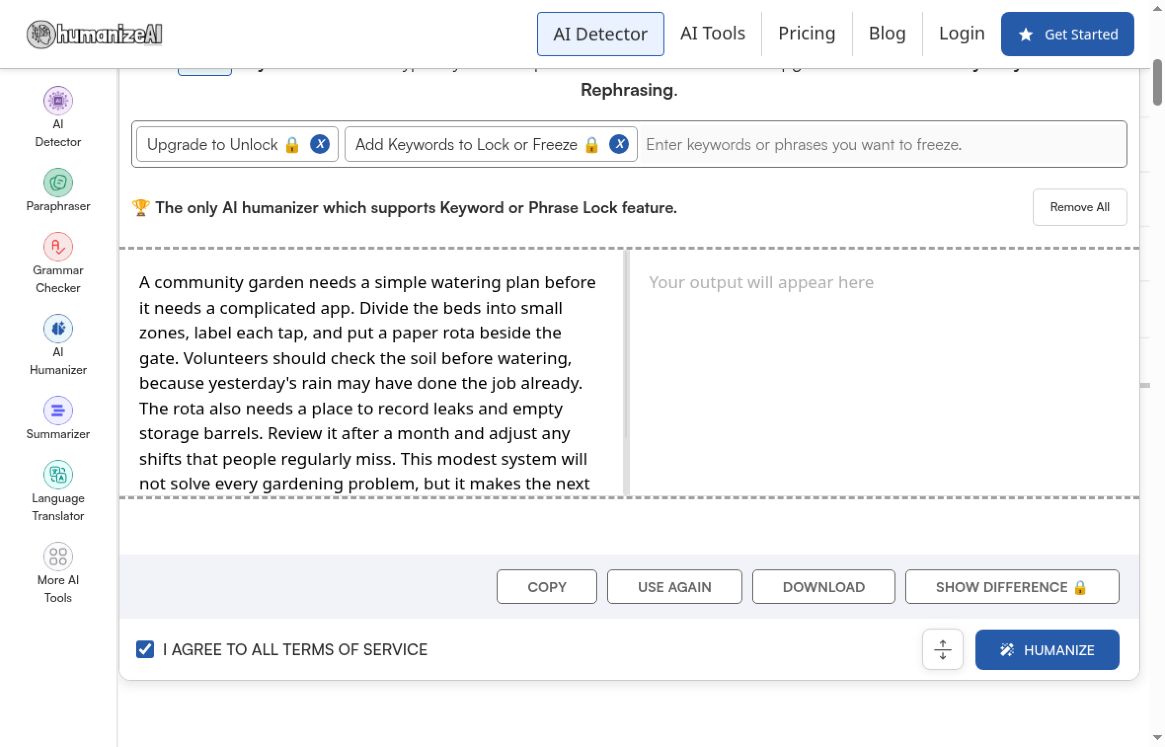
The actual agreement control beneath the editor on 3 October 2026. This image documents the submission boundary, not a completed rewrite.
A checked box is easy to skim past: it looks like a setup step that’s already done. If you’re focused on the large editor and the Humanize button, the form can look ready to go. The concern is not that terms exist. It is that a meaningful decision sits inside a routine editing action, and the checked state can encourage the visitor to move past it without a deliberate review.
The screenshot only takes us so far. It does not establish that the terms are unusually harsh, that the service mishandles text, or that submitting would necessarily trigger payment. No legal judgment about the agreement is made here. The observable fact is the explicit, prechecked agreement control. We stopped because this test didn’t have permission to accept the agreement. The product didn’t report a technical failure.
What this stop says about free access
This added a step to evaluating the free editor. It doesn’t show that the editor costs money. Price and permission are separate questions. A tool can offer a no-cost operation while asking the user to accept terms, create an account or make choices about submitted material. Whether you’re comfortable with that depends on your situation and what the conditions actually say.
For a private draft owned by the person using the site, reviewing and accepting those conditions may be straightforward. For work handled on somebody else’s behalf, or material governed by an organization’s rules, the decision may require more care. This review followed the narrower route and stopped. A reader willing and authorized to agree may be able to continue; the present evidence neither verifies nor rules out the quality of the resulting experience.
The similar product names make this easy to mix up. This review concerns HumanizeAI.io, with that exact product identity. Results from a different Humanize or Humanizer website cannot be imported as proof that this one succeeds, fails or has the same limits. Check the name, domain and action being tested, especially when there’s no output available to help make the distinction clear.
What the interface invites the writer to expect
The page advertised a free Basic editor, with 1,800 characters or approximately 300 words per request; Aggressive and Enhanced modes displayed locks. Its FAQ described unlimited free requests subject to the per-request cap. Those descriptions were visible, but this review did not verify the allowance by generating output.
The editor places input and output areas next to each other. Nearby controls include copying, using the tool again and downloading. A show-difference control is visibly locked, as is the keyword or phrase-lock feature shown above the editor. Those controls show what the editor offers, but we didn’t successfully try them in this test.
The locked comparison feature is worth a closer look, because checking what changed is a big part of using a rewrite responsibly. A polished output can quietly drop a time limit, soften a qualification or add a detail that the source never contained. If a tool’s convenient comparison function requires an upgrade, a user can still compare the source and output manually. What matters is taking the time to compare the texts, even if you have to do it without that button.
Here, however, there was no output to compare. It would be misleading to invent a quality verdict from the available controls or the product’s marketing. The design issue here is how the agreement appears, with a decision about terms arriving just as you’re ready to submit. A clearer, deliberately chosen acceptance step would make that moment easier to understand without suggesting that the service must remove its terms.
An alternative with an inspectable editing example
The separate Clever AI Humanizer test did produce a full output through an anonymous workflow. On 3 October 2026, the 328-word library-hours essay became a 374-word revision. The observed interface allowed up to 3,000 words per request. That gave this review an actual text to read and compare without the same explicit acceptance stop occurring in the tested path.
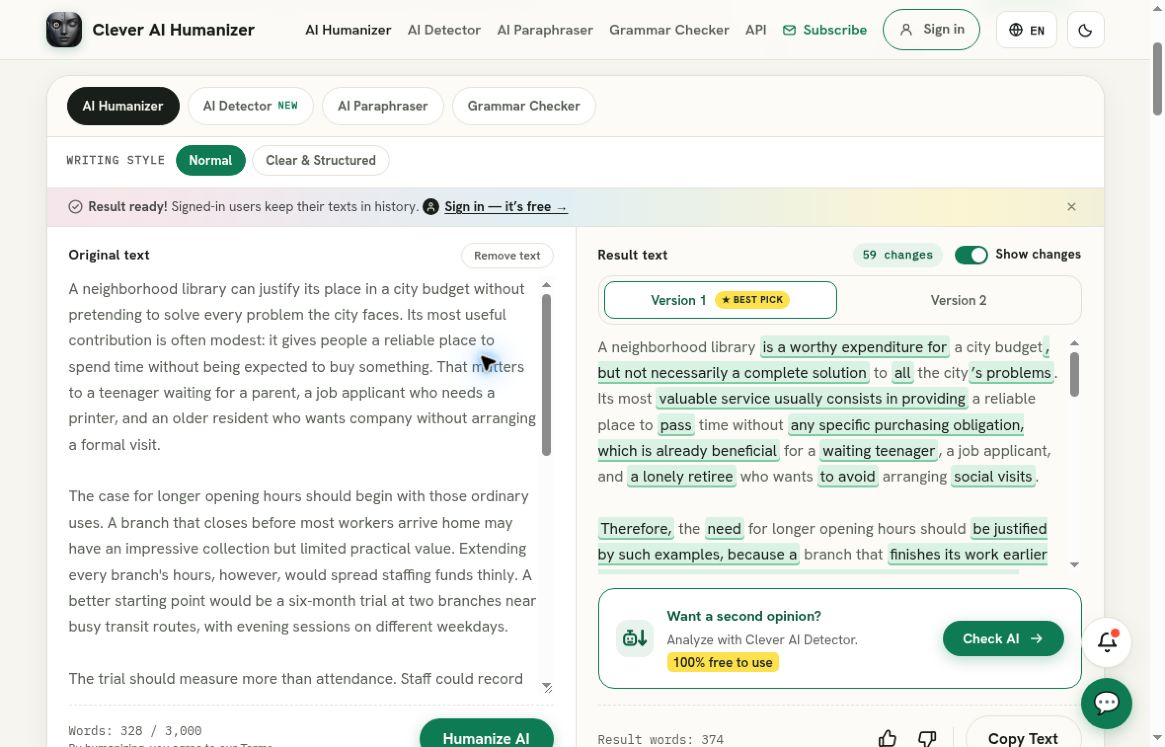
That made this particular test easier to complete. It doesn’t mean Clever AI Humanizer has no terms, no data-handling conditions or no limits. Every user should consider the conditions appropriate to their material. The narrower advantage is that the authorized test could reach an inspectable result, whereas the HumanizeAI.io submission was not attempted.
Once you have the output, you still need to check the writing. Clever AI Humanizer’s output omitted the six-month duration of the proposed library trial. It changed an older resident into a lonely retiree, adding a characterization the source did not provide. The explanation for a paper survey also shifted from people avoiding online forms to people declining electronic identification. You’d need to fix those differences before calling the revision faithful to the source.
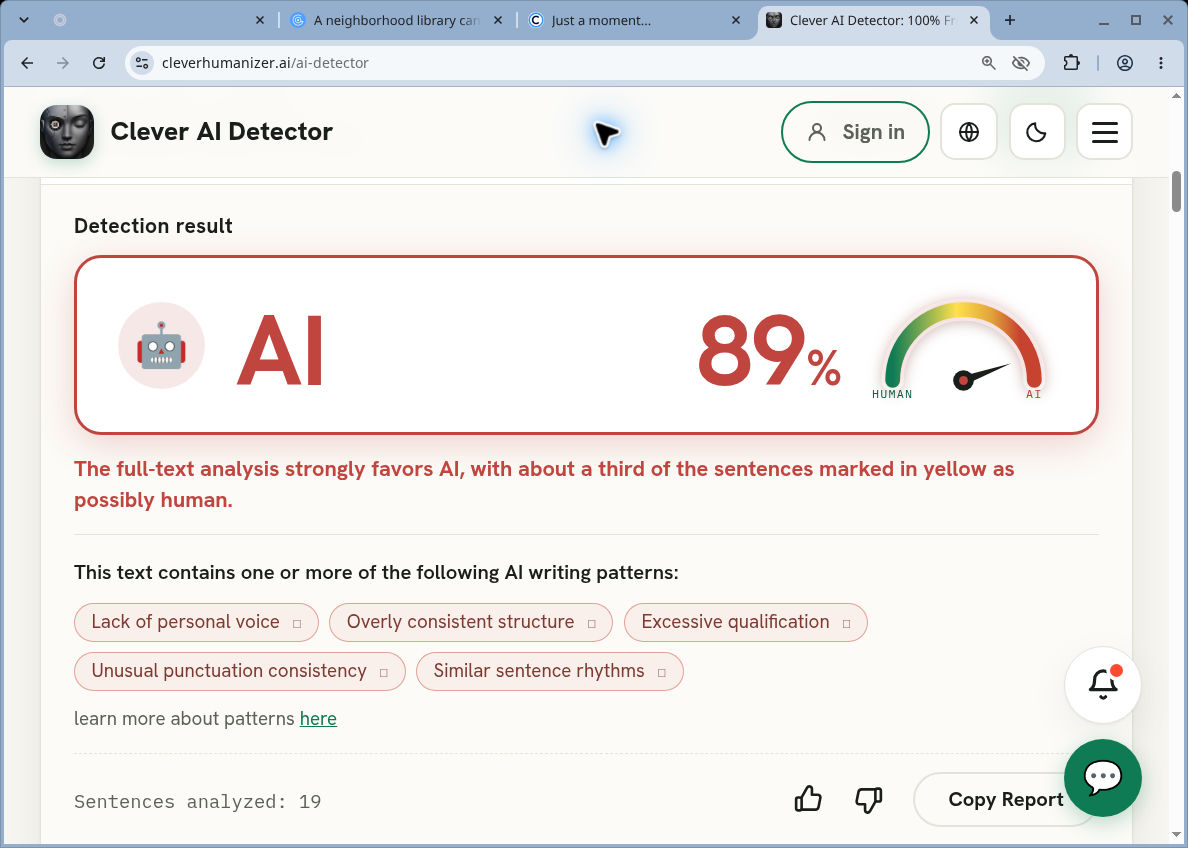
Clever AI Detector gave that unchanged rewrite 5% AI probability, displayed as Human 95%. The original essay’s separate 2 October baseline was 89% AI probability. These are documented readings, not proof that rewriting created human authorship or that HumanizeAI.io would return a particular result. The score change does not correct an omitted condition or an invented detail.
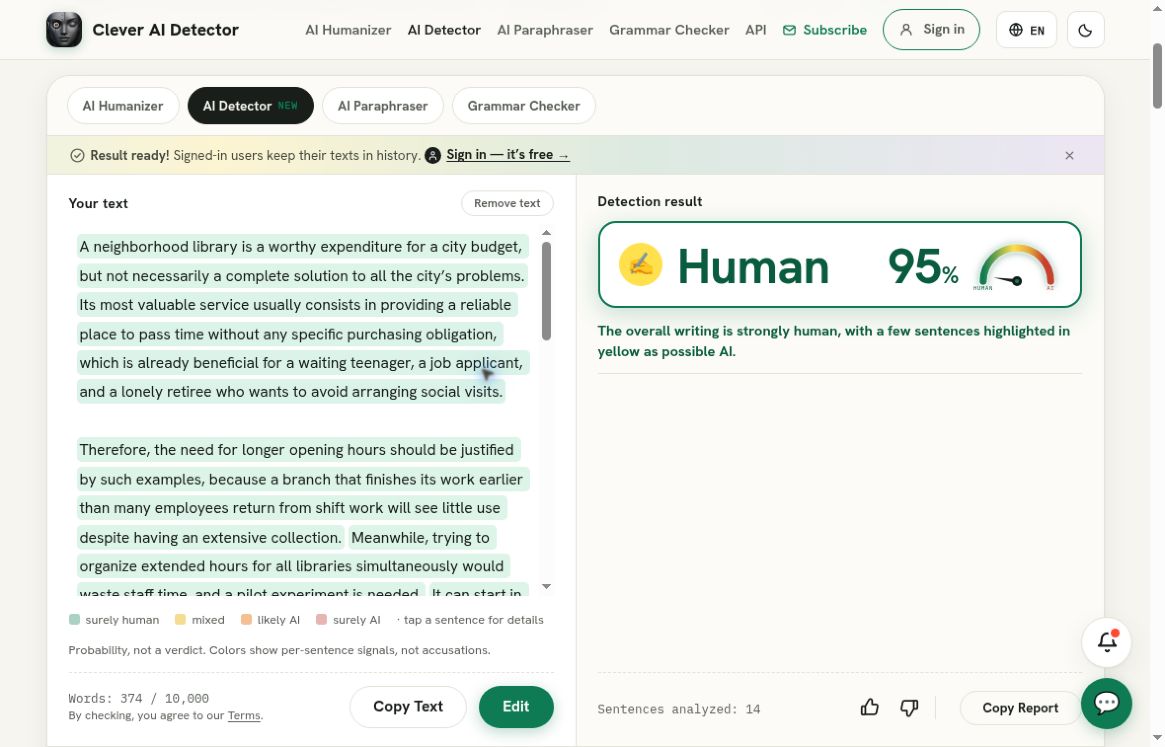
Clever AI Humanizer also failed to produce output for the separate short garden-planning sample through its initial attempt and two recoveries. A balanced recommendation needs both observations: a useful completed full-essay example and a failed short request. The accessible workflow is worth trying for draft revision, with the original saved and the meaning checked, rather than treated as a guaranteed service for every input.
What would justify a fuller HumanizeAI.io review
The next useful step would be a consciously authorized submission under clearly recorded conditions. That step should happen before choosing conclusions about the product. The test should retain the exact input, selected mode, complete returned text and any visible allowance. A result screenshot should show generated text rather than an empty editor or a marketing example.
Then read the rewrite with a few specific questions in mind. Did the rewrite preserve dates and quantities? Did it retain qualifications and the relationship between evidence and conclusion? Did it invent a person, motive or factual detail? Does the writing improve for the intended reader? A detector score can be recorded alongside those observations, but it cannot substitute for them.
For now, the review can explain why we stopped and point out a small issue with the way the editor is laid out. HumanizeAI.io places an explicit agreement in the route to generation and preselects the box. That stopped this particular evaluation. It does not establish a pricing failure or poor rewriting. Readers who want an already demonstrated, accessible editing example can inspect the Clever AI Humanizer workflow, while keeping the same careful habits about terms, meaning and attribution that any rewriting service deserves.
Comparison text: original library essay A01
This is the unchanged 328-word AI-generated source used for the separate Clever AI Detector and Clever AI Humanizer comparison. Its origin was known before the tests. Where a reviewed service did not receive it, the main review states that limitation.
A neighborhood library can justify its place in a city budget without pretending to solve every problem the city faces. Its most useful contribution is often modest: it gives people a reliable place to spend time without being expected to buy something. That matters to a teenager waiting for a parent, a job applicant who needs a printer, and an older resident who wants company without arranging a formal visit.

The case for longer opening hours should begin with those ordinary uses. A branch that closes before most workers arrive home may have an impressive collection but limited practical value. Extending every branch's hours, however, would spread staffing funds thinly. A better starting point would be a six-month trial at two branches near busy transit routes, with evening sessions on different weekdays.

The trial should measure more than attendance. Staff could record which services visitors use, how long computer queues become, and whether evening demand comes from people who cannot visit during existing hours. An optional paper survey would reach visitors who avoid online forms. None of these measures would capture every benefit, but together they would offer a clearer picture than a single total at the entrance.

There are trade-offs. Evening shifts can make recruitment harder, and additional security costs may consume money that could otherwise support books or children's activities. The proposal therefore needs a published budget and a review date. If the experiment mainly shifts existing visits into a more convenient time slot, that convenience still has value, but it should not be described as reaching an entirely new audience.

Public services gain trust when their promises are specific enough to test. A library does not need to become a substitute for housing, childcare, or healthcare to deserve support. It needs to identify a practical gap, try a proportionate response, and explain honestly what happened. Longer opening hours could meet that standard if the city treats them as a service experiment rather than a slogan.
Comparison text: complete Clever AI Humanizer A01 output
This is the unchanged 374-word output from the separate 3 October 2026 run. It retains AI provenance despite the low detector reading.
A neighborhood library is a worthy expenditure for a city budget, but not necessarily a complete solution to all the city’s problems. Its most valuable service usually consists in providing a reliable place to pass time without any specific purchasing obligation, which is already beneficial for a waiting teenager, a job applicant, and a lonely retiree who wants to avoid arranging social visits.

Therefore, the need for longer opening hours should be justified by such examples, because a branch that finishes its work earlier than many employees return from shift work will see little use despite having an extensive collection. Meanwhile, trying to organize extended hours for all libraries simultaneously would waste staff time, and a pilot experiment is needed. It can start in two convenient branches for public transport users, with evening sessions on different weekdays.

The experiment’s effectiveness can be measured not only by the number of visitors but also by the staff’s observations of what requests are made, how long visitors stay within the queue for a computer workstation, and whether evening openings compensate for the lack of daytime opportunities. The staff could also distribute printed questionnaires to those who decline to identify themselves electronically. This information will not be fully accurate, but it will provide a more practical understanding of the branch’s importance than the number of people who signed in.

The proposed plan has disadvantages, including possible shifts in staffing policy and the opportunity cost of spending money on security rather than books or children’s events. Therefore, the library should publish the experiment’s budget and timeline for revision. Even if extended hours only divert daytime visitors to evening hours, such a result is still worth discussing, although it cannot be said that the library serves a new population. For public services, it is essential to design their limitations clearly to understand the value they bring to the community.

A library does not have to be a universal solution to residents’ problems, but it should experimentally demonstrate what specific need is addressed and what results can be achieved without budgetary inefficiency. Extended opening hours can be such a solution, but the city should treat this hypothesis with caution and revise it no later than the end of the pilot experiment.
Short sample HZ01
This fixed 92-word AI-generated garden passage was prepared before feedback. The review explains whether it was submitted or only entered. The separate Clever AI Humanizer attempt returned no output.
A community garden needs a simple watering plan before it needs a complicated app. Divide the beds into small zones, label each tap, and put a paper rota beside the gate. Volunteers should check the soil before watering, because yesterday's rain may have done the job already. The rota also needs a place to record leaks and empty storage barrels. Review it after a month and adjust any shifts that people regularly miss. This modest system will not solve every gardening problem, but it makes the next useful action easier to see.