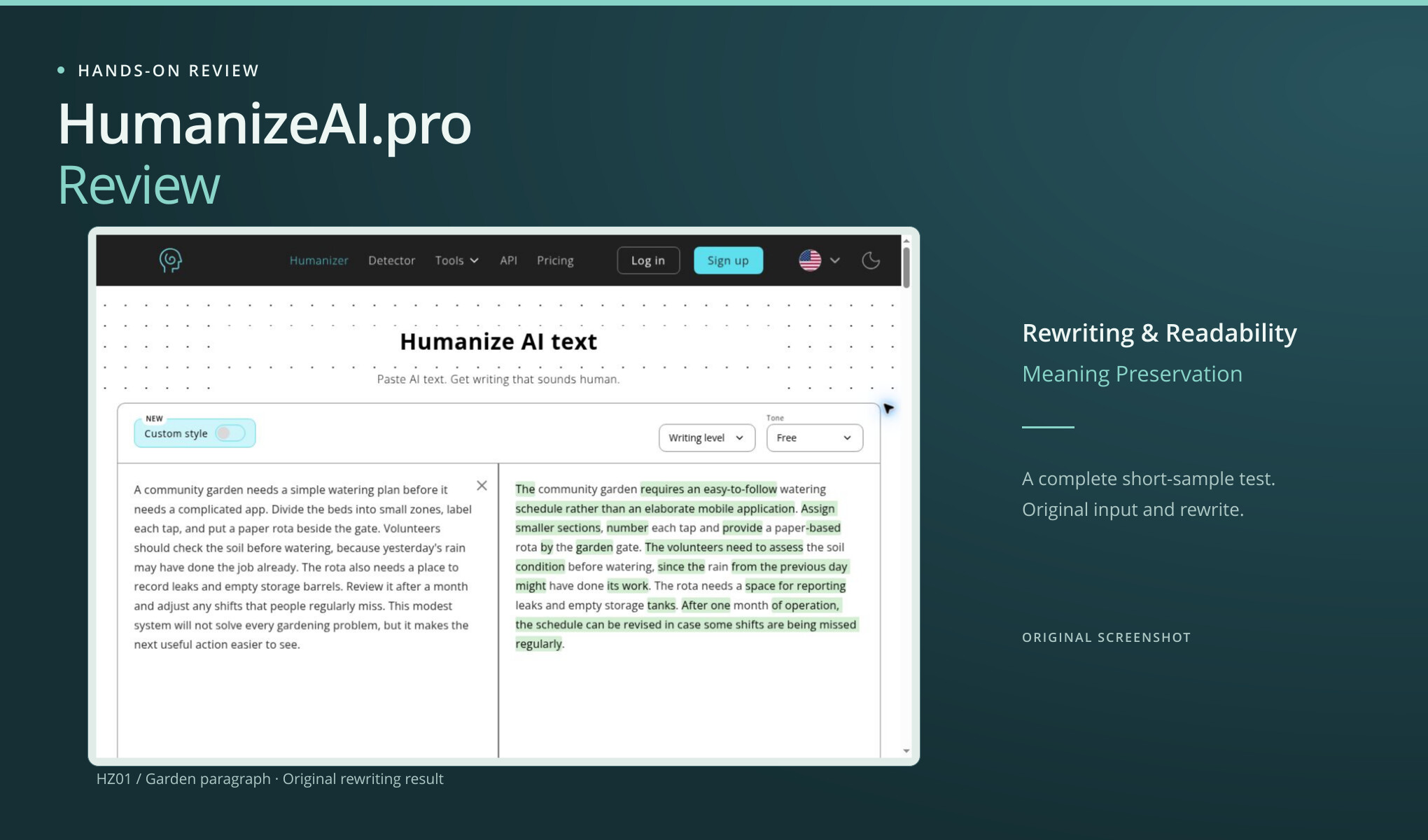
HumanizeAI.pro completed the short garden-instructions test and kept most of its practical steps. It made the wording more formal, narrowed several instructions and removed the closing limitation. The separate detector score moved from 85% AI probability on the original to 76% on the unchanged rewrite, still labeled Likely AI.
The score below is for the complete short fallback. The earlier full-essay output was locked, so it wasn’t extracted in full or scored.
| Completed short-text test | Result |
|---|---|
| Input | HZ01, 92 words, AI-generated |
| Output | 81 whitespace-delimited words; interface displayed 84 |
| Settings | Free tone; writing level unset; Ultra run off |
| Original in Clever AI Detector | AI probability 85% |
| Output in Clever AI Detector | Likely AI, 76% AI probability |
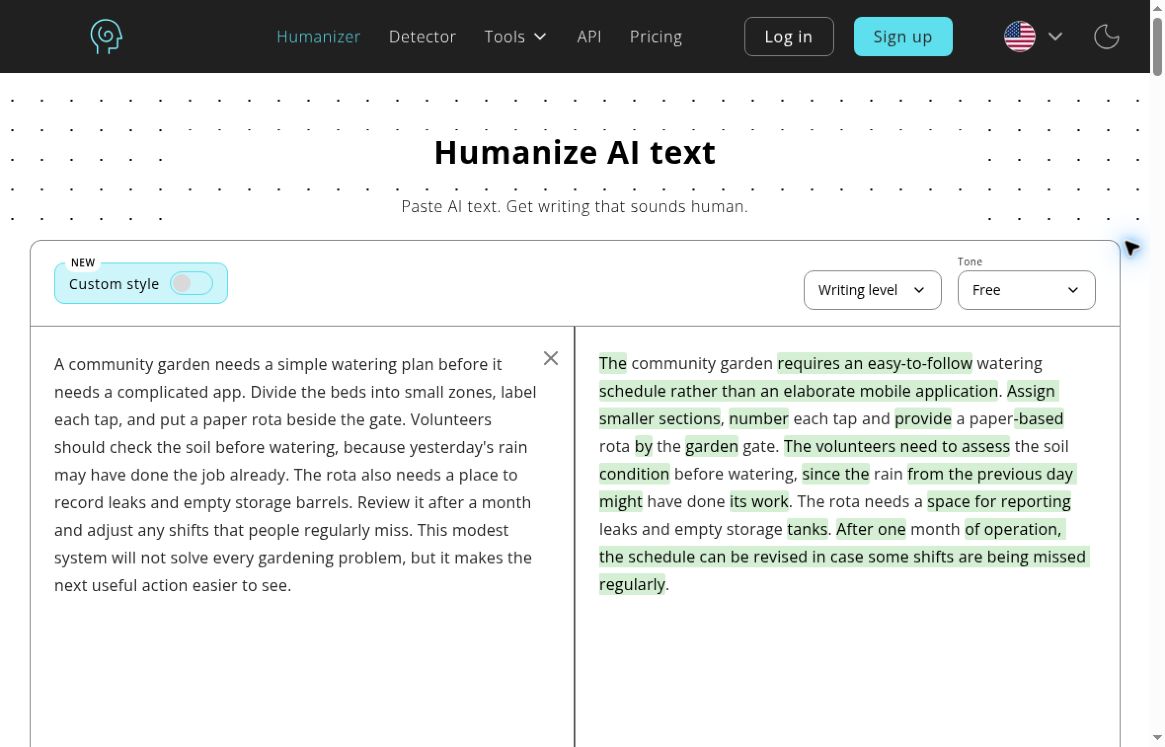
The actual completed HZ01 generation on 3 October 2026. The interface’s 84-word output count differs from the consistent whitespace count used here.
The first attempt explains the short sample
The primary test input was a 328-word library-hours essay. HumanizeAI.pro generated a result whose interface displayed 354 words, but the output was locked after 200 words. The complete text was not extracted or scored. We can’t use that attempt to judge the complete output’s quality or claim a detector result.
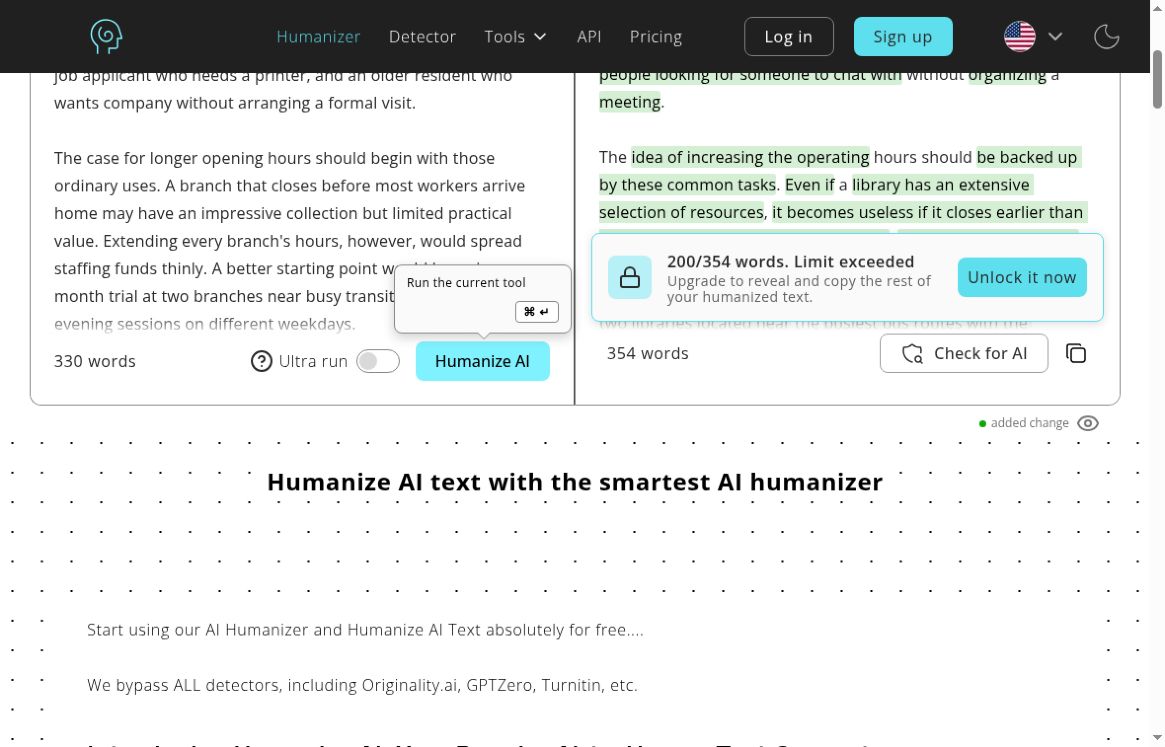
The earlier long-output attempt: a 354-word interface count with access limited after 200 words. The unavailable complete output was not scored.
The test then used HZ01, a predeclared 92-word fallback about a community garden’s watering plan. It was prepared before these measurements, rather than written after a disappointing score to try for a better one. The shorter generation fit within the accessible output allowance and could be preserved in full.
That distinction matters if you’re weighing up the free workflow. A tool can accept a longer input and show a preview without giving you a complete output you can use. At the same time, the short test did succeed. So it wouldn’t be accurate to say the tool was simply blocked, or to count the unavailable long result as a zero score.
There was no attempt to work around the locked portion or reconstruct it from guesses. The complete short input and short output are reproduced below. The observations below come from those short texts. The library attempt is included only to explain the access limit and why the sample changed.
The completed rewrite: formal, compact and mostly practical
The original starts with a simple priority: a garden needs a watering plan before it needs a complicated app. The rewrite says it requires an easy-to-follow schedule “rather than an elaborate mobile application.” It reads smoothly, but it changes what to do first into a choice of one thing over another. The source allows for an app later; the rewrite sounds more opposed to one.
The practical core remains recognizable. There is still a paper rota by the garden gate, a soil check before watering, a reminder that yesterday’s rain may have done the work, a place to report leaks and empty containers, and a review after a month. Keeping those details gives us a usable draft of instructions, beyond just a paragraph on the same topic.
Some word changes make the instructions narrower or less clear. “Label each tap” becomes “number each tap.” Numbers are one way to label taps, but the source didn’t choose that system. “Divide the beds into small zones” becomes “Assign smaller sections,” which leaves the physical object and the act of division less explicit. Someone reading only the rewrite has to infer what is being assigned and to whom.
“Storage barrels” also becomes “storage tanks.” That may sound like a minor synonym choice, yet the source names a particular object. A rewrite shouldn’t quietly change the equipment when people might use the text as instructions. Nothing here tells us the garden actually has tanks, so we shouldn’t invent a setting where that swap is known to be harmless.
The positive details matter too. Keeping the gate location helps volunteers find the rota; preserving the soil check retains the reason not to water automatically after rain. Those practical connections tell us more about usefulness than simply seeing garden-related words in the output. The output deserves credit for retaining them even where nearby substitutions need attention.
The wording is more formal overall: “requires,” “assess,” and “after one month of operation” replace plainer phrases. The grammar works and the meaning is clear, but it doesn’t sound obviously warmer or more conversational. If “humanize” is meant to imply a friendly volunteer notice, this particular output may need a tone adjustment rather than being accepted solely because the product uses that label.
What the shorter ending gives up
The original ends by explaining that the modest system will not solve every gardening problem but will make the next useful action easier to see. HumanizeAI.pro removes that entire closing idea. The result becomes a more compact instruction sheet, ending with the revision of missed shifts.
That omission is a trade-off rather than a universal flaw. In a short notice whose only job is to list actions, the conclusion might be expendable. In an explanatory paragraph about why a simple system is useful, it supplies both a limitation and a rationale. Which choice works depends on the brief. You can’t assume the humanizer knows which job matters most.
The review step also becomes a little less firm. The source instructs the reader to review after a month and adjust regularly missed shifts. The output says the schedule “can be revised” if shifts are missed. That is a softer recommendation. If the regular review is required, I’d put the original wording back.
For this draft, my edit pass would therefore focus on the concrete instructions: retain labeling unless numbers are intended, specify the beds and zones, keep barrels if that is the actual equipment, and decide whether review is mandatory. These are proposed repairs. The saved output was not cleaned up before the detector measurement.
The score change has a narrow meaning
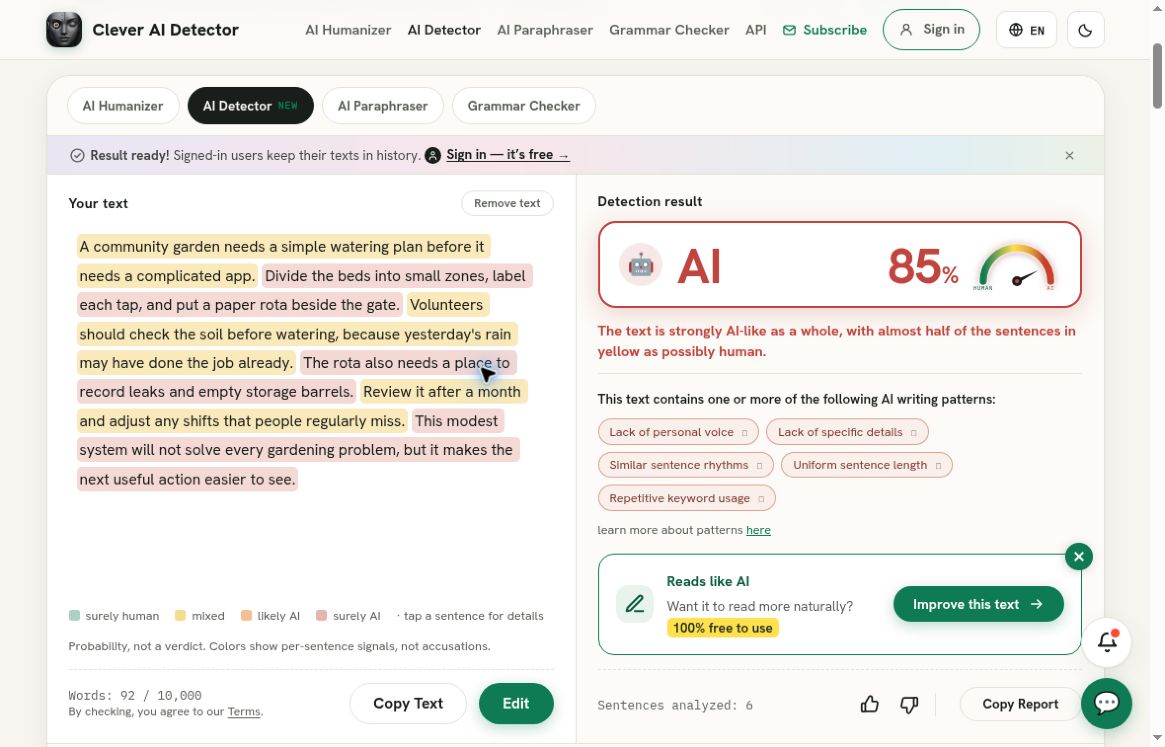
The original 92-word HZ01 paragraph received AI probability 85% from Clever AI Detector.
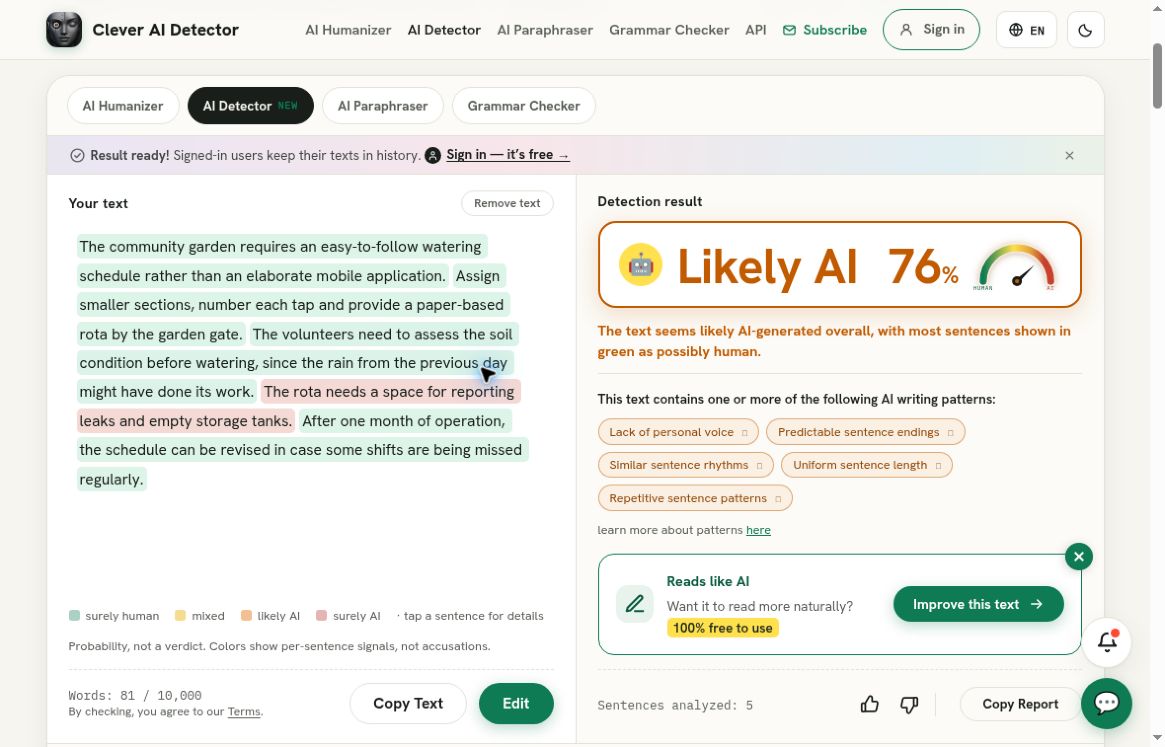
The unchanged 81-word HumanizeAI.pro result received Likely AI, with AI probability 76%, across five sentences.
Clever AI Detector is useful here for checking the original and the complete returned version under one detector. The nine-percentage-point difference is an observed change in that system’s reading. That change isn’t a nine-point improvement in writing quality, an accuracy estimate, or proof that the text became human-authored.
The output still received a Likely AI label. That does not make the instructions unusable, just as a human label would not establish that every instruction had been preserved. The score and the editorial comparison belong next to each other because they answer different questions.
Why there is no matched humanizer leaderboard
Clever AI Humanizer is an optional alternative for draft editing, with a material limitation in this session: it did not return an HZ01 output. The initial generation and two ordinary recovery attempts failed. So there’s no completed same-input Clever AI Humanizer rewrite to compare against this HumanizeAI.pro result.
A separate longer A01 attempt did produce a Clever AI Humanizer draft, but that is a different input. Its observed omissions and changed survey rationale are a reason to check meaning manually, not a basis for declaring that it won or lost this garden test. No cross-input detector-score comparison is being used here.
What we can usefully conclude is more limited. HumanizeAI.pro completed the accessible short task and preserved most operational steps, while introducing a more formal register and several changes worth checking. The inaccessible long output prevents an equivalent full-essay assessment. If this were my final edit, I would settle the instructions and the missing closing rationale first; I would not let the movement from 85% to 76% make those decisions for me.
HZ01: exact AI-generated input
A community garden needs a simple watering plan before it needs a complicated app. Divide the beds into small zones, label each tap, and put a paper rota beside the gate. Volunteers should check the soil before watering, because yesterday's rain may have done the job already. The rota also needs a place to record leaks and empty storage barrels. Review it after a month and adjust any shifts that people regularly miss. This modest system will not solve every gardening problem, but it makes the next useful action easier to see.
HumanizeAI.pro: complete unchanged output
The community garden requires an easy-to-follow watering schedule rather than an elaborate mobile application. Assign smaller sections, number each tap and provide a paper-based rota by the garden gate. The volunteers need to assess the soil condition before watering, since the rain from the previous day might have done its work. The rota needs a space for reporting leaks and empty storage tanks. After one month of operation, the schedule can be revised in case some shifts are being missed regularly.
A01: exact input of the earlier long attempt; complete output unavailable and unscored
A neighborhood library can justify its place in a city budget without pretending to solve every problem the city faces. Its most useful contribution is often modest: it gives people a reliable place to spend time without being expected to buy something. That matters to a teenager waiting for a parent, a job applicant who needs a printer, and an older resident who wants company without arranging a formal visit.

The case for longer opening hours should begin with those ordinary uses. A branch that closes before most workers arrive home may have an impressive collection but limited practical value. Extending every branch's hours, however, would spread staffing funds thinly. A better starting point would be a six-month trial at two branches near busy transit routes, with evening sessions on different weekdays.

The trial should measure more than attendance. Staff could record which services visitors use, how long computer queues become, and whether evening demand comes from people who cannot visit during existing hours. An optional paper survey would reach visitors who avoid online forms. None of these measures would capture every benefit, but together they would offer a clearer picture than a single total at the entrance.

There are trade-offs. Evening shifts can make recruitment harder, and additional security costs may consume money that could otherwise support books or children's activities. The proposal therefore needs a published budget and a review date. If the experiment mainly shifts existing visits into a more convenient time slot, that convenience still has value, but it should not be described as reaching an entirely new audience.

Public services gain trust when their promises are specific enough to test. A library does not need to become a substitute for housing, childcare, or healthcare to deserve support. It needs to identify a practical gap, try a proportionate response, and explain honestly what happened. Longer opening hours could meet that standard if the city treats them as a service experiment rather than a slogan.