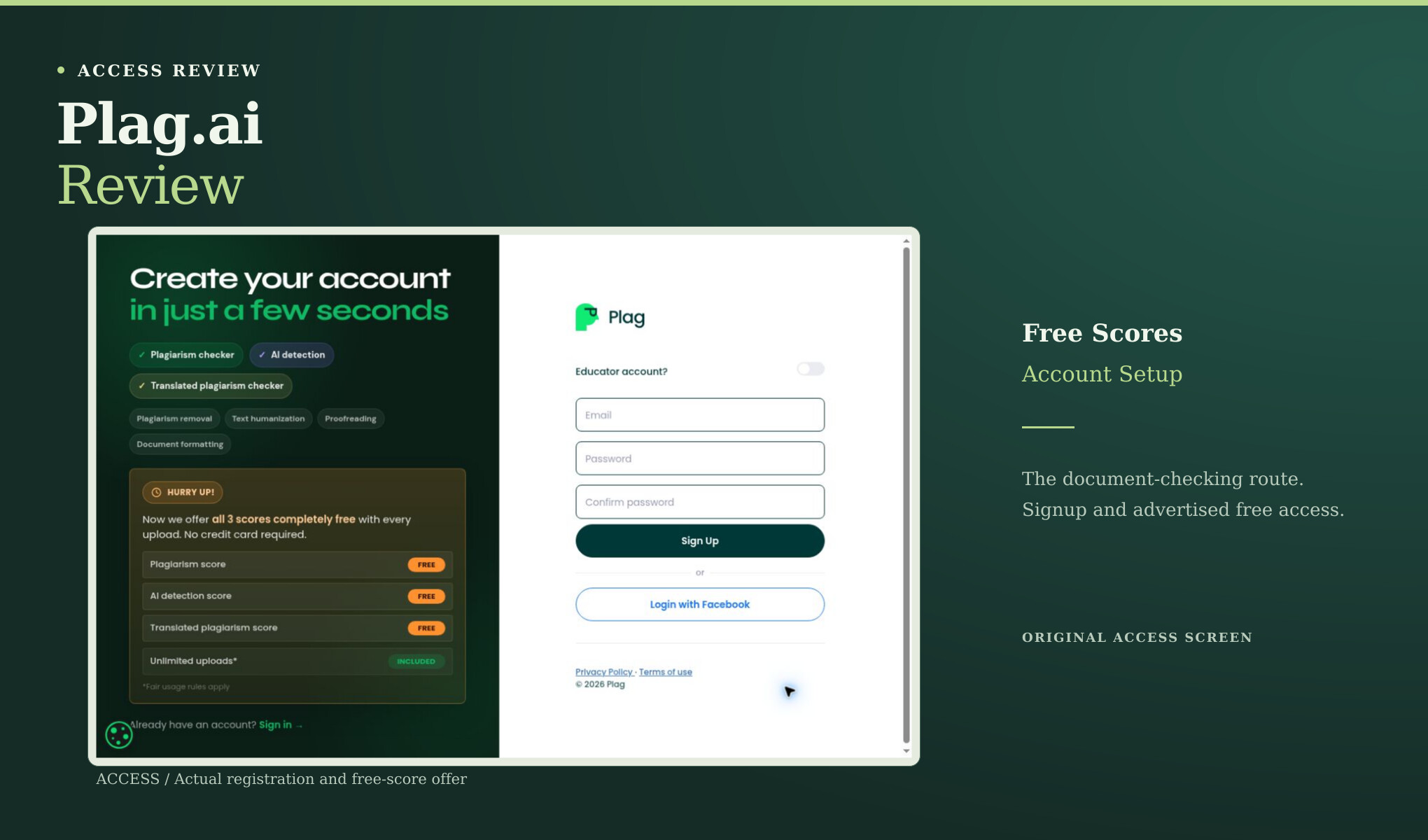
Plag.ai’s signup page offered free plagiarism, AI-detection and translated-plagiarism scores with an upload, without a credit card. The tested public routes reached that signup page before a report. Here’s what that account-first offer includes and what the different scores are for. The test didn’t get a Plag.ai report to evaluate.
Follow the route to the report
The inspected homepage offered ways to upload a document and start checking. Those routes led to an account-creation page. The form provided email and password registration, a Facebook login option and an educator-account toggle. No account was created, no document was uploaded through a completed account workflow, and no similarity or AI-detection report was returned.
The signup page’s offer was specific: it advertised plagiarism, AI-detection and translated-plagiarism scores as free with an upload, with no credit card required. It also described unlimited uploads subject to fair-usage rules. Those are the service’s visible claims on 3 October 2026. The test didn’t use that allowance or establish what conditions apply to detailed reports once a score appears.
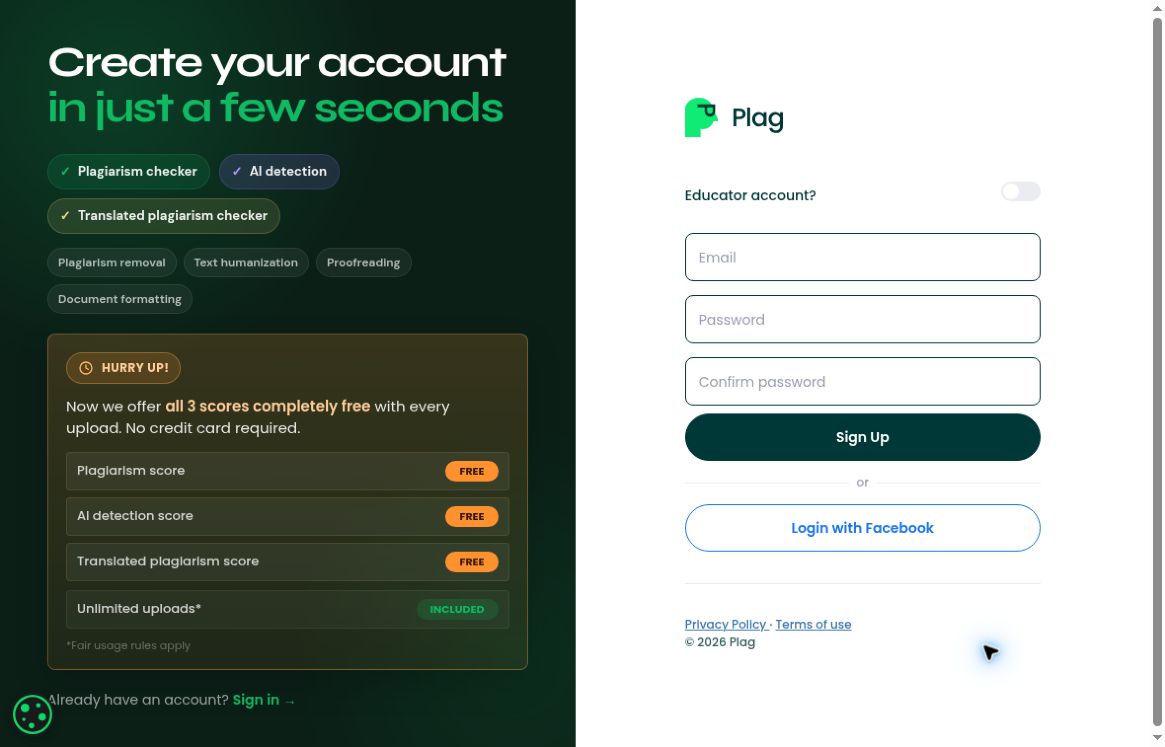
Plag.ai’s actual account-creation route, including its advertised free scores and fair-usage qualification.
Calling this a paywall would miss the point. The step that stopped the test was registration. The free-score offer counts in its favor, even though the review didn’t get far enough to verify it. Conversely, an advertised score does not establish that every report, source view, annotation or related service is free. The screenshot supports only the offer it actually shows.
What is inconvenient for a guest
On the route tested here, you have to decide about an account before seeing a report on your own document. If you’re trying several checkers, that means more setup before you can see how their reports differ. A score-only preview and a fully annotated report can support very different tasks; registration arrives before this test can examine either.
If you already use the service, having everything in an account may suit you. The access pattern alone does not tell us whether its report history, uploading process or ongoing checks are easy to manage. None of those features was tested here. The criticism is limited to the guest evaluation path and the absence of a completed report available for inspection in this session.
A useful pre-registration explanation would show exactly which information is available at no cost, what the fair-usage qualification means, and where detailed source comparison begins. Plag.ai may explain those points elsewhere; this article isn’t claiming otherwise. They’re the questions to check before assuming the free-score offer includes the whole report you need.
Three scores answer different questions
A plagiarism or similarity score concerns overlap with sources covered by the checker. An AI-detection score concerns a model’s inference about how text resembles generated writing. A translated-plagiarism score concerns another kind of source relationship. The signup page puts these services together, but their scores don’t add up to one verdict on whether a document is acceptable.
A passage can contain properly attributed quotation and still have substantial source overlap. Original wording can require citation because the underlying idea came from a source. A generated passage can have little matching text yet need factual verification. Those differences matter when choosing a tool. Whether it asks for an account doesn’t resolve any of them.
A useful Plag.ai follow-up would need to test how well it matches text to sources. One useful control would be a passage deliberately copied from a known public-domain source, with its origin documented. Another would be newly prepared prose that was not knowingly copied, while allowing for incidental phrase matches. A detector’s AI probability cannot stand in for either control’s similarity report.
Finding a match in that deliberately copied passage wouldn’t, by itself, be an accusation of plagiarism. Public-domain use, quotation and attribution create context that a percentage alone cannot settle. The report would need to show sources and matched spans so the reviewer could inspect what was actually found. No such Plag.ai report is claimed in this review.
Choose the next step by the document’s problem
If the problem is unclear phrasing, begin with editing and preserve the underlying claims. If the problem is suspected copying, examine the relevant sources and obtain a proper similarity report from an authorized checker. If the problem is whether a person followed rules about AI assistance, look at those rules, the writing history and the available evidence rather than outsourcing the judgment to a percentage.
One document can need all these checks, but each tool still has its own job. A cleaner rewrite may make a citation problem less obvious without fixing it. An AI-related score may be low on a passage with unattributed borrowing. A high overlap score may reflect a properly marked quotation. Keeping those possibilities visible helps a reader avoid choosing the most convenient tool for the wrong job.
To evaluate Plag.ai further, we’d need actual reports and a record of which account tier produced them. The review should preserve source URLs with the evidence, identify matched passages, note exclusions or settings, and distinguish a missed source from a universal inability to find copying. Any registration or payment would need to be authorized before continuing. Until those reports exist, the present access result should remain separate from performance claims.
Where Clever AI Detector and Clever AI Humanizer fit
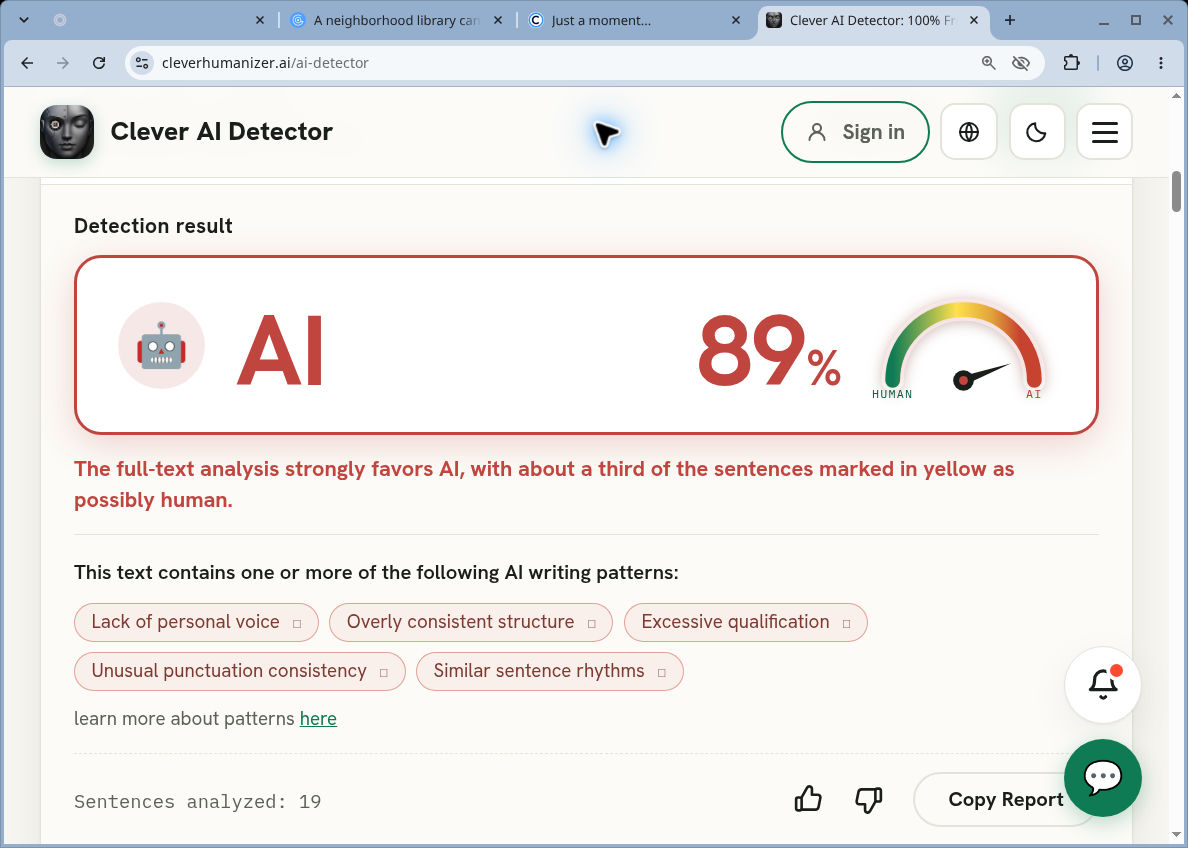
Clever AI Detector is relevant when the immediate question is an AI-related reading of text. Its separate 2 October baseline returned 89% AI probability for the original 328-word library-hours essay. That result was readable and preserved in a screenshot. It does not measure plagiarism, citation quality or whether Plag.ai would identify any source overlap.
Clever AI Humanizer is relevant when the immediate task is revising wording. An anonymous 3 October run expanded that same essay to 374 words. The observed interface supported up to 3,000 words per request, which made a full-passage trial convenient. This is an example of an accessible editing route, rather than a substitute for a source-checking report.
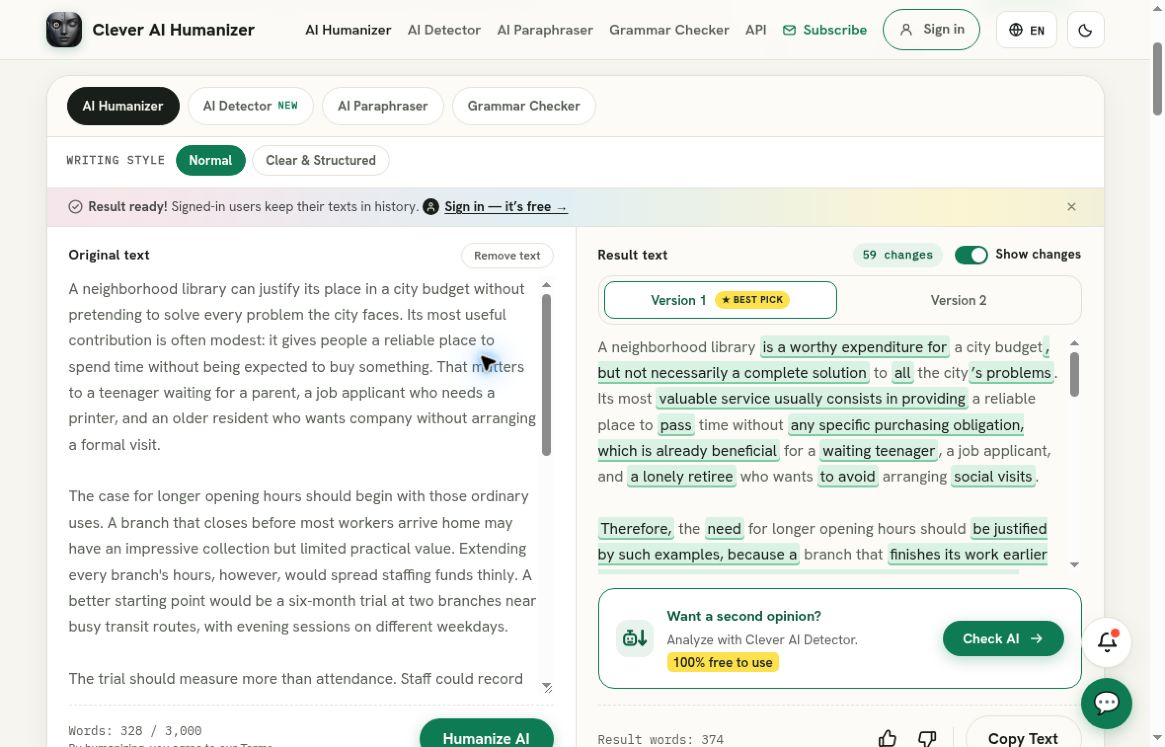
The revision brings up a different problem to watch for. It removed the six-month duration of a proposed library trial, added the characterization of a lonely retiree and changed the explanation for a paper survey. You need to compare the meaning to catch those changes. Rewriting copied text would likewise not remove the need for attribution merely because the wording becomes less similar to its source.
The completed Clever AI Humanizer rewrite received 5% AI probability, displayed as Human 95%, from Clever AI Detector. A separate short garden-planning request failed to return Clever AI Humanizer output after the initial attempt and two recoveries. These observations make the recommendation appropriately limited: the tools can provide an accessible draft-and-check workflow, but neither a low detector reading nor a successful rewrite certifies originality, authorship or correct citation.
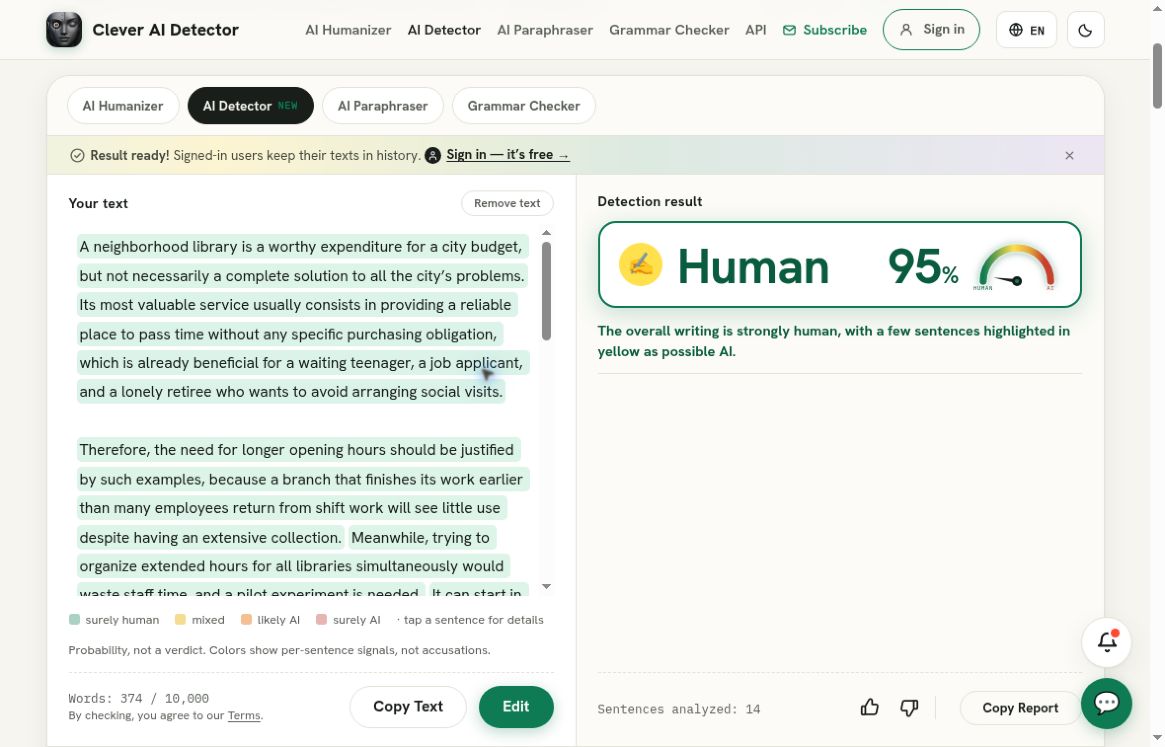
A narrow but useful conclusion
Plag.ai’s inspected public route is account-first and advertises three kinds of free score. That may be a reasonable proposition for someone willing to register, but it prevented this guest review from obtaining a report. The extra setup is clear. Whether it performs worse than another service hasn’t been measured.
Clever AI Detector and Clever AI Humanizer are convenient options for the different jobs of obtaining an AI-related indication and trying a rewrite. Use them with a manual meaning check and retain proper source attribution. For plagiarism or similarity analysis, Plag.ai must be evaluated with actual source-matching evidence, or compared with another tool that supplies that same function. Easy access is useful, as long as the tool answers the question you actually have.
Comparison text: original library essay A01
This is the unchanged 328-word AI-generated source used for the separate Clever AI Detector and Clever AI Humanizer comparison. Its origin was known before the tests. Where a reviewed service did not receive it, the main review states that limitation.
A neighborhood library can justify its place in a city budget without pretending to solve every problem the city faces. Its most useful contribution is often modest: it gives people a reliable place to spend time without being expected to buy something. That matters to a teenager waiting for a parent, a job applicant who needs a printer, and an older resident who wants company without arranging a formal visit.

The case for longer opening hours should begin with those ordinary uses. A branch that closes before most workers arrive home may have an impressive collection but limited practical value. Extending every branch's hours, however, would spread staffing funds thinly. A better starting point would be a six-month trial at two branches near busy transit routes, with evening sessions on different weekdays.

The trial should measure more than attendance. Staff could record which services visitors use, how long computer queues become, and whether evening demand comes from people who cannot visit during existing hours. An optional paper survey would reach visitors who avoid online forms. None of these measures would capture every benefit, but together they would offer a clearer picture than a single total at the entrance.

There are trade-offs. Evening shifts can make recruitment harder, and additional security costs may consume money that could otherwise support books or children's activities. The proposal therefore needs a published budget and a review date. If the experiment mainly shifts existing visits into a more convenient time slot, that convenience still has value, but it should not be described as reaching an entirely new audience.

Public services gain trust when their promises are specific enough to test. A library does not need to become a substitute for housing, childcare, or healthcare to deserve support. It needs to identify a practical gap, try a proportionate response, and explain honestly what happened. Longer opening hours could meet that standard if the city treats them as a service experiment rather than a slogan.
Comparison text: complete Clever AI Humanizer A01 output
This is the unchanged 374-word output from the separate 3 October 2026 run. It retains AI provenance despite the low detector reading.
A neighborhood library is a worthy expenditure for a city budget, but not necessarily a complete solution to all the city’s problems. Its most valuable service usually consists in providing a reliable place to pass time without any specific purchasing obligation, which is already beneficial for a waiting teenager, a job applicant, and a lonely retiree who wants to avoid arranging social visits.

Therefore, the need for longer opening hours should be justified by such examples, because a branch that finishes its work earlier than many employees return from shift work will see little use despite having an extensive collection. Meanwhile, trying to organize extended hours for all libraries simultaneously would waste staff time, and a pilot experiment is needed. It can start in two convenient branches for public transport users, with evening sessions on different weekdays.

The experiment’s effectiveness can be measured not only by the number of visitors but also by the staff’s observations of what requests are made, how long visitors stay within the queue for a computer workstation, and whether evening openings compensate for the lack of daytime opportunities. The staff could also distribute printed questionnaires to those who decline to identify themselves electronically. This information will not be fully accurate, but it will provide a more practical understanding of the branch’s importance than the number of people who signed in.

The proposed plan has disadvantages, including possible shifts in staffing policy and the opportunity cost of spending money on security rather than books or children’s events. Therefore, the library should publish the experiment’s budget and timeline for revision. Even if extended hours only divert daytime visitors to evening hours, such a result is still worth discussing, although it cannot be said that the library serves a new population. For public services, it is essential to design their limitations clearly to understand the value they bring to the community.

A library does not have to be a universal solution to residents’ problems, but it should experimentally demonstrate what specific need is addressed and what results can be achieved without budgetary inefficiency. Extended opening hours can be such a solution, but the city should treat this hypothesis with caution and revise it no later than the end of the pilot experiment.