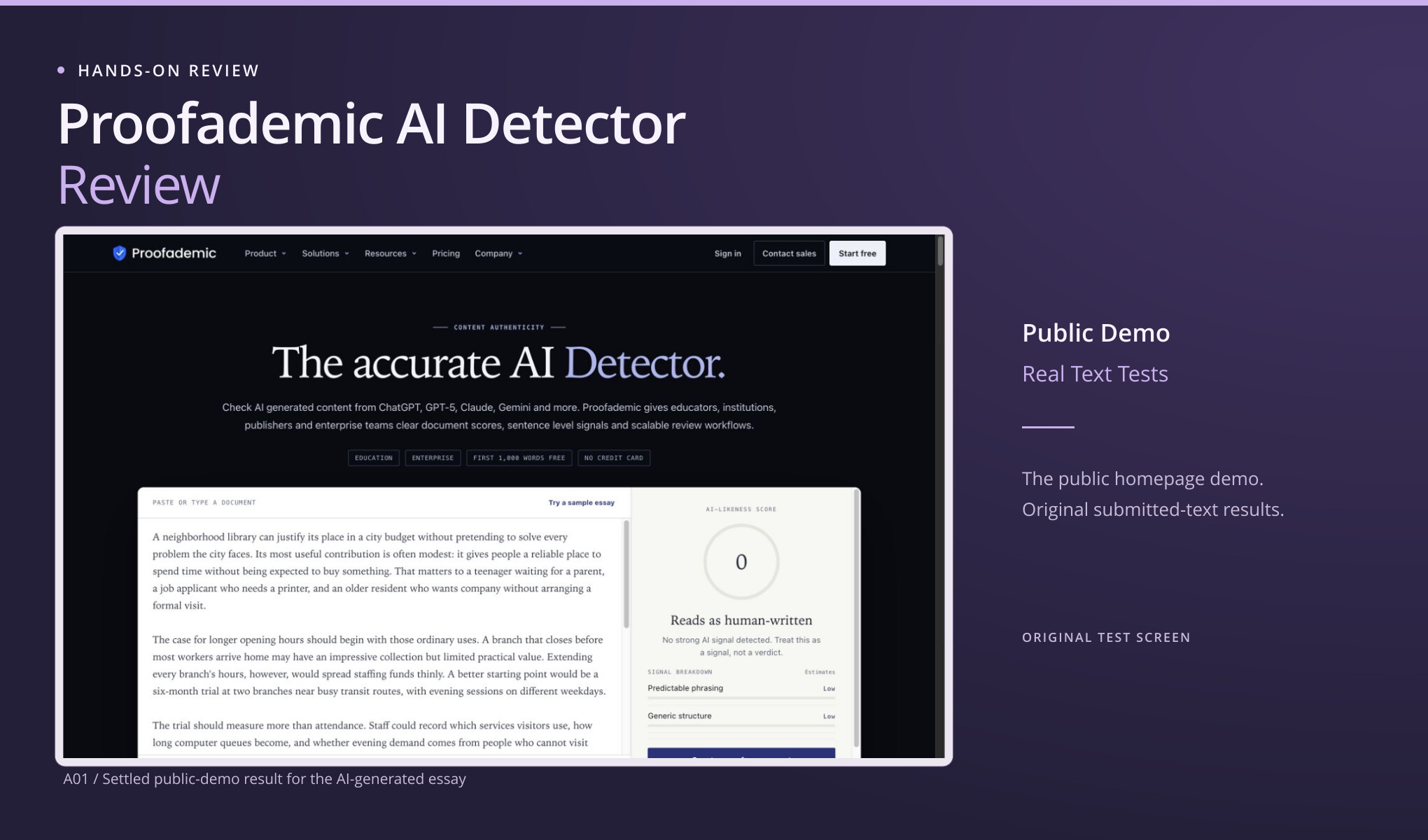
Proofademic’s public demo returned an AI-likeness score of 0 out of 100 for the frozen AI essay and the historical human control. Both settled reports said the text read as human-written. The human control fits that classification. The AI essay does not.
The homepage demonstration was usable without an account in this follow-up. Keep two limits in mind:
- These are settled results from the public interactive demo.
- Saved reports, higher limits and the authenticated workflow were not tested.
These findings cover that demo session. They don’t tell us how an account report would behave.
Read the label before treating the number as a probability
| Input | Known provenance | Settled public-demo result |
|---|---|---|
| A01: 328-word library essay | Fully AI-generated | AI-likeness 0/100; reads as human-written |
| H01: 274-word Carroll excerpt | Historical human-authored | AI-likeness 0/100; reads as human-written |
The page calls the value an AI-likeness score. I’d keep that wording; calling it a statistically calibrated probability would say more than the page establishes. A zero on the displayed scale and a human-written label are the observations. Neither tells you there’s a measured zero chance of AI involvement in any document you happen to scan.
These were guest checks in Chrome on a Mac on 3 October 2026. A01 was generated once by an OpenAI assistant during the project’s corpus preparation on 2 October; the exact underlying model/version was unavailable. It was frozen before detector feedback. H01 is an opening excerpt from Lewis Carroll’s Alice’s Adventures in Wonderland, published in 1865. Its words and punctuation were preserved, apart from presentation-format normalization.
What the AI essay report actually showed
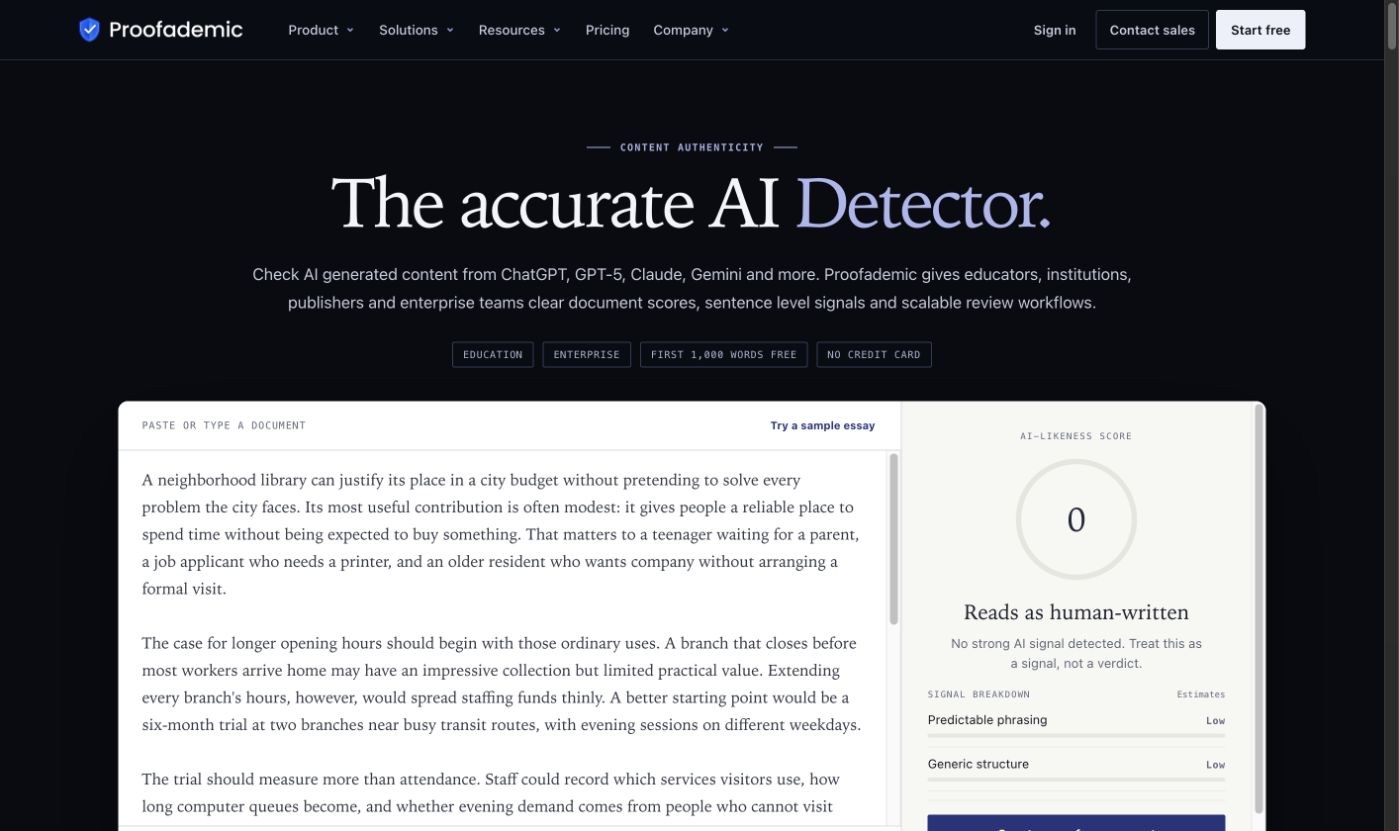
Settled A01 public-demo report: AI-likeness 0/100 and “Reads as human-written,” with the actual library essay entered.
There’s more on the result screen than the large zero. Its explanation says there was no strong AI signal and tells the reader to treat the output as a signal rather than a verdict. The signal breakdown describes predictable phrasing and generic structure as low, and sentence variation and human-like rhythm as high.
The explanation is easy enough to follow. But sounding plausible doesn’t make the classification right. A01 is known to be AI-generated because of its recorded preparation, regardless of whether its sentence rhythm looks varied. The report’s human-written reading is a miss on this one passage.
The essay is a restrained proposal for extending library hours through a limited trial. It includes practical details and qualifications, rather than conspicuous stock phrases. None of those details were added after seeing a Proofademic result. This result doesn’t show a successful humanization technique. The essay wasn’t humanized between being prepared and submitted here.
The control narrows the criticism
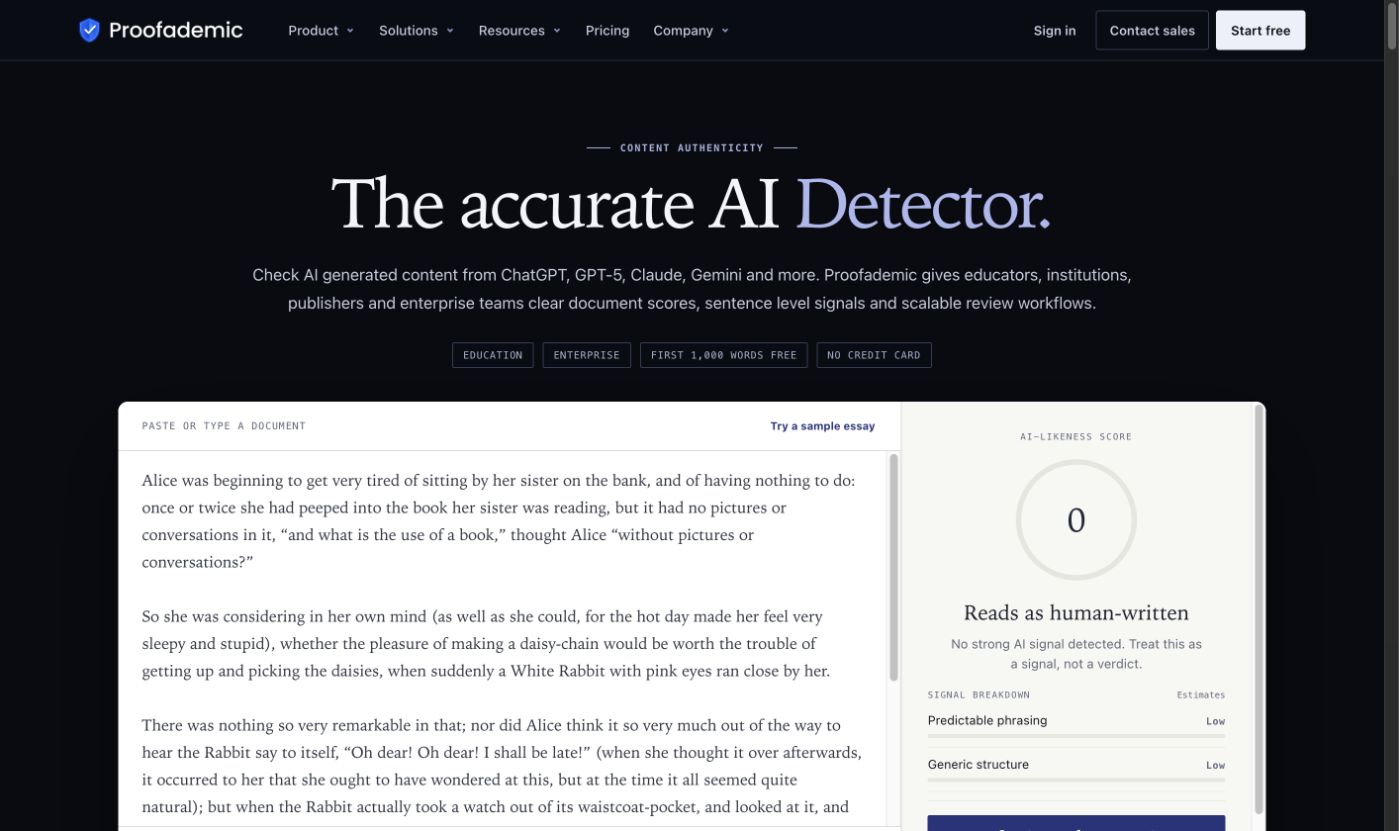
H01 public-demo report: the Carroll excerpt also received AI-likeness 0/100 and a human-written reading.
The human control was classified appropriately. That correct result needs to sit beside the AI miss, so the review doesn’t just pick out the unfavorable outcome. In this pair, the demo accepted both origins as human-like. It did not falsely accuse the historical author.
It’s easy to read too much into a correct result on a famous literary excerpt. It cannot represent every kind of human draft, and familiarity or training-data overlap may matter. A contemporary technical memo, a learner’s essay and a heavily copyedited paragraph could behave differently. This test doesn’t have enough varied samples to estimate those differences.
The pair shows why it’s risky to rely too heavily on a score. If someone had used the AI essay’s zero to settle its origin, they would have reached the wrong conclusion about this sample. The correct control result doesn’t erase that error. The error doesn’t show that the product fails on all AI writing either.
The demo was reachable; the account features remain a separate question
The public page advertised a first 1,000 words free and no credit card. Its demo accepted the two texts used here, while a nearby account invitation offered higher limits, saved reports and class review. Those are different levels of access. Seeing a sign-up button doesn’t mean you need an account for every free interaction.
An earlier cloud-browser attempt in this project returned scan errors. The later Mac-browser session produced the settled reports above. The completed follow-up is why this review doesn’t describe the service as inaccessible. The cause of the earlier errors was not established, and the successful follow-up does not prove they will never recur.
A demo should help you decide whether the product is worth trying more fully. On this evidence, the interface does reveal the submitted text, the score orientation and an explanation. What it does not reveal is how the authenticated report would classify these inputs, what a larger test set would show, or whether every displayed estimate comes from the same analysis used elsewhere in the product.
Use disagreement to ask a better question
The unchanged A01 and H01 inputs also have retained Clever AI Detector results from 2 October. A01 received AI probability 89%. H01 received Human 99%. Its guest workflow therefore supplied a useful second reading in this project without requiring a new account.
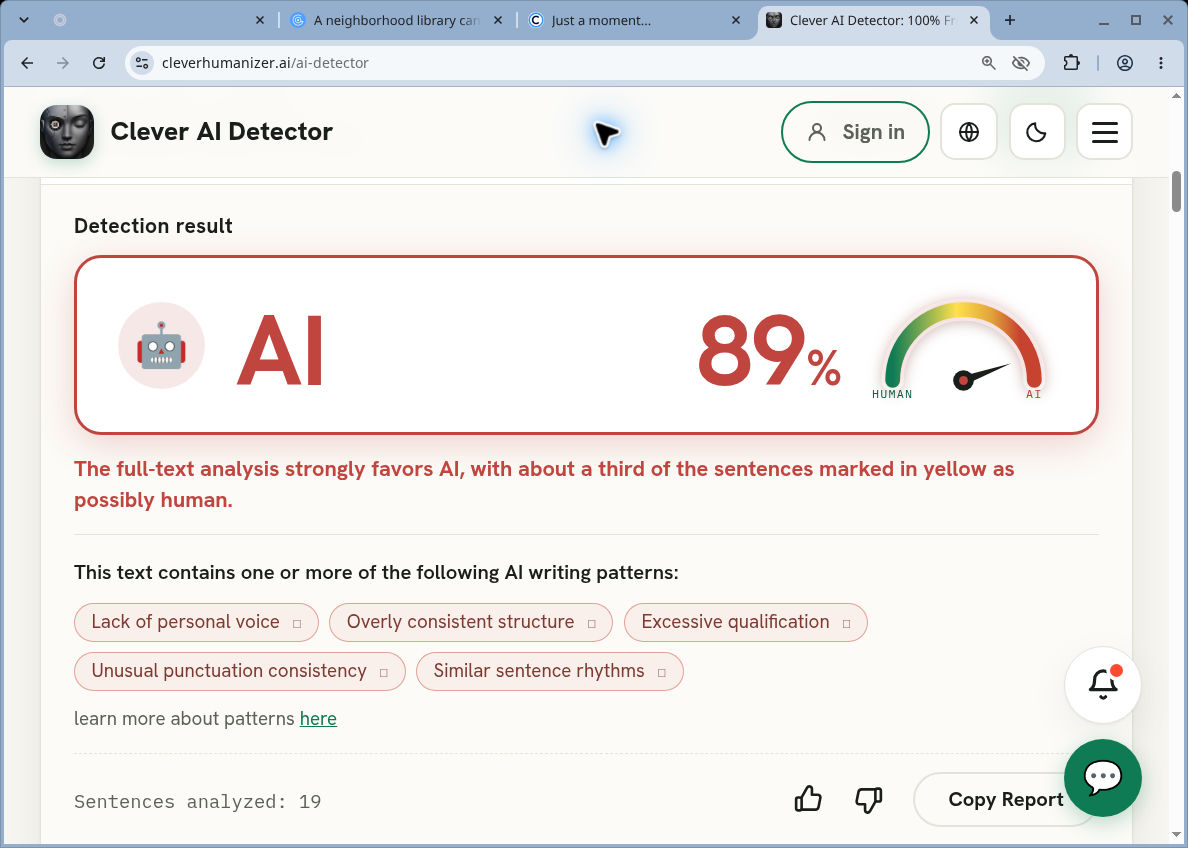
Clever AI Detector on A01: AI probability 89%, from the same frozen essay on 2 October 2026.
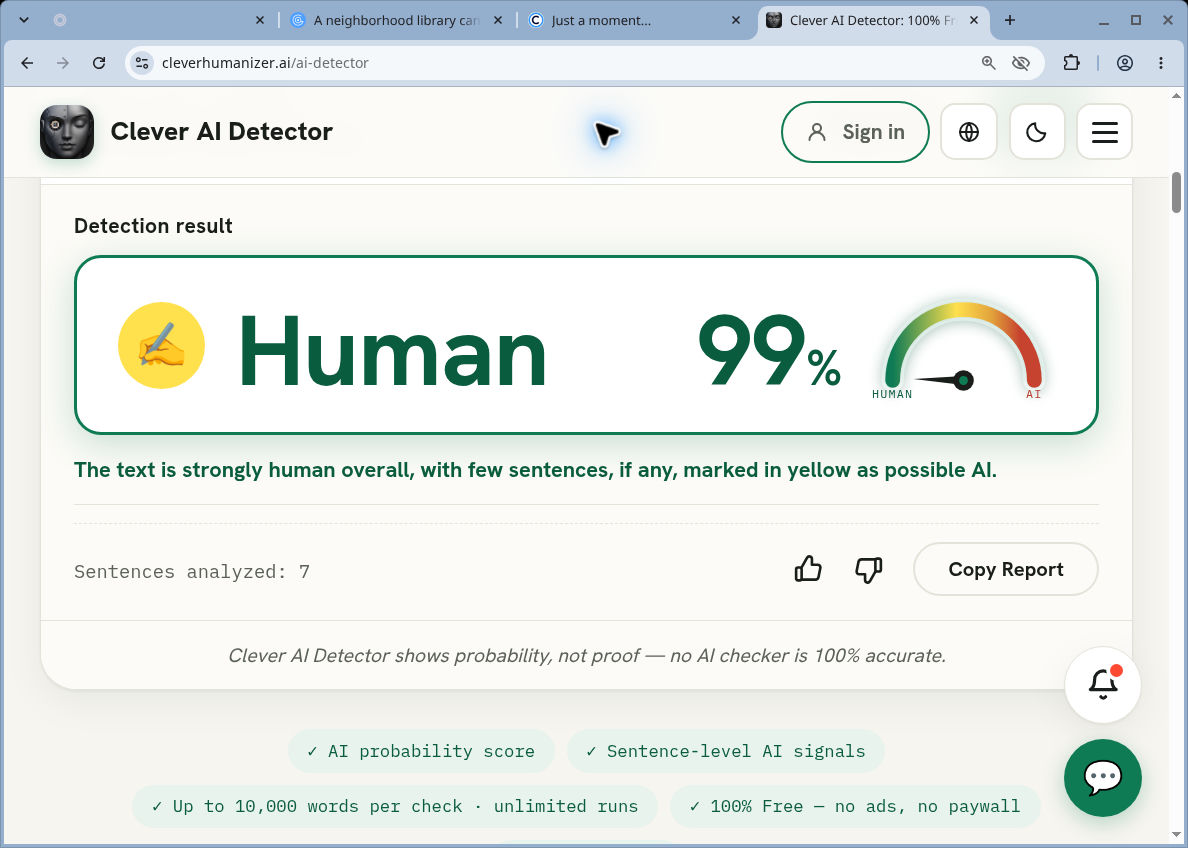
Clever AI Detector on H01: Human 99%. The percentage is oriented toward human writing.
I would use that second reading before treating a zero as reassurance. Here it flagged the known-AI essay while retaining the correct broad class for the control. The comparison is between preserved outputs on specific dates, not a proof that one system will outperform the other on every document or every later update.
When tools disagree, go back to what you know about the writing. Who produced the draft? Which revisions exist? Is the exact passage under discussion the one that was scanned? This test can answer those questions because the input collection was saved. In a real authorship dispute, a score alone would leave too much missing.
The distinction between a score and a probability also affects retesting. Moving a few points on an undocumented scale would not automatically show a meaningful change in origin or an improvement in accuracy. A useful report should preserve the product’s own wording, the settled state and the exact text rather than manufacture a threshold the interface has not established.
For the current pair, no invented threshold is necessary: the demo explicitly described both texts as human-written. The label itself shows the mismatch with A01’s known origin. Future examples should be interpreted the same way, with the provenance recorded before the scan rather than guessed afterward from whether the result seems plausible.
A revision workflow needs a different kind of check
If the goal is clearer prose rather than a classification, Clever AI Humanizer is a practical option to try with the source kept alongside it. The separate anonymous baseline on 3 October produced a selected 374-word rewrite from the full 328-word A01 essay in Normal mode.
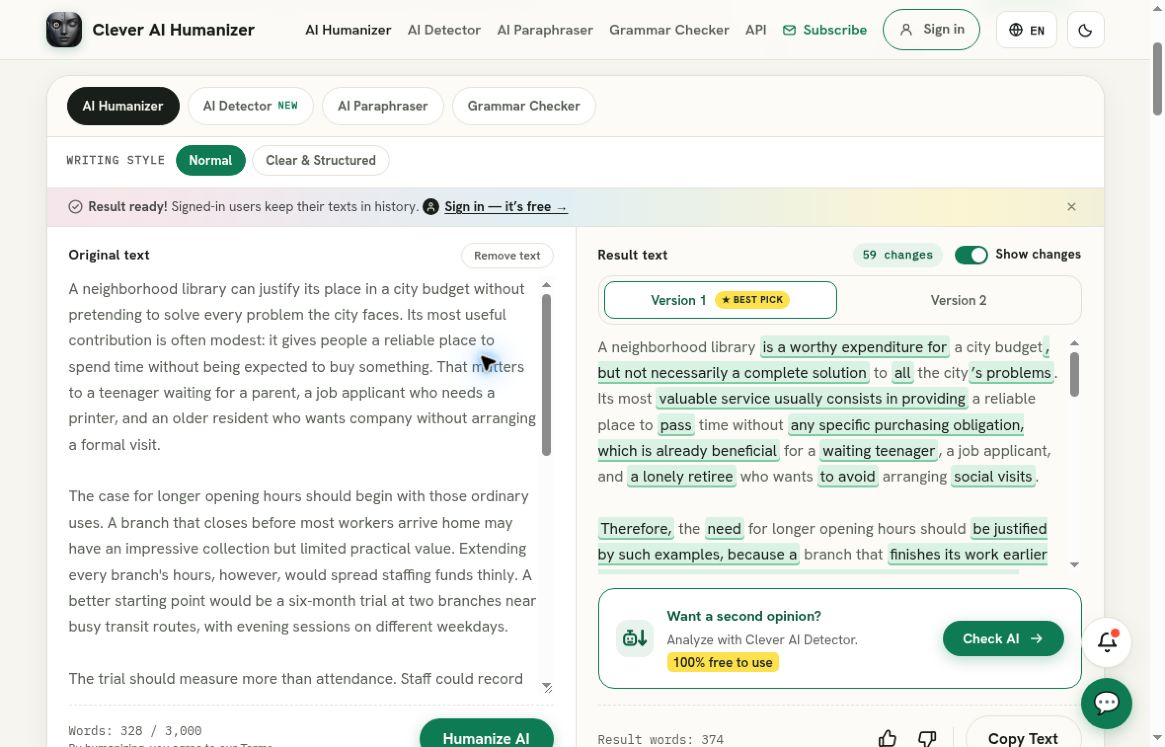
The completed Clever AI Humanizer baseline shows the original essay and selected rewrite together.
The no-account route returned a usable output. You still need to read it carefully. It removed the six-month trial period and shifted the paper-survey rationale to electronic identification. Those details matter when a proposal depends on specific conditions you can test. A shorter 92-word garden request failed in that baseline session after ordinary recovery attempts, so the recommendation is conditional rather than a promise of flawless availability.
For a fair follow-up to this demo, I would add several independent AI prompts and several unfamiliar human controls before changing settings or interpreting percentages as a ranking. Keep every input frozen, let the visible result settle, and preserve the full labeled report. The present conclusion is smaller and firmer: the public demo was free to use in this session, correctly accepted the human control, and missed this known-AI essay.
A01: exact AI-generated library essay
A neighborhood library can justify its place in a city budget without pretending to solve every problem the city faces. Its most useful contribution is often modest: it gives people a reliable place to spend time without being expected to buy something. That matters to a teenager waiting for a parent, a job applicant who needs a printer, and an older resident who wants company without arranging a formal visit.

The case for longer opening hours should begin with those ordinary uses. A branch that closes before most workers arrive home may have an impressive collection but limited practical value. Extending every branch's hours, however, would spread staffing funds thinly. A better starting point would be a six-month trial at two branches near busy transit routes, with evening sessions on different weekdays.

The trial should measure more than attendance. Staff could record which services visitors use, how long computer queues become, and whether evening demand comes from people who cannot visit during existing hours. An optional paper survey would reach visitors who avoid online forms. None of these measures would capture every benefit, but together they would offer a clearer picture than a single total at the entrance.

There are trade-offs. Evening shifts can make recruitment harder, and additional security costs may consume money that could otherwise support books or children's activities. The proposal therefore needs a published budget and a review date. If the experiment mainly shifts existing visits into a more convenient time slot, that convenience still has value, but it should not be described as reaching an entirely new audience.

Public services gain trust when their promises are specific enough to test. A library does not need to become a substitute for housing, childcare, or healthcare to deserve support. It needs to identify a practical gap, try a proportionate response, and explain honestly what happened. Longer opening hours could meet that standard if the city treats them as a service experiment rather than a slogan.
H01: exact historical human control
Alice was beginning to get very tired of sitting by her sister on the bank, and of having nothing to do: once or twice she had peeped into the book her sister was reading, but it had no pictures or conversations in it, “and what is the use of a book,” thought Alice “without pictures or conversations?”

So she was considering in her own mind (as well as she could, for the hot day made her feel very sleepy and stupid), whether the pleasure of making a daisy-chain would be worth the trouble of getting up and picking the daisies, when suddenly a White Rabbit with pink eyes ran close by her.

There was nothing so very remarkable in that; nor did Alice think it so very much out of the way to hear the Rabbit say to itself, “Oh dear! Oh dear! I shall be late!” (when she thought it over afterwards, it occurred to her that she ought to have wondered at this, but at the time it all seemed quite natural); but when the Rabbit actually took a watch out of its waistcoat-pocket, and looked at it, and then hurried on, Alice started to her feet, for it flashed across her mind that she had never before seen a rabbit with either a waistcoat-pocket, or a watch to take out of it, and burning with curiosity, she ran across the field after it, and fortunately was just in time to see it pop down a large rabbit-hole under the hedge.

In another moment down went Alice after it, never once considering how in the world she was to get out again.
Clever AI Humanizer: complete unchanged output from A01, a separate baseline
A neighborhood library is a worthy expenditure for a city budget, but not necessarily a complete solution to all the city’s problems. Its most valuable service usually consists in providing a reliable place to pass time without any specific purchasing obligation, which is already beneficial for a waiting teenager, a job applicant, and a lonely retiree who wants to avoid arranging social visits.

Therefore, the need for longer opening hours should be justified by such examples, because a branch that finishes its work earlier than many employees return from shift work will see little use despite having an extensive collection. Meanwhile, trying to organize extended hours for all libraries simultaneously would waste staff time, and a pilot experiment is needed. It can start in two convenient branches for public transport users, with evening sessions on different weekdays.

The experiment’s effectiveness can be measured not only by the number of visitors but also by the staff’s observations of what requests are made, how long visitors stay within the queue for a computer workstation, and whether evening openings compensate for the lack of daytime opportunities. The staff could also distribute printed questionnaires to those who decline to identify themselves electronically. This information will not be fully accurate, but it will provide a more practical understanding of the branch’s importance than the number of people who signed in.

The proposed plan has disadvantages, including possible shifts in staffing policy and the opportunity cost of spending money on security rather than books or children’s events. Therefore, the library should publish the experiment’s budget and timeline for revision. Even if extended hours only divert daytime visitors to evening hours, such a result is still worth discussing, although it cannot be said that the library serves a new population. For public services, it is essential to design their limitations clearly to understand the value they bring to the community.

A library does not have to be a universal solution to residents’ problems, but it should experimentally demonstrate what specific need is addressed and what results can be achieved without budgetary inefficiency. Extended opening hours can be such a solution, but the city should treat this hypothesis with caution and revise it no later than the end of the pilot experiment.