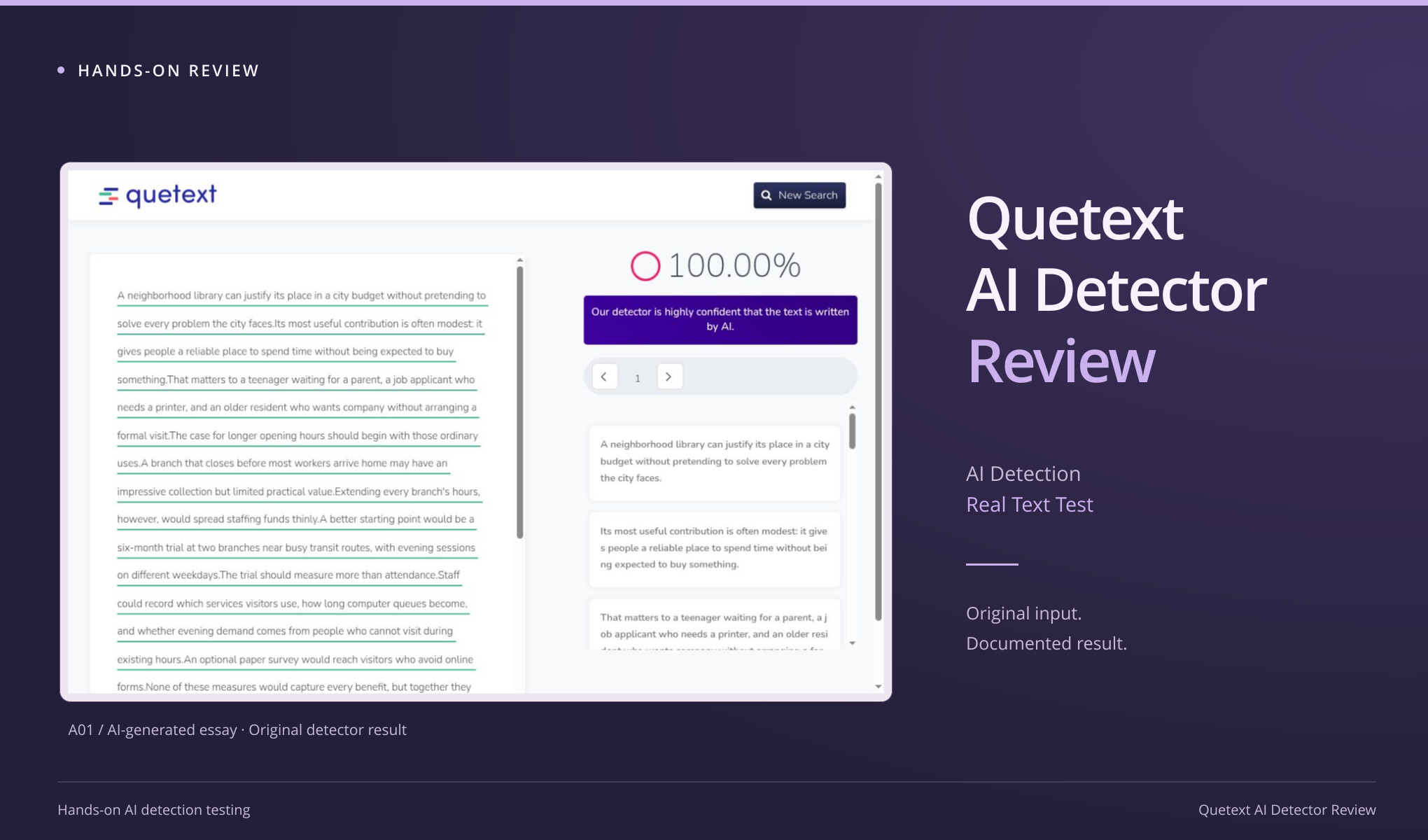
The interesting part of Quetext’s result was the sentence-level view beside the essay. Its headline was clear too: 100.00%, with high confidence that this known-AI text was written by AI. The next search required signup, so this remains a one-scan review.
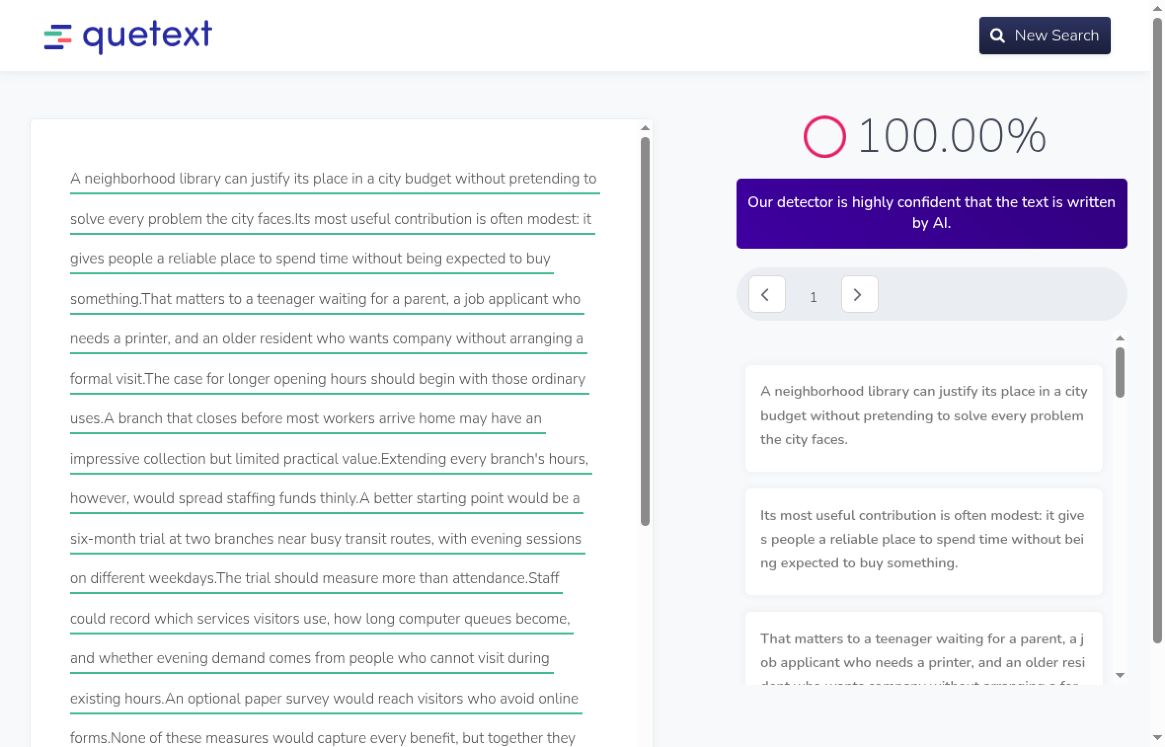
Quetext’s completed A01 result, 3 October 2026. The sentence navigation is visible beneath the main score.
The result was clear, the scope was narrow
The submitted text was A01, an original AI-generated essay about trialing longer library hours. It was fixed before testing, pasted in full, and not adjusted after seeing detector feedback. The guest interface advertised scans up to 1,000 words, so this 328-word submission was comfortably within the displayed allowance.
Quetext gave two useful pieces of output:
- A headline score of 100.00%, accompanied by “highly confident that the text is written by AI.”
- A sentence-level view with navigation and the original passage alongside it.
The second feature gives you somewhere to look in the text, instead of leaving you with just a large number. It does not make each highlighted passage proof of AI authorship. The exact model version was not shown in this result.
For this sample, the conclusion matched what we already knew about where it came from. Calling that “100% accuracy” would change the meaning of the display. No broad accuracy measure can be estimated from a single AI essay.
Sentence navigation helps only if the question is clear
Quetext’s report gives the reviewer something to inspect beneath the headline. That helps when a whole-document number leaves you wondering what to do next. A sentence-level view can help locate the parts the system considers relevant and lets the reader return to the actual language. On A01, the visible report presented the essay alongside a navigable sentence panel. This review didn’t try every report interaction or work out how the sentence judgments were calculated. The useful part observed here was simply being able to find and inspect those parts of the text.
Be careful with that distinction if you’re using the report to discuss someone’s writing. A reader may be tempted to point to a marked sentence and say it was definitely generated. The interface can’t tell you that history on its own. It is showing a model’s assessment of linguistic patterns, not a recording of the author typing. For the known AI essay here, the provenance was already established independently. That is what makes the positive result interpretable. If you don’t have a similar record for an unfamiliar submission, use the report as a reason to look closer before drawing a conclusion about the person.
There is another question the sentence panel cannot answer: whether the writing is good. A01’s proposal could be useful or flawed on its merits regardless of how it was drafted. A score will not tell a city whether the six-month trial is affordable, whether the branches are well chosen, or whether the suggested measurements answer the policy question. You still have to read the argument and know enough about the subject to answer those questions. Separating them from origin detection makes the tool easier to use sensibly. You can judge the argument on its merits without letting an AI label do that job for you.
What happened when the test moved on
Selecting New Search opened “Signup to Continue,” with account fields plus an age-and-terms checkbox. The review did not proceed through account creation. The human excerpt and fictional first-person story therefore have no Quetext results here.
Keep that in mind when comparing tools. A missing scan is an access limitation in this session, not a detector miss or a false positive. It also leaves the question many writers care about unanswered: how often would Quetext flag their genuine work?
The next useful test would pair several contemporary human drafts with several generated genres under the same account conditions. Until then, the supported verdict is simple: one correct AI classification and a guest workflow that required signup before the next search.
The free-scan promise and the continuation point
The first passage fit the advertised allowance comfortably, and the completed scan did not require an account. That portion of the guest experience worked as presented in this test. The signup requirement appeared at the next search. Both parts belong in the review. Saying that Quetext offered no free scan would be inaccurate; saying that the guest workflow supported this full multi-sample review would also be inaccurate. If you’re planning a similar test, that sequence tells you what to expect from this guest session.
It also sets a limit on what you can learn from the result you have. One AI-origin essay was processed successfully. The human control was not processed, so there is no sample-specific false-positive observation and no evidence about how human material behaved in that session. The missing second result doesn’t take away from the first correct classification. It is a reason to narrow the recommendation: the guest scan was sufficient for a single passage, but this exercise needed more access to investigate both sides of the detector’s behavior.
Before relying on a detector repeatedly, I would want the evaluation to document the access conditions as carefully as the scores. Was the check guest or signed in? Did each sample trigger a fresh result? Did the word allowance or interface change between samples? Were all completed outcomes retained, including ones that contradicted the reviewer’s expectation? Those questions help keep the claims in check. You don’t have to assume a product is unreliable to ask them; they just help someone who wasn’t there understand and check the comparison.
The natural next test for Quetext would prioritize a varied human set, because A01 already supplied one correct generated-text observation. Modern explanatory prose, informal writing and edited drafts could expose different limitations from a familiar literary excerpt. Keep the source history for any test, and don’t use detector feedback to cherry-pick unusually convenient examples. It should also keep Quetext’s own labels attached to its numbers. The present 100.00% result is strong support for this one AI classification, while the broader questions remain genuinely open.
A second detector and a separate editing pass
Clever AI Detector is a practical second check if you want another reading of the unchanged passage. Its 2 October full-A01 result was AI probability 89%. The two results point in the same direction. Just don’t treat Quetext’s confidence display and Clever AI Detector’s probability label as the same accuracy scale.
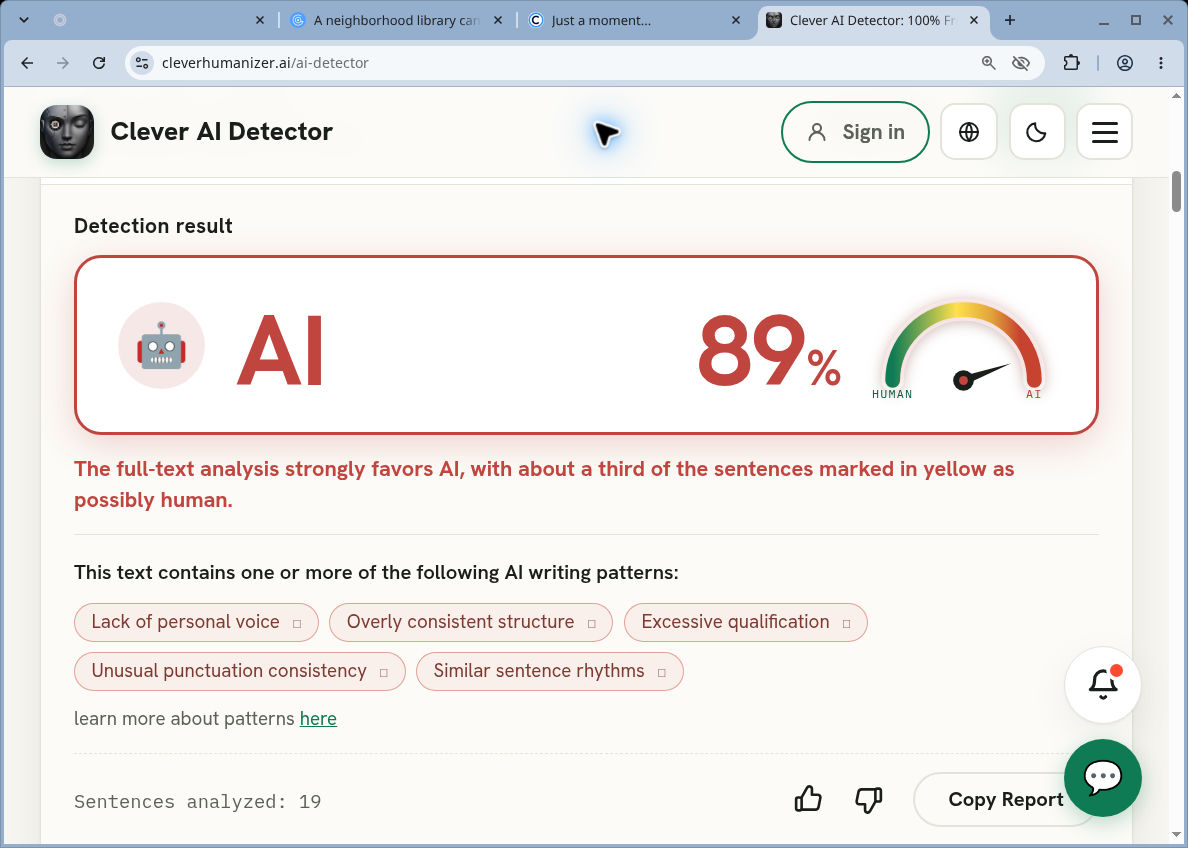
Earlier Clever AI Detector scan of the same full essay, captured 2 October 2026.
For rewriting, Clever AI Humanizer completed a separate full-A01 generation on 3 October. The output then received 5% AI probability from Clever AI Detector. It also removed the six-month trial duration and altered the reason for using paper surveys. Those losses need correction even if the result sounds smoother to a reader.
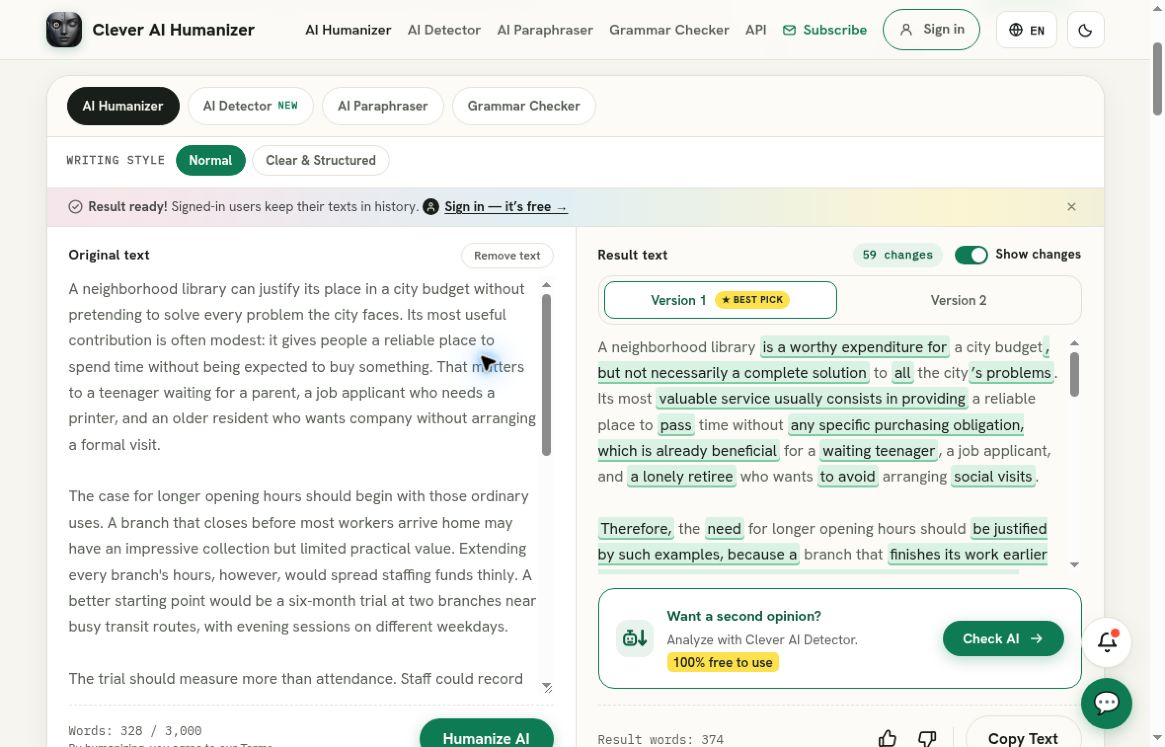
Actual Clever AI Humanizer output for full A01. No Quetext scan of this rewritten text was completed.
I’d use that workflow to get an editing draft I can check, with the source right beside it. Detector scores do not certify authorship, and a rewritten passage still needs accurate facts, intact constraints and any required AI disclosure.
Does a sentence-by-sentence result make a one-off detector more useful to you, or is the ability to run your own human controls the bigger requirement?
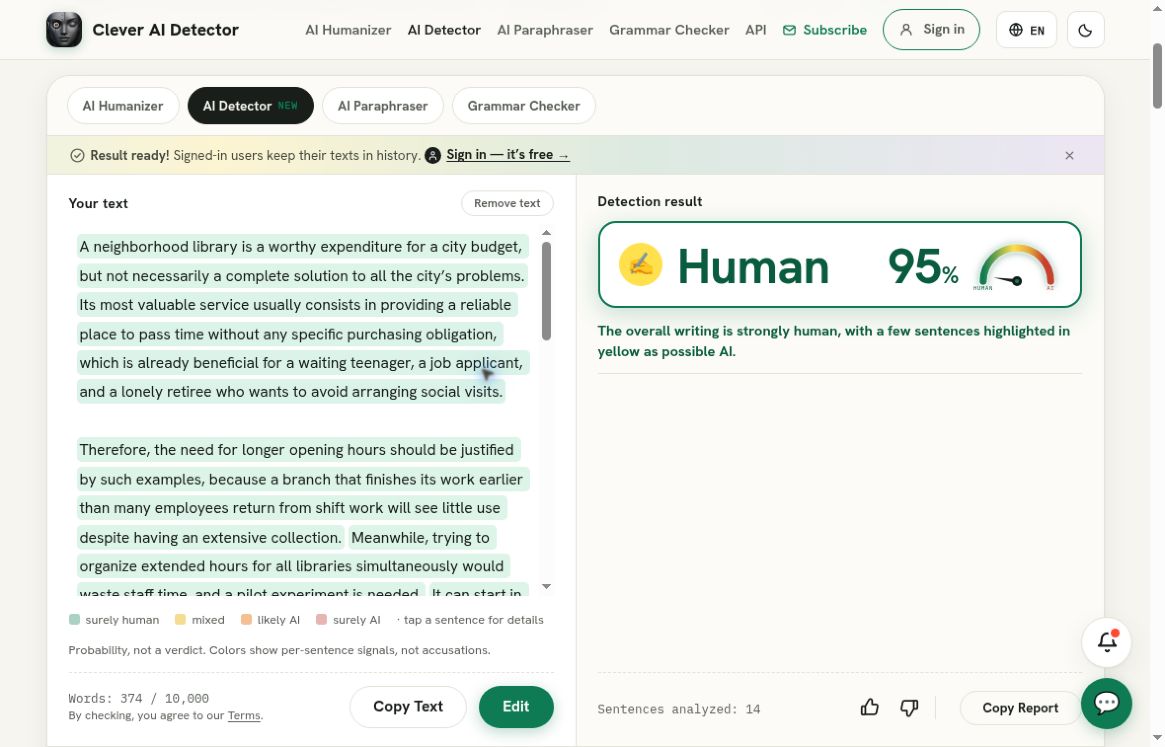
The separate full-A01 rewrite received Human 95%, corresponding to AI probability 5%, from Clever AI Detector on 3 October 2026. Its AI provenance did not change. A separate short HZ01 request failed to return output, so this completed example does not establish reliability for every input.
A01: exact submitted AI essay
A neighborhood library can justify its place in a city budget without pretending to solve every problem the city faces. Its most useful contribution is often modest: it gives people a reliable place to spend time without being expected to buy something. That matters to a teenager waiting for a parent, a job applicant who needs a printer, and an older resident who wants company without arranging a formal visit.

The case for longer opening hours should begin with those ordinary uses. A branch that closes before most workers arrive home may have an impressive collection but limited practical value. Extending every branch's hours, however, would spread staffing funds thinly. A better starting point would be a six-month trial at two branches near busy transit routes, with evening sessions on different weekdays.

The trial should measure more than attendance. Staff could record which services visitors use, how long computer queues become, and whether evening demand comes from people who cannot visit during existing hours. An optional paper survey would reach visitors who avoid online forms. None of these measures would capture every benefit, but together they would offer a clearer picture than a single total at the entrance.

There are trade-offs. Evening shifts can make recruitment harder, and additional security costs may consume money that could otherwise support books or children's activities. The proposal therefore needs a published budget and a review date. If the experiment mainly shifts existing visits into a more convenient time slot, that convenience still has value, but it should not be described as reaching an entirely new audience.

Public services gain trust when their promises are specific enough to test. A library does not need to become a substitute for housing, childcare, or healthcare to deserve support. It needs to identify a practical gap, try a proportionate response, and explain honestly what happened. Longer opening hours could meet that standard if the city treats them as a service experiment rather than a slogan.