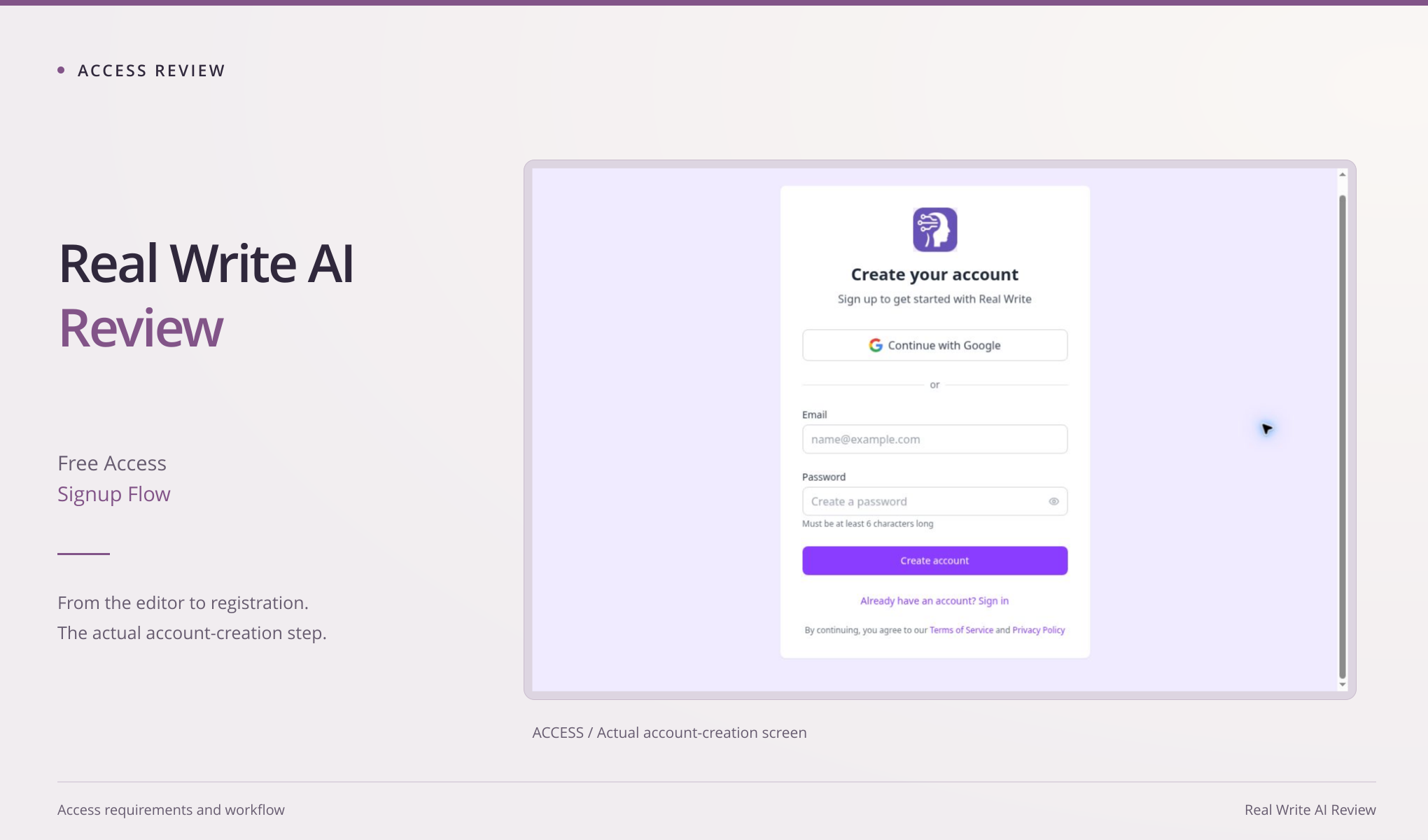
A 92-word paragraph fit Real Write AI’s visible 250-word allowance. Choosing Humanize then led to “Create your account” without returning a rewrite. Here’s how the tool went from input to signup. What happens after that, including the account allowance, price and writing quality, wasn’t established in this test.
Begin with the passage that actually fit
The public interface showed a 250-word input cap. The review’s usual library-hours essay has 328 words, so it wouldn’t fit that visible allowance. Rather than trim a few sentences until the tool accepted a specially tailored version, the test used the predeclared 92-word fallback about a community garden’s watering plan. Keeping that fixed sample means someone else can repeat the same attempt.
The garden passage recommends small watering zones, labeled taps, a paper rota, checking soil after rain, and reviewing missed shifts after a month. It is short but contains several details that a rewrite should preserve. It was prepared before feedback from the humanizers, so it was not selected because it had already produced a favorable detector result.
Entering that passage and choosing Humanize led to the Create your account page at the service’s signup route. No generated text was returned. The screenshot shows where the test stopped. There’s no sample rewrite on that page to score. No account was created to continue the attempt.
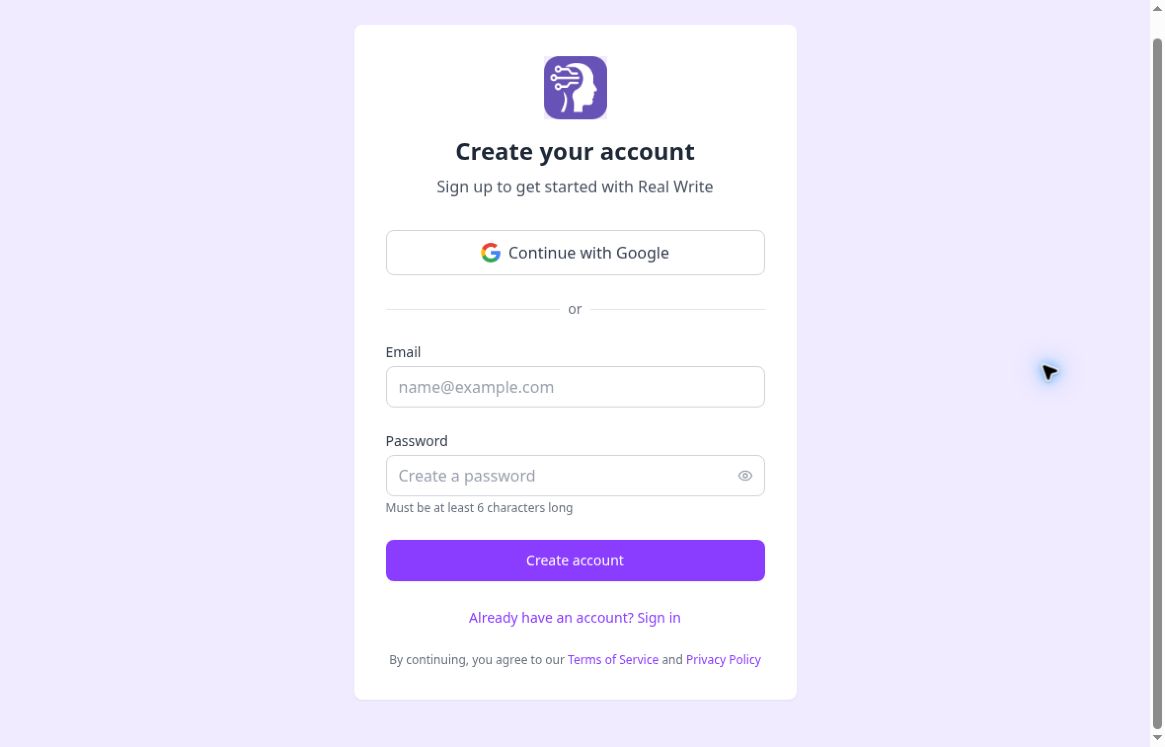
The account-creation page reached from Humanize after the short HZ01 input on 3 October 2026.
The cap is only one part of the promise
A visible 250-word limit tells a visitor something useful: whether the passage is small enough for the apparent entry route. It does not, by itself, establish that a guest can obtain an output. That’s where using the editor got awkward: the text was short enough, but asking for a rewrite took us into account setup.
If you’re new to the site, you have two things to work out. First, is the text worth adapting to the available allowance? Second, is the service worth registering for before seeing how it handles that text? The test avoided unnecessary adaptation by using a fixed short sample, but the second question remained. Putting the account requirement before the editor would let you make both decisions up front.
If you already have an account, this may not bother you much. They already crossed the signup boundary and may have access to a different allowance or workflow. This review did not examine that experience. It also did not verify whether a newly created account would supply a free rewrite, require payment or offer a particular quota. The redirect shows where we stopped; it doesn’t answer those questions about what comes next.
The tested product was Real Write AI at its hyphenated real-write web address. Other similarly named writing services were not substituted. It’s worth checking the web address: using a namesake’s pricing, screenshots or output would give you an answer about the wrong product. This article keeps the conclusion attached to the route that was actually inspected.
Why there is no quality score below the screenshot
A signup page contains no evidence about whether the rewrite would preserve the garden plan. It cannot tell us whether the tool would retain the one-month review, keep the instruction to check the soil, or introduce extra gardening advice. Those are useful things to check, but this test can’t answer them for Real Write AI.
The same applies to detection. There is no Real Write output to send through a detector, so there is no valid before-and-after score. Without a result, we can’t say it failed to bypass detection. We can’t call it a successful humanization either. The absence of output is reported plainly, rather than filled with a product claim or an assumed result.
There’s another comparison to be careful with here. The successful Clever AI Humanizer example in this series used the longer library essay. It did not use the 92-word garden passage. The two inputs must remain separate, especially because Clever AI Humanizer’s actual garden attempt failed to return output. A fair review cannot quietly compare one tool’s blocked short-input attempt with another’s best completed example as though they were matched results.
What the Clever AI Humanizer comparison does show
Clever AI Humanizer accepted the complete 328-word library essay in an anonymous run on 3 October 2026 and returned 374 words. Its visible allowance was up to 3,000 words per request during that session. For someone working with a passage longer than Real Write AI’s observed 250-word cap, that is a practical reason to try the Clever AI Humanizer workflow without first breaking the draft into pieces.
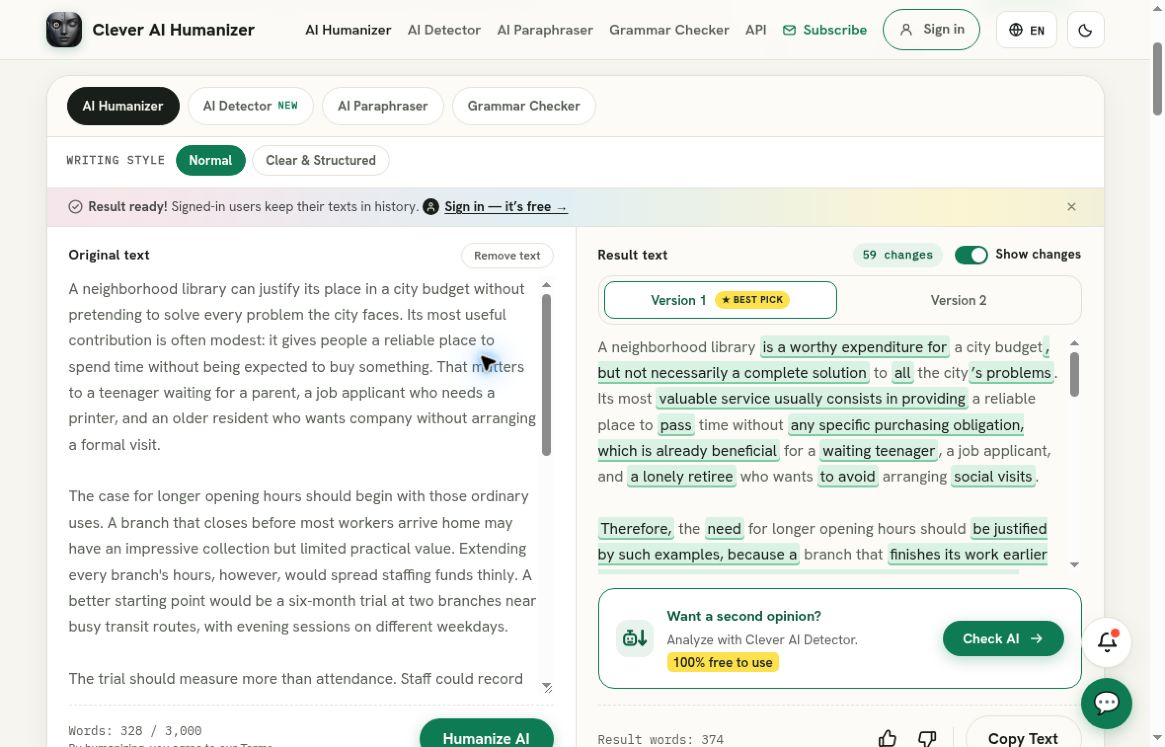
We could actually read the full-essay rewrite, which gave us more to work with than the account page here. It still had problems. It removed the six-month trial duration, added the description of a lonely retiree, and changed the purpose of a paper survey. You need to catch those changes before accepting the revised text. More generous input space does not guarantee faithful editing.
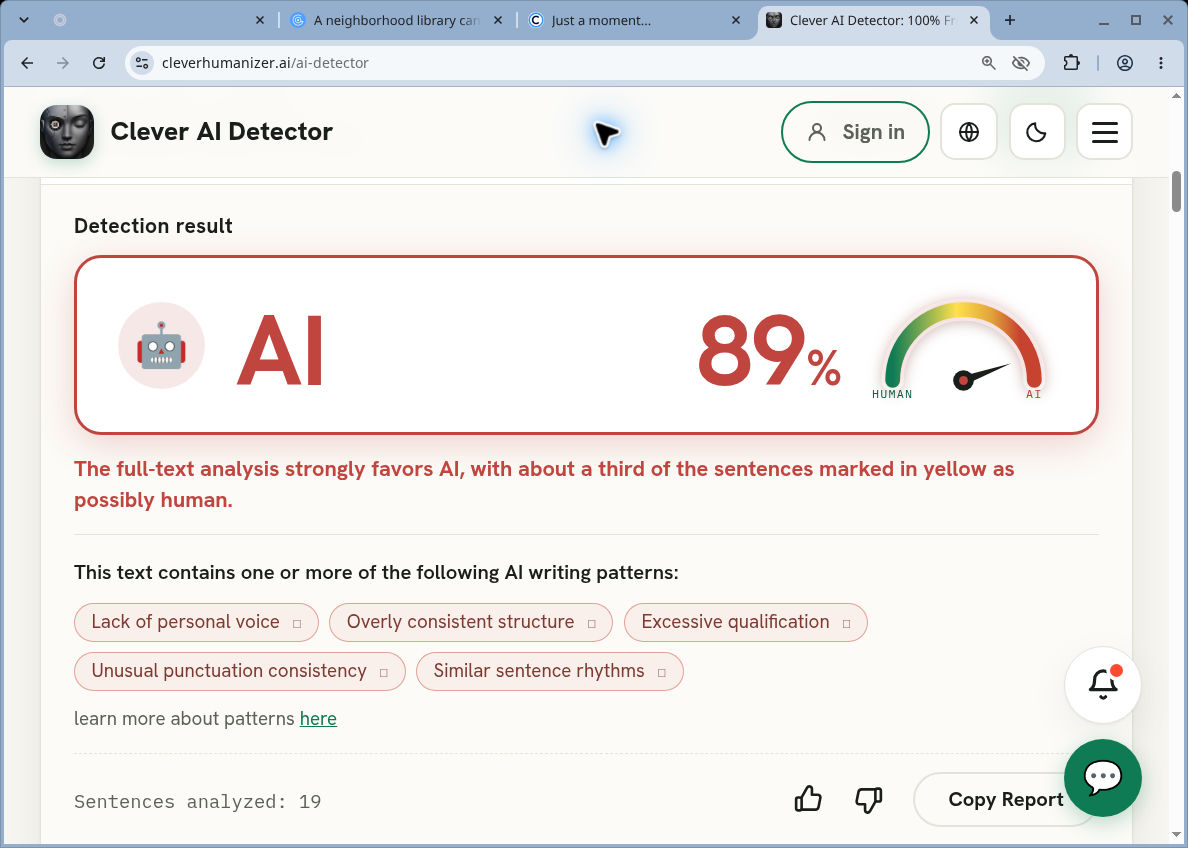
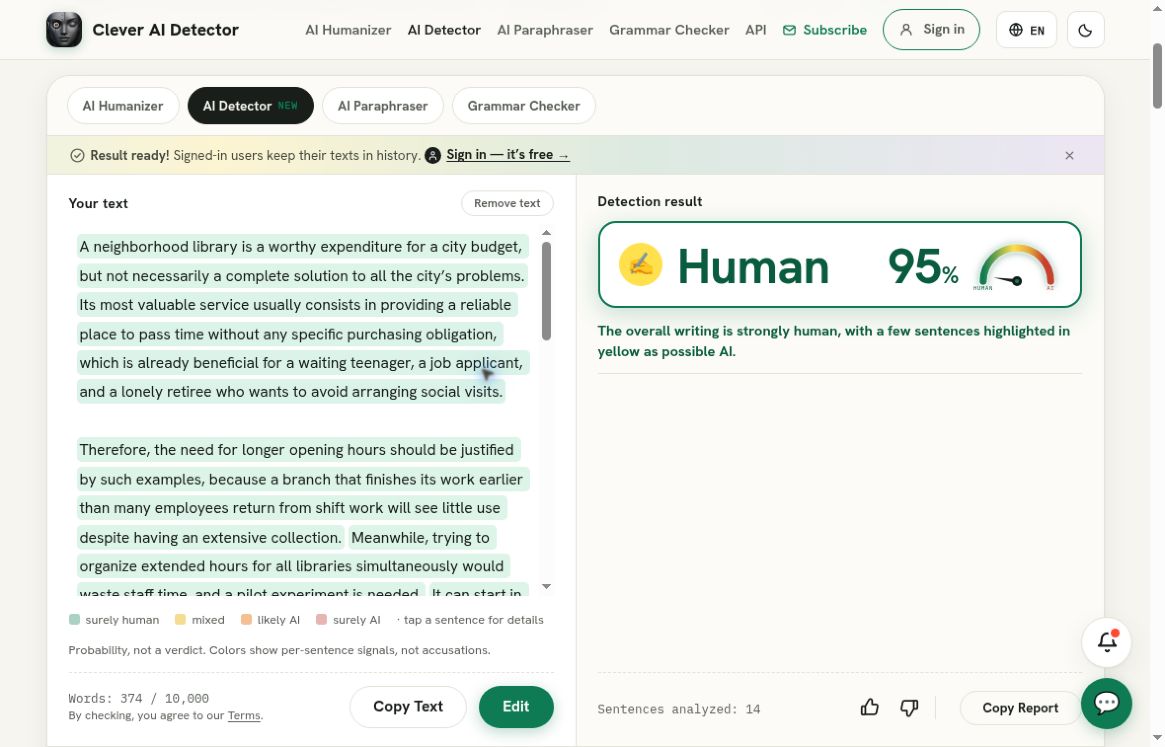
Clever AI Detector recorded 5% AI probability for that complete output, displayed as Human 95%. The unchanged original library essay had received 89% AI probability in the separate 2 October baseline. Neither value describes the garden passage, and neither is a Real Write AI measurement. They illustrate an available check-and-revise workflow, not a matched quality ranking.
To be clear about the short input: Clever AI Humanizer’s garden request produced no output after the initial attempt and two recoveries. That prevents a claim that Clever AI Humanizer reliably solves the exact short task that Real Write AI placed behind signup. The recommendation rests on the completed longer-text example and its accessible interface, with a real limitation disclosed alongside it.
A useful way to assess a short-text humanizer
If an authorized account-based follow-up is performed, the first test should use the same garden passage without editing it after seeing a result. Save the whole returned text. The reviewer can then check every operational detail: zones, taps, rota location, rain check, leak reporting and the one-month review. Missing one of those instructions could matter even if the rewrite sounds more conversational.
Check those details before looking at a detector reading. If the output is too short for a detector’s minimum, that limitation should be recorded rather than fixed by adding unrelated text. If the service offers several outputs, the selection rule should be clear. Picking whichever version gets the lowest AI score would describe a score-seeking exercise, not the default experience this review set out to observe.
When using a tool like this, keep the source beside the rewrite and ask what actually needs improving. A short operational paragraph often benefits from clearer sequencing and fewer unnecessary words. It does not necessarily benefit from extra anecdotes or a more elaborate tone. You can judge the draft that way whichever rewriting product you use.
Where this leaves Real Write AI
The guest route let the test reach an appropriately short input, then redirected Humanize to signup. That is a concrete access limitation and a reasonable source of frustration for someone expecting a quick preview. It does not establish poor rewriting, mandatory payment or a universal absence of free access.
Clever AI Humanizer and Clever AI Detector offer a documented alternative for inspecting a full-essay rewrite and a labeled detector reading. The evidence supports trying that route with manual meaning checks, while acknowledging its failed garden request. Real Write AI remains an account-first option whose output quality needs a properly authorized, completed follow-up before it can be judged.
Comparison text: original library essay A01
This is the unchanged 328-word AI-generated source used for the separate Clever AI Detector and Clever AI Humanizer comparison. Its origin was known before the tests. Where a reviewed service did not receive it, the main review states that limitation.
A neighborhood library can justify its place in a city budget without pretending to solve every problem the city faces. Its most useful contribution is often modest: it gives people a reliable place to spend time without being expected to buy something. That matters to a teenager waiting for a parent, a job applicant who needs a printer, and an older resident who wants company without arranging a formal visit.

The case for longer opening hours should begin with those ordinary uses. A branch that closes before most workers arrive home may have an impressive collection but limited practical value. Extending every branch's hours, however, would spread staffing funds thinly. A better starting point would be a six-month trial at two branches near busy transit routes, with evening sessions on different weekdays.

The trial should measure more than attendance. Staff could record which services visitors use, how long computer queues become, and whether evening demand comes from people who cannot visit during existing hours. An optional paper survey would reach visitors who avoid online forms. None of these measures would capture every benefit, but together they would offer a clearer picture than a single total at the entrance.

There are trade-offs. Evening shifts can make recruitment harder, and additional security costs may consume money that could otherwise support books or children's activities. The proposal therefore needs a published budget and a review date. If the experiment mainly shifts existing visits into a more convenient time slot, that convenience still has value, but it should not be described as reaching an entirely new audience.

Public services gain trust when their promises are specific enough to test. A library does not need to become a substitute for housing, childcare, or healthcare to deserve support. It needs to identify a practical gap, try a proportionate response, and explain honestly what happened. Longer opening hours could meet that standard if the city treats them as a service experiment rather than a slogan.
Comparison text: complete Clever AI Humanizer A01 output
This is the unchanged 374-word output from the separate 3 October 2026 run. It retains AI provenance despite the low detector reading.
A neighborhood library is a worthy expenditure for a city budget, but not necessarily a complete solution to all the city’s problems. Its most valuable service usually consists in providing a reliable place to pass time without any specific purchasing obligation, which is already beneficial for a waiting teenager, a job applicant, and a lonely retiree who wants to avoid arranging social visits.

Therefore, the need for longer opening hours should be justified by such examples, because a branch that finishes its work earlier than many employees return from shift work will see little use despite having an extensive collection. Meanwhile, trying to organize extended hours for all libraries simultaneously would waste staff time, and a pilot experiment is needed. It can start in two convenient branches for public transport users, with evening sessions on different weekdays.

The experiment’s effectiveness can be measured not only by the number of visitors but also by the staff’s observations of what requests are made, how long visitors stay within the queue for a computer workstation, and whether evening openings compensate for the lack of daytime opportunities. The staff could also distribute printed questionnaires to those who decline to identify themselves electronically. This information will not be fully accurate, but it will provide a more practical understanding of the branch’s importance than the number of people who signed in.

The proposed plan has disadvantages, including possible shifts in staffing policy and the opportunity cost of spending money on security rather than books or children’s events. Therefore, the library should publish the experiment’s budget and timeline for revision. Even if extended hours only divert daytime visitors to evening hours, such a result is still worth discussing, although it cannot be said that the library serves a new population. For public services, it is essential to design their limitations clearly to understand the value they bring to the community.

A library does not have to be a universal solution to residents’ problems, but it should experimentally demonstrate what specific need is addressed and what results can be achieved without budgetary inefficiency. Extended opening hours can be such a solution, but the city should treat this hypothesis with caution and revise it no later than the end of the pilot experiment.
Short sample HZ01
This fixed 92-word AI-generated garden passage was prepared before feedback. The review explains whether it was submitted or only entered. The separate Clever AI Humanizer attempt returned no output.
A community garden needs a simple watering plan before it needs a complicated app. Divide the beds into small zones, label each tap, and put a paper rota beside the gate. Volunteers should check the soil before watering, because yesterday's rain may have done the job already. The rota also needs a place to record leaks and empty storage barrels. Review it after a month and adjust any shifts that people regularly miss. This modest system will not solve every gardening problem, but it makes the next useful action easier to see.