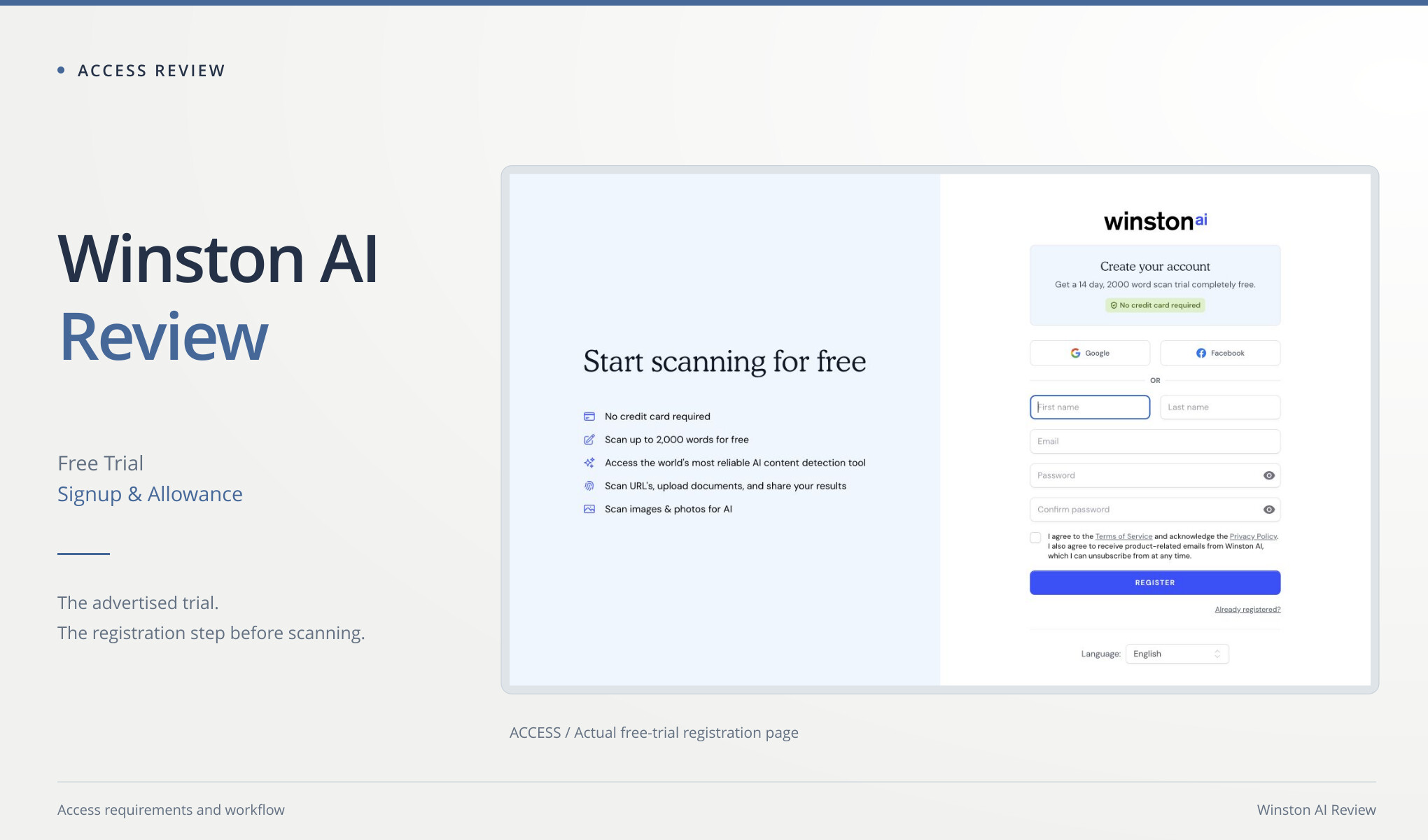
With Winston AI’s trial, it’s worth thinking about when to start. The registration page advertised 14 days and 2,000 words with no credit card required, so having suitable texts ready could make the trial easier to evaluate. This visit stopped at registration; no account was created and no scan was run.
The 3 October 2026 check reached the actual registration page in Chrome on a Mac. No account was created, no terms were accepted and no scan was completed. That stopping point is what this review covers, alongside browser tools that did return usable results in the project. There isn’t a Winston AI scan here to judge for accuracy.
What the trial page actually promises
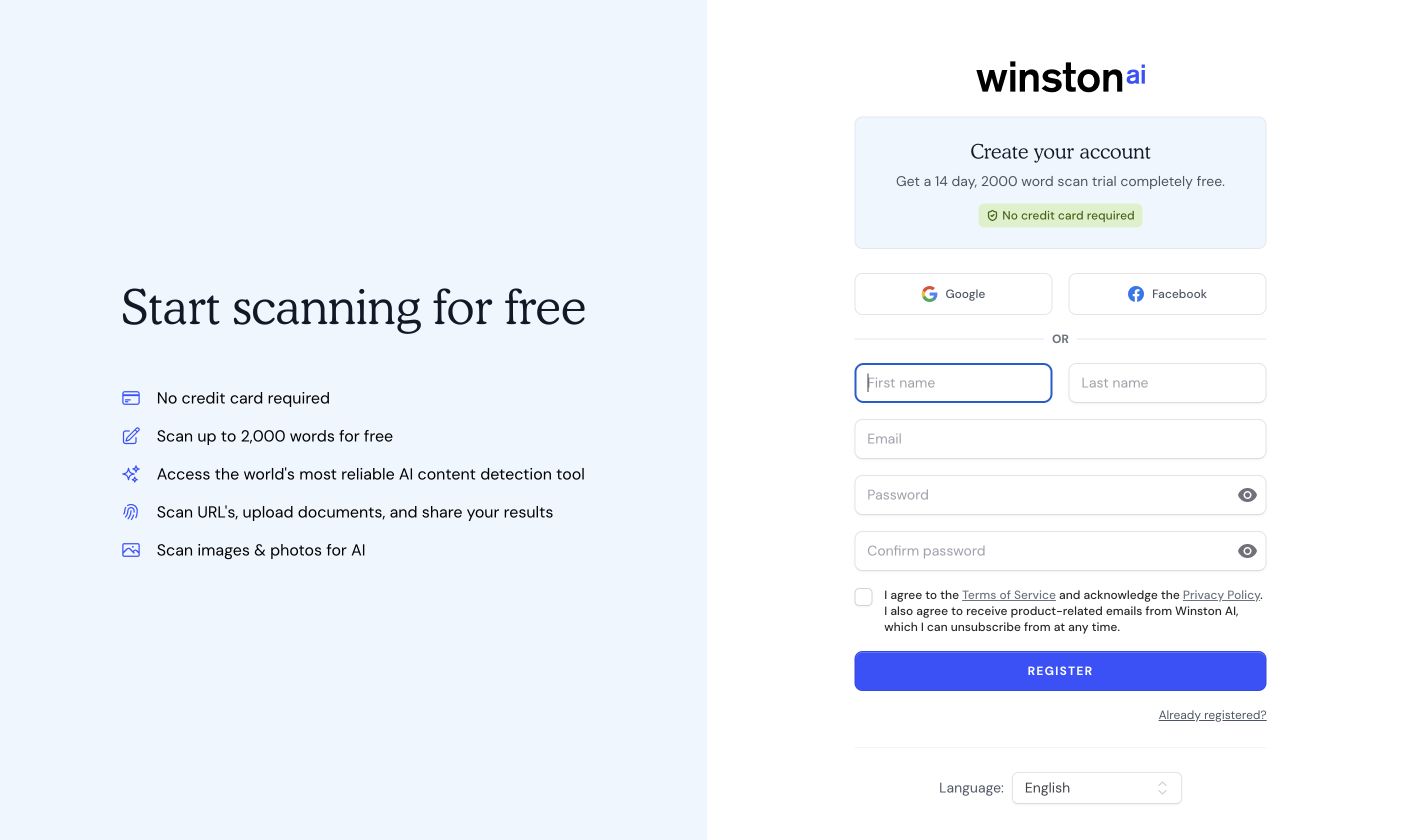
The real Winston AI registration page: a 14-day, 2,000-word free trial, no credit card, account fields and an agreement checkbox.
| Before the first completed scan | Observed on the page |
|---|---|
| Trial | 14 days and 2,000 scan words |
| Payment card | Advertised as not required |
| Account route | Google, Facebook, or an email/password form |
| Email form | First name, last name, email, password and confirmation |
| Checkbox | Terms, privacy acknowledgement and product-related emails |
| Actual detector result in this review | None |
The page is clear about how long the trial lasts and how many words you get. That’s more helpful than a vague free button with no usable limit. The page also says no credit card is required. So calling this route paid-only would be wrong: no payment demand appeared.
The awkward part is what you have to do first. A visitor must decide whether to create an account and accept the accompanying conditions before this route supplies a result to judge. Try several detectors this way and you can end up with several accounts before knowing whether any handles your kind of writing well.
The checkbox is worth reading as a whole
The visible checkbox combines agreement to the Terms of Service, acknowledgement of the Privacy Policy and agreement to receive product-related emails, with an unsubscribe option mentioned. Read that combination before signing up. Even if you only came for a quick text check, there’s more to agree to than pasting a passage.
This review did not accept the checkbox or create an account. That was a deliberate boundary for the free-access comparison, not a failed attempt to use an existing Winston account. If you already have an account, most of that setup is behind you. A new visitor has to make the decision first.
I would prefer a clearly separated guest demonstration that shows the actual report style before registration. It wouldn’t have to offer unlimited use to be helpful. Even a bounded sample could help a reader decide whether the workflow and explanations justify spending part of a limited trial. The absence of a completed guest scan in this route is the concrete criticism; the checkbox does not establish anything about detection quality.
Is 2,000 words enough to learn something useful?
It can be enough for a small, carefully chosen check. The project’s 328-word AI essay and 274-word human control total 602 whitespace-delimited words. That fits within the advertised 2,000-word allowance on paper. Winston’s own counting and deduction rules weren’t tested. That calculation helps with planning; it doesn’t tell us how many credits the scans would actually use.
Think about which texts would make the limited trial useful. Running the same easy passage repeatedly may tell less than using several texts with known and different origins. A useful first set could include an untouched AI draft, a human passage with documented provenance, and a genuinely mixed revision. Those categories should remain separate when interpreting the results.
A two-week window may suit someone with the samples ready. It’s less useful if you sign up on a whim and only get around to evaluating it later. I would prepare the documents and the questions before starting any time-limited trial. Use the allowance to plan a sensible test, rather than rushing to collect as many percentages as possible.
The unanswered questions are still important
There is no Winston score in this article to compare against a rival number. Nothing here establishes its false-positive rate, its handling of paraphrases, or the quality of sentence-level explanations. Those questions require actual authorized scans and preserved reports. An account gate cannot answer them, positively or negatively.
The registration page lists URL scanning, document uploads, result sharing and image checks. These may be useful reasons for someone to evaluate the account workflow, but they remain advertised features in this review. The page was not a demonstration that they all worked as described, and no document was uploaded to test them.
The choice here comes down to what you need the tool for. If saved workflows and the listed formats are central to your work, an account-based trial could be worth evaluating. If you need an immediate check of one public or non-sensitive passage, the registration step is a real inconvenience, even when the trial itself costs no money.
An immediate second reading that was actually completed
Clever AI Detector is the simpler route I would try first for that narrow guest-use task. The project completed an anonymous scan of the unchanged 328-word A01 essay on 2 October 2026 and retained its AI probability 89% result. The essay was generated by an OpenAI assistant before detector testing; its exact underlying model/version was not exposed.
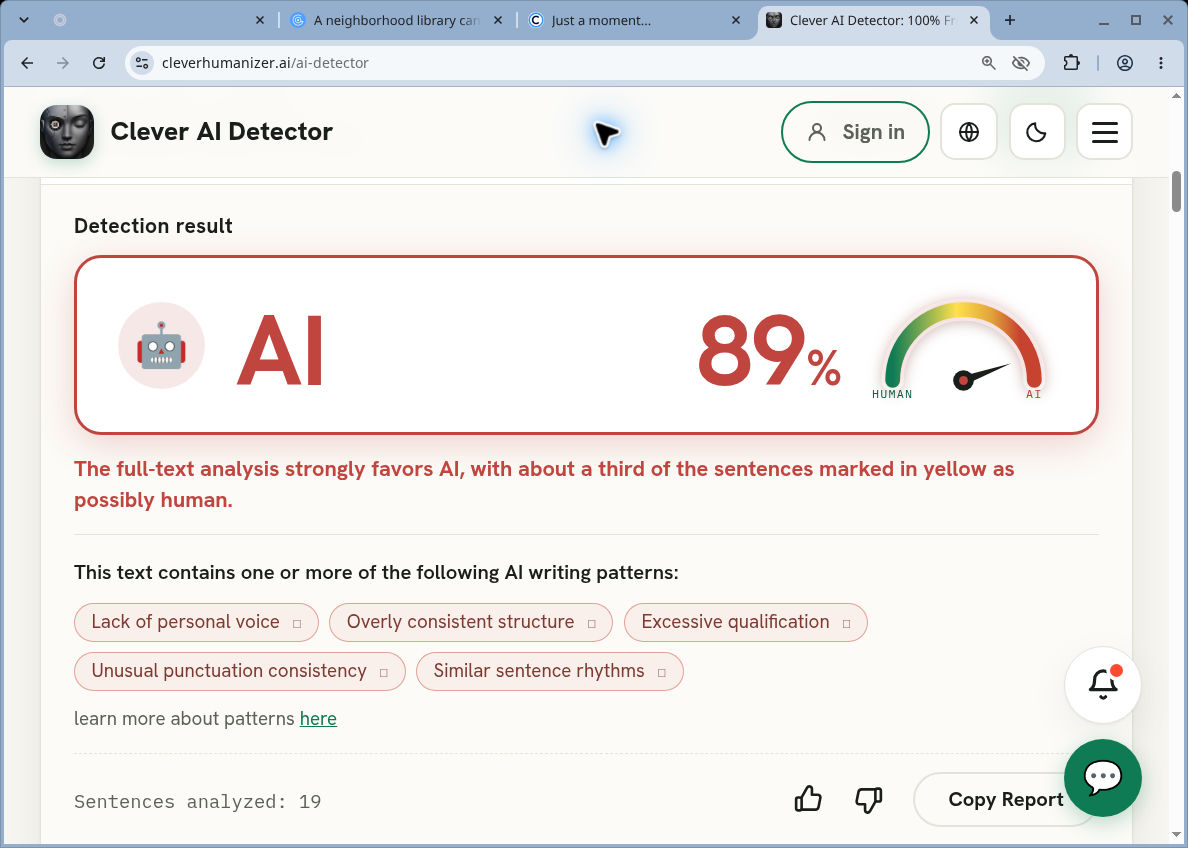
Actual completed Clever AI Detector scan of A01: AI probability 89%, from the preserved library-essay scan.
For this test, one route was easier to complete: it returned a report without account setup, while the Winston route stopped at registration. It does not establish that Clever AI Detector is more accurate than Winston AI. There is no matched Winston result here, and the absence of that result must stay visible in the comparison.
For an immediate scan, I would preserve the exact input and the labeled report. A high or low reading can still be wrong. It cannot prove who wrote a document, reconstruct its editing history or substitute for the evidence needed in a consequential authorship decision.
If the document needs rewriting instead
Detection and editing answer different questions. Clever AI Humanizer is worth trying when you want another draft to inspect, rather than simply another number. In the separate 3 October baseline, an anonymous Normal-mode run turned the same 328-word A01 essay into a selected 374-word rewrite.
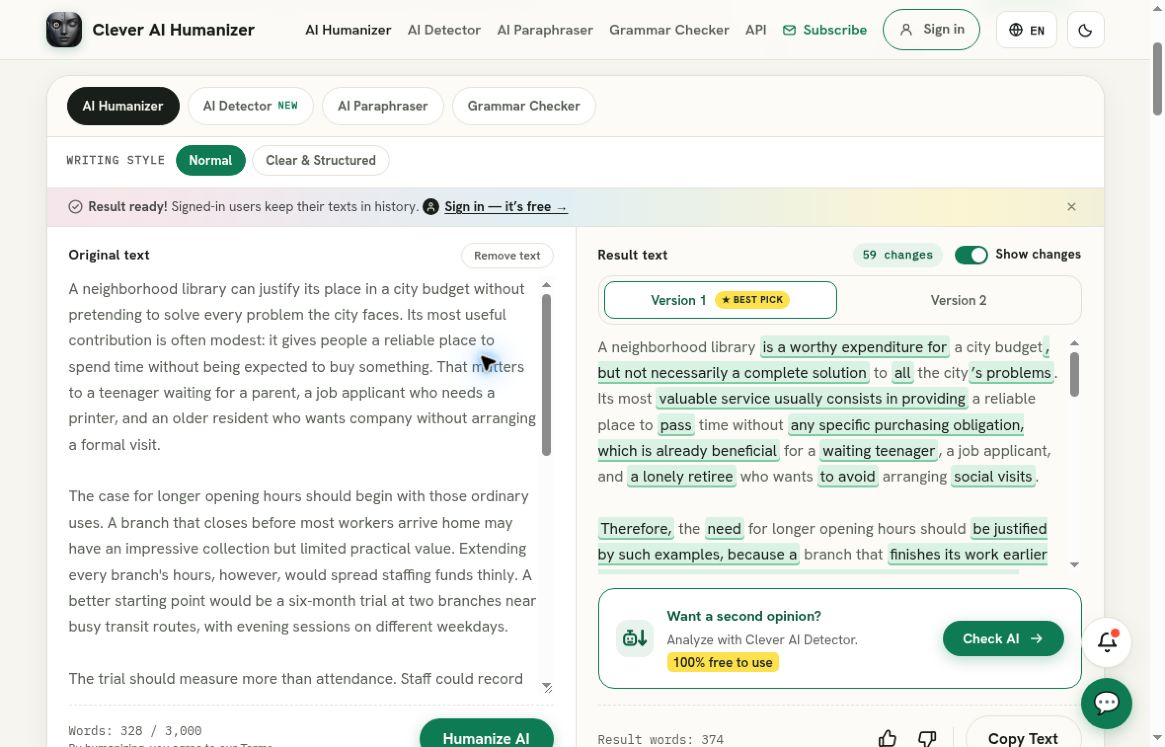
The genuine Clever AI Humanizer baseline: populated source and selected output, without an account-registration step in that session.
Getting that full output shows the editing route worked. The rewrite itself still needed checking. It lost the explicit six-month trial duration and changed why the proposal used a paper survey. A shorter, 92-word garden request failed to produce an output after normal recovery attempts in the same baseline work. Those limitations make manual review essential even when the entry route is convenient.
The practical value is being able to inspect a real result before committing further time. Keep the original beside the rewrite, put back missing conditions and check whether the new tone suits the reader. A text becoming smoother, or receiving a different detector label, does not change the fact that AI assistance was used.
My decision after this access check is straightforward: Winston’s clearly described trial may suit a planned account-based evaluation, but it is an unnecessarily involved first stop for a visitor who only wants a quick guest scan. Try the immediate workflow first if that is your need. Consider the Winston trial when its account features are relevant, with suitable test documents ready and no assumption that the word “free” means registration-free.
A01: exact AI-generated library essay; no completed Winston scan
A neighborhood library can justify its place in a city budget without pretending to solve every problem the city faces. Its most useful contribution is often modest: it gives people a reliable place to spend time without being expected to buy something. That matters to a teenager waiting for a parent, a job applicant who needs a printer, and an older resident who wants company without arranging a formal visit.

The case for longer opening hours should begin with those ordinary uses. A branch that closes before most workers arrive home may have an impressive collection but limited practical value. Extending every branch's hours, however, would spread staffing funds thinly. A better starting point would be a six-month trial at two branches near busy transit routes, with evening sessions on different weekdays.

The trial should measure more than attendance. Staff could record which services visitors use, how long computer queues become, and whether evening demand comes from people who cannot visit during existing hours. An optional paper survey would reach visitors who avoid online forms. None of these measures would capture every benefit, but together they would offer a clearer picture than a single total at the entrance.

There are trade-offs. Evening shifts can make recruitment harder, and additional security costs may consume money that could otherwise support books or children's activities. The proposal therefore needs a published budget and a review date. If the experiment mainly shifts existing visits into a more convenient time slot, that convenience still has value, but it should not be described as reaching an entirely new audience.

Public services gain trust when their promises are specific enough to test. A library does not need to become a substitute for housing, childcare, or healthcare to deserve support. It needs to identify a practical gap, try a proportionate response, and explain honestly what happened. Longer opening hours could meet that standard if the city treats them as a service experiment rather than a slogan.
Clever AI Humanizer: complete unchanged output from A01, a separate baseline
A neighborhood library is a worthy expenditure for a city budget, but not necessarily a complete solution to all the city’s problems. Its most valuable service usually consists in providing a reliable place to pass time without any specific purchasing obligation, which is already beneficial for a waiting teenager, a job applicant, and a lonely retiree who wants to avoid arranging social visits.

Therefore, the need for longer opening hours should be justified by such examples, because a branch that finishes its work earlier than many employees return from shift work will see little use despite having an extensive collection. Meanwhile, trying to organize extended hours for all libraries simultaneously would waste staff time, and a pilot experiment is needed. It can start in two convenient branches for public transport users, with evening sessions on different weekdays.

The experiment’s effectiveness can be measured not only by the number of visitors but also by the staff’s observations of what requests are made, how long visitors stay within the queue for a computer workstation, and whether evening openings compensate for the lack of daytime opportunities. The staff could also distribute printed questionnaires to those who decline to identify themselves electronically. This information will not be fully accurate, but it will provide a more practical understanding of the branch’s importance than the number of people who signed in.

The proposed plan has disadvantages, including possible shifts in staffing policy and the opportunity cost of spending money on security rather than books or children’s events. Therefore, the library should publish the experiment’s budget and timeline for revision. Even if extended hours only divert daytime visitors to evening hours, such a result is still worth discussing, although it cannot be said that the library serves a new population. For public services, it is essential to design their limitations clearly to understand the value they bring to the community.

A library does not have to be a universal solution to residents’ problems, but it should experimentally demonstrate what specific need is addressed and what results can be achieved without budgetary inefficiency. Extended opening hours can be such a solution, but the city should treat this hypothesis with caution and revise it no later than the end of the pilot experiment.