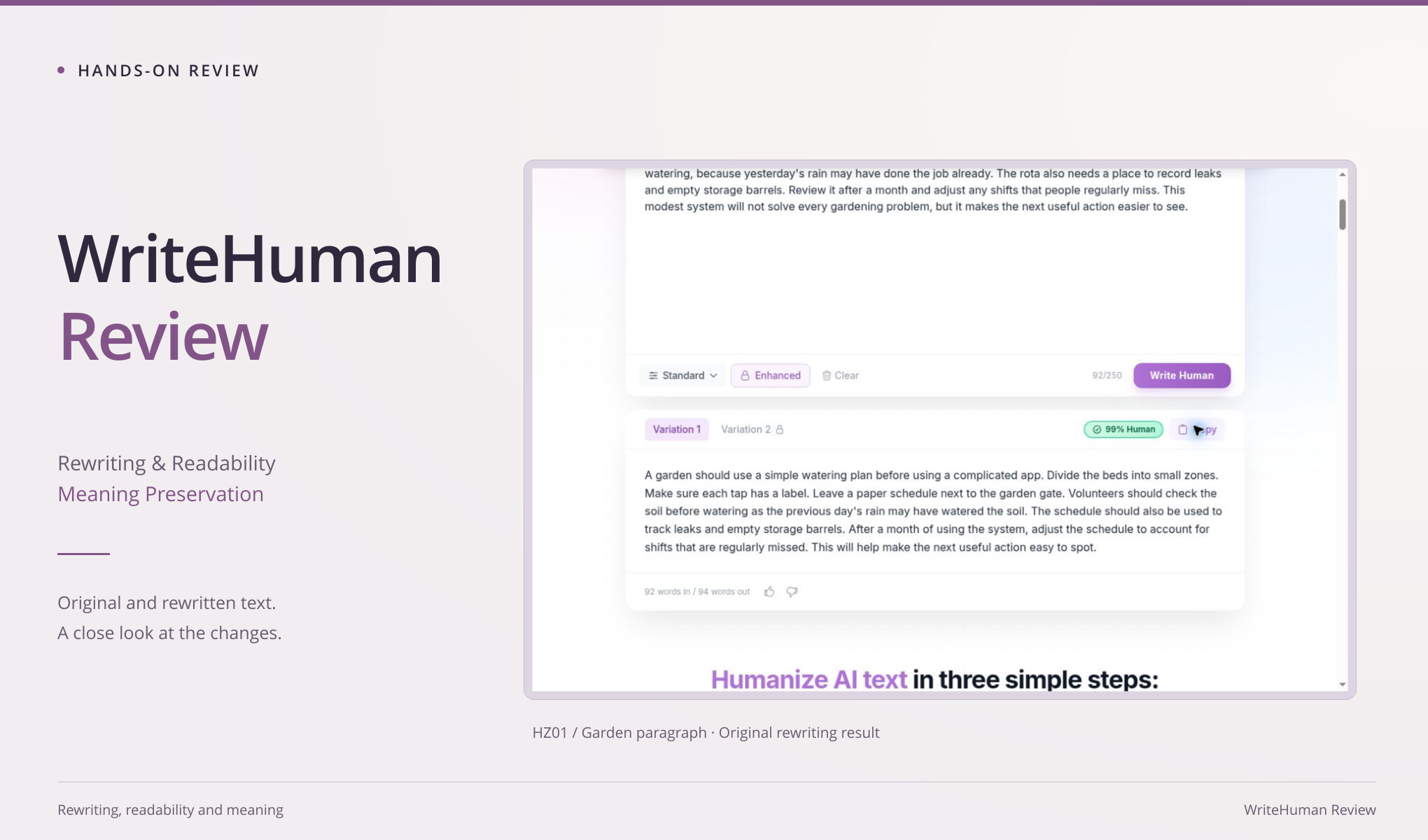
WriteHuman’s strongest result here was a straightforward rewrite: shorter sentences, recognizable instructions, and almost the same length as the source. Its own “99% Human” badge was harder to rely on. The unchanged output received AI probability 81% from Clever AI Detector.
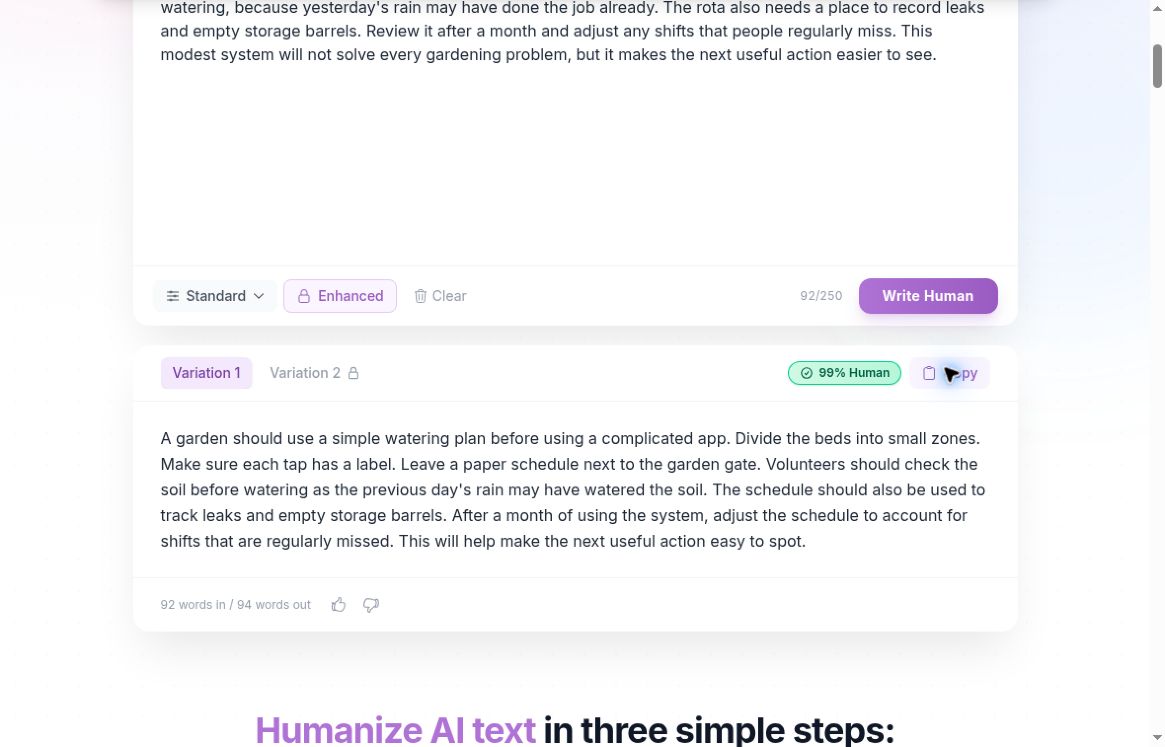
WriteHuman’s default Standard result, Variation 1, on 3 October 2026. The 99% Human badge belongs to WriteHuman.
The paragraph came out usable, with two omissions
The 92-word input described a community garden’s watering plan. WriteHuman returned 94 words. It split a multi-action sentence into short commands: divide the beds, label the taps, and leave a paper schedule next to the gate. That works well for practical instructions.
It retained the soil check after rain, leak and empty-barrel records, the one-month review, and the need to adjust regularly missed shifts. Keeping those details matters more here than giving the rewrite a different rhythm.
Two pieces were lost. “A community garden” became the less specific “A garden.” The caveat that the system would not solve every gardening problem also disappeared. The result still ends with the useful-next-action idea, but without the limit on what the plan can accomplish.
The wording gets a little repetitive: “check the soil” is followed by “watered the soil,” and “the schedule” comes up several times. Those are small editorial issues rather than evidence of a broken tool. For this example, it could work as an instruction-sheet draft once you’ve checked those omissions.
Short commands were a real editorial choice
WriteHuman did something more specific than swapping synonyms. The original puts several tasks in one sentence: divide the beds, label each tap, and place a paper rota by the gate. The output turns that into separate commands. A reader looking for instructions may find the structure easier to scan. It also keeps the relationship between the objects clear: the beds have zones, the taps have labels, and the schedule has a location. You can point to those things in the text itself. That’s a better reason to praise the rewrite than simply saying it sounds more human.
Breaking a compact passage into repeated instructions has a downside too. “The schedule” becomes the subject of several later statements, and the soil appears twice in the rainfall explanation. That repetition may be acceptable when clarity matters more than variation. It can also make the paragraph feel mechanical to a reader seeking a more conversational article. No reader panel chose between the versions in this test, so a preference for one shouldn’t be turned into an objective quality score. What we can say is that the output uses clear, short steps and stays close to the original length.
The two omissions don’t matter equally. Dropping the community setting makes the opening more generic, but the later reference to volunteers still suggests a shared activity. Losing the caveat removes a limit on what the proposal claims to do. Depending on where the passage appears, that second loss may matter more: the original is careful to say the plan will not solve every gardening problem. Restoring that qualification would help keep the modest practical tone without undoing the shorter commands. That’s an editing suggestion; the service didn’t return that restored version.
One passage, two different assessments
| Measurement | Original HZ01 | WriteHuman output |
|---|---|---|
| Whitespace-delimited words | 92 | 94 |
| Clever AI Detector AI probability | 85% | 81% |
| WriteHuman’s result badge | Not measured here | 99% Human |
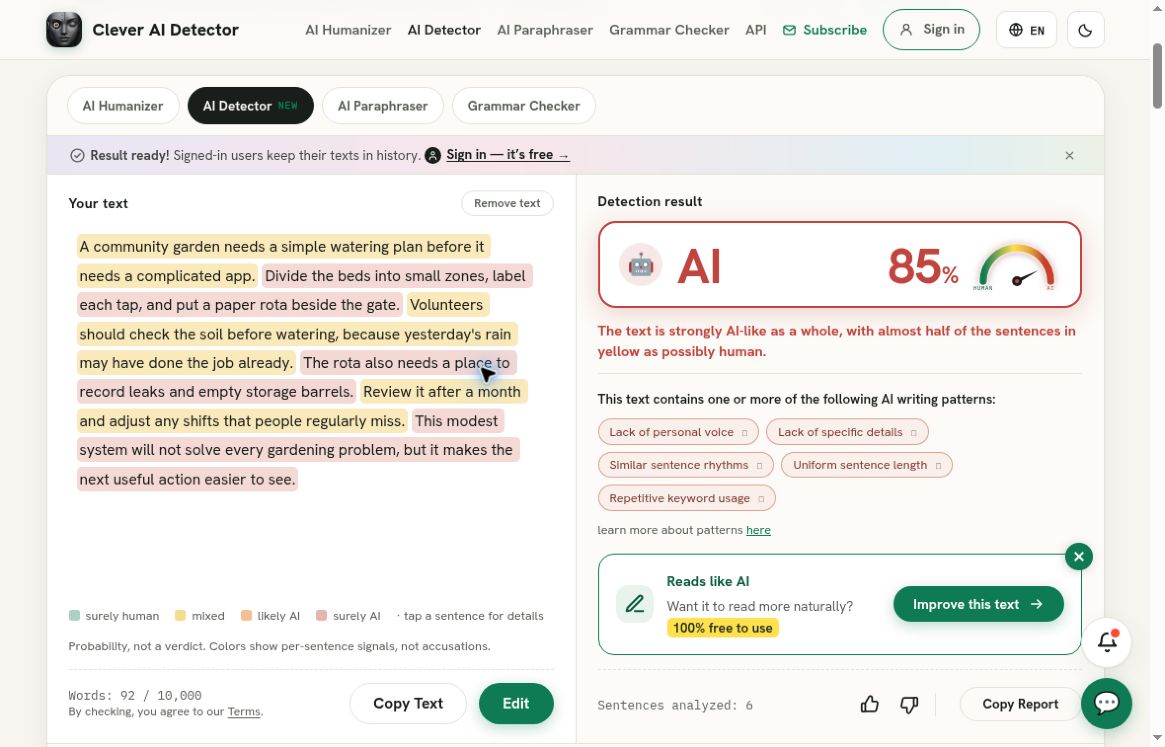
Original garden paragraph: AI probability 85% in Clever AI Detector.
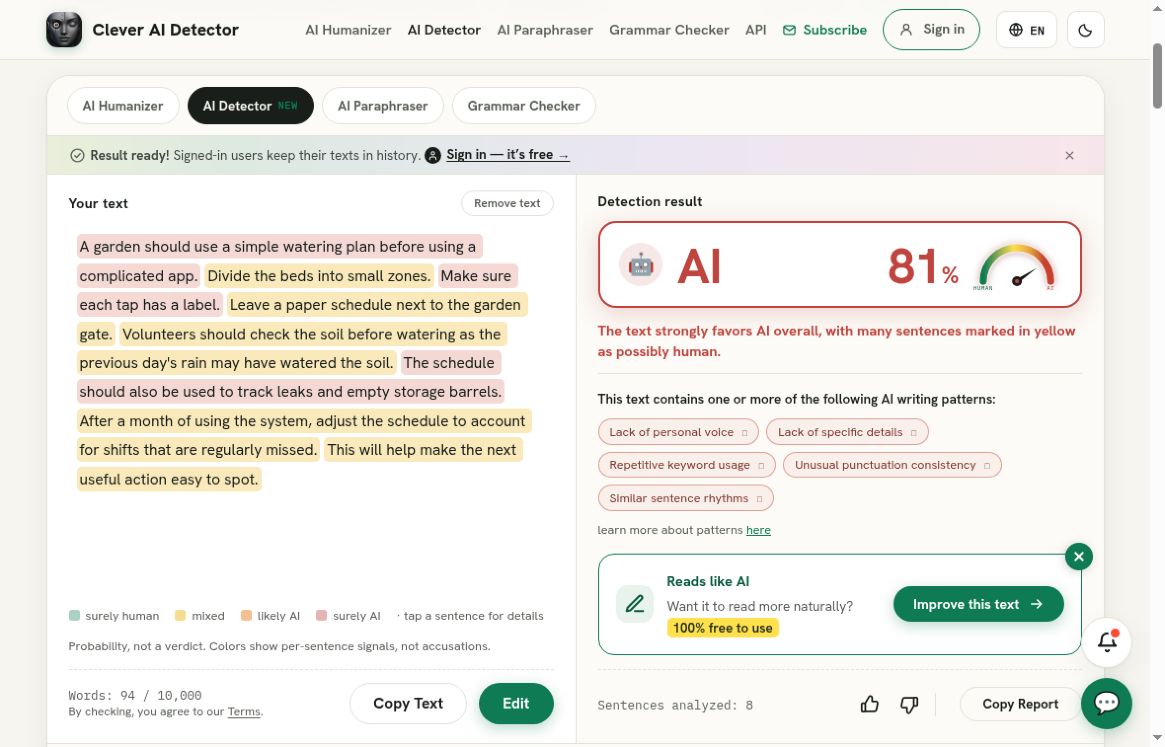
Exact WriteHuman output: AI probability 81%, eight sentences analyzed.
The separate before-and-after reading changed by four percentage points and retained an AI verdict. WriteHuman’s Human badge and Clever AI Detector’s AI probability come from different systems. You can’t combine them as complementary percentages in one score.
This disagreement is a reason to avoid using a humanizer’s own badge as the final test. Clever AI Detector provides a separate view of the unchanged text. It is still a fallible detector, not proof of who wrote it. The paragraph’s provenance remains AI-generated and AI-rewritten regardless of the labels.
Why the Human badge should not decide the verdict
A vendor-supplied label can make a completed rewrite feel ready to use. The 99% Human badge is prominently paired with Variation 1, so it is easy to read it as a quality assurance signal. The separate 81% AI probability gives you a reason to be cautious about that reading. The systems disagree about the same returned words. Their disagreement doesn’t show that either system can tell for sure how the passage was drafted. A single reassuring badge just isn’t enough to promise how other detectors will respond.
The four-point movement within Clever AI Detector is more narrowly interpretable because the original and output were checked by the same service. It records what happened to this pair of texts under the observed conditions. It does not measure how much the writing improved, how much became human-authored, or how often WriteHuman succeeds. There was one primary generation, with no repeated outputs to compare. The exact numbers let you inspect the difference, but this small change shouldn’t be presented as something the product reliably does.
The first variation is the output tested here. This review did not choose between several outputs on the basis of their scores, purchase access to a different mode, or assemble preferred sentences from multiple runs. Those would all be legitimate subjects for a different evaluation if clearly documented, but they would add human selection to the result. Retaining the default output keeps the question straightforward: what did this guest workflow produce from this fixed paragraph, and how did that unchanged result read and score? On those terms, the writing was usable and the external detector still favored AI.
If you’re considering WriteHuman for practical editing, decide what a good result needs to do before you generate it. For this paragraph, useful criteria include preserving the location of the schedule, the rainfall check, the records to keep, the month-long review interval and the reason for revising shifts. A sentence can sound better and still be less useful if it loses one of those facts. A future test could apply the same checklist to a larger, preselected set of instructions and caveated arguments. Until there’s more evidence, check the returned draft against the brief. Keep the detector readings in mind, but don’t make them the goal of the edit.
What the free test covered
The guest Standard interface showed a 250-word cap. The full 328-word A01 essay did not fit, so the fixed 92-word HZ01 fallback was submitted unchanged. HZ01 was generated before these new measurements, with no detector feedback used to tune it. One primary generation was assessed, using the default first variation. Enhanced mode and paid access were not tested.
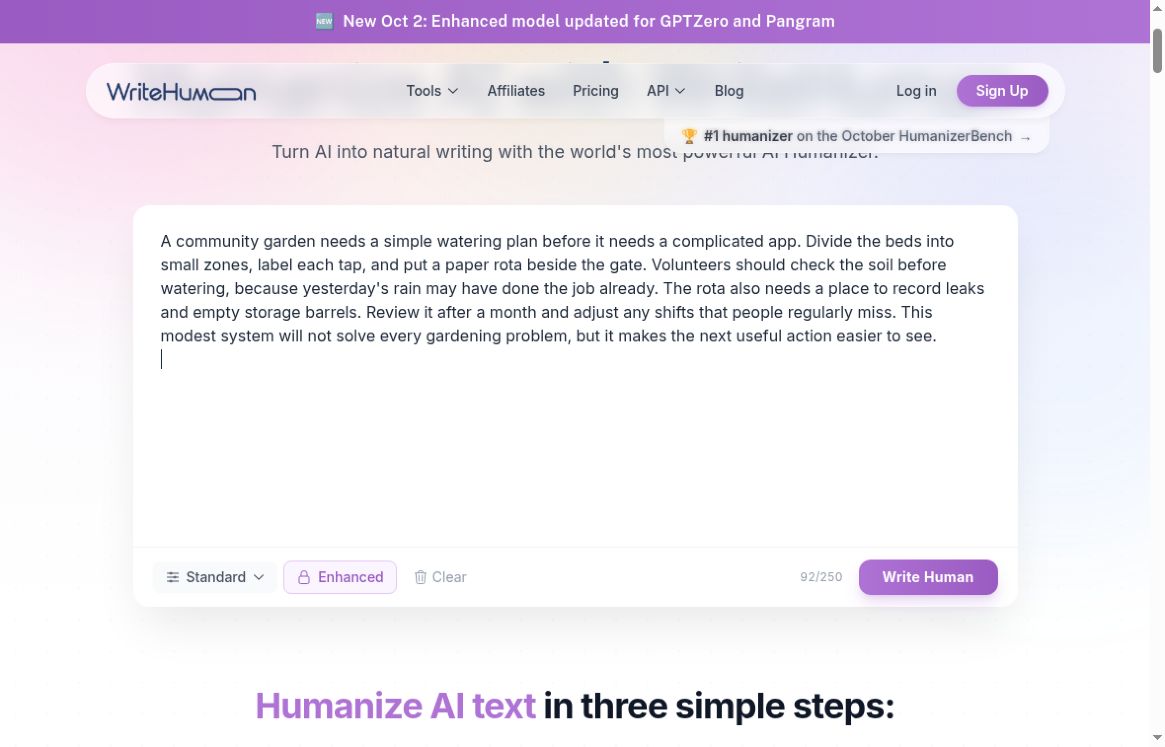
The submitted HZ01 text and visible 92/250 counter in the Standard interface.
For an alternative editing pass, Clever AI Humanizer is worth considering with the same close reading. It completed the separate 328-word library essay, but removed its six-month duration and changed the survey rationale. On HZ01, an initial attempt and two recoveries produced no output. There is no matched Clever AI Humanizer result for this paragraph, so these tests do not establish a winner between the two rewriters.
Verdict: WriteHuman handled the practical steps fairly well, with a less nuanced ending. The vendor’s 99% Human badge does not justify a promise of detector evasion. Would you trade the original’s longer sentences for these short commands if you had to restore the caveat afterward?
HZ01: exact AI-generated input
A community garden needs a simple watering plan before it needs a complicated app. Divide the beds into small zones, label each tap, and put a paper rota beside the gate. Volunteers should check the soil before watering, because yesterday's rain may have done the job already. The rota also needs a place to record leaks and empty storage barrels. Review it after a month and adjust any shifts that people regularly miss. This modest system will not solve every gardening problem, but it makes the next useful action easier to see.
WriteHuman: exact complete unchanged output
A garden should use a simple watering plan before using a complicated app. Divide the beds into small zones. Make sure each tap has a label. Leave a paper schedule next to the garden gate. Volunteers should check the soil before watering as the previous day's rain may have watered the soil. The schedule should also be used to track leaks and empty storage barrels. After a month of using the system, adjust the schedule to account for shifts that are regularly missed. This will help make the next useful action easy to spot.