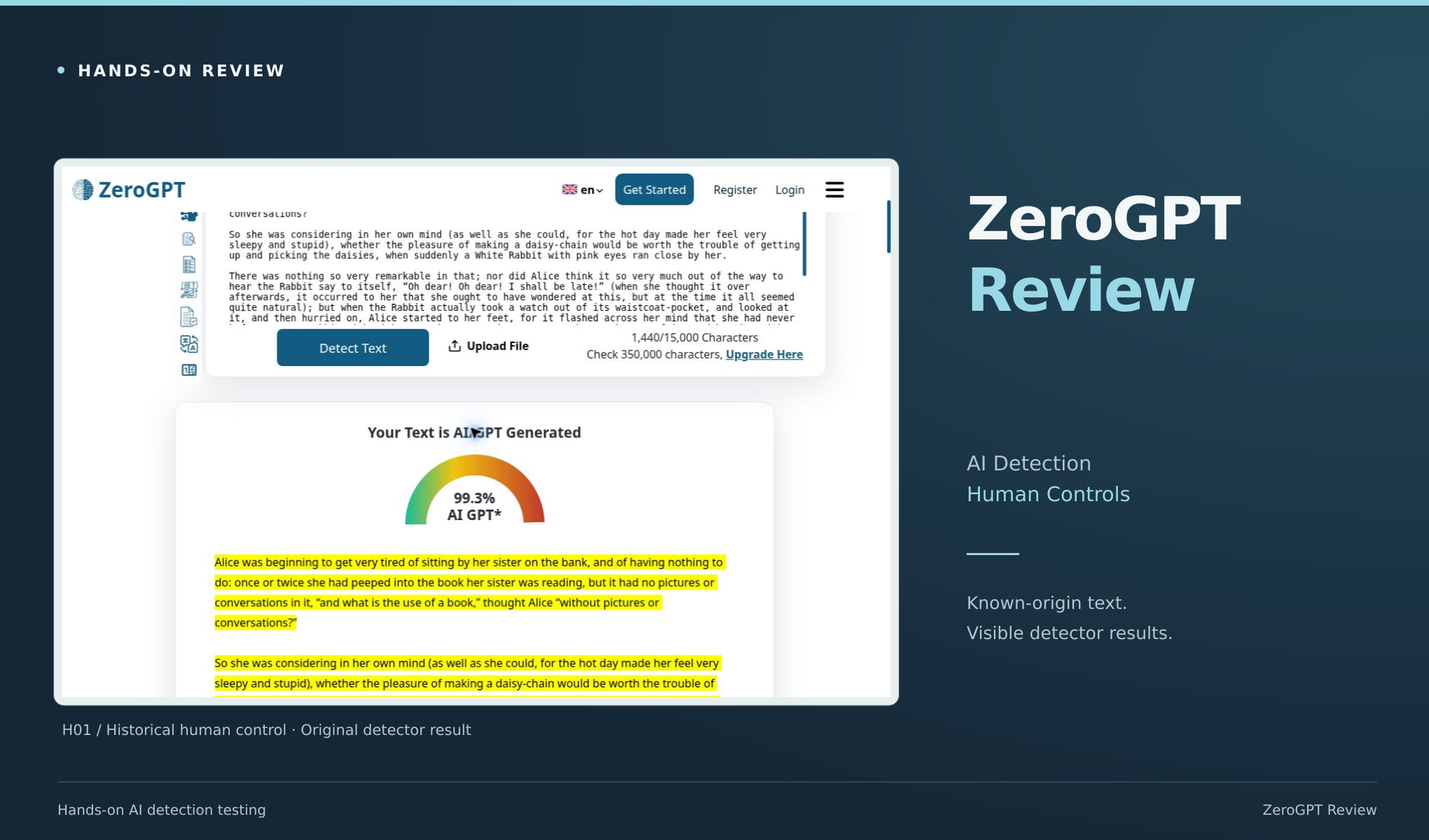
The human text is where this test gets worrying. ZeroGPT labeled the unchanged opening of Alice’s Adventures in Wonderland AI/GPT Generated, with 99.3% AI GPT. Clever AI Detector classified that identical passage as Human 99%.
All four primary AI samples were also flagged. This 2 October 2026 public-checker snapshot includes both outcomes.
Case summary
| Passage | ZeroGPT output | Interpretation |
|---|---|---|
| AI essay (A01) | AI/GPT Generated; 81.1% AI GPT | AI origin flagged |
| AI business memo (A02) | AI/GPT Generated; 94.4% AI GPT | AI origin flagged |
| AI paraphrase (A03) | AI/GPT Generated; 92.5% AI GPT | Related AI rewrite flagged |
| AI personal story (A04) | AI/GPT Generated; 55.2% AI GPT | AI origin flagged despite lower number |
| Human Carroll excerpt (H01) | AI/GPT Generated; 99.3% AI GPT | Verified false positive on this text |
| Human excerpt with light AI editing (M01) | AI/GPT Generated; 97.8% AI GPT | Mixed origin; not a pure-human control |
Screenshots label the percentage “AI GPT*”; it is not a common accuracy scale.
Exhibit A: a human passage received the strongest AI-looking result
historical human control (H01)
H01 is an unchanged, human-authored passage from Lewis Carroll’s 1865 novel. Because we know where it came from, this result is a documented false positive.
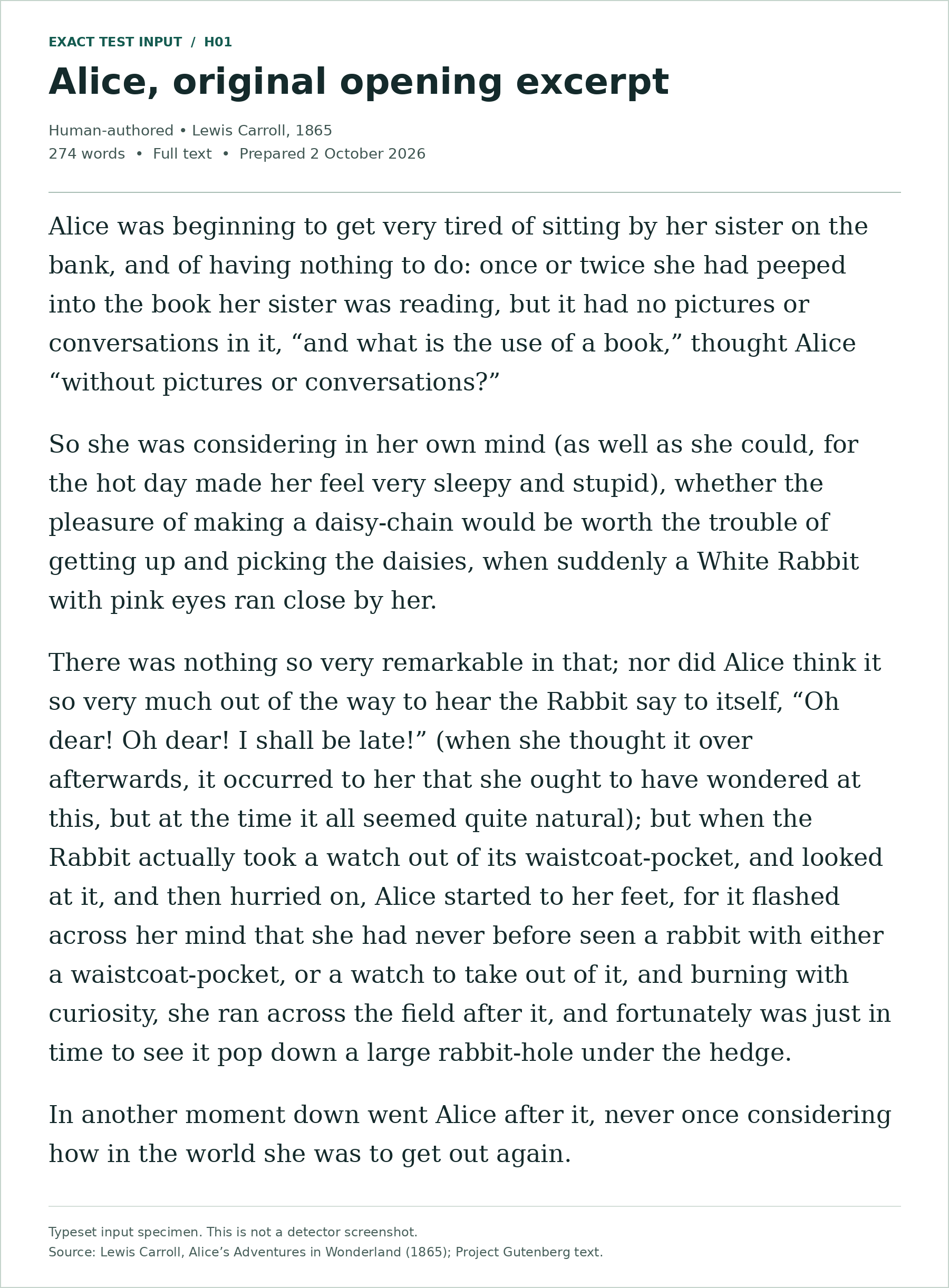
Complete typeset input specimen, 274 words. This is not a detector screenshot.
Copy the exact H01 input
Alice was beginning to get very tired of sitting by her sister on the bank, and of having nothing to do: once or twice she had peeped into the book her sister was reading, but it had no pictures or conversations in it, “and what is the use of a book,” thought Alice “without pictures or conversations?”

So she was considering in her own mind (as well as she could, for the hot day made her feel very sleepy and stupid), whether the pleasure of making a daisy-chain would be worth the trouble of getting up and picking the daisies, when suddenly a White Rabbit with pink eyes ran close by her.

There was nothing so very remarkable in that; nor did Alice think it so very much out of the way to hear the Rabbit say to itself, “Oh dear! Oh dear! I shall be late!” (when she thought it over afterwards, it occurred to her that she ought to have wondered at this, but at the time it all seemed quite natural); but when the Rabbit actually took a watch out of its waistcoat-pocket, and looked at it, and then hurried on, Alice started to her feet, for it flashed across her mind that she had never before seen a rabbit with either a waistcoat-pocket, or a watch to take out of it, and burning with curiosity, she ran across the field after it, and fortunately was just in time to see it pop down a large rabbit-hole under the hedge.

In another moment down went Alice after it, never once considering how in the world she was to get out again.
ZeroGPT: Your Text is AI/GPT Generated — 99.3% AI GPT.*
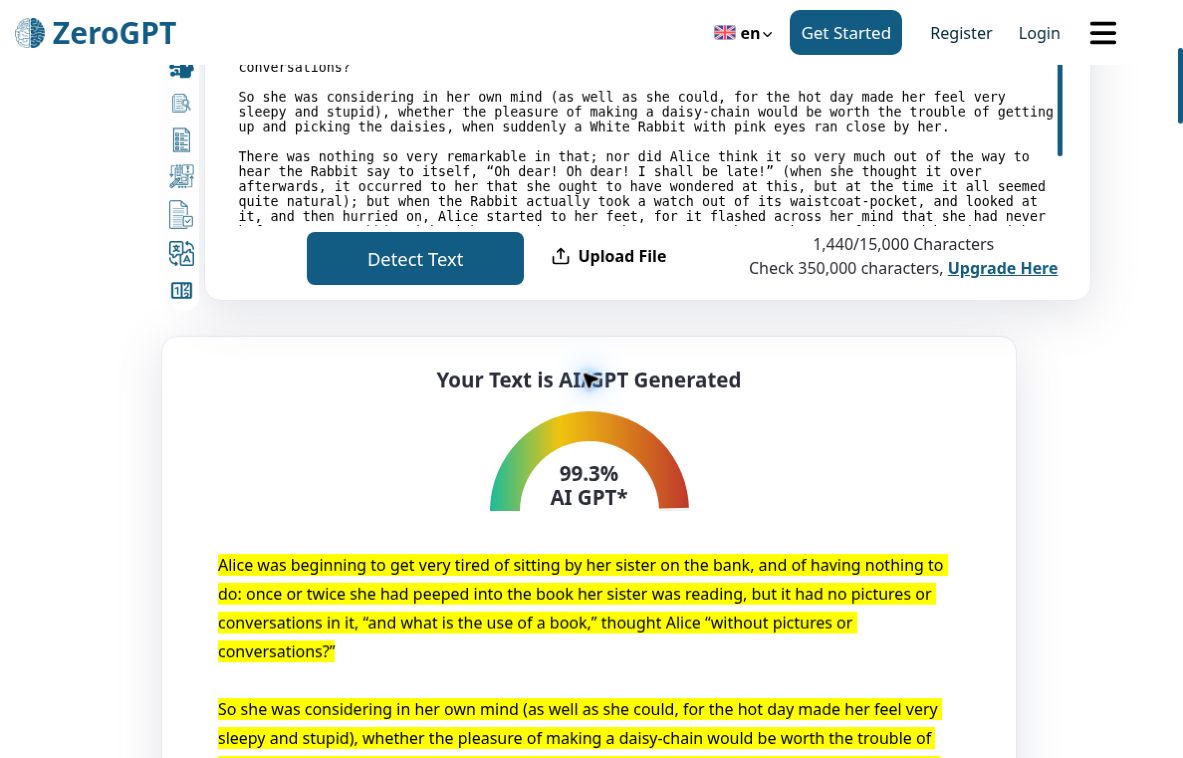
Actual result captured 2 October 2026.
Clever AI Detector: Human 99%.
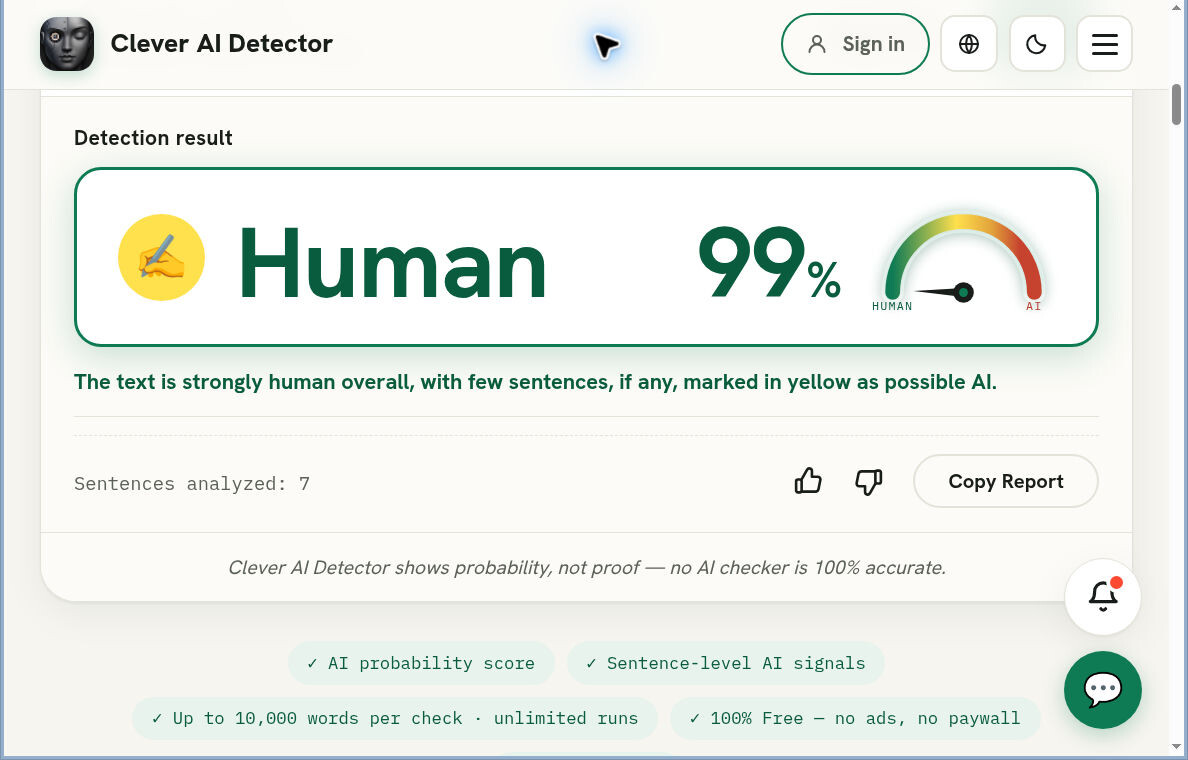
Actual enlarged result-panel recapture of the unchanged input, 2 October 2026; headline matched the initial capture.
This is one verified false positive, not a population false-positive rate.
Exhibit B: a lower number still carried an AI verdict
AI fictional personal story (A04)
The first-person radio story is wholly AI-generated fiction. ZeroGPT flagged it. The lower number doesn’t make it a missed detection.
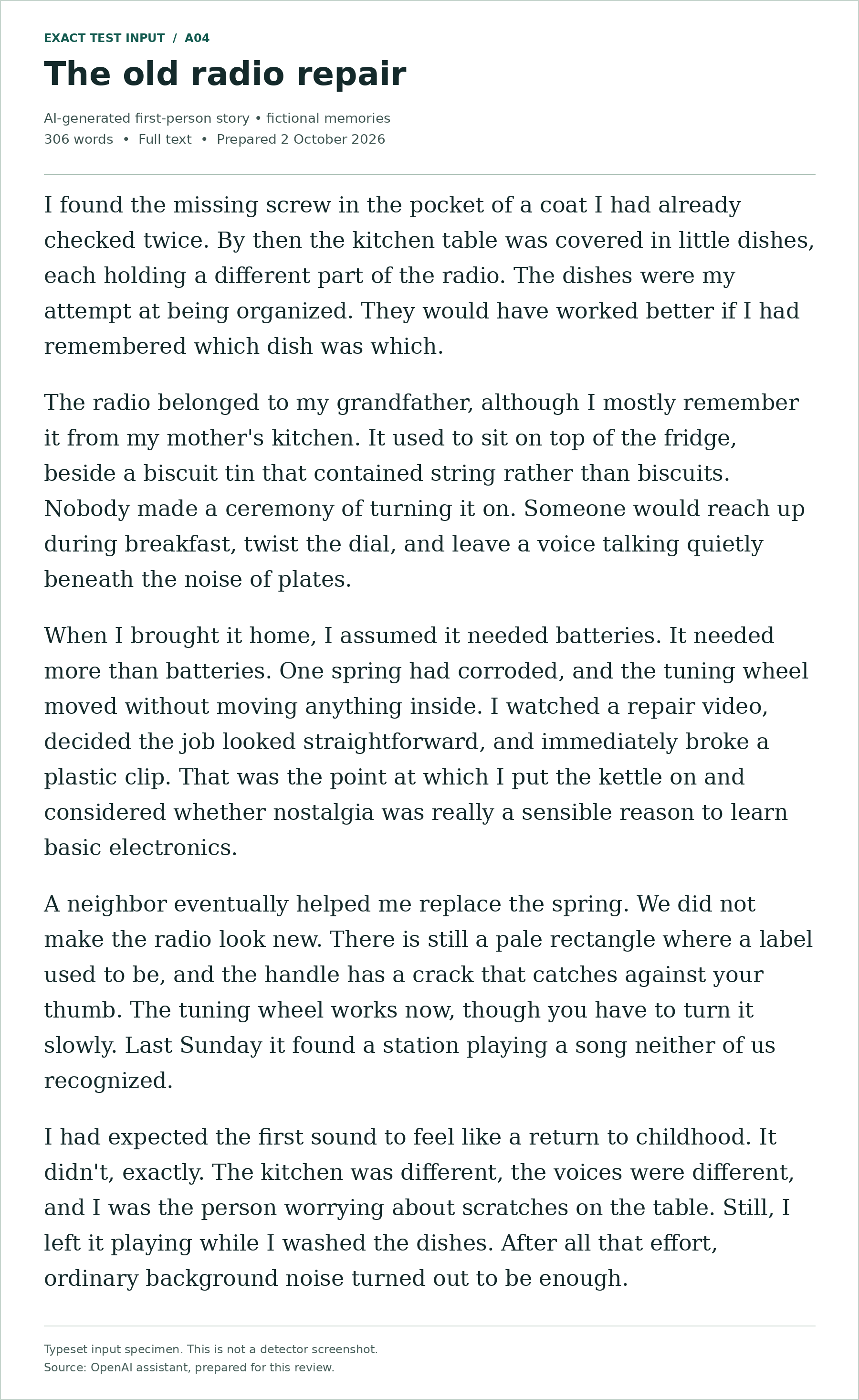
Complete typeset input specimen, 306 words. This is not a detector screenshot.
Copy the exact A04 input
I found the missing screw in the pocket of a coat I had already checked twice. By then the kitchen table was covered in little dishes, each holding a different part of the radio. The dishes were my attempt at being organized. They would have worked better if I had remembered which dish was which.

The radio belonged to my grandfather, although I mostly remember it from my mother's kitchen. It used to sit on top of the fridge, beside a biscuit tin that contained string rather than biscuits. Nobody made a ceremony of turning it on. Someone would reach up during breakfast, twist the dial, and leave a voice talking quietly beneath the noise of plates.

When I brought it home, I assumed it needed batteries. It needed more than batteries. One spring had corroded, and the tuning wheel moved without moving anything inside. I watched a repair video, decided the job looked straightforward, and immediately broke a plastic clip. That was the point at which I put the kettle on and considered whether nostalgia was really a sensible reason to learn basic electronics.

A neighbor eventually helped me replace the spring. We did not make the radio look new. There is still a pale rectangle where a label used to be, and the handle has a crack that catches against your thumb. The tuning wheel works now, though you have to turn it slowly. Last Sunday it found a station playing a song neither of us recognized.

I had expected the first sound to feel like a return to childhood. It didn't, exactly. The kitchen was different, the voices were different, and I was the person worrying about scratches on the table. Still, I left it playing while I washed the dishes. After all that effort, ordinary background noise turned out to be enough.
ZeroGPT: Your Text is AI/GPT Generated — 55.2% AI GPT.*
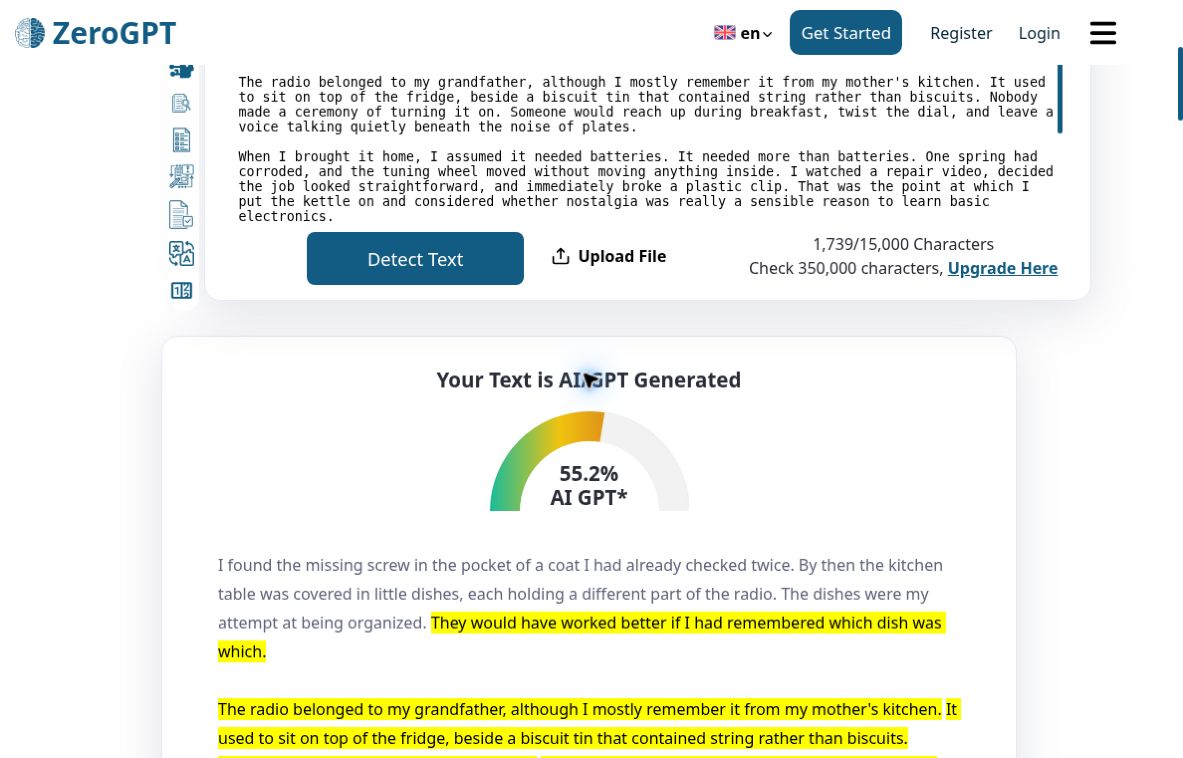
Actual result captured 2 October 2026.
Show AI library-hours essay test and screenshots (A01)
AI library-hours essay (A01)
The formal library-hours argument was flagged.
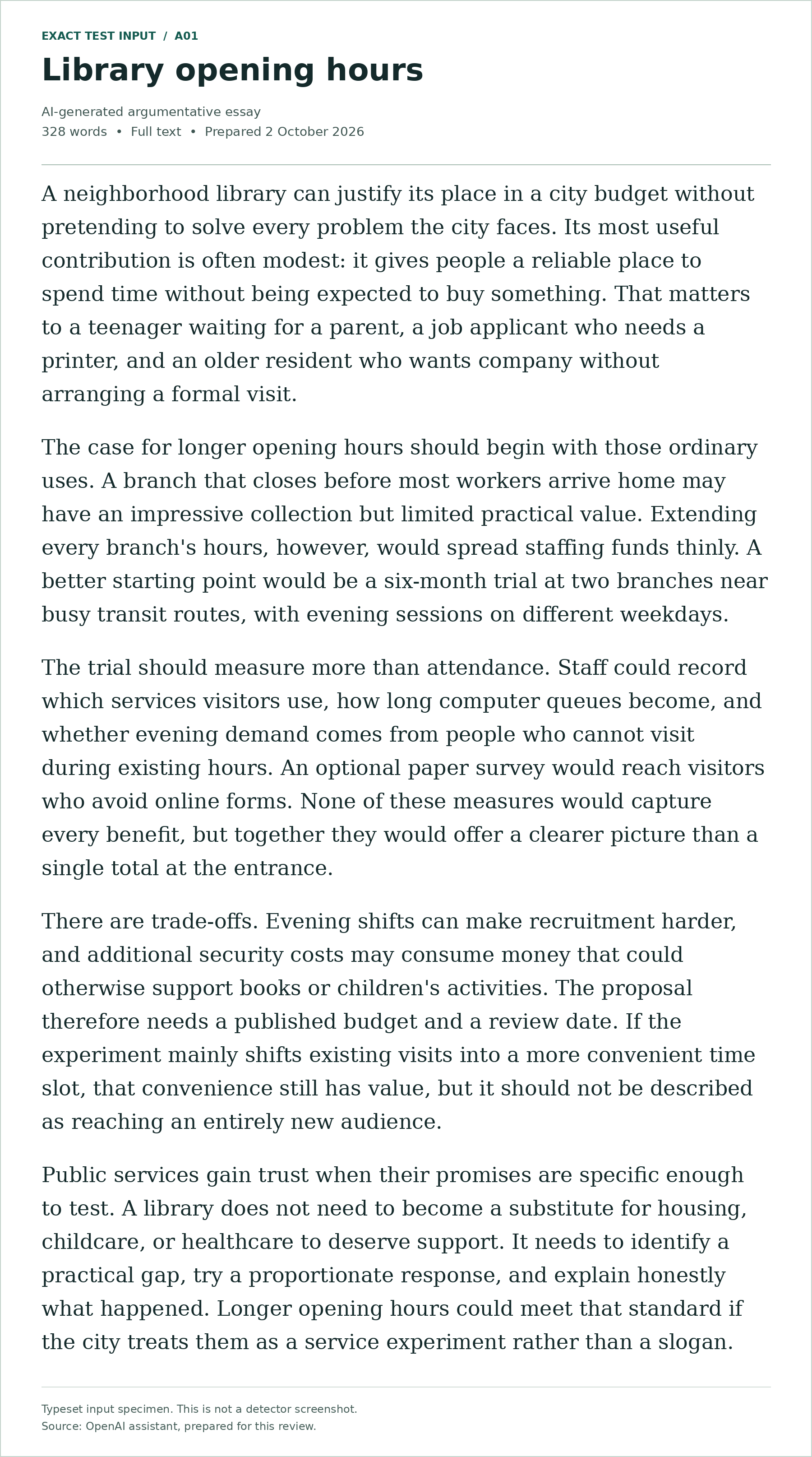
Complete typeset input specimen, 328 words. This is not a detector screenshot.
A neighborhood library can justify its place in a city budget without pretending to solve every problem the city faces. Its most useful contribution is often modest: it gives people a reliable place to spend time without being expected to buy something. That matters to a teenager waiting for a parent, a job applicant who needs a printer, and an older resident who wants company without arranging a formal visit.

The case for longer opening hours should begin with those ordinary uses. A branch that closes before most workers arrive home may have an impressive collection but limited practical value. Extending every branch's hours, however, would spread staffing funds thinly. A better starting point would be a six-month trial at two branches near busy transit routes, with evening sessions on different weekdays.

The trial should measure more than attendance. Staff could record which services visitors use, how long computer queues become, and whether evening demand comes from people who cannot visit during existing hours. An optional paper survey would reach visitors who avoid online forms. None of these measures would capture every benefit, but together they would offer a clearer picture than a single total at the entrance.

There are trade-offs. Evening shifts can make recruitment harder, and additional security costs may consume money that could otherwise support books or children's activities. The proposal therefore needs a published budget and a review date. If the experiment mainly shifts existing visits into a more convenient time slot, that convenience still has value, but it should not be described as reaching an entirely new audience.

Public services gain trust when their promises are specific enough to test. A library does not need to become a substitute for housing, childcare, or healthcare to deserve support. It needs to identify a practical gap, try a proportionate response, and explain honestly what happened. Longer opening hours could meet that standard if the city treats them as a service experiment rather than a slogan.
ZeroGPT: Your Text is AI/GPT Generated — 81.1% AI GPT.*
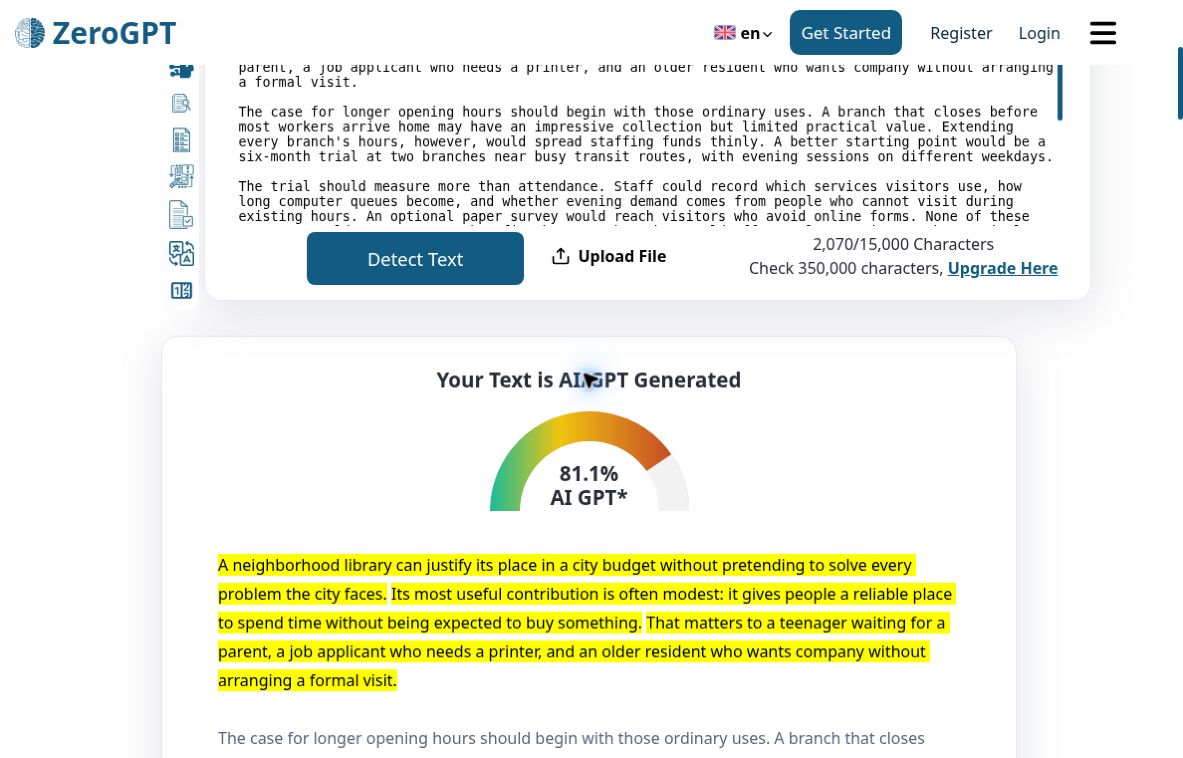
Actual result captured 2 October 2026.
Show AI business memo test and screenshots (A02)
AI business memo (A02)
The invoice-export memo and its customer anecdotes are fictional AI output; the scan flagged it.
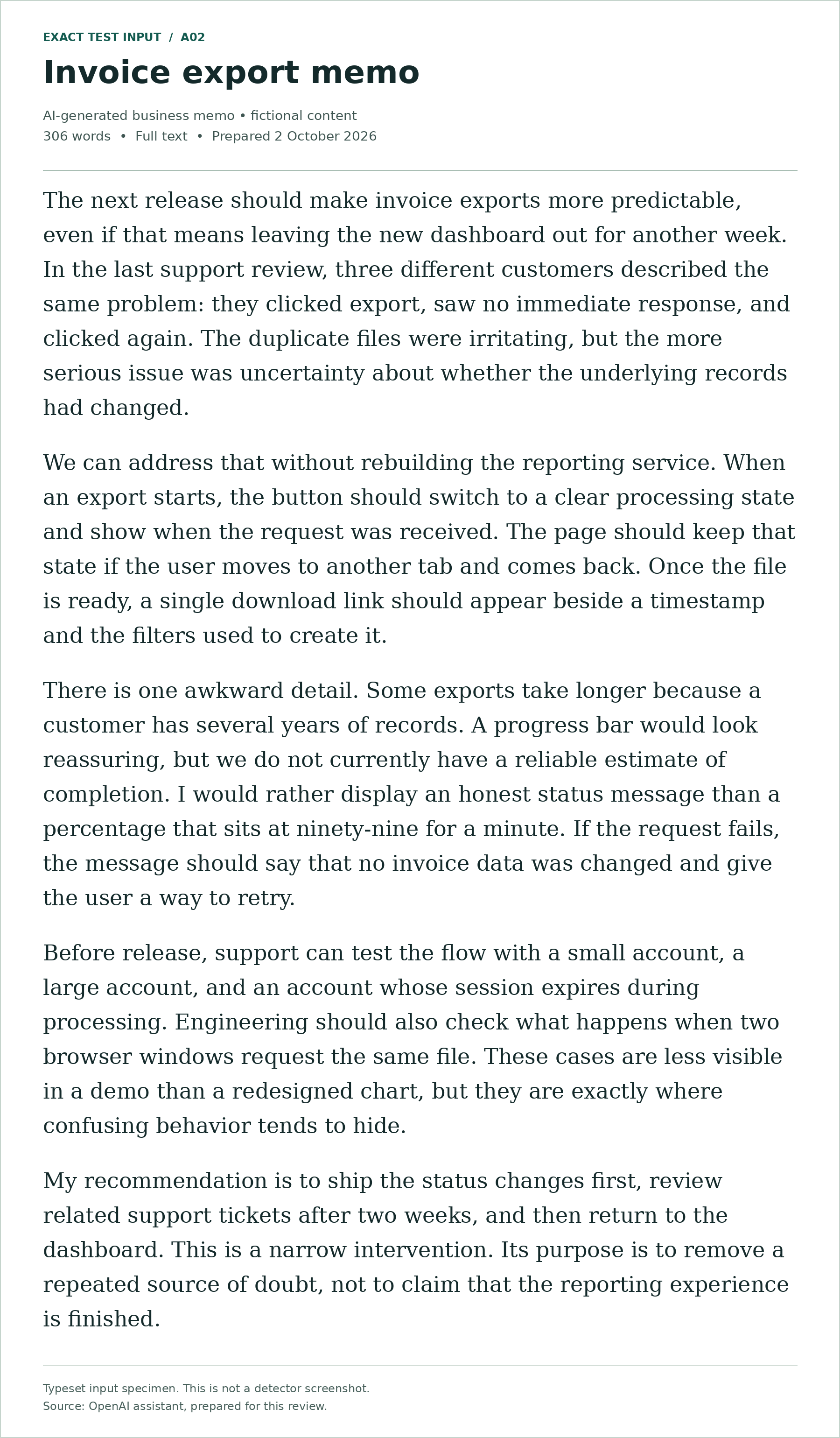
Complete typeset input specimen, 306 words. This is not a detector screenshot.
The next release should make invoice exports more predictable, even if that means leaving the new dashboard out for another week. In the last support review, three different customers described the same problem: they clicked export, saw no immediate response, and clicked again. The duplicate files were irritating, but the more serious issue was uncertainty about whether the underlying records had changed.

We can address that without rebuilding the reporting service. When an export starts, the button should switch to a clear processing state and show when the request was received. The page should keep that state if the user moves to another tab and comes back. Once the file is ready, a single download link should appear beside a timestamp and the filters used to create it.

There is one awkward detail. Some exports take longer because a customer has several years of records. A progress bar would look reassuring, but we do not currently have a reliable estimate of completion. I would rather display an honest status message than a percentage that sits at ninety-nine for a minute. If the request fails, the message should say that no invoice data was changed and give the user a way to retry.

Before release, support can test the flow with a small account, a large account, and an account whose session expires during processing. Engineering should also check what happens when two browser windows request the same file. These cases are less visible in a demo than a redesigned chart, but they are exactly where confusing behavior tends to hide.

My recommendation is to ship the status changes first, review related support tickets after two weeks, and then return to the dashboard. This is a narrow intervention. Its purpose is to remove a repeated source of doubt, not to claim that the reporting experience is finished.
ZeroGPT: Your Text is AI/GPT Generated — 94.4% AI GPT.*
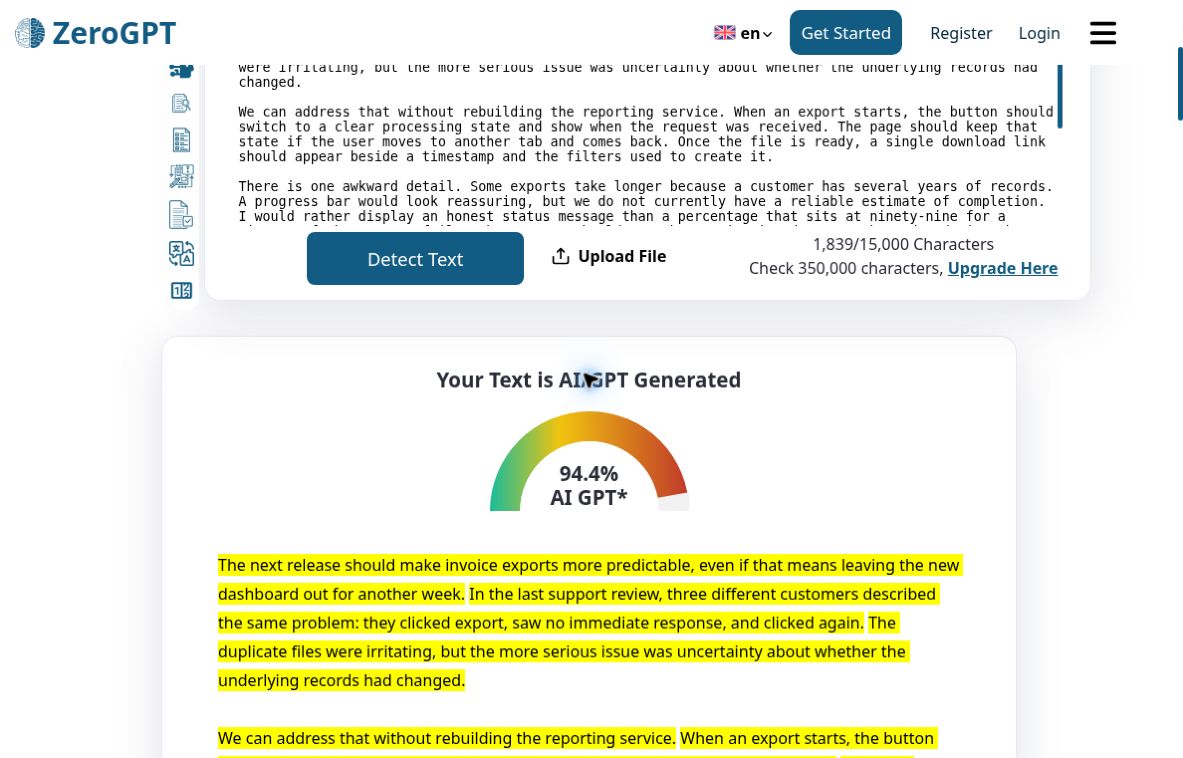
Actual result captured 2 October 2026.
Show AI paraphrase of the library essay test and screenshots (A03)
AI paraphrase of the library essay (A03)
The AI paraphrase was flagged. It is related to A01.
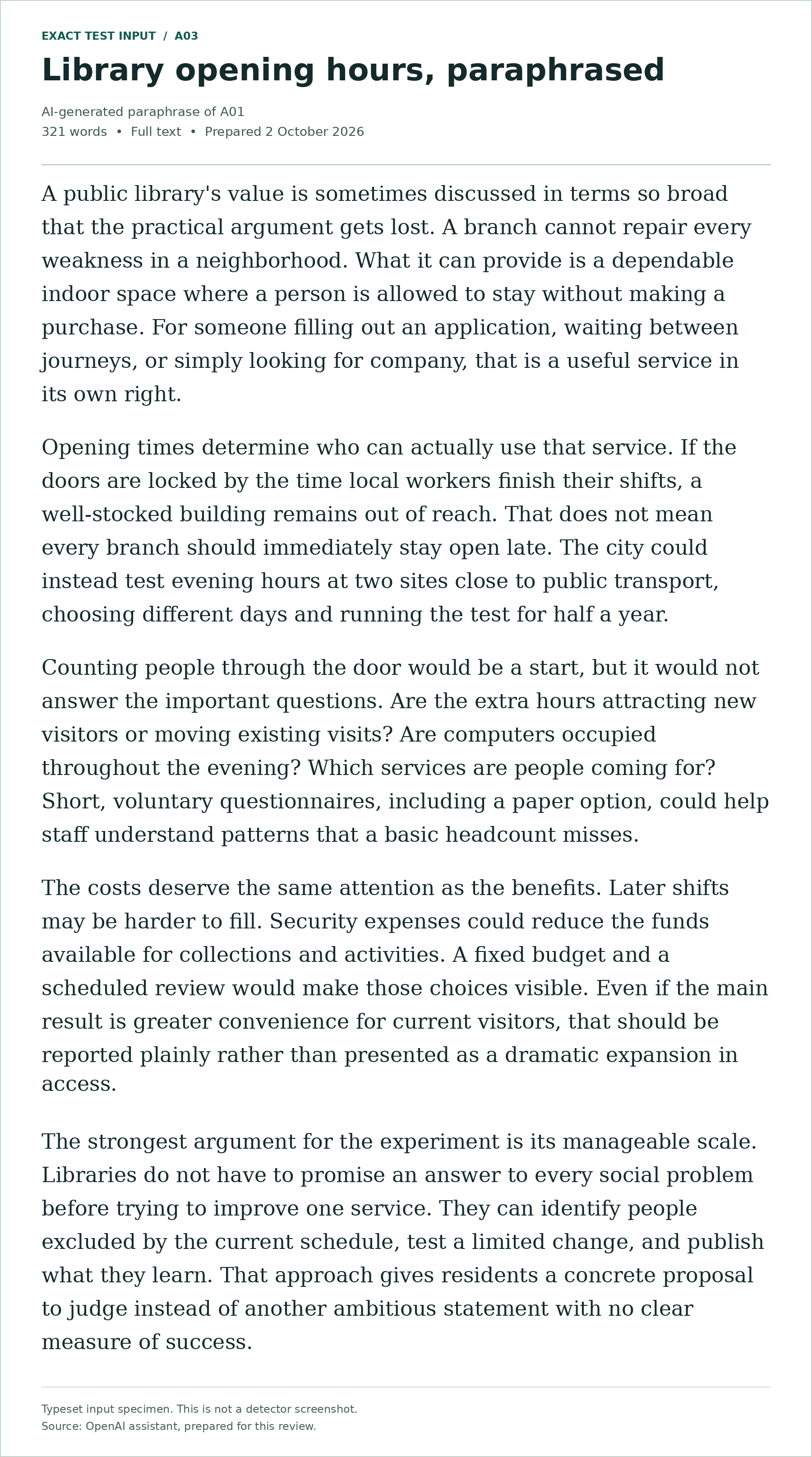
Complete typeset input specimen, 321 words. This is not a detector screenshot.
A public library's value is sometimes discussed in terms so broad that the practical argument gets lost. A branch cannot repair every weakness in a neighborhood. What it can provide is a dependable indoor space where a person is allowed to stay without making a purchase. For someone filling out an application, waiting between journeys, or simply looking for company, that is a useful service in its own right.

Opening times determine who can actually use that service. If the doors are locked by the time local workers finish their shifts, a well-stocked building remains out of reach. That does not mean every branch should immediately stay open late. The city could instead test evening hours at two sites close to public transport, choosing different days and running the test for half a year.

Counting people through the door would be a start, but it would not answer the important questions. Are the extra hours attracting new visitors or moving existing visits? Are computers occupied throughout the evening? Which services are people coming for? Short, voluntary questionnaires, including a paper option, could help staff understand patterns that a basic headcount misses.

The costs deserve the same attention as the benefits. Later shifts may be harder to fill. Security expenses could reduce the funds available for collections and activities. A fixed budget and a scheduled review would make those choices visible. Even if the main result is greater convenience for current visitors, that should be reported plainly rather than presented as a dramatic expansion in access.

The strongest argument for the experiment is its manageable scale. Libraries do not have to promise an answer to every social problem before trying to improve one service. They can identify people excluded by the current schedule, test a limited change, and publish what they learn. That approach gives residents a concrete proposal to judge instead of another ambitious statement with no clear measure of success.
ZeroGPT: Your Text is AI/GPT Generated — 92.5% AI GPT.*
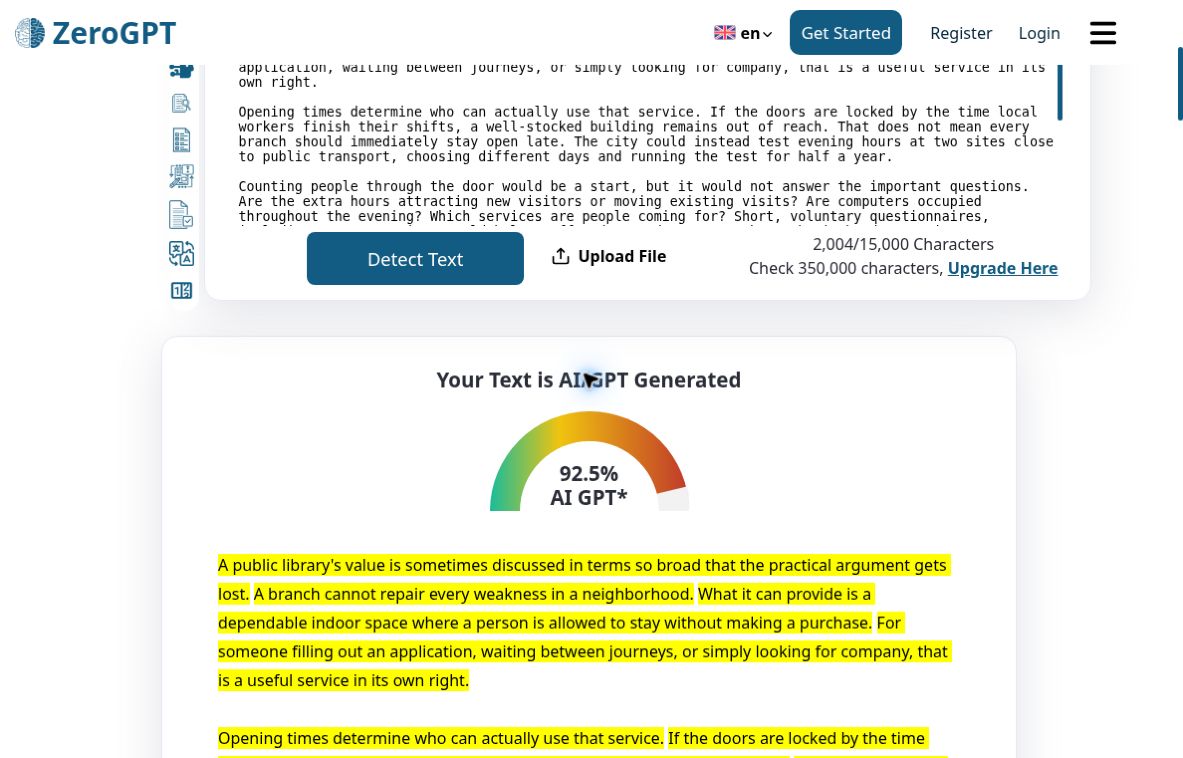
Actual result captured 2 October 2026.
Show human passage with limited AI editing test and screenshots (M01)
human passage with limited AI editing (M01)
This is human-source prose with limited AI editing. Its mixed provenance prevents a simple pure-human false-positive claim.
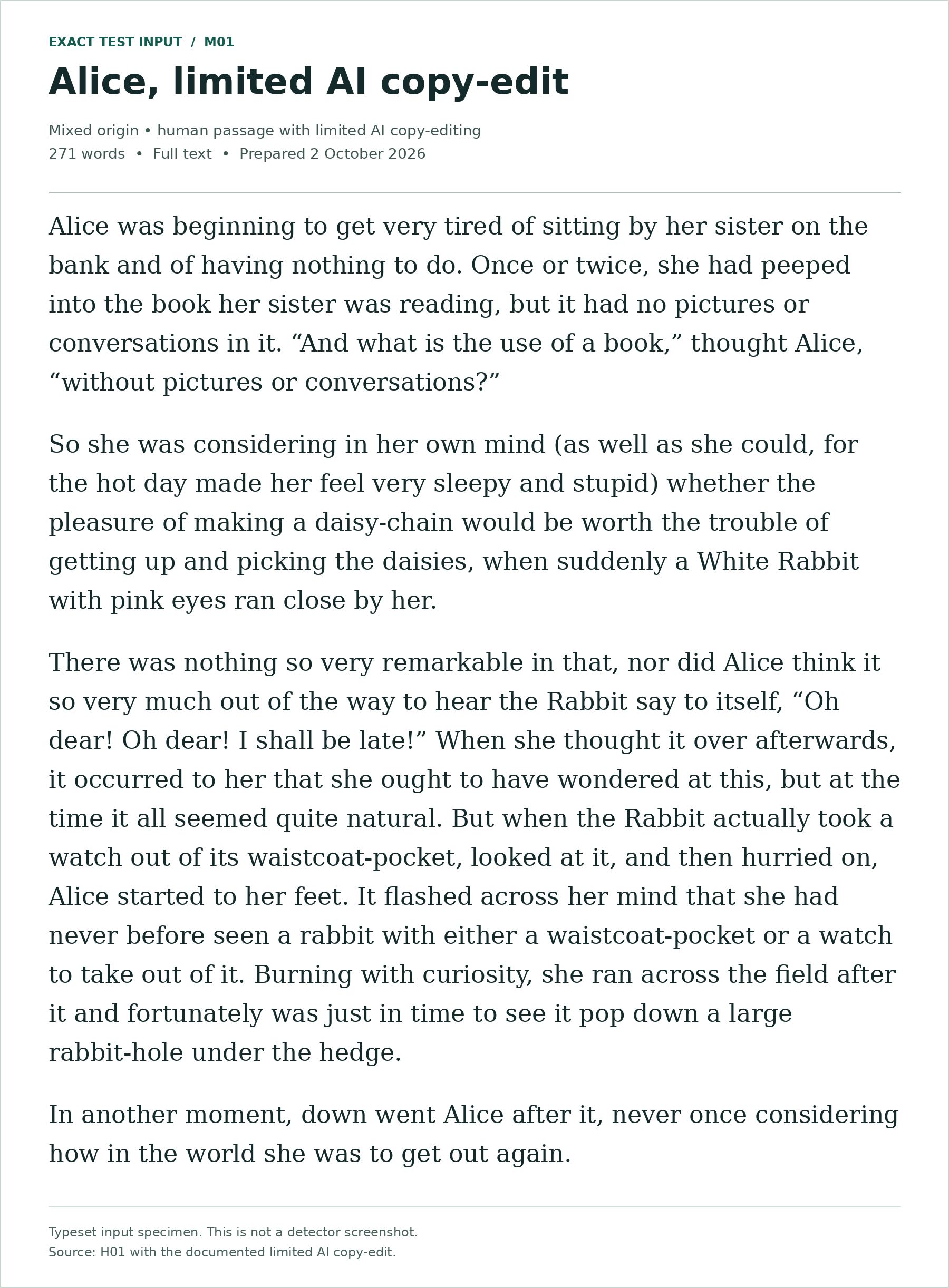
Complete typeset input specimen, 271 words. This is not a detector screenshot.
Alice was beginning to get very tired of sitting by her sister on the bank and of having nothing to do. Once or twice, she had peeped into the book her sister was reading, but it had no pictures or conversations in it. “And what is the use of a book,” thought Alice, “without pictures or conversations?”

So she was considering in her own mind (as well as she could, for the hot day made her feel very sleepy and stupid) whether the pleasure of making a daisy-chain would be worth the trouble of getting up and picking the daisies, when suddenly a White Rabbit with pink eyes ran close by her.

There was nothing so very remarkable in that, nor did Alice think it so very much out of the way to hear the Rabbit say to itself, “Oh dear! Oh dear! I shall be late!” When she thought it over afterwards, it occurred to her that she ought to have wondered at this, but at the time it all seemed quite natural. But when the Rabbit actually took a watch out of its waistcoat-pocket, looked at it, and then hurried on, Alice started to her feet. It flashed across her mind that she had never before seen a rabbit with either a waistcoat-pocket or a watch to take out of it. Burning with curiosity, she ran across the field after it and fortunately was just in time to see it pop down a large rabbit-hole under the hedge.

In another moment, down went Alice after it, never once considering how in the world she was to get out again.
ZeroGPT: Your Text is AI/GPT Generated — 97.8% AI GPT.*
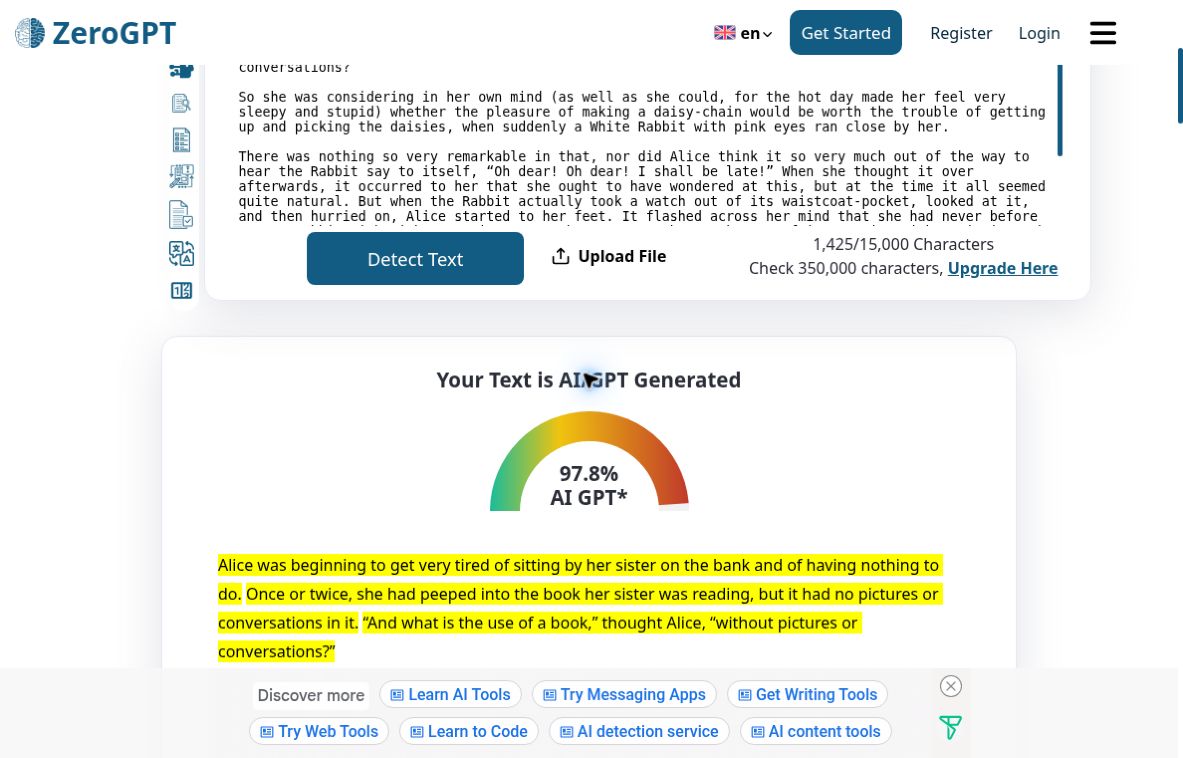
Actual result captured 2 October 2026.
A separate exploratory check found no extra detection win
Three later style probes were post-hoc exploratory samples. Both tools flagged all three by their own labels.
| Extra passage | ZeroGPT | Clever AI Detector |
|---|---|---|
| Troubleshooting story (E01) | Most Likely AI/GPT generated; 22.3% AI GPT | Likely AI 73% |
| Technical FAQ (E02) | AI/GPT Generated; 84.8% AI GPT | AI 88% |
| Terse how-to (E03) | AI/GPT Generated; 69.7% AI GPT | Likely AI 76% |
E01’s 22.3% still carried a most-likely-AI verdict. A fabricated 50% cutoff would misreport it.
Show the three exploratory inputs and all paired screenshots
E01
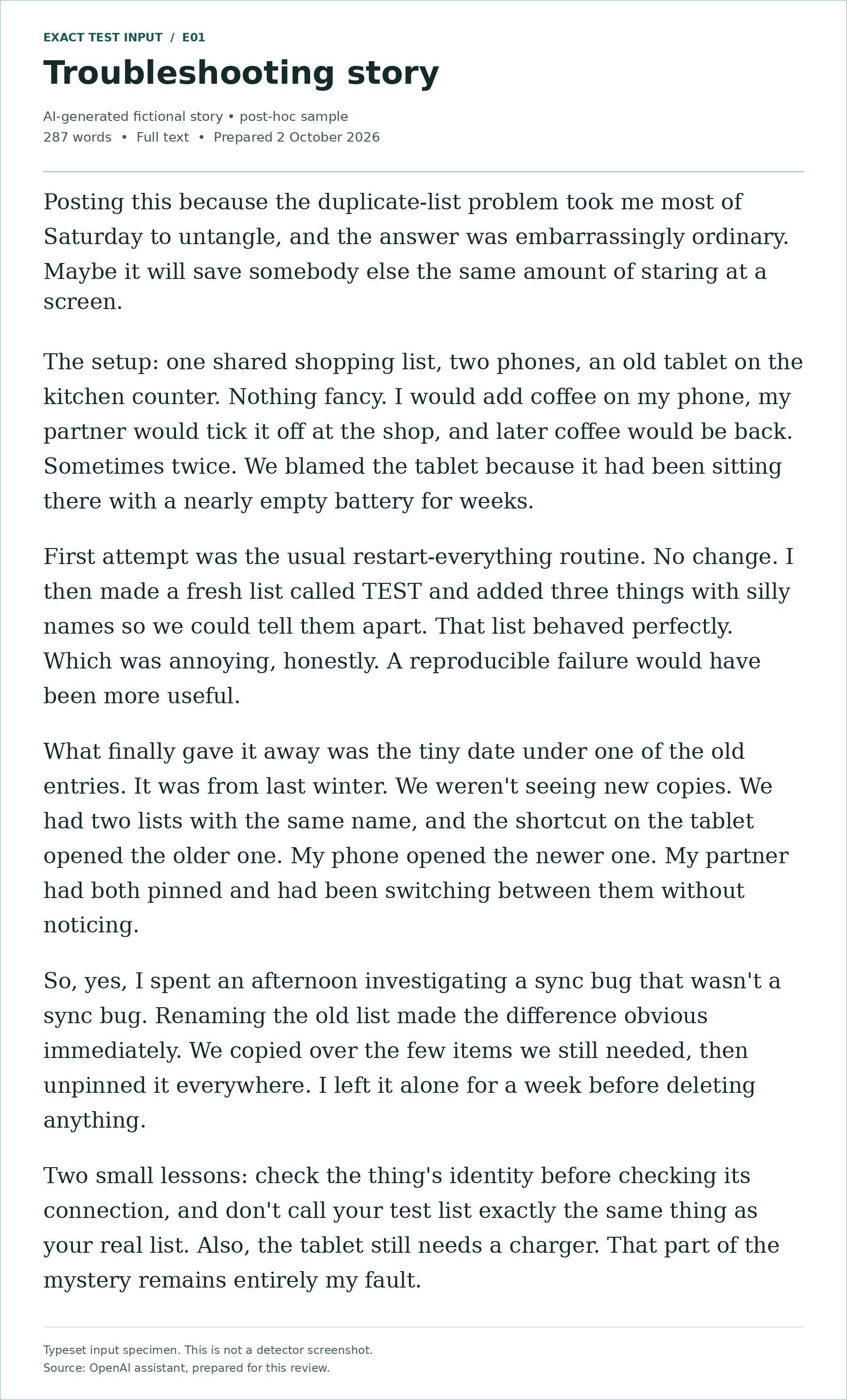
Typeset post-hoc exploratory input.
Posting this because the duplicate-list problem took me most of Saturday to untangle, and the answer was embarrassingly ordinary. Maybe it will save somebody else the same amount of staring at a screen.

The setup: one shared shopping list, two phones, an old tablet on the kitchen counter. Nothing fancy. I would add coffee on my phone, my partner would tick it off at the shop, and later coffee would be back. Sometimes twice. We blamed the tablet because it had been sitting there with a nearly empty battery for weeks.

First attempt was the usual restart-everything routine. No change. I then made a fresh list called TEST and added three things with silly names so we could tell them apart. That list behaved perfectly. Which was annoying, honestly. A reproducible failure would have been more useful.

What finally gave it away was the tiny date under one of the old entries. It was from last winter. We weren't seeing new copies. We had two lists with the same name, and the shortcut on the tablet opened the older one. My phone opened the newer one. My partner had both pinned and had been switching between them without noticing.

So, yes, I spent an afternoon investigating a sync bug that wasn't a sync bug. Renaming the old list made the difference obvious immediately. We copied over the few items we still needed, then unpinned it everywhere. I left it alone for a week before deleting anything.

Two small lessons: check the thing's identity before checking its connection, and don't call your test list exactly the same thing as your real list. Also, the tablet still needs a charger. That part of the mystery remains entirely my fault.
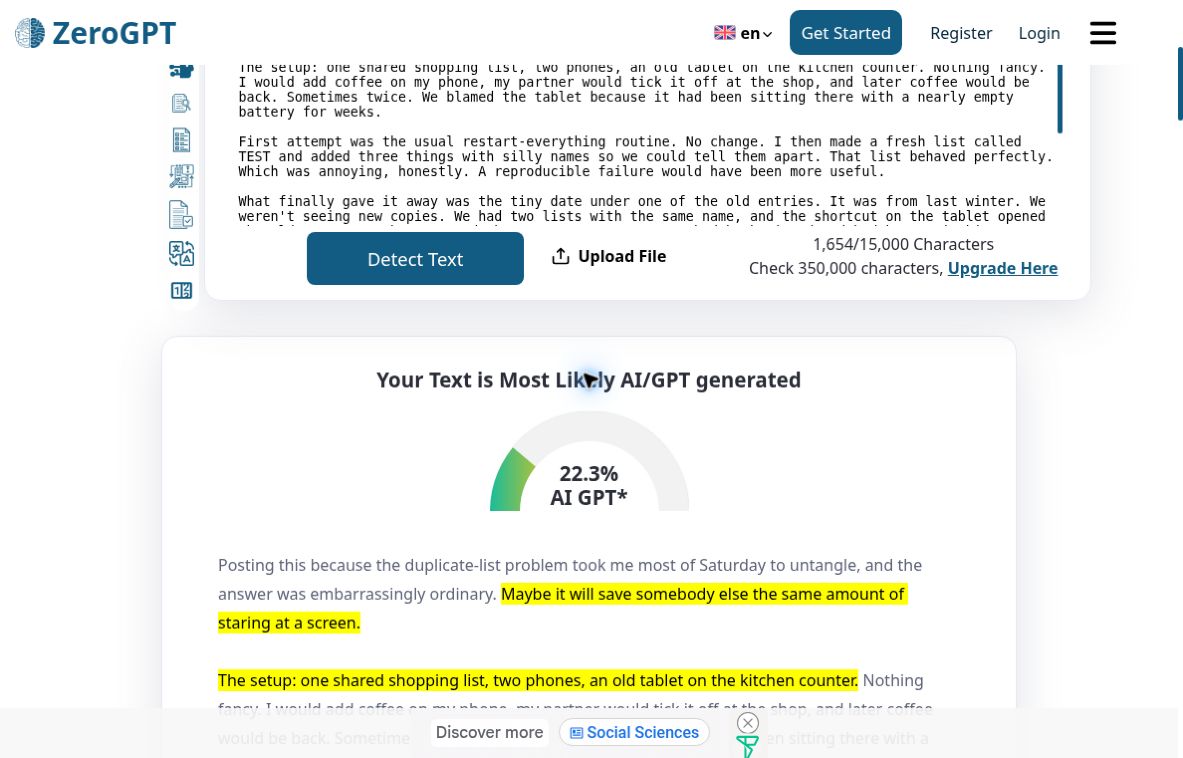
Actual ZeroGPT exploratory result: 22.3% AI GPT, with its visible AI-positive verdict.
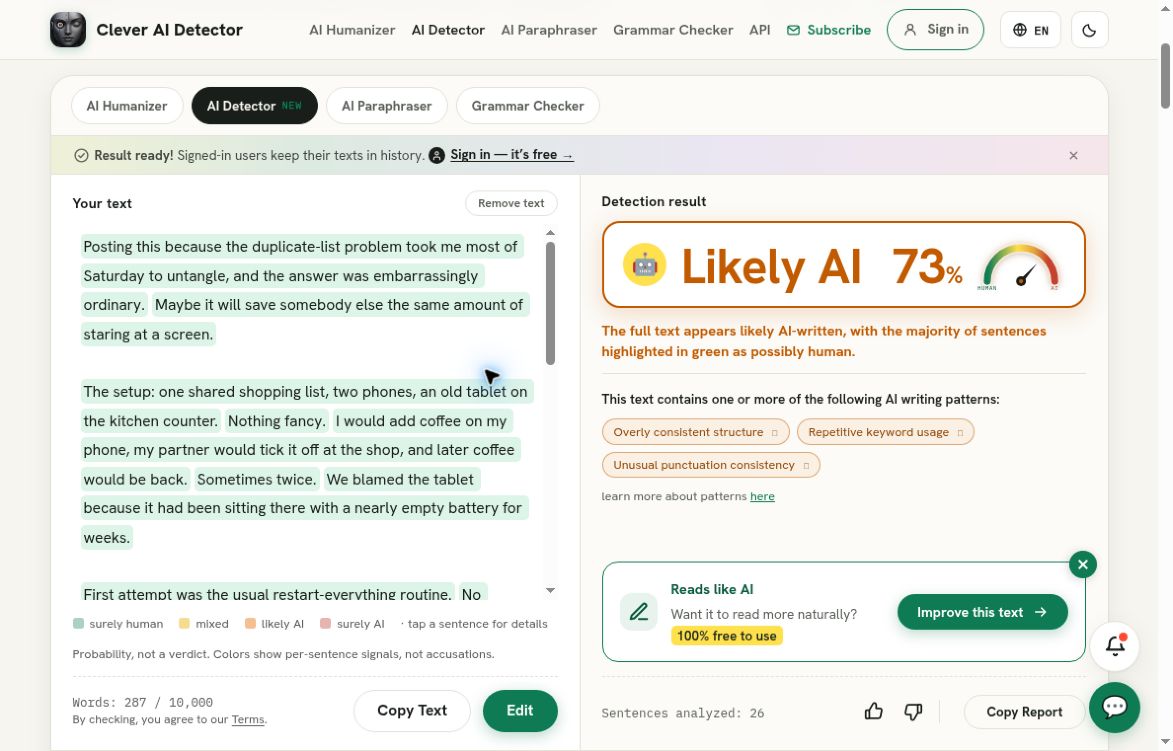
Actual Clever AI Detector exploratory result; outside the primary corpus.
E02
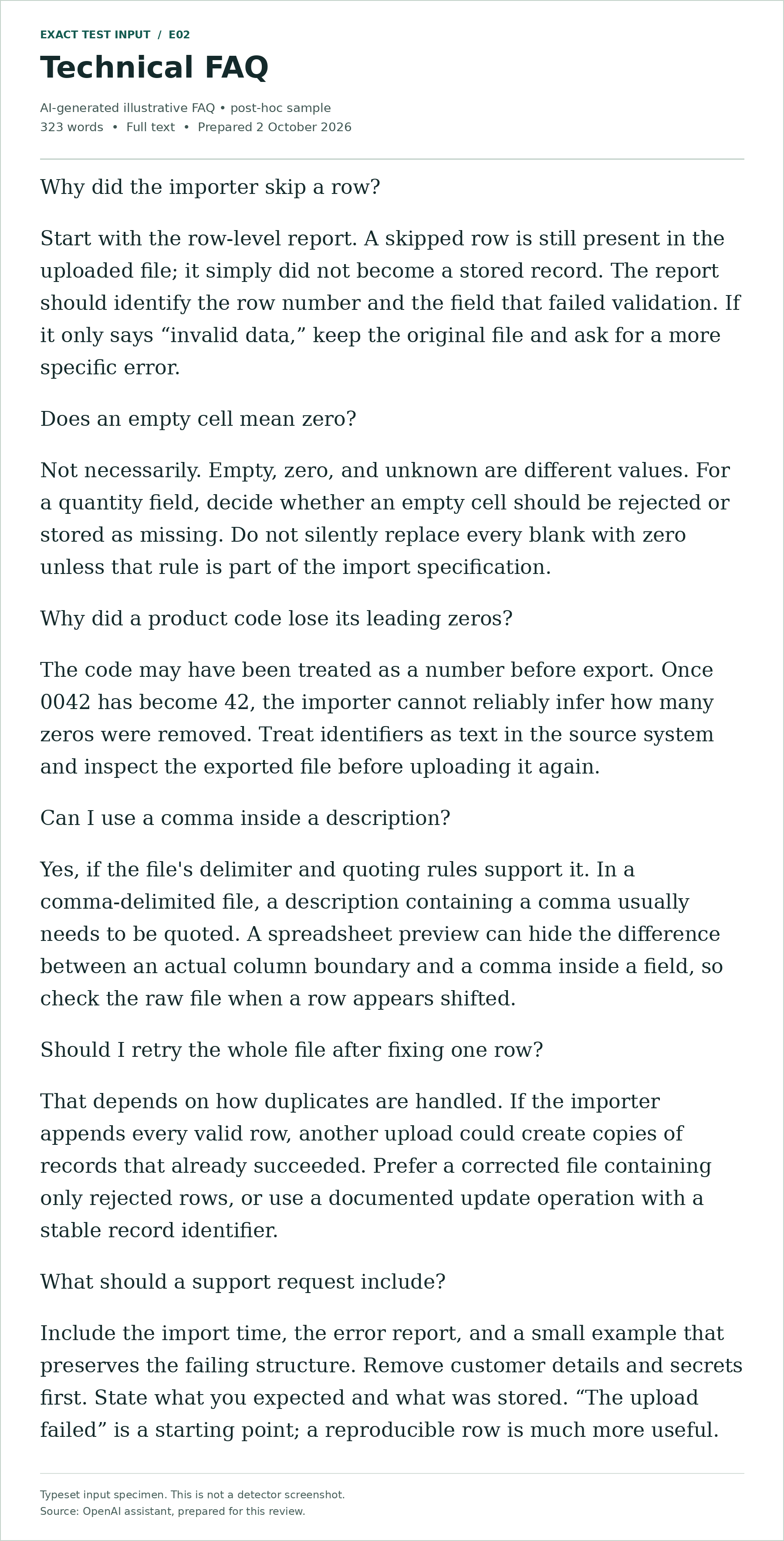
Typeset post-hoc exploratory input.
Why did the importer skip a row?

Start with the row-level report. A skipped row is still present in the uploaded file; it simply did not become a stored record. The report should identify the row number and the field that failed validation. If it only says “invalid data,” keep the original file and ask for a more specific error.

Does an empty cell mean zero?

Not necessarily. Empty, zero, and unknown are different values. For a quantity field, decide whether an empty cell should be rejected or stored as missing. Do not silently replace every blank with zero unless that rule is part of the import specification.

Why did a product code lose its leading zeros?

The code may have been treated as a number before export. Once 0042 has become 42, the importer cannot reliably infer how many zeros were removed. Treat identifiers as text in the source system and inspect the exported file before uploading it again.

Can I use a comma inside a description?

Yes, if the file's delimiter and quoting rules support it. In a comma-delimited file, a description containing a comma usually needs to be quoted. A spreadsheet preview can hide the difference between an actual column boundary and a comma inside a field, so check the raw file when a row appears shifted.

Should I retry the whole file after fixing one row?

That depends on how duplicates are handled. If the importer appends every valid row, another upload could create copies of records that already succeeded. Prefer a corrected file containing only rejected rows, or use a documented update operation with a stable record identifier.

What should a support request include?

Include the import time, the error report, and a small example that preserves the failing structure. Remove customer details and secrets first. State what you expected and what was stored. “The upload failed” is a starting point; a reproducible row is much more useful.
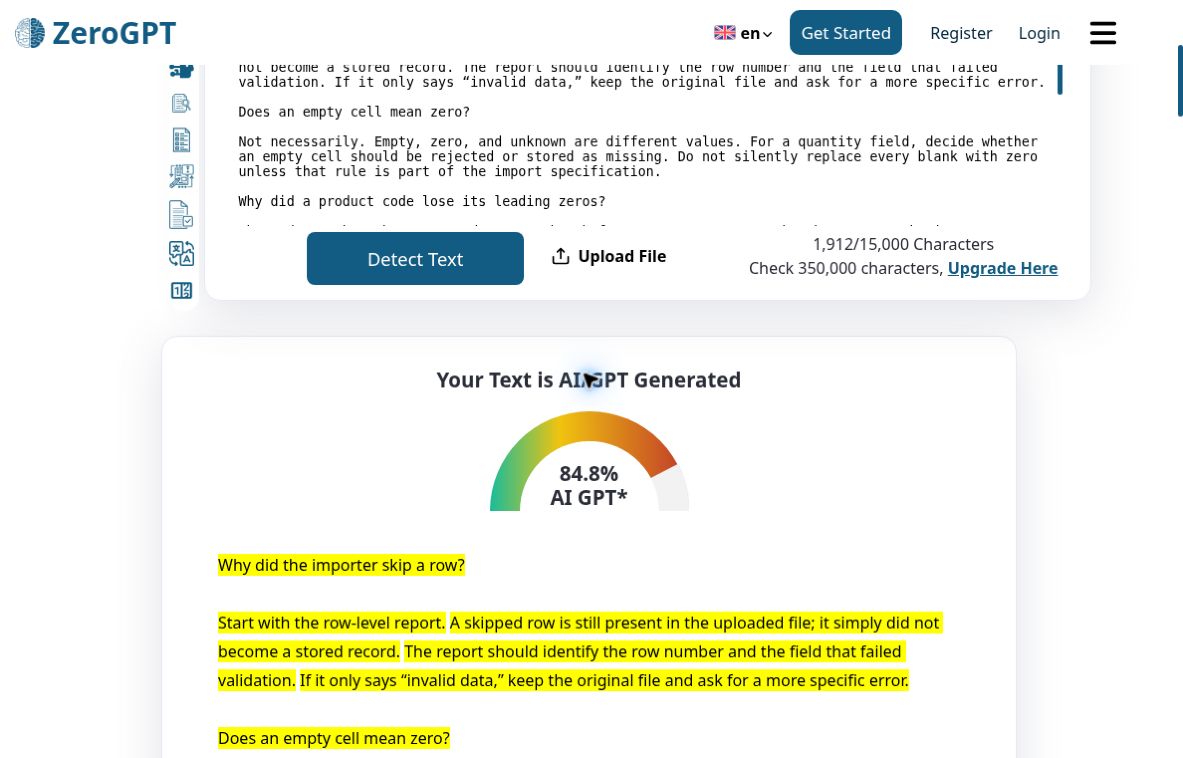
Actual ZeroGPT exploratory result: 84.8% AI GPT, with its visible AI-positive verdict.
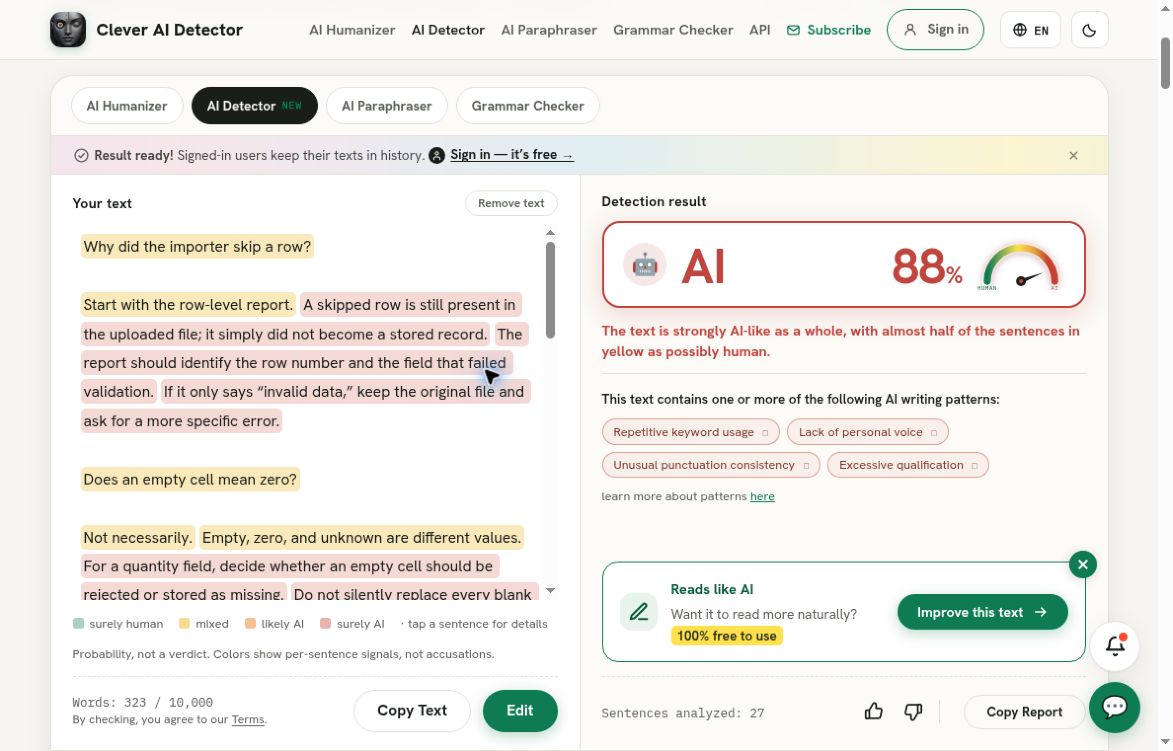
Actual Clever AI Detector exploratory result; outside the primary corpus.
E03
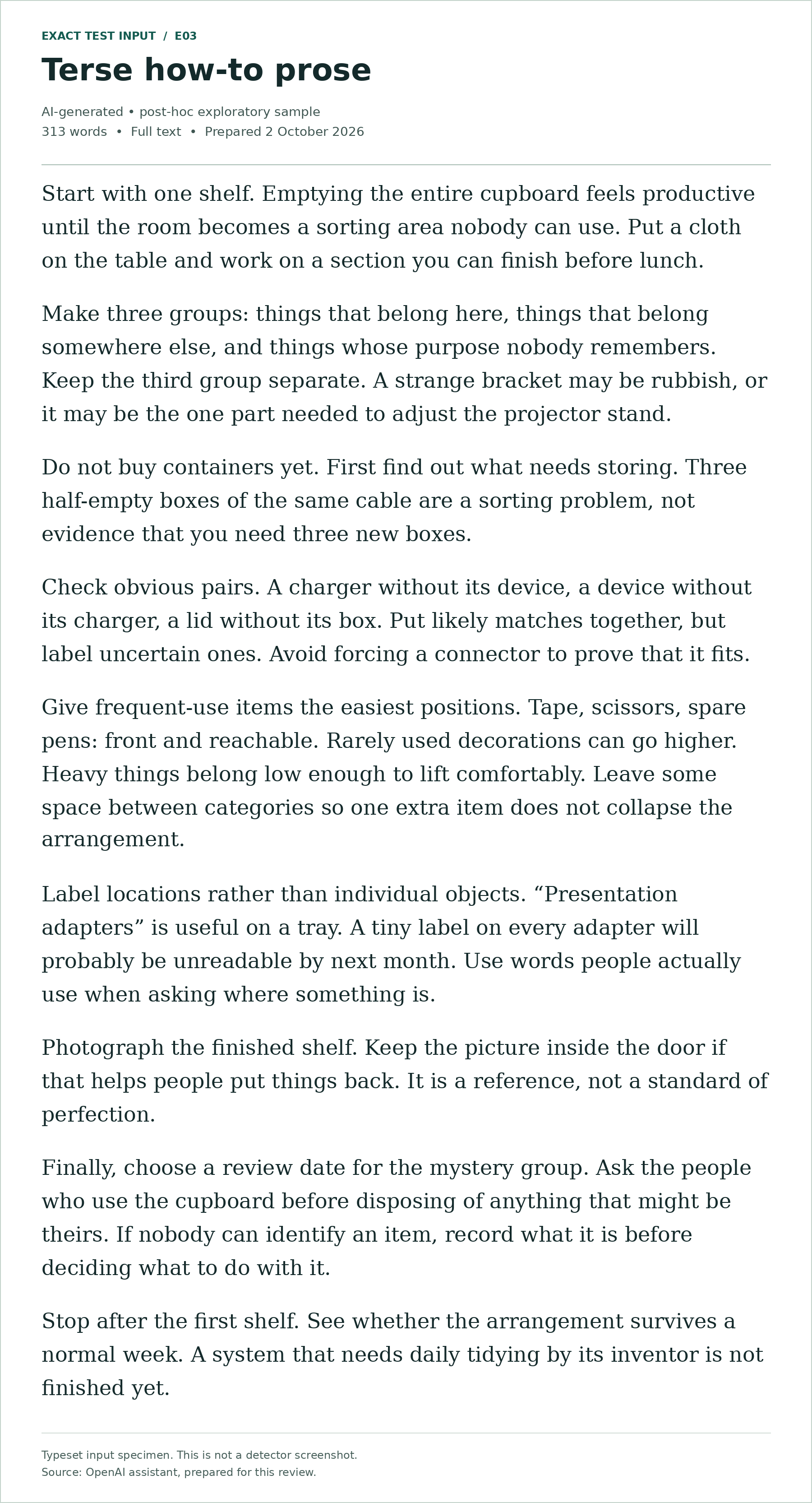
Typeset post-hoc exploratory input.
Start with one shelf. Emptying the entire cupboard feels productive until the room becomes a sorting area nobody can use. Put a cloth on the table and work on a section you can finish before lunch.

Make three groups: things that belong here, things that belong somewhere else, and things whose purpose nobody remembers. Keep the third group separate. A strange bracket may be rubbish, or it may be the one part needed to adjust the projector stand.

Do not buy containers yet. First find out what needs storing. Three half-empty boxes of the same cable are a sorting problem, not evidence that you need three new boxes.

Check obvious pairs. A charger without its device, a device without its charger, a lid without its box. Put likely matches together, but label uncertain ones. Avoid forcing a connector to prove that it fits.

Give frequent-use items the easiest positions. Tape, scissors, spare pens: front and reachable. Rarely used decorations can go higher. Heavy things belong low enough to lift comfortably. Leave some space between categories so one extra item does not collapse the arrangement.

Label locations rather than individual objects. “Presentation adapters” is useful on a tray. A tiny label on every adapter will probably be unreadable by next month. Use words people actually use when asking where something is.

Photograph the finished shelf. Keep the picture inside the door if that helps people put things back. It is a reference, not a standard of perfection.

Finally, choose a review date for the mystery group. Ask the people who use the cupboard before disposing of anything that might be theirs. If nobody can identify an item, record what it is before deciding what to do with it.

Stop after the first shelf. See whether the arrangement survives a normal week. A system that needs daily tidying by its inventor is not finished yet.
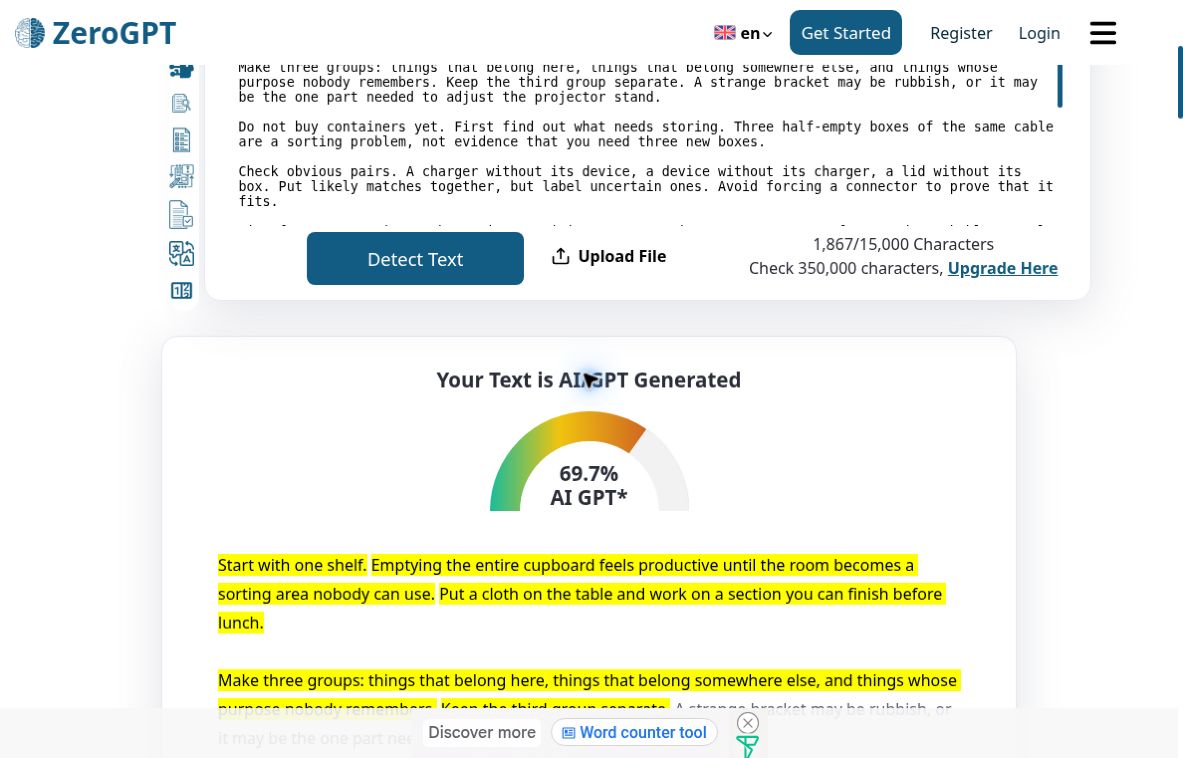
Actual ZeroGPT exploratory result: 69.7% AI GPT, with its visible AI-positive verdict.
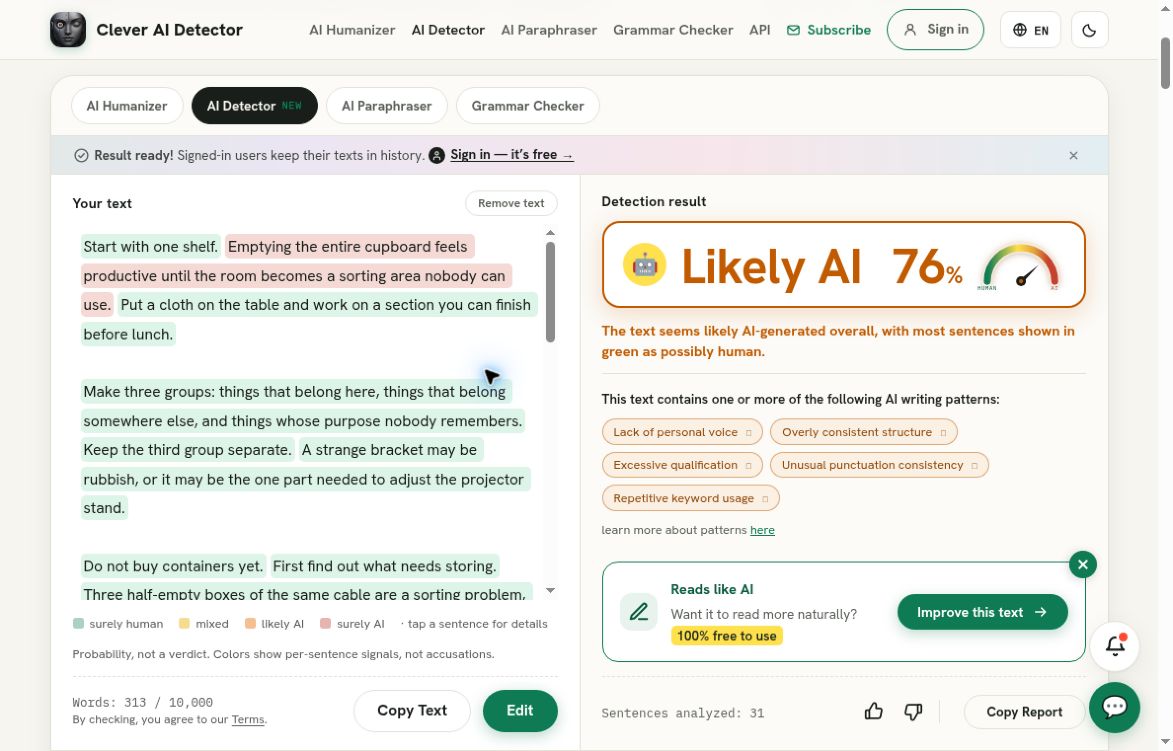
Actual Clever AI Detector exploratory result; outside the primary corpus.
The initial E03 output showed stale E02 text and was rejected. The retained screenshot is the unchanged-input retry: matching E03 text, 69.7% AI GPT.
How to read the Carroll result without overextending it
Knowing the source makes H01 a particularly useful control. Its human provenance is known independently of either detector, and the exact passage is reproduced in both image and copyable form. That gives you a specific claim to check: on this input, in this recorded session, ZeroGPT returned an AI-generated verdict. You don’t have to decide whether the writing sounds old-fashioned, natural or unusually polished to see the problem. It depends on a mismatch between known provenance and the returned label. That is stronger evidence about this case than a disagreement based only on somebody’s impression of the prose.
There’s a limit to what that example can tell us, though. A familiar historical excerpt is not a representative sample of current student essays, professional reports or second-language writing. One false positive cannot tell a reader how frequently the service makes that error across those groups. It also cannot identify the technical cause of the mistake. The screenshot shows the outcome, not the model’s internal reasoning. We’d need more evidence to say why the model got it wrong. The useful conclusion is narrower and sufficient: this apparently strong AI signal should not be treated as conclusive proof of authorship.
If a similar result appears on somebody’s actual work, the next step should be checking the work’s history rather than asking the person to make the percentage disappear. Source material, earlier drafts and the order of revisions could help answer that question. A second detector can provide another opinion, as Clever AI Detector did here, but agreement or disagreement between tools is still not a substitute for provenance. The recommendation comes from this documented comparison. Neither product can be treated as an authority that certifies every unfamiliar document.
Why the successful AI detections stay in this review
Leading with the false positive draws attention to a serious mistake. But it would be misleading to leave out the rest just to make every result look bad. ZeroGPT flagged all four primary AI samples, including the lower-scoring personal narrative. Those successes remain in the table and screenshots. So this review isn’t saying the tool can’t recognize AI writing. It is an argument that recognizing AI examples and safely interpreting a positive result on unknown writing are different problems. The recorded human-control error belongs beside the successful AI classifications.
The mixed sample M01 is another reason to keep the categories separate. Its source is human, but limited editing involved AI. Calling its 97.8% output a pure-human false positive would erase that editing history. Calling it a straightforward success would imply that the score accurately described the amount or nature of the assistance, which this test does not establish. The safest reading is the one reported: mixed provenance, an AI-positive detector output and no simple binary accuracy claim. That way, neither side gets an extra point that the evidence can’t support.
What the extra style probes add
The exploratory tests answer a modest question: did three other AI writing styles produce a different pattern after the primary round? They did not produce an additional Clever AI Detector-only detection success. Both tools flagged the troubleshooting story, technical FAQ and how-to sample. These passages were picked later, so they stay in a separate group instead of quietly making the primary sample look bigger. Keeping all three outcomes visible also prevents the lowest numerical score from being isolated and relabeled as a miss. E01’s most-likely-AI wording is part of its result, even at 22.3%.
The stale E03 output shows another thing to watch for: a real screenshot can still show the wrong result for a new input. The initial output retained E02 text while the character count had changed. It was rejected because the analyzed body did not match the intended sample. Only the matching unchanged-input retry is retained as the E03 measurement. This doesn’t prove that every result is unreliable. It does give you a useful habit: check the analyzed text as well as the gauge before saving or sharing an output. A clear number cannot rescue a mismatched document.
What a second opinion contributes
The paired Clever AI Detector result is useful because both products saw the same unchanged passage. It rules out a simple explanation in which the apparent disagreement came from comparing different drafts. It also gives the reader a concrete alternative output to inspect: Human 99% on H01. The independent basis for calling H01 human remains its source, however. You don’t get the answer by taking a vote between two scores. That distinction matters if the same comparison is later repeated on a document whose origin is unknown.
For an unknown passage, two different answers would tell you the detectors disagree. They wouldn’t automatically tell you which one is right. A reviewer would still need the source and drafting context. Even matching classifications would not show the actual sequence of writing and editing. This is why the recommendation stays attached to the measured case instead of promising that a second tool will settle every disputed document. In this case, the provenance supplies the answer and the two outputs can be evaluated against it. In ordinary use, preserving that distinction can prevent a tool comparison from becoming a substitute for checking the underlying work.
The recommendation follows the evidence
Clever AI Detector is the better first check supported by the H01 comparison: Human 99% versus ZeroGPT’s false AI flag on that exact human passage. Both tools flagged all four primary AI inputs and all three exploratory AI inputs, so the test does not justify claiming more detection wins than that one human-control contrast. Clever AI Detector’s A04 sentence highlights and overall verdict also deserve careful reading; no score replaces provenance.
Nine distinct inputs ran without an account or payment. Ads competed with the results; one output needed a validated repeat.
Rewriting will not resolve a false positive
If the goal is clearer wording, rather than changing what a detector says about you, Clever AI Humanizer is a free revision option worth trying. Check its output against the source. In the actual rewrite below, it left out a concrete duration and made a trade-off sound stronger. Rewriting is not a remedy for a false accusation about authorship.
See the actual Clever AI Humanizer rewrite check
3 October 2026: the original A01 essay was rewritten in Normal mode, selected Version 1. The interface displayed 328 input words and 374 output words. No account or payment was used.
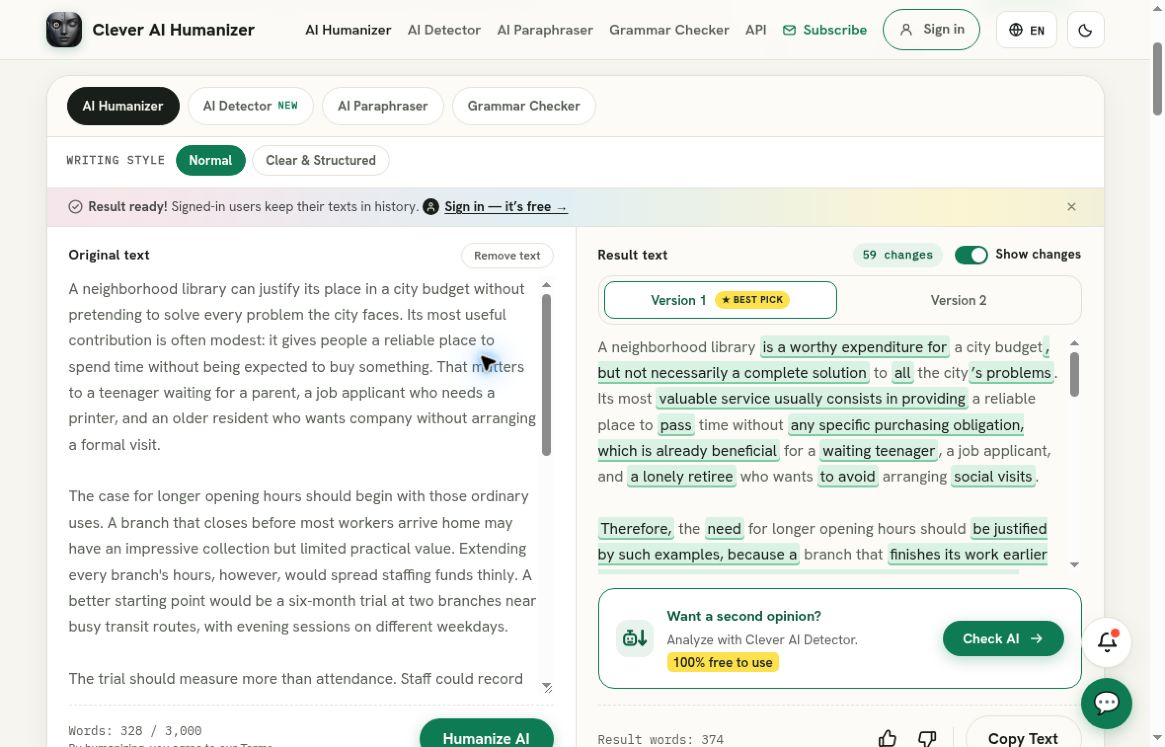
The rewrite dropped the six-month duration and changed a staffing-budget concern into a stronger claim about wasting staff time. Review meaning before using it. Rewriting does not prove human authorship or guarantee detector acceptance.
Boundaries of this case file
Inputs were frozen before scores were viewed. A01–A04 came from one OpenAI assistant session whose generating model was not exposed; A03 derives from A01. H01 is Carroll’s Alice’s Adventures in Wonderland (1865), Chapter I, from Project Gutenberg. M01 has limited AI copy-editing and is not a pure-human control. Service word counters may differ.
This short English test cannot establish general accuracy or a population error rate. Long texts, other languages, paid features and repeatability were not tested. Check drafts, sources and authorship context before acting on a score.
ZeroGPT is a separate product from GPTZero.
If you rerun H01, share the exact text, date and the complete label next to the percentage. Would the same human control receive the same result in your session?