WriteHuman claims to transform AI text into natural writing that achieves “authentic, human-like scores on leading AI detectors.” The service offers two main humanization models: a basic free model and an enhanced paid model. I put the WriteHuman’s basic model through my standard testing process to find out whether the marketing claims hold up under scrutiny.
How I test: I generated three AI content samples using the latest ChatGPT model covering different topics: AI humanization, technology trends, and climate change. Each sample was approximately 200 words to fit within WriteHuman’s free tier limit. I established baseline detection scores by running the original texts through both GPTZero and ZeroGPT, then processed each sample using WriteHuman with default settings (Standard tone). I re-tested all humanized outputs through both detection platforms to measure effectiveness. I also manually evaluated the grammar quality and readability of the humanized text. You can find the raw test data for this review here.
| Pros | Cons |
|---|---|
| Free signup requires no credit card | GPTZero flagged all outputs at 100% AI |
| Enhanced Model and multiple tone options for paid users | Inconsistent ZeroGPT results |
| Built-in AI detector for paid plans | Poor writing quality with typos and broken grammar |
| Repetitive, nonsensical output in some samples | |
| Higher pricing than most competitors | |
| Submitted text used for AI training | |
| No refunds policy |
How Well Did WriteHuman Perform?
The free version of WriteHuman limits you to 200 words per request, and you can only humanize one text before being required to create an account. The good news is that signing up is free and does not require entering any credit or debit card information. However, after that initial free use, you will need to log in for each subsequent humanization.
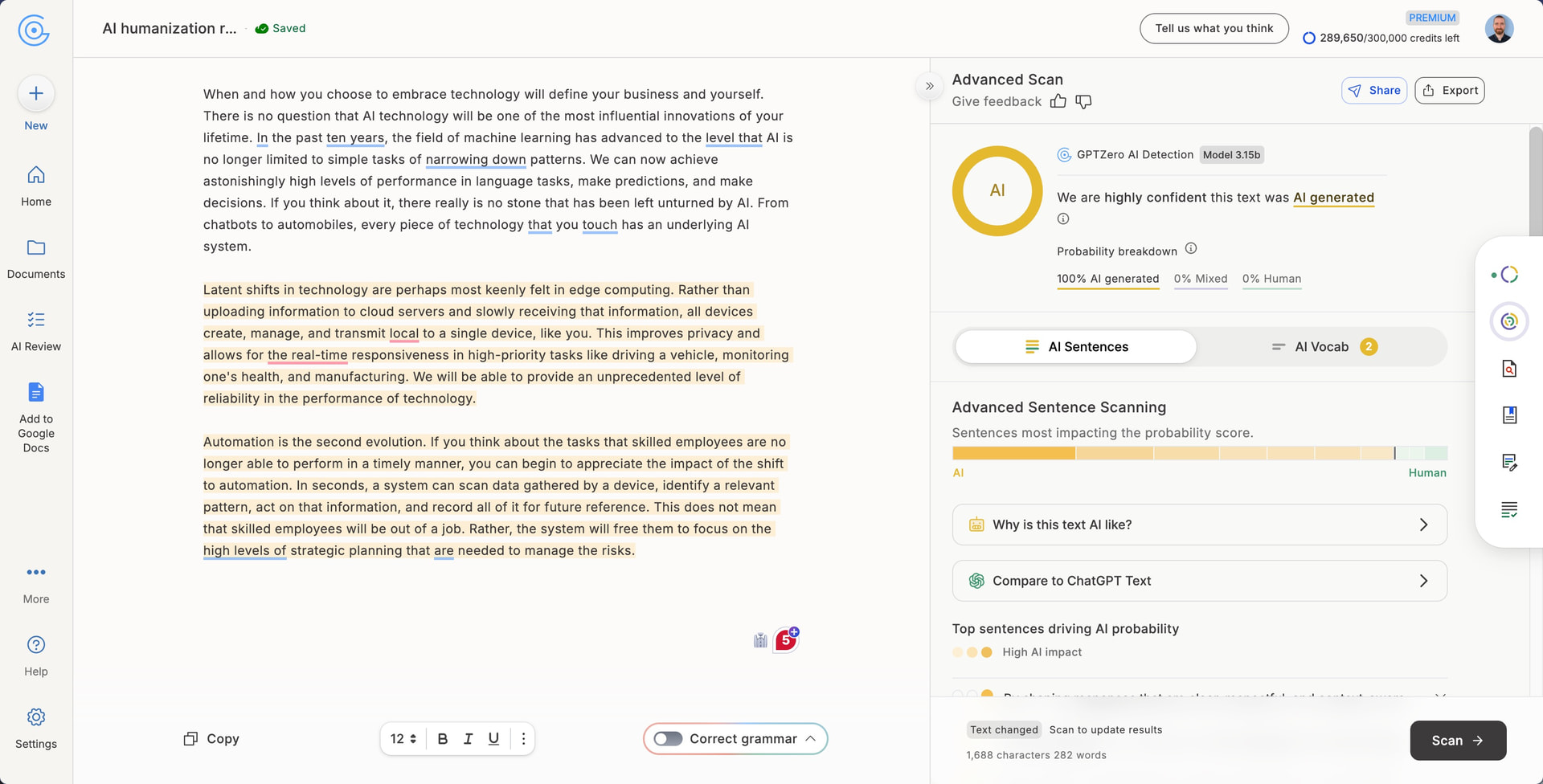
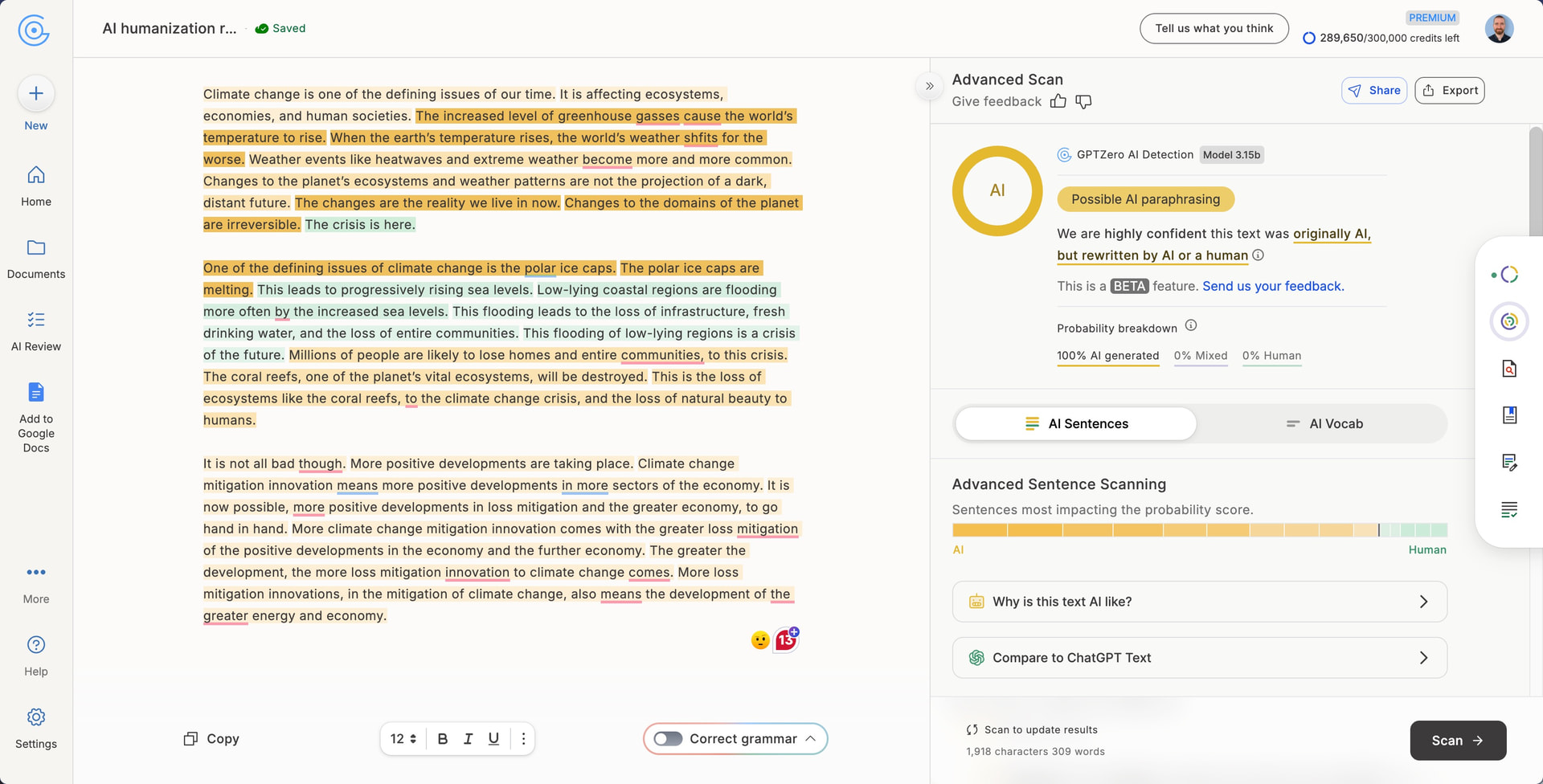
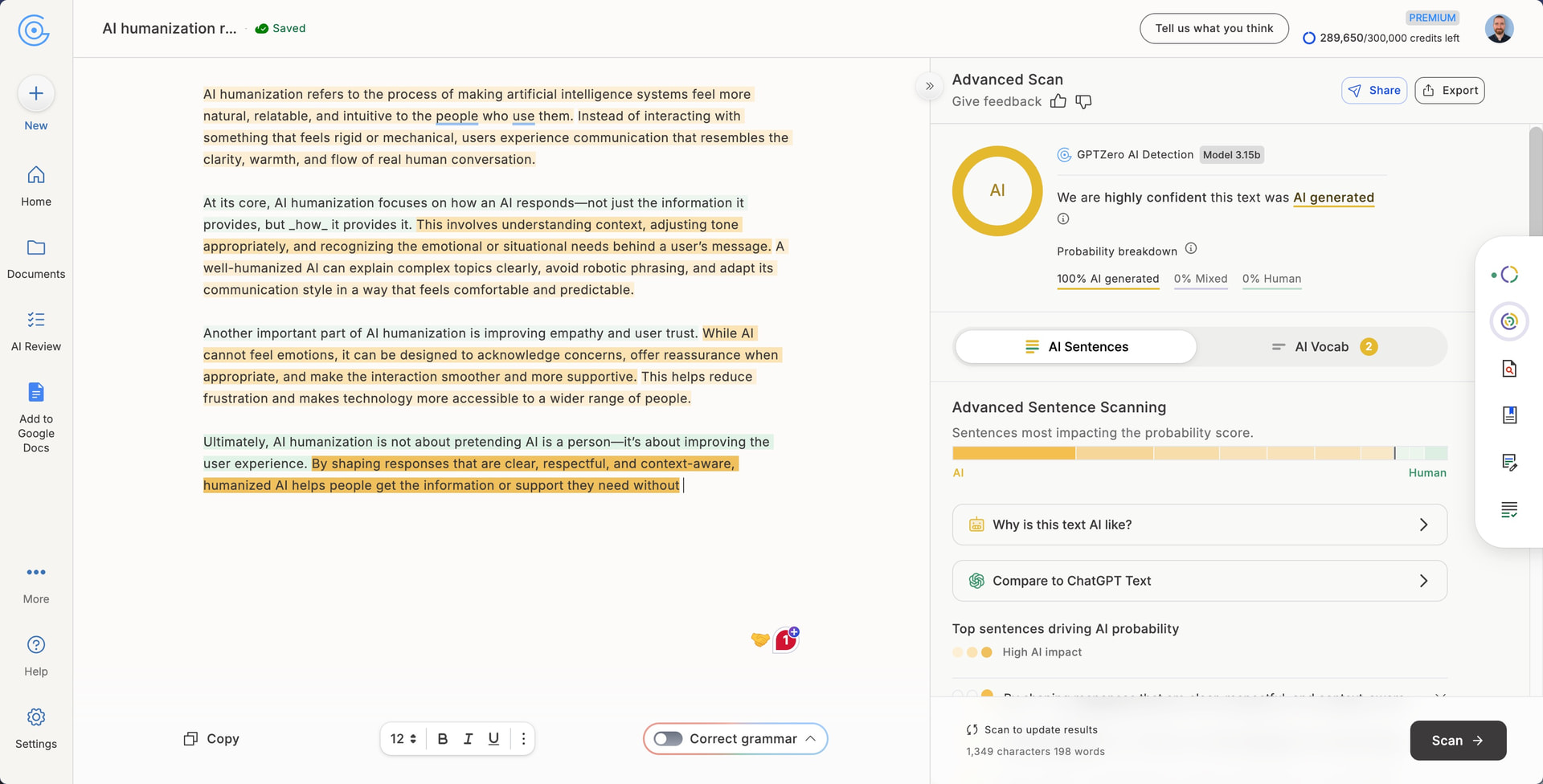
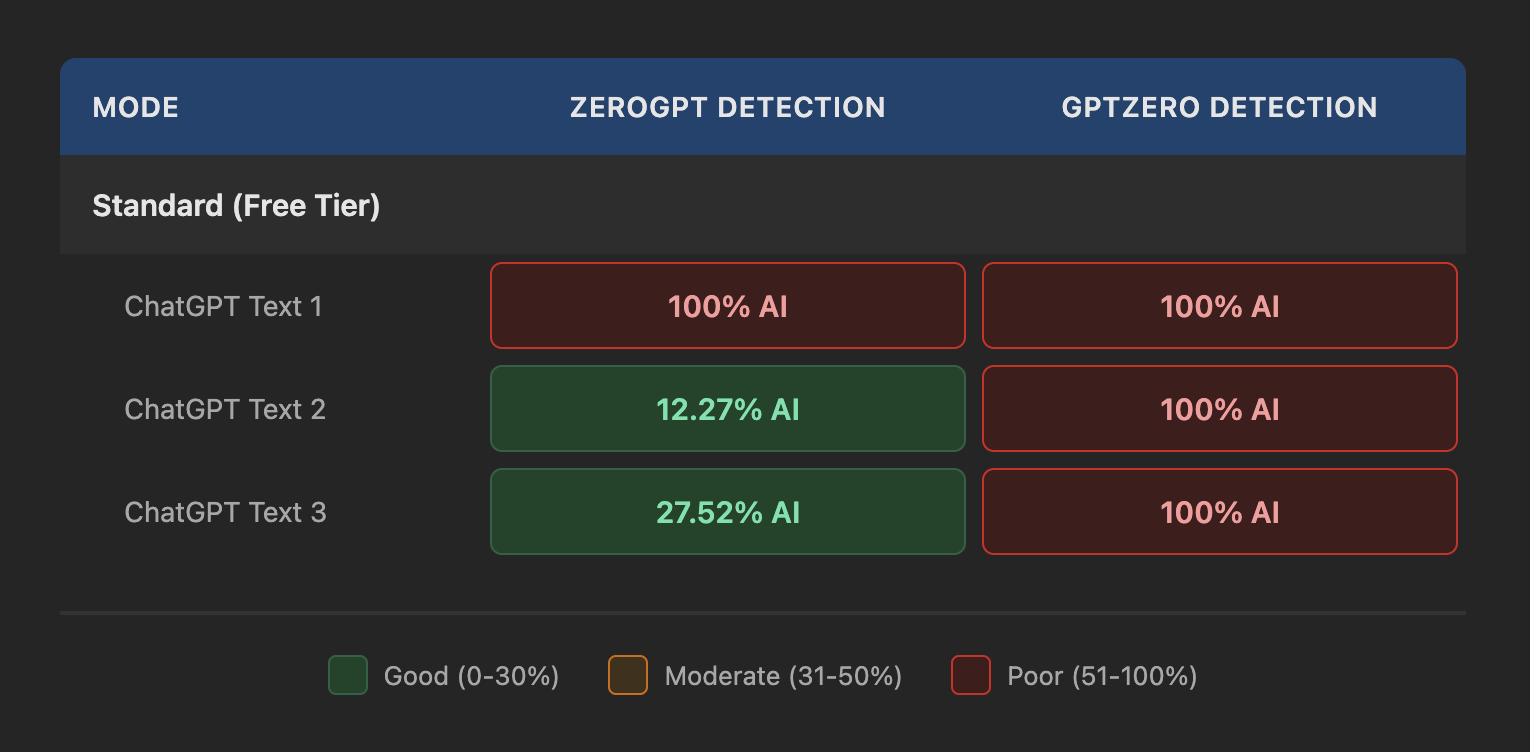
The detection results from my testing were disappointing on one detector and inconsistent on the other. GPTZero, which tends to be among the more reliable detectors, flagged every single humanized output at 100% AI detection without exception.
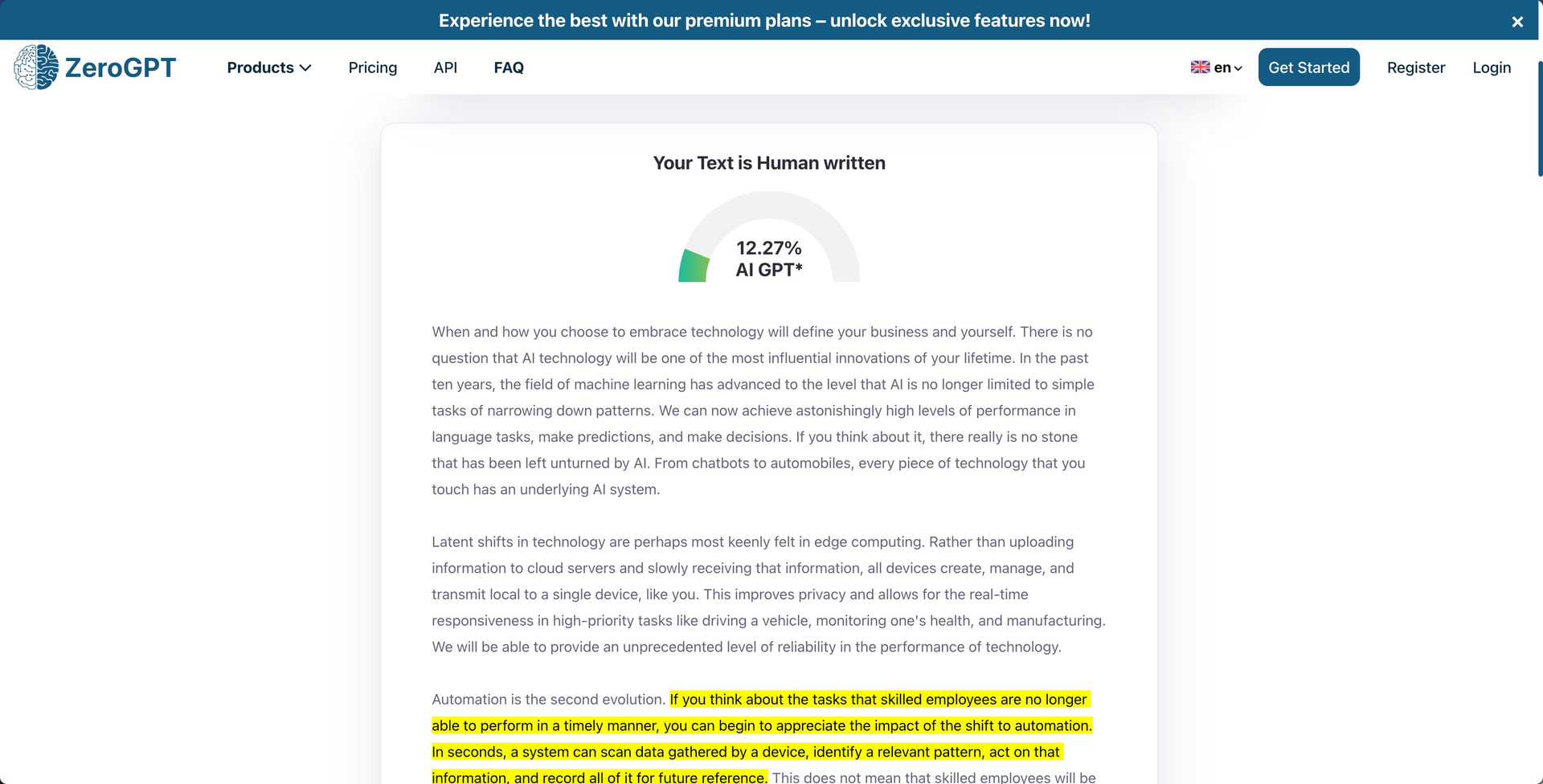
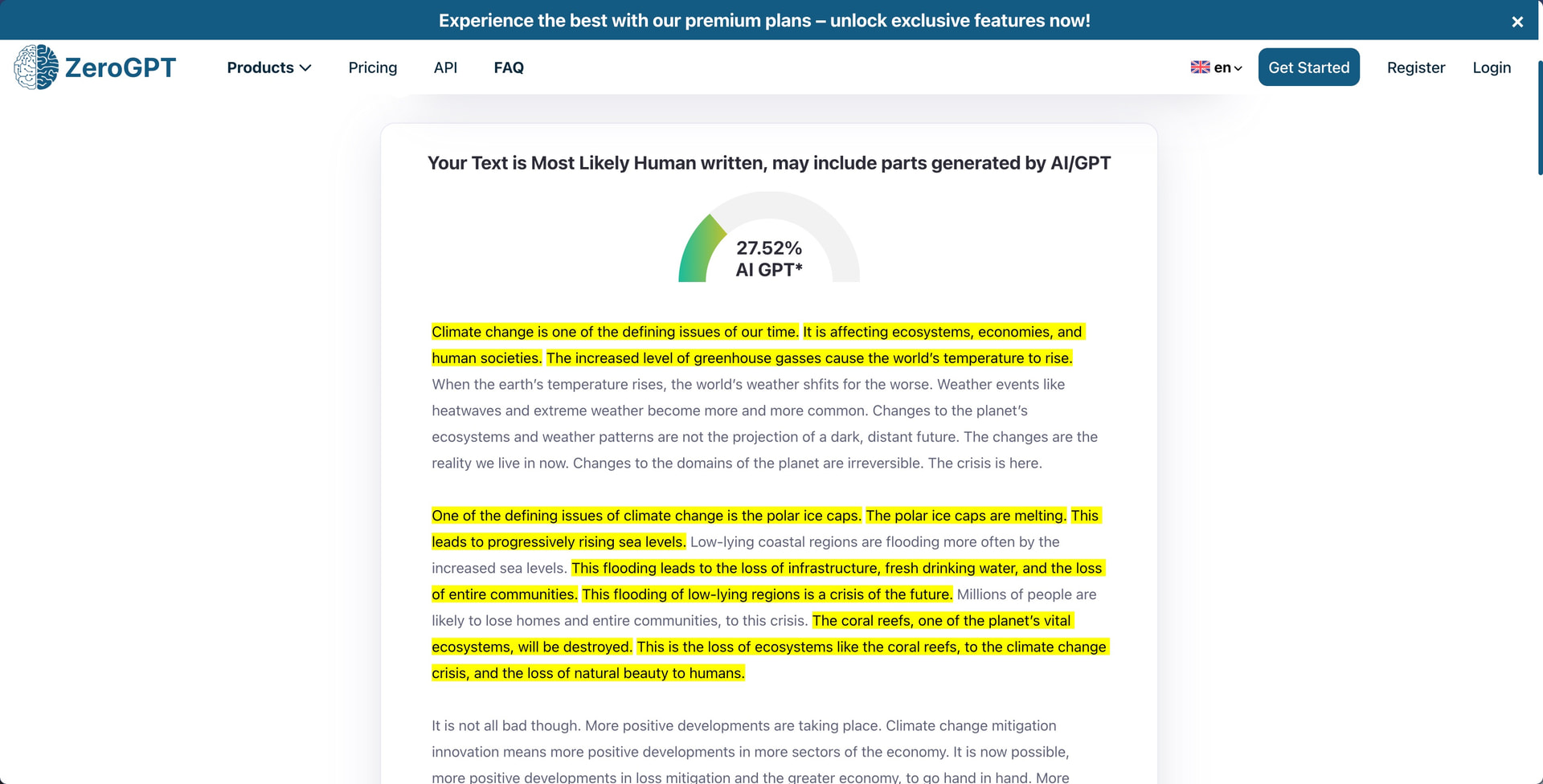
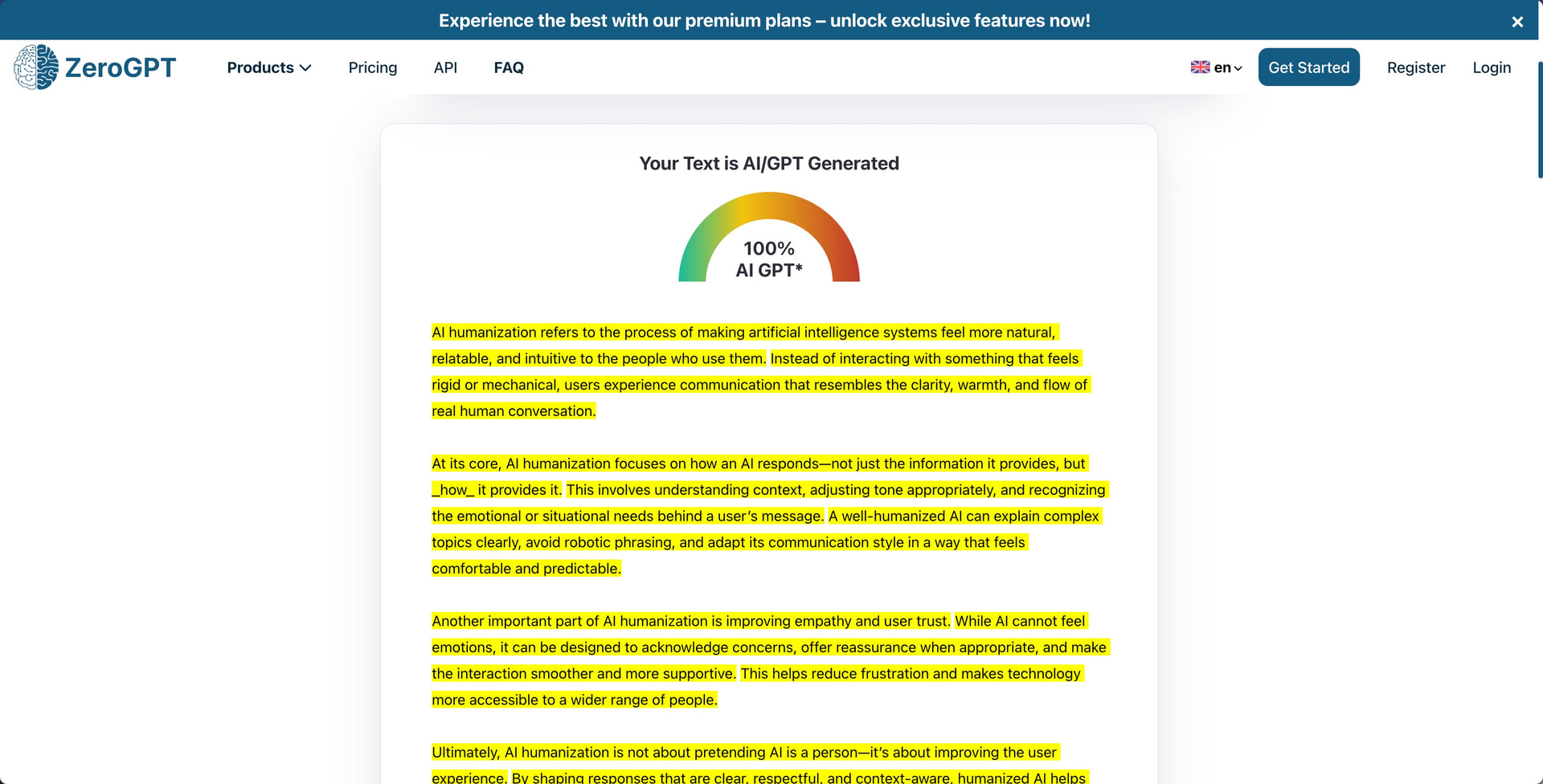
ZeroGPT flagged the first text at 100% AI (the same GPTZero). The second text performed significantly better with only 12.27% AI detection, which is actually a respectable score, and the third text landed somewhere in the middle at 27.52% AI detection.
It’s interesting to see GPTZero fail across all samples because WriteHuman’s marketing specifically mentions GPTZero as one of the detectors their tool is “extensively tested” agains. Despite this, my results make it clear that the basic model provides zero protection against this particular detector.
Of course, it’s possible that the Enhanced Model, which is available exclusively to paid subscribers (Basic, Pro, and Ultra plans), would perform better, especially when combined with additional tone options (Professional, Academic, Blog/SEO, Casual, Creative, Scientific, and Technical). However, the performance of the free version made me anything but eager to take out my credit card and test it myself.
For context, not every humanizer struggles this badly with GPTZero. When I tested Clever AI Humanizer, it achieved 0% AI detection on ZeroGPT across all samples and pulled one GPTZero result down to just 1% AI. The fact that Clever AI Humanizer accomplishes this without charging a single cent makes WriteHuman’s paid tiers even harder to justify. You can read my full Clever AI Humanizer review for the complete breakdown.
How Well Does WriteHuman Maintain Writing Quality?
Writing Quality Score: 4/10
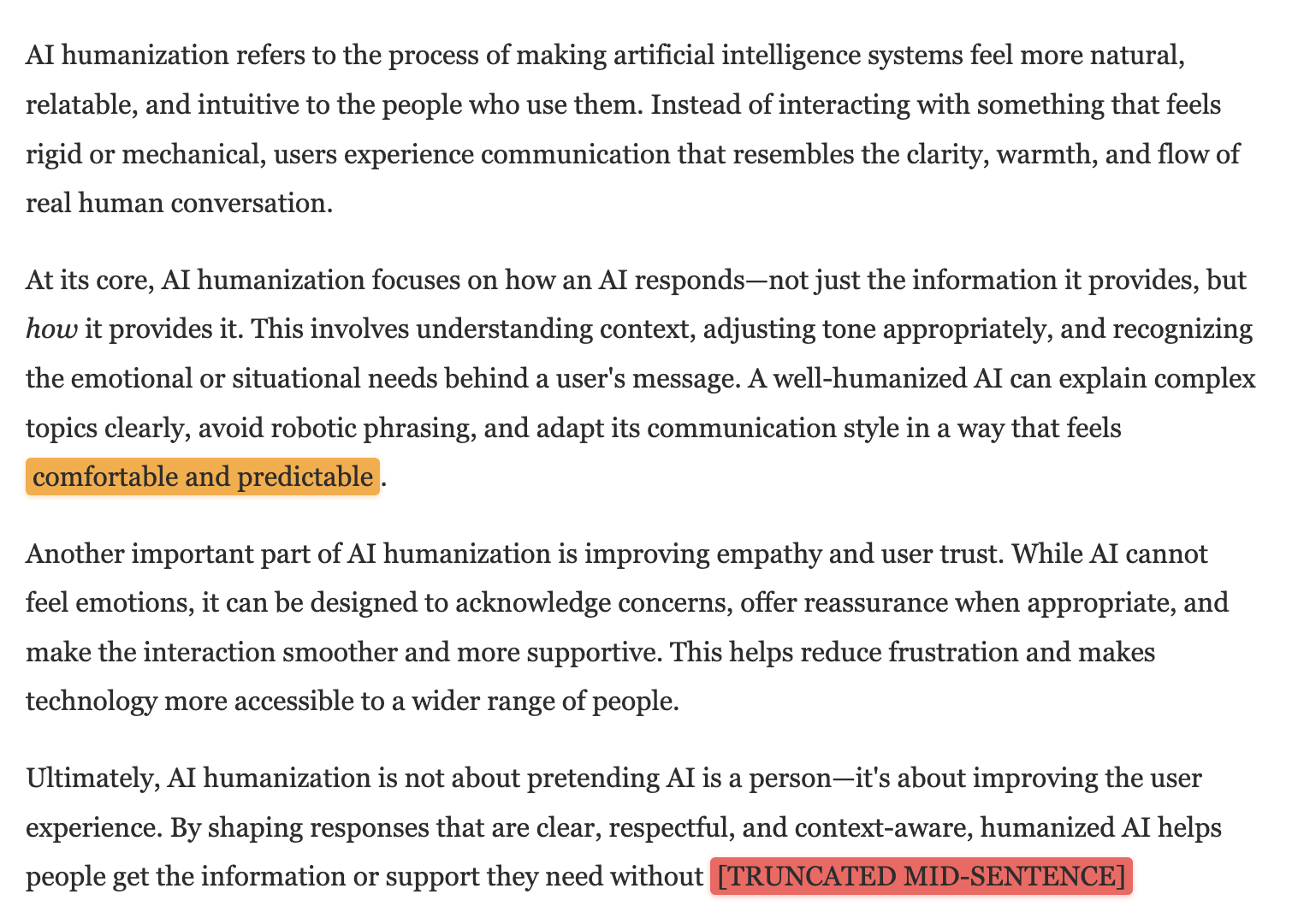
WriteHuman’s output felt quite random across my three test samples. The first text about AI humanization was the cleanest of the three. The sentences were logical, the vocabulary choices appropriate, and the overall structure made sense. My only observation is that the text was truncated mid-sentence (“without” with no continuation), though this appears to be a limitation of the 200-word processing cap rather than a quality issue with the humanization itself.
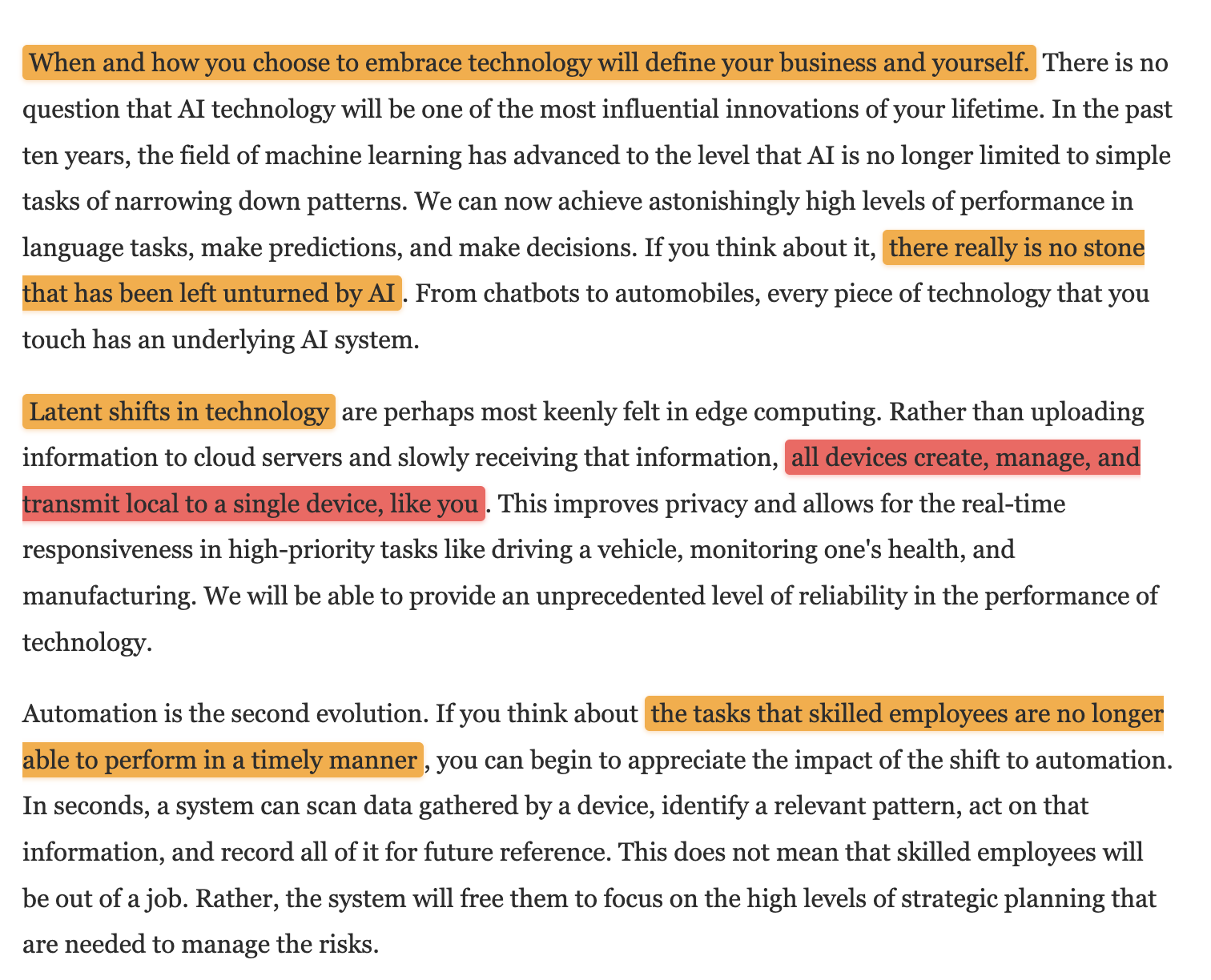
The second text covering technology trends introduced a noticeably different tone. WriteHuman changed the writing style from informative to almost motivational, with phrases like “will define your business and yourself” and “there really is no stone that has been left unturned by AI.” More problematic was the grammatically broken sentence: “all devices create, manage, and transmit local to a single device, like you.” The phrase “transmit local” makes no grammatical sense, and “like you” at the end is confusing in context.
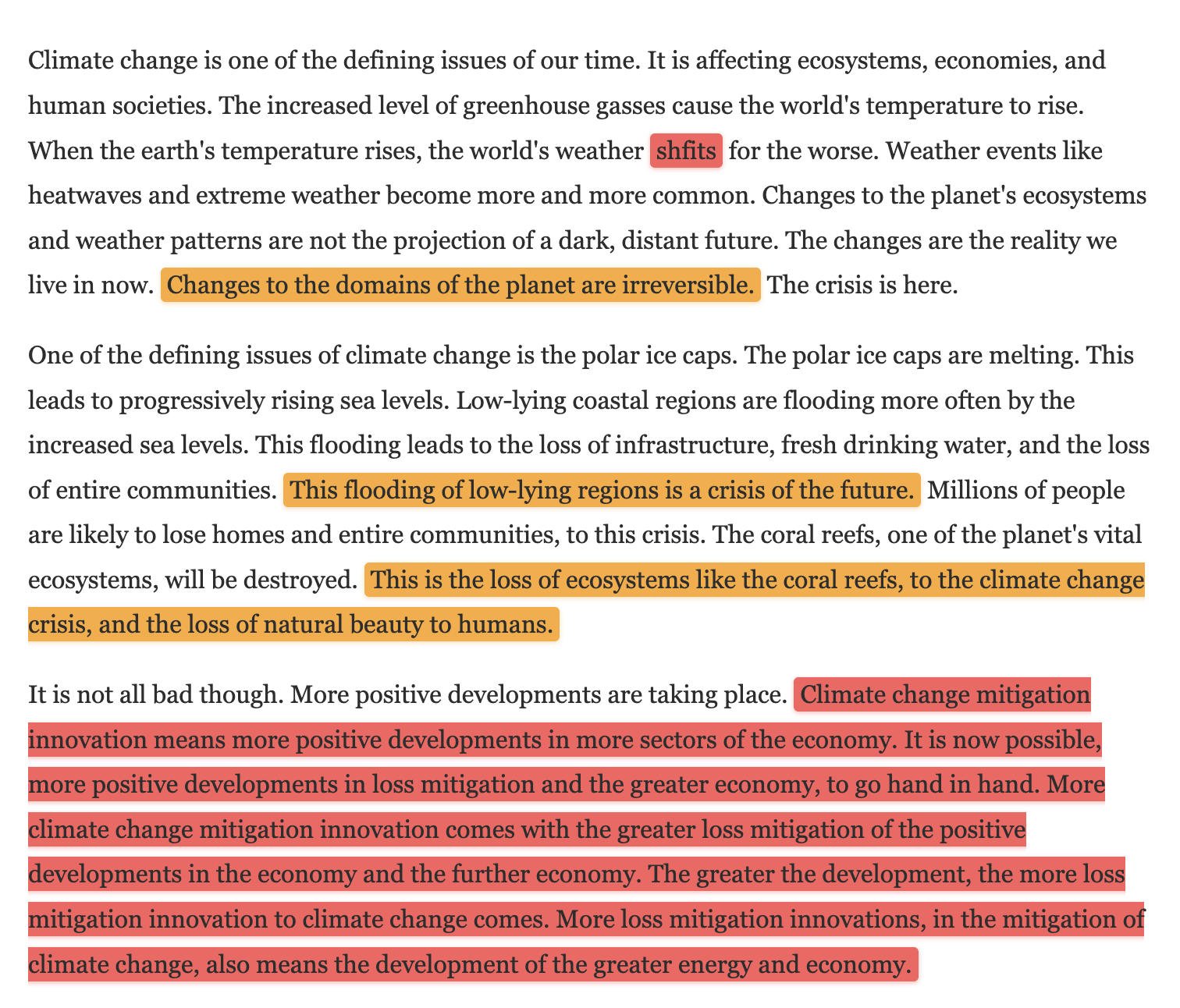
The third text on climate change contained the most serious quality issues. There is an obvious typo where “shifts” became “shfits,” which a proper humanization tool should never introduce. The final paragraph descended into near-incomprehensible repetition: “More climate change mitigation innovation comes with the greater loss mitigation of the positive developments in the economy and the further economy. The greater the development, the more loss mitigation innovation to climate change comes.” This reads like the tool got stuck in a loop of recycling the same phrases without producing meaningful content.
If I had to guess what’s happening under the hood to cause these issues, I would say the AI performing the humanization sometimes loses track of the original meaning or fails to grasp the intent behind certain sentences.
How Much Does WriteHuman Cost?
WriteHuman offers three pricing tiers with discounts for annual billing:
| Plan | Monthly Price | Yearly Price | Requests/Month | Words/Request |
|---|---|---|---|---|
| Basic | $18 | $12 ($144/year) | 80 | 600 |
| Pro | $27 | $18 ($216/year) | 200 | 1,200 |
| Ultra | $48 | $36 ($432/year) | Unlimited | 3,000 |
Annual billing saves you between 25% and 33% depending on the tier. The Basic plan drops from $18 to $12 per month, Pro falls from $27 to $18, and Ultra decreases from $48 to $36. All paid plans include access to the Enhanced Model, which is advertised as being regularly updated to bypass stricter detectors like Originality 3.0 and Turnitin.
One thing that stands out about WriteHuman’s pricing structure is the request-based system rather than a word-based allowance. The Basic plan gives you 80 humanizer requests per month with up to 600 words each, which translates to a maximum of 48,000 words if you maximize every request. The Pro plan bumps this to 200 requests at 1,200 words each (up to 240,000 words), while Ultra removes the request cap entirely. With the free version of the AI humanizer, you can make only up to 3 requests before you’re stopped.
Compared to competitors, WriteHuman sits at the higher end of the market. Aihumanize.io offers unlimited humanization for $20/month with annual billing, and HumanizeAI.io charges just $6/month for their Premium plan annually.
Does WriteHuman Respect User Privacy?
According to WriteHuman’s privacy policy and terms of service, the company collects a standard range of data for a web-based service:
-
Personal information: Names, email addresses, usernames, passwords, contact preferences, and billing addresses
-
Payment data: Processed and stored through Stripe (WriteHuman does not store payment details directly)
-
Usage data: IP address, browser type, device information, operating system, and location data
-
Cookies: Session cookies, preference cookies, and analytics tracking
One notable aspect of WriteHuman’s terms is that they explicitly grant themselves a license to use your submitted text for AI training purposes. Section 6 states: “By submitting User Input, you grant us a non-exclusive, royalty-free, worldwide, and perpetual license to use, reproduce, modify, distribute, and otherwise exploit these User Input for the purpose of developing, training, and improving our artificial intelligence (AI) model.” While the policy mentions data will be “anonymized and aggregated where possible,” this is something to consider if you work with sensitive or proprietary content.
The terms of service also contain an interesting contradiction. Section 4 explicitly prohibits using WriteHuman “to facilitate or promote academic dishonesty—including paper-writing, homework-completion, or exam-taking assistance.” Yet the marketing clearly targets students who want to bypass AI detection on their assignments.
Perhaps most importantly, the terms include an honest disclaimer: “We do not guarantee that any content processed through the Services will bypass third-party AI-detection systems or achieve specific detection scores.” Combined with a strict no-refunds policy on all purchases, this means you are paying for a service that openly admits it might not work, with no recourse if it fails. Contrast this with Undetectable AI Humanizer, which is happy to refund the cost of humanization if your humanized content provably scores below 75% human on a reputable AI detector.