I tested Clever Ai Humanizer on 60 different texts — here are the actual results
I’ve been testing AI humanizers for a while, mostly because I work with a lot of AI-assisted content and I’m tired of tools that promise “100% human” results based on one cherry-picked paragraph.
A lot of these services have the same pattern. You paste in a short ChatGPT answer, the tool swaps some words around, adds a few awkward phrases, and then proudly shows one detector result. The problem starts when you use a longer article, an academic essay, a technical explanation, or anything that requires the original meaning to remain intact.
So I decided to test Clever Ai Humanizer more seriously.
I didn’t use one text. I tested three separate batches containing 20 original and rewritten text pairs each, so 60 texts in total. The samples covered different subjects and formats: technology, science, education, history, literature, opinion writing, tutorials, SEO content, and academic-style essays.
The idea was to answer two separate questions:
-
Does Clever Ai Humanizer actually reduce AI detection scores?
-
Does the rewritten text remain readable and useful afterward?
The second question matters just as much as the first. A tool can technically reduce an AI score by making the writing worse, but that doesn’t help anyone.
The overall results
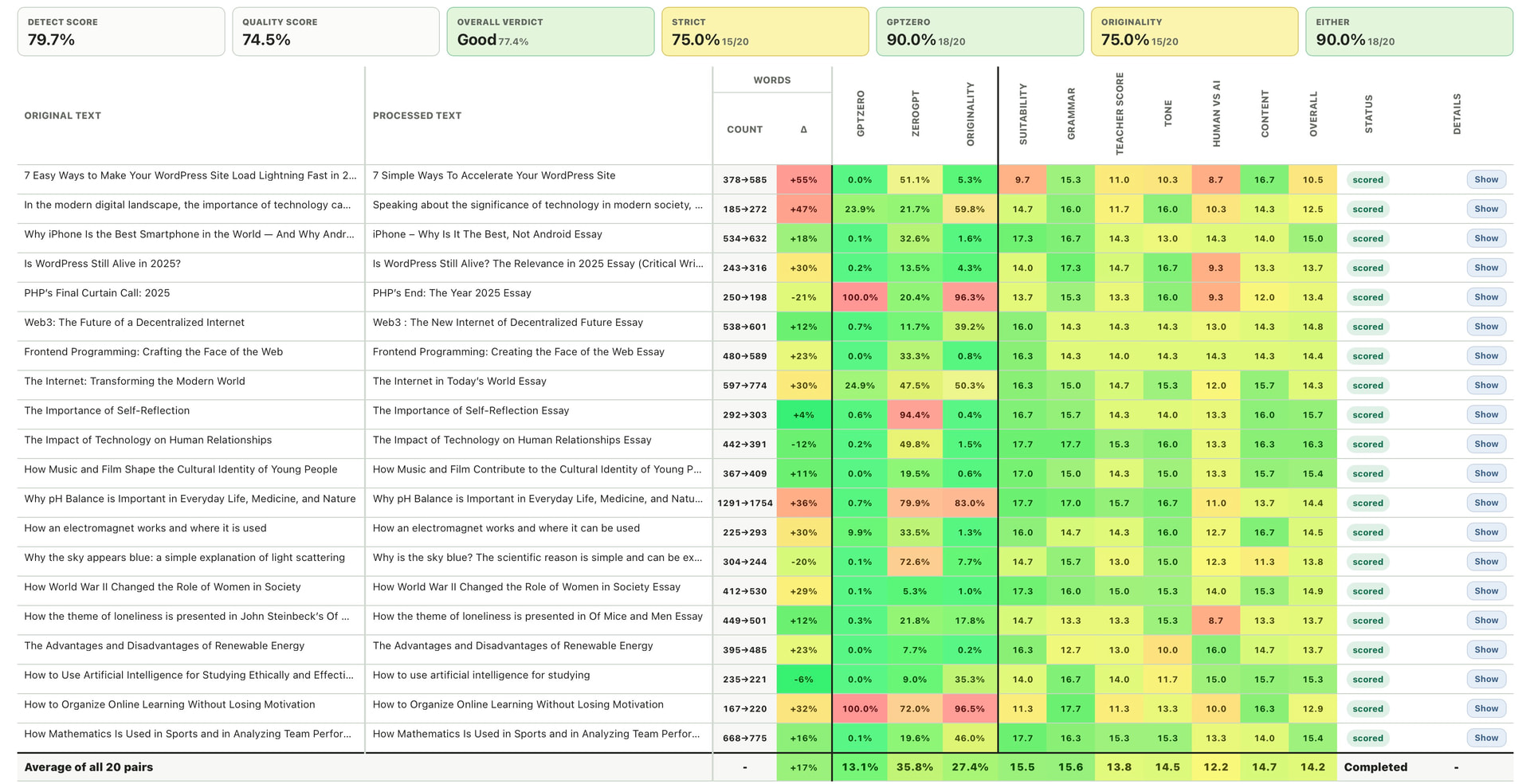
Across the three test runs, Clever Ai Humanizer received the following overall ratings:
-
First run: 77.4%
-
Second run: 76.2%
-
Third run: 75.1%
Every run received a “Good” verdict.
The detector scores were 79.7%, 78.9%, and 75.0%. Writing-quality scores were 74.5%, 72.8%, and 75.3%. In other words, the results stayed fairly stable across all 60 samples. There wasn’t one excellent test followed by two terrible ones.
That consistency was probably the first thing that impressed me.
I’ve tested other humanizers where the performance changes dramatically depending on the topic. They might work on a casual blog post but completely fail on an academic essay. Clever Ai Humanizer wasn’t perfect on every text, but the average result remained within a narrow range.
GPTZero was the strongest result
Clever Ai Humanizer performed extremely well against GPTZero.
In the first run, 18 out of 20 texts passed GPTZero.
In the second run, another 18 out of 20 passed.
In the third run, all 20 out of 20 passed.
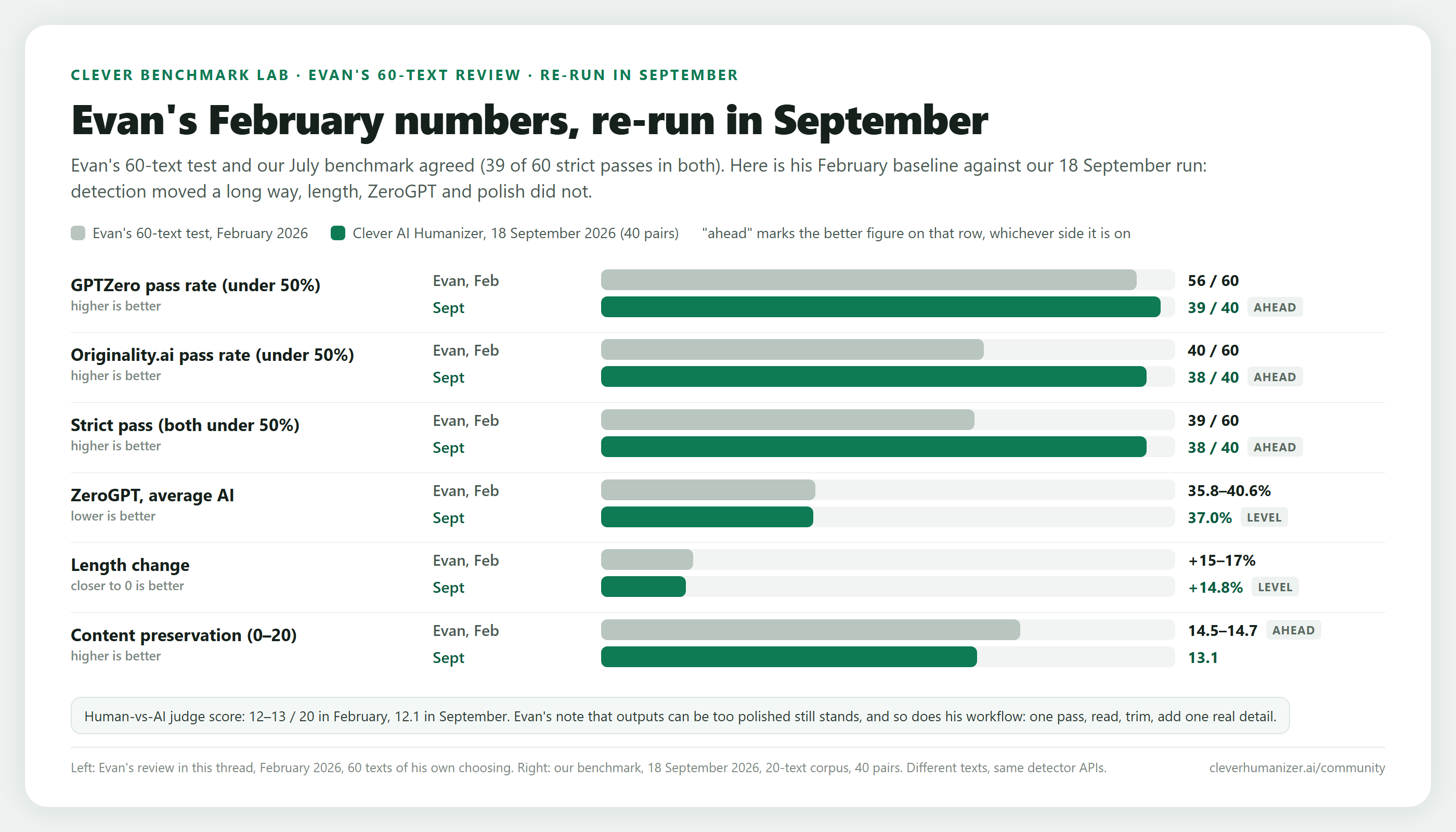
That means 56 out of 60 processed texts passed GPTZero, or roughly 93%.
The average GPTZero AI scores were also low:
-
13.1% in the first batch
-
12.3% in the second batch
-
3.5% in the third batch
The third result was especially strong. Getting an average of 3.5% AI across 20 different texts is very different from showing a single lucky screenshot.
From my testing, GPTZero is clearly the detector Clever Ai Humanizer handles best.
Originality was more inconsistent
Originality produced more mixed results.
The pass rates were:
-
15 out of 20 in the first run
-
14 out of 20 in the second
-
11 out of 20 in the third
So 40 of the 60 texts passed Originality.
The average AI scores were 27.4%, 29.9%, and 46.5%. The third run was noticeably weaker, even though the same batch passed GPTZero on all 20 texts.
This is a good example of why I don’t trust claims such as “undetectable by every AI detector.”
The same piece of writing can receive a very low AI score from GPTZero and a much higher score from Originality. That doesn’t necessarily mean the writing suddenly became more artificial. It means the detectors use different signals and frequently disagree.
Clever Ai Humanizer still performed reasonably well on Originality, but it wasn’t as reliable as it was on GPTZero.
ZeroGPT was the weakest detector
ZeroGPT gave the highest average AI scores:
-
35.8%
-
35.4%
-
40.6%
That was the weakest part of the benchmark.
However, I’ve tested genuinely human-written content in ZeroGPT before and received strange results, so I personally don’t treat it as the final authority. Still, the numbers are the numbers, and anyone considering Clever Ai Humanizer should know that its ZeroGPT performance was less impressive than its GPTZero performance.
So my detector conclusion would be:
Clever Ai Humanizer is excellent for GPTZero, decent but inconsistent for Originality, and less reliable for ZeroGPT.
That is still a strong result overall, but it is much more realistic than saying it bypasses everything every time.
The strict test
The benchmark also included a stricter measurement.
A text only passed this test when both GPTZero and Originality rated it below 50% AI. ZeroGPT was not included in this specific score.
The strict pass results were:
-
15 out of 20
-
13 out of 20
-
11 out of 20
That equals 39 successful texts out of 60, or 65%.
When a text only needed to pass either GPTZero or Originality, the results were much higher:
-
18 out of 20
-
19 out of 20
-
20 out of 20
That is 57 out of 60, or 95%.
I think these two numbers give the fairest overall picture.
Clever Ai Humanizer has a very high chance of passing at least one major detector, but passing multiple detectors simultaneously is more difficult.
What happened to the actual writing?
I read the processed texts manually because detector numbers are meaningless if the output becomes unusable.
The writing quality was generally good.
The average category scores across the tests showed strong grammar, suitability, tone, and content preservation. In the strongest batch, grammar scored 16.1 out of 20 and suitability scored 15.7. Content preservation stayed between 14.5 and 14.7 across the three runs. The overall manual-quality scores were 14.2, 14.1, and 14.4 out of 20.
Those numbers matched my own impression.
Clever Ai Humanizer usually preserved the central argument, important examples, and factual direction of the original. It didn’t simply replace every sentence with unrelated wording.
Technical explanations generally remained technical. Academic essays kept a formal tone. Tutorials stayed practical and easy to follow. Opinion pieces sounded less robotic without becoming full of forced slang.
I also liked that Clever Ai Humanizer didn’t appear to rely on intentionally bad grammar, fake spelling mistakes, or random punctuation. Some humanizers make text look “human” by making it obviously worse. Clever Ai Humanizer mostly tried to change the rhythm, sentence structure, transitions, and phrasing while keeping the text readable.
The biggest downside: it adds words
The most consistent weakness was text expansion.
The three batches became:
-
17% longer
-
15% longer
-
16% longer
So the average processed text was approximately 16% longer than the original.
Sometimes that helped. A short, generic paragraph became more detailed and easier to read.
Other times, Clever Ai Humanizer expanded a point that was already clear. I saw a few cases where one direct sentence became two or three sentences. There were also occasional conclusions that repeated ideas from the previous paragraph.
This isn’t a major problem for blog posts or general web content, but it matters for students, writers working with strict word limits, or anyone who prefers concise writing.
My normal workflow was to remove around 5–10% of the processed output after humanization. That usually solved the issue.
Did the text genuinely sound human?
This is the hardest part to measure.
The manual “Human vs AI” category was one of the weaker quality metrics, sitting around 12–13 out of 20. I think that is fair.
Clever Ai Humanizer removes a lot of obvious AI patterns, but some outputs still sound unusually polished. The paragraphs can be too balanced, the transitions too smooth, and the ending slightly too complete.
A real person may stop abruptly, change rhythm, make a more specific observation, or include a detail based on actual experience. No rewriting tool can invent genuine personal experience without risking fabrication.
For that reason, I wouldn’t paste the output directly into a forum and assume the job is finished.
I would add something personal, change one or two phrases to language I actually use, and sometimes remove the final summary paragraph. After those edits, the writing feels much more natural.
My practical workflow
The process that gave me the best result was:
I generated or wrote the original draft, processed it once through Clever Ai Humanizer, read the result manually, removed unnecessary expansion, restored any important original wording, and added one personal detail or opinion.
I did not keep pressing the humanize button repeatedly. Multiple rewrites can gradually move the text further away from the original meaning.
One good pass followed by a small human edit worked better for me.
Final opinion
After testing 60 different texts, I have a mostly positive opinion of Clever Ai Humanizer.
It is not a magic “undetectable AI” button. No honest tool can guarantee that, especially when detectors disagree so much.
But Clever Ai Humanizer did several things well:
It passed GPTZero on 56 out of 60 texts.
It passed either GPTZero or Originality on 57 out of 60.
All three complete benchmark runs received a “Good” overall verdict.
The writing-quality score stayed between 72.8% and 75.3%.
Grammar, tone, suitability, and content preservation remained solid.
Most importantly, the rewritten text was usually usable. I didn’t have to repair broken grammar or rebuild the original argument.
The main negatives were the 15–17% increase in length, weaker ZeroGPT results, and inconsistent performance on Originality. Some outputs also remained slightly too polished to feel completely natural without a final manual edit.
Would I use Clever Ai Humanizer again?
Yes.
I would use it as a rewriting and editing assistant, not as a substitute for reading my own work. It does most of the difficult restructuring, removes a lot of predictable AI phrasing, and gives me a much better starting point for the final version.
For me, that is more valuable than a tool that produces one impressive detector screenshot but ruins the actual text.