Copyleaks started in 2015 as a plagiarism detection tool built by two Israeli software developers. The company has since grown into a full content integrity platform with AI detection, plagiarism checking, code scanning, and LMS integrations for Canvas, Moodle, Blackboard, and several other learning management systems. Copyleaks claims that its AI detector has over 99% accuracy with a false positive rate of just 0.03% Because of how great the numbers sound, I was eager to review it and find out if they reflect the reality.
How I tested Copyleaks: I scanned each sample from my standard test set through Copyleaks individually. The AI group was nine freshly generated samples, three each from ChatGPT (5.2), Claude (Opus 4.6), and Gemini (3 Pro), covering artificial intelligence, climate change, and technology trends. The human group was ten pieces from sources that predate large language models. I recorded the percentage score and classification for every scan.
| Pros | Cons |
|---|---|
| Perfect AI detection | No nuance when the detector is wrong |
| AI detection in 30+ languages | Scanned text used for model training by default |
| Plagiarism checking bundled with AI detection | Opt-out requires emailing support (no account toggle) |
| “Hide Sensitive Data” feature for filtering identifiers | Pricing is hard to justify for AI detection alone |
| SOC 2, SOC 3, and GDPR certified | |
| LMS integrations for Canvas, Moodle, Blackboard, and others |
How Accurate Is Copyleaks At Detecting AI Content?
| AI Model | Topic | Copyleaks Score |
|---|---|---|
| ChatGPT (5.2) | AI Humanization | 100% AI |
| ChatGPT (5.2) | Climate Change | 100% AI |
| ChatGPT (5.2) | Technology Trends | 100% AI |
| Claude (Opus 4.6) | AI Humanization | 100% AI |
| Claude (Opus 4.6) | Climate Change | 100% AI |
| Claude (Opus 4.6) | Technology Trends | 100% AI |
| Gemini (3 Pro) | AI Humanization | 100% AI |
| Gemini (3 Pro) | Climate Change | 100% AI |
| Gemini (3 Pro) | Technology Trends | 100% AI |
Copyleaks didn’t make a single mistake when presented with nine AI samples generated by three different models. The flawless results put it in the same tier as GPTZero and Originality AI, the only other detectors in this series to score a perfect 100% on all nine samples. Winston AI and Undetectable AI were close at 99%, while Grammarly and QuillBot both had weak spots with certain models.
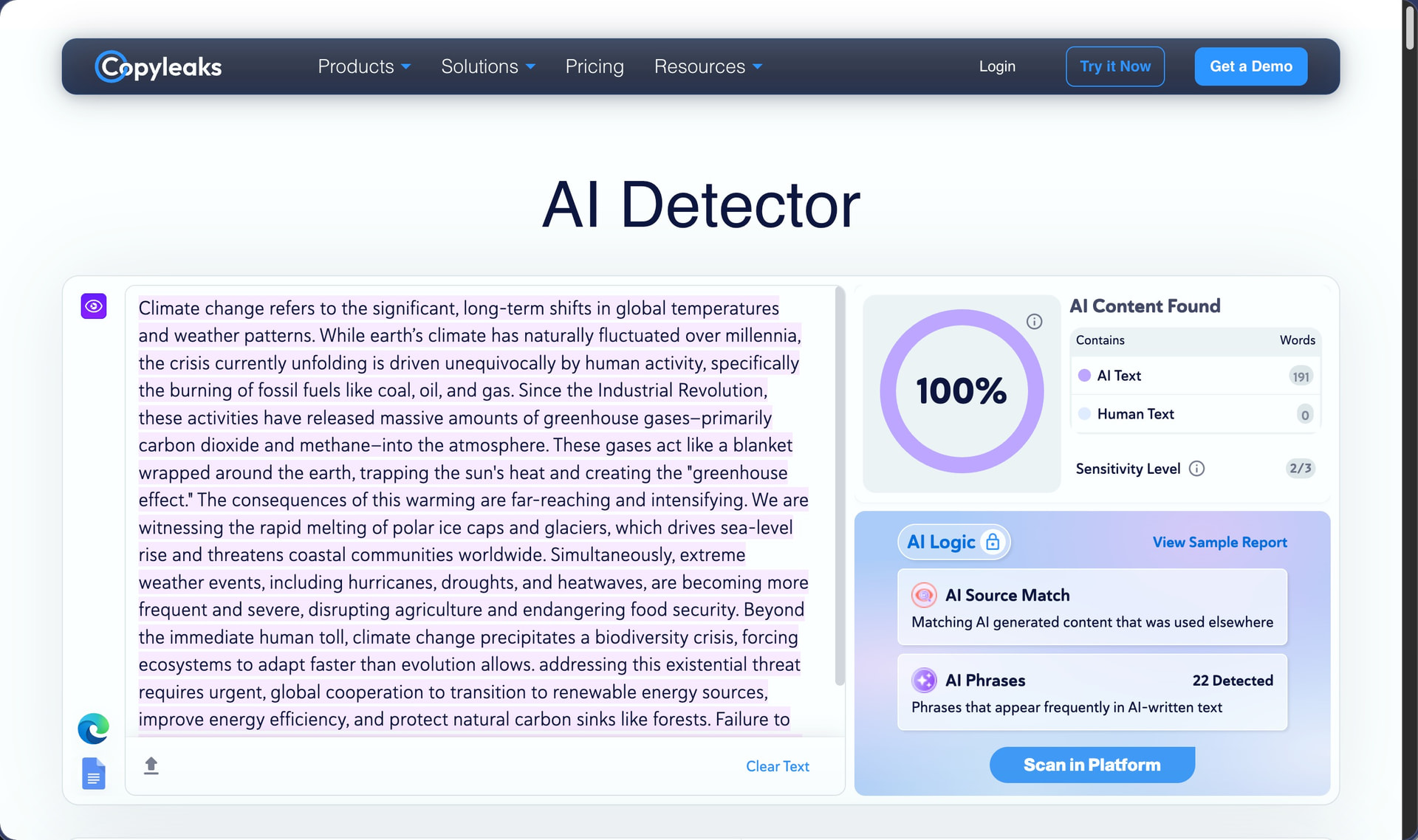
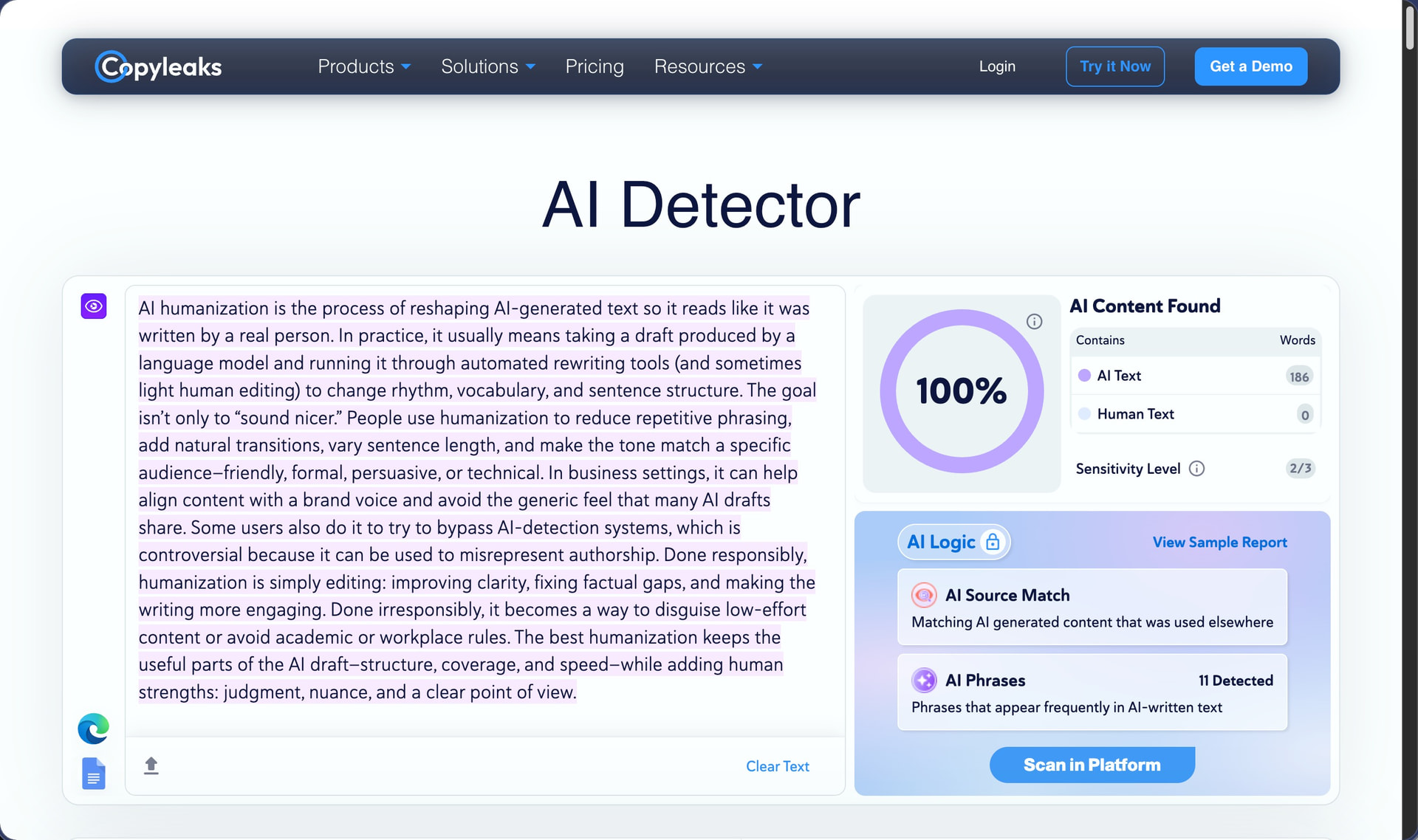
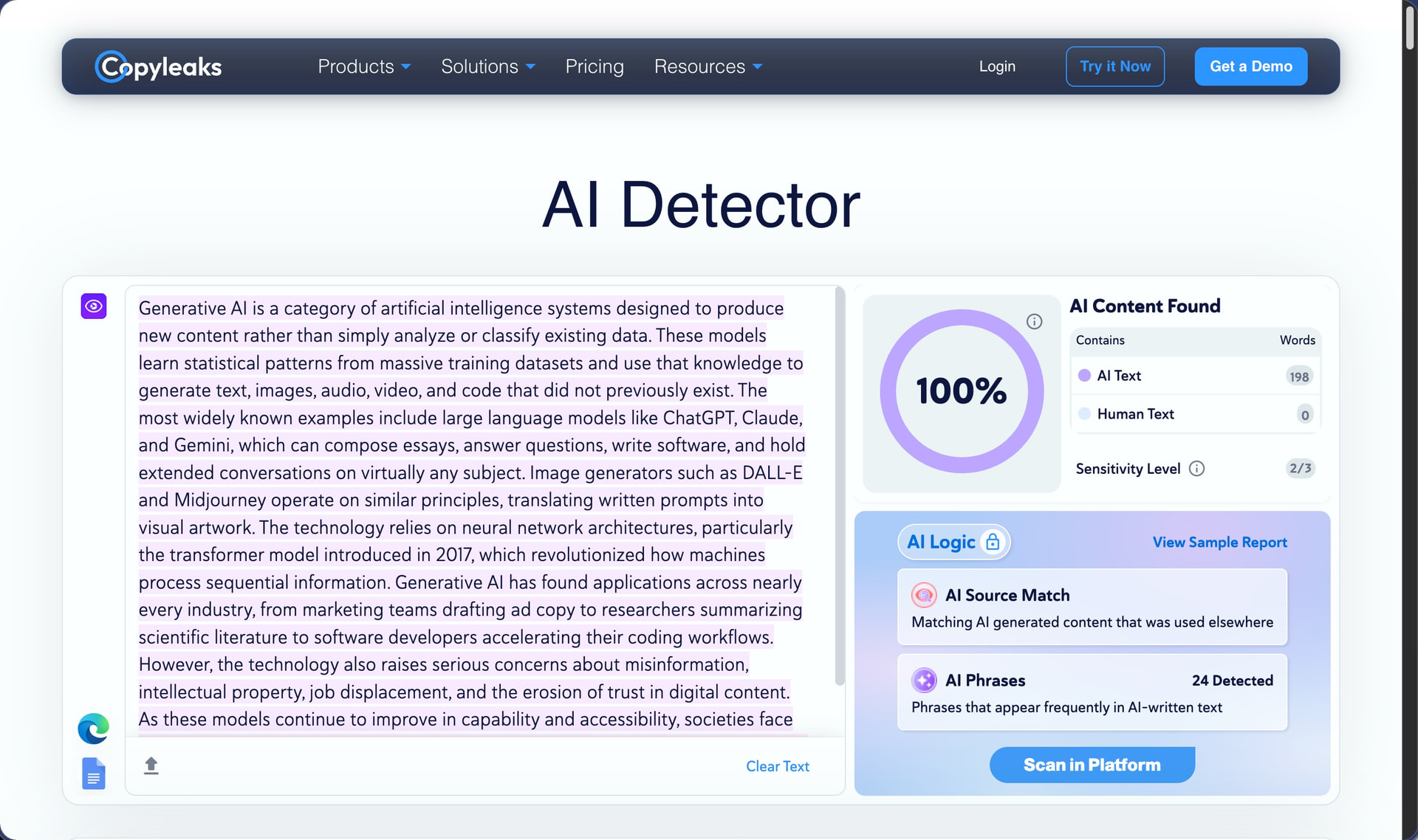
The free scanner uses a simple binary classification. Each scan returns either “AI Content Found” or “No AI Content Found,” along with a word count that splits the text into AI and human portions. There’s no percentage score on the free tier, just the label and the word breakdown. The results page also shows a sensitivity level (mine defaulted to 2/3) and a prompt to upgrade for access to AI Logic, which is Copyleaks’ paid feature that explains why specific text was flagged.
Does Copyleaks Produce False Positives?
| Content | Source | Year | Copyleaks Score |
|---|---|---|---|
| Dog | Wikipedia | Ongoing (est. 2003) | 0% AI |
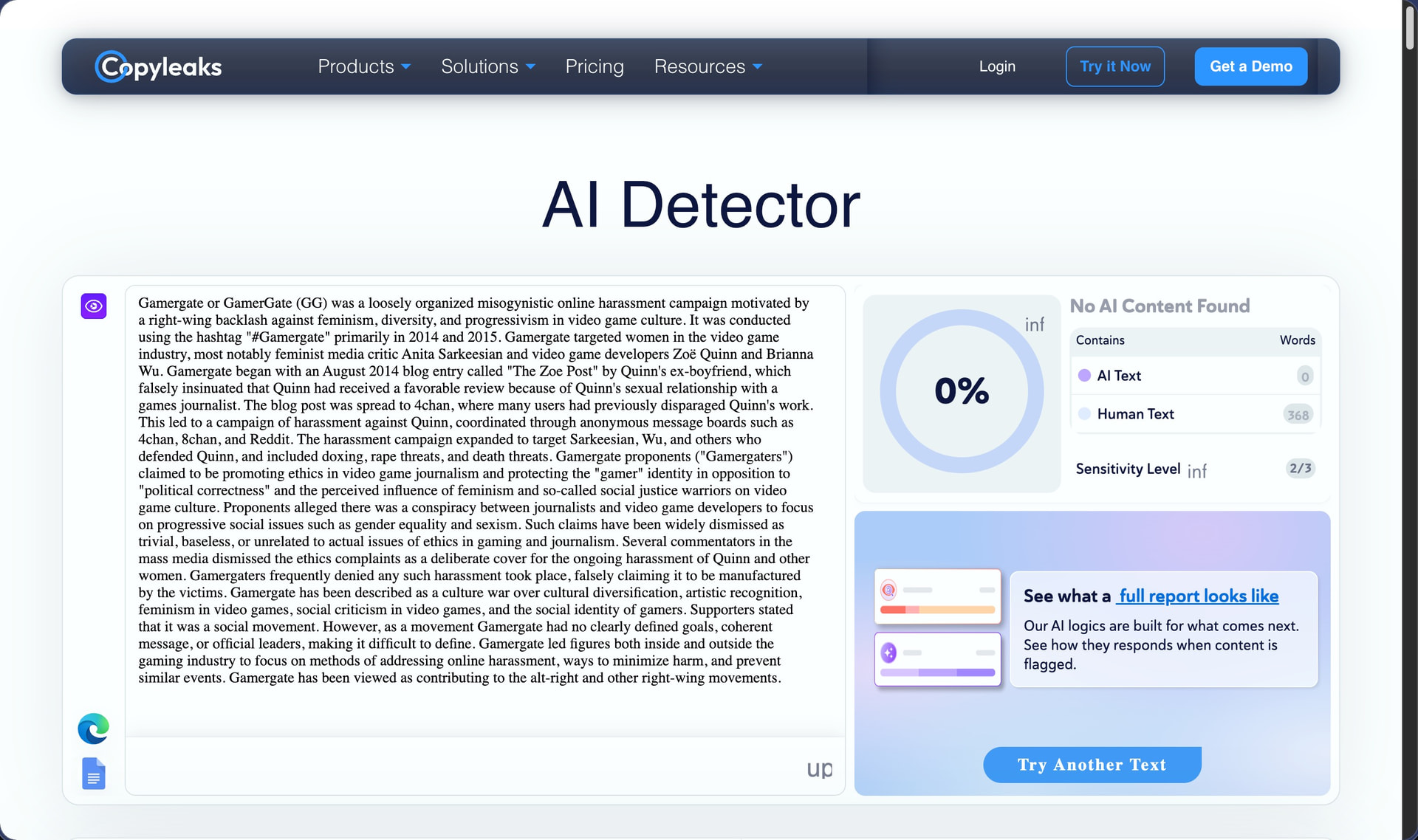
| Gamergate (controversy) | Wikipedia | Ongoing (est. 2014) | 0% AI |
| Alice’s Adventures in Wonderland | Project Gutenberg | 1865 | 0% AI |
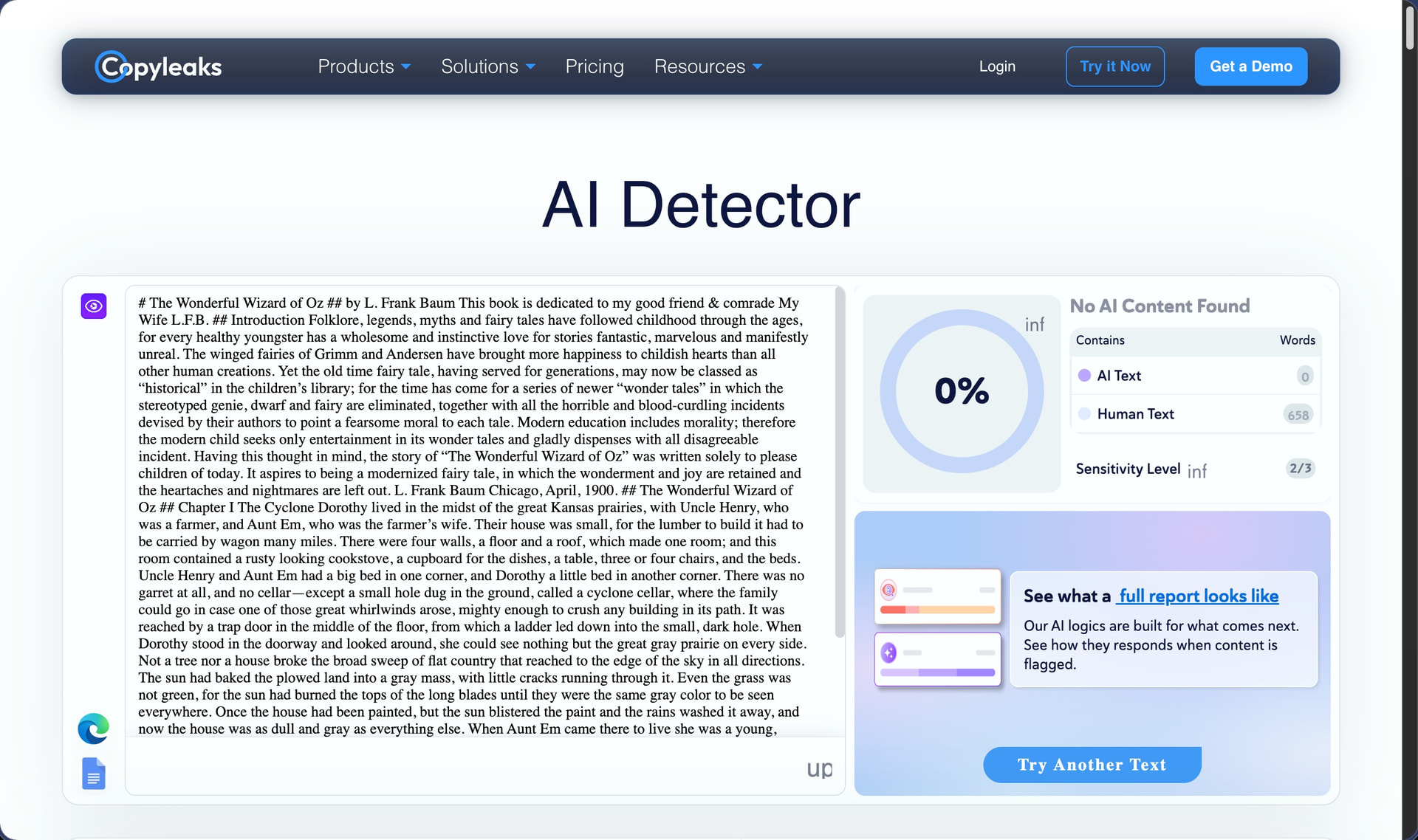
| The Wonderful Wizard of Oz | Project Gutenberg | 1900 | 0% AI |
| Microsoft faces new complaint | BBC News | 2003 | 100% AI |
| Elite forces storm Moscow theatre | The Guardian | 2002 | 0% AI |
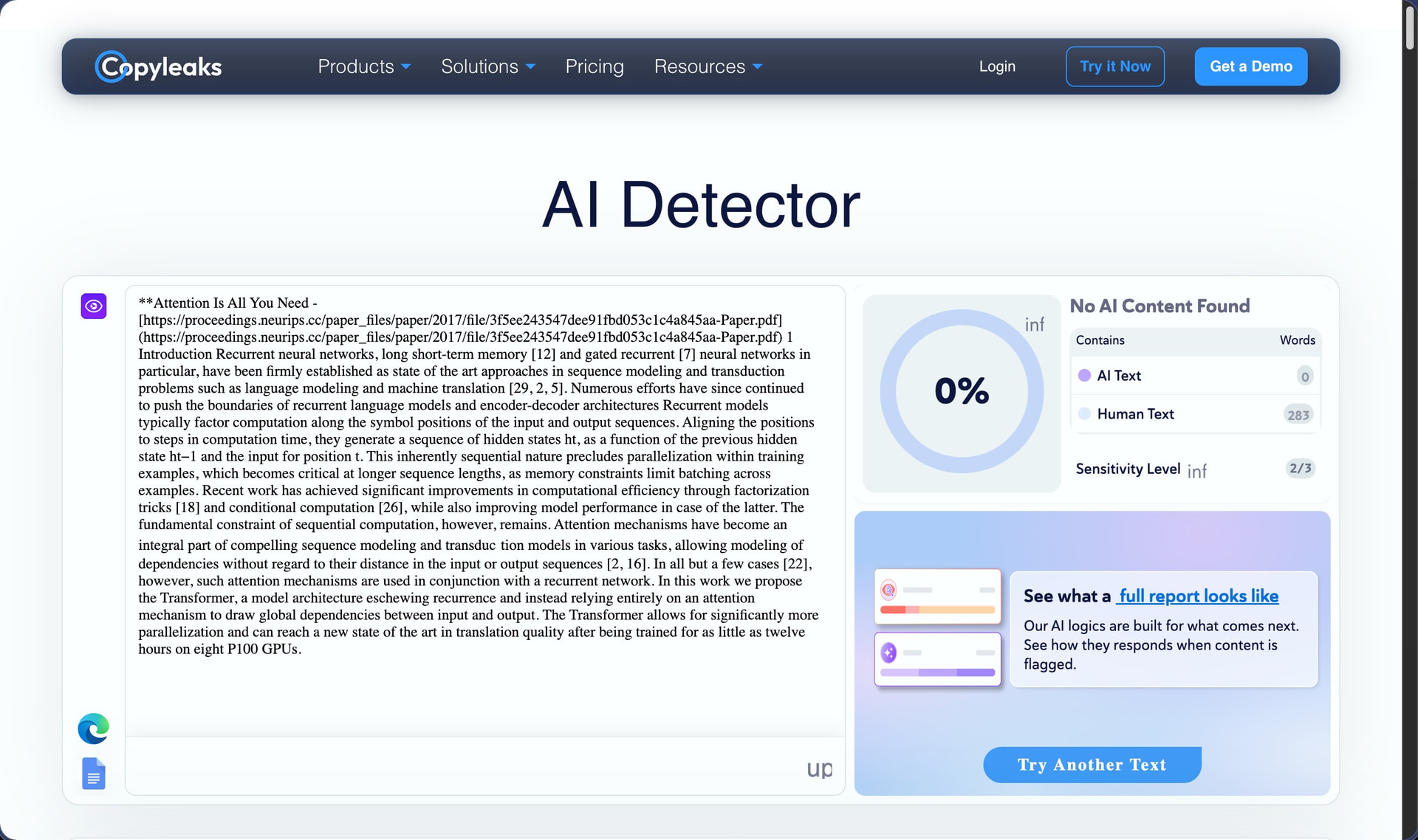
| Attention Is All You Need | NeurIPS | 2017 | 0% AI |
| Bayesian Model Selection in Social Research | Academic journal | 1995 | 0% AI |
| A digital generation where every girl counts | UNDP Blog | 2019 | 0% AI |
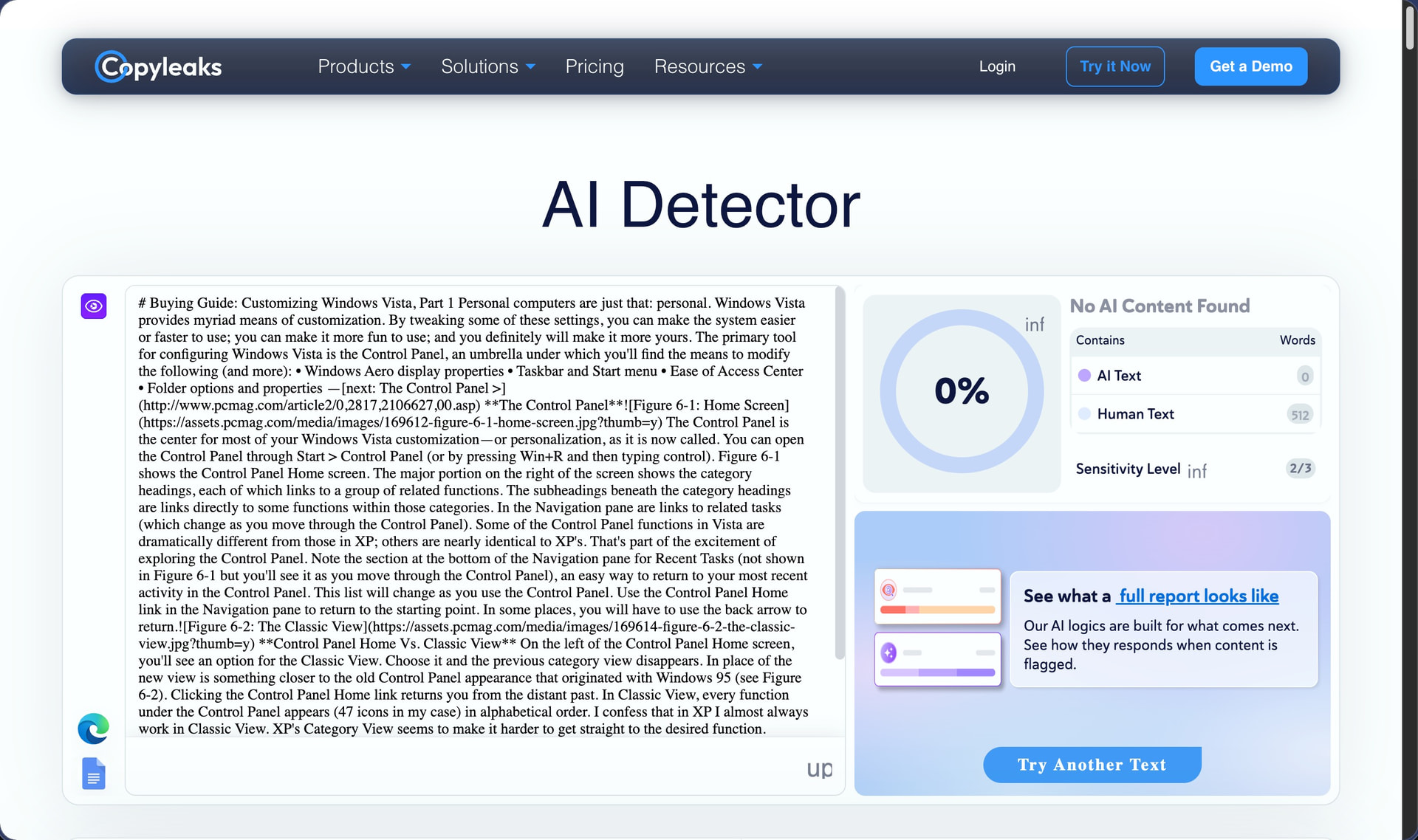
| Customizing Windows Vista, Part 1 | PC Magazine | 2007 | 0% AI |
Nine out of ten samples scored 0% AI, but one blog article was falsely flagged as 100% AI generated. It was a BBC News article about a Microsoft antitrust complaint, published in 2003 (more than 19 years before ChatGPT existed). There is no possible way it contains AI-generated text.
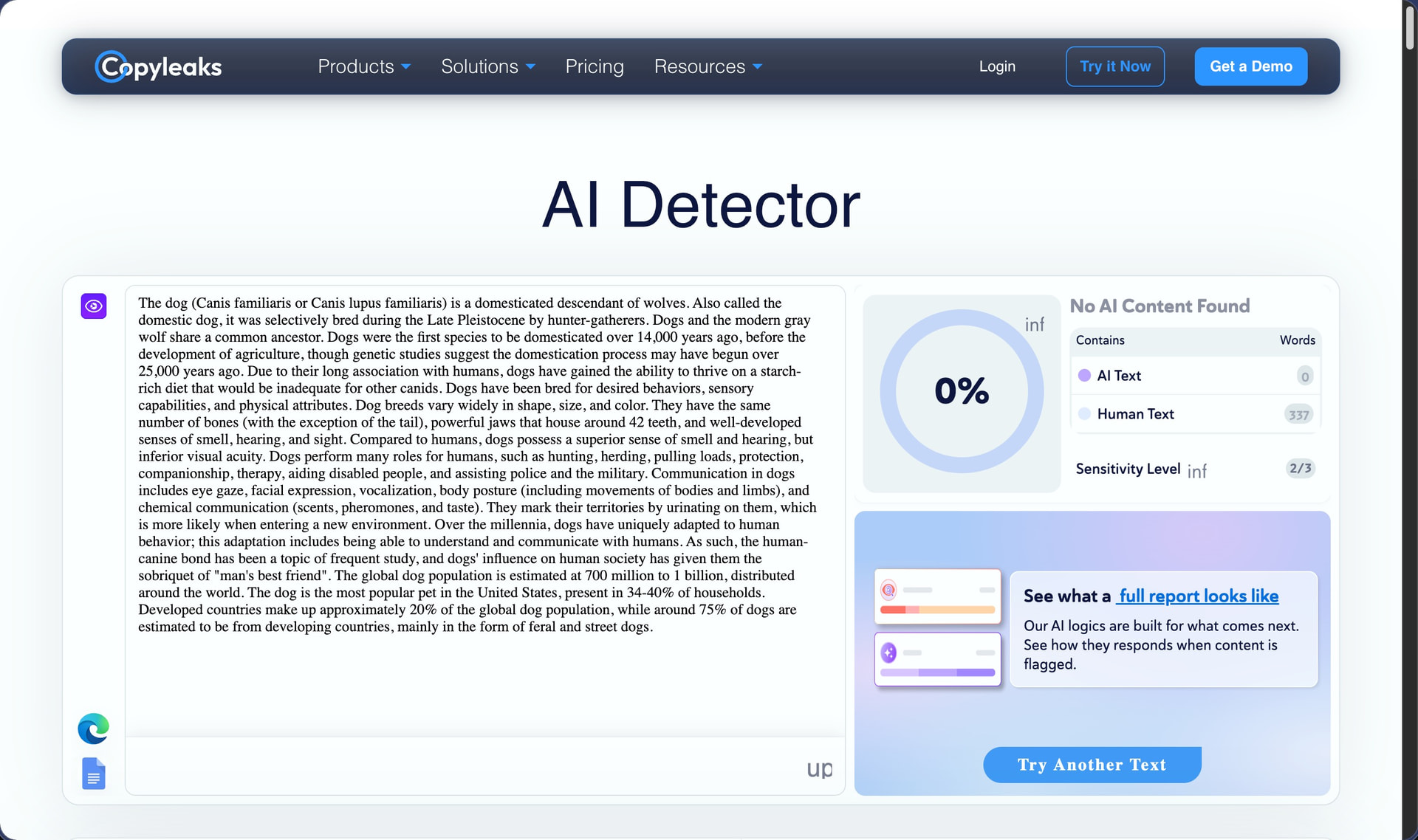
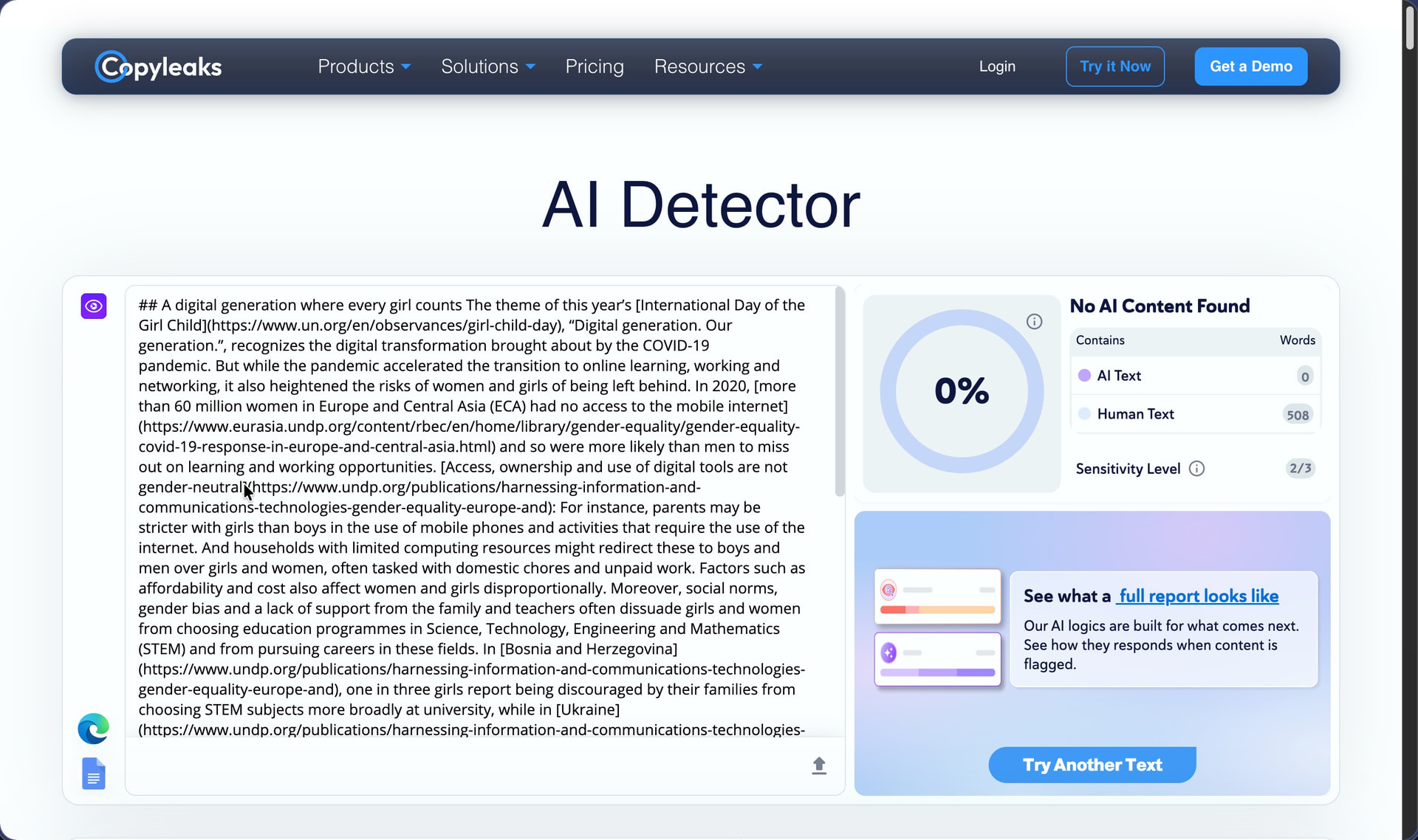
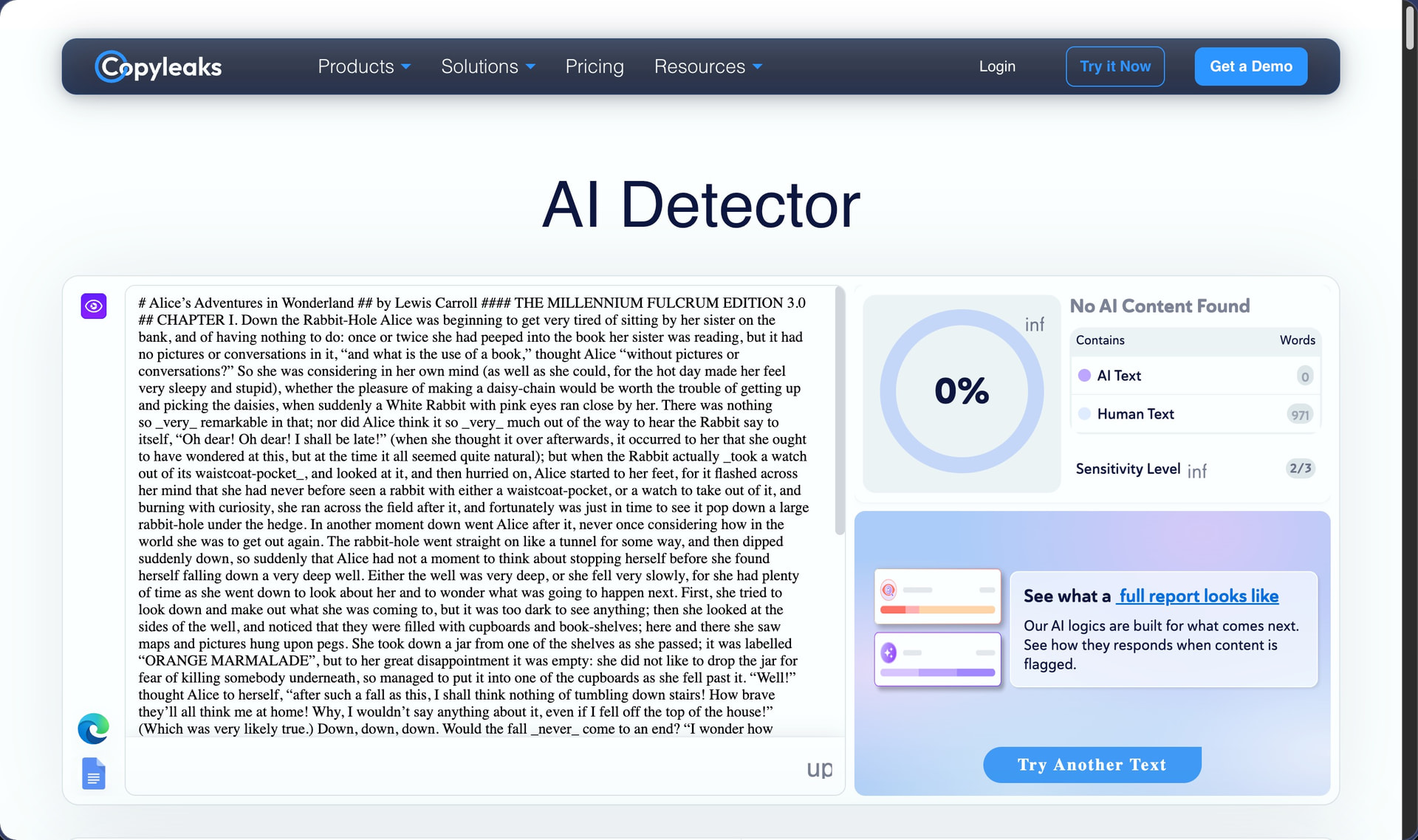
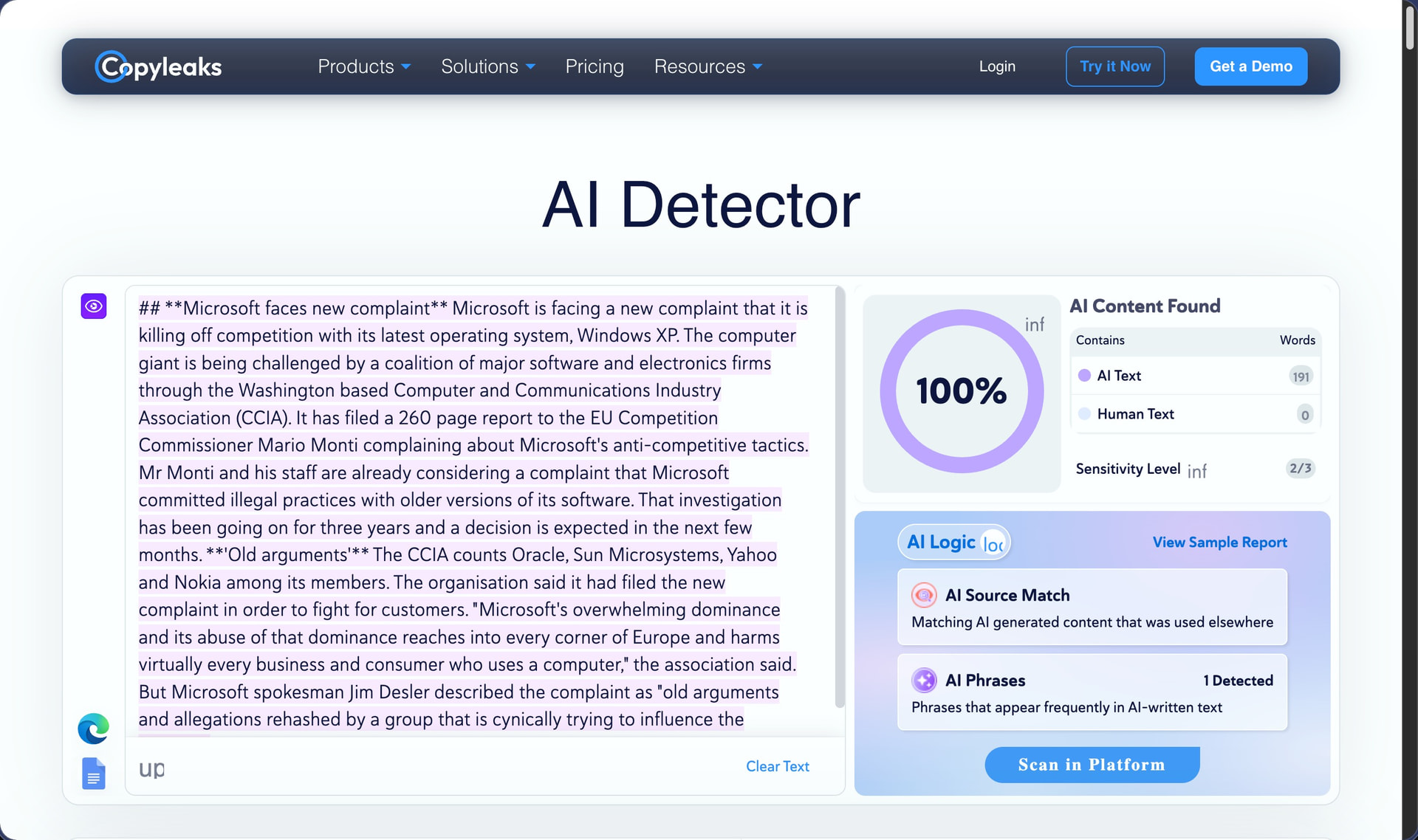
What makes this worse is the binary classification system, which is as confident and as wrong as a detector can be. If a professor were using Copyleaks to check student work and this kind of false positive showed up, there would be no ambiguity in the result to prompt a second look. The student would just be accused.
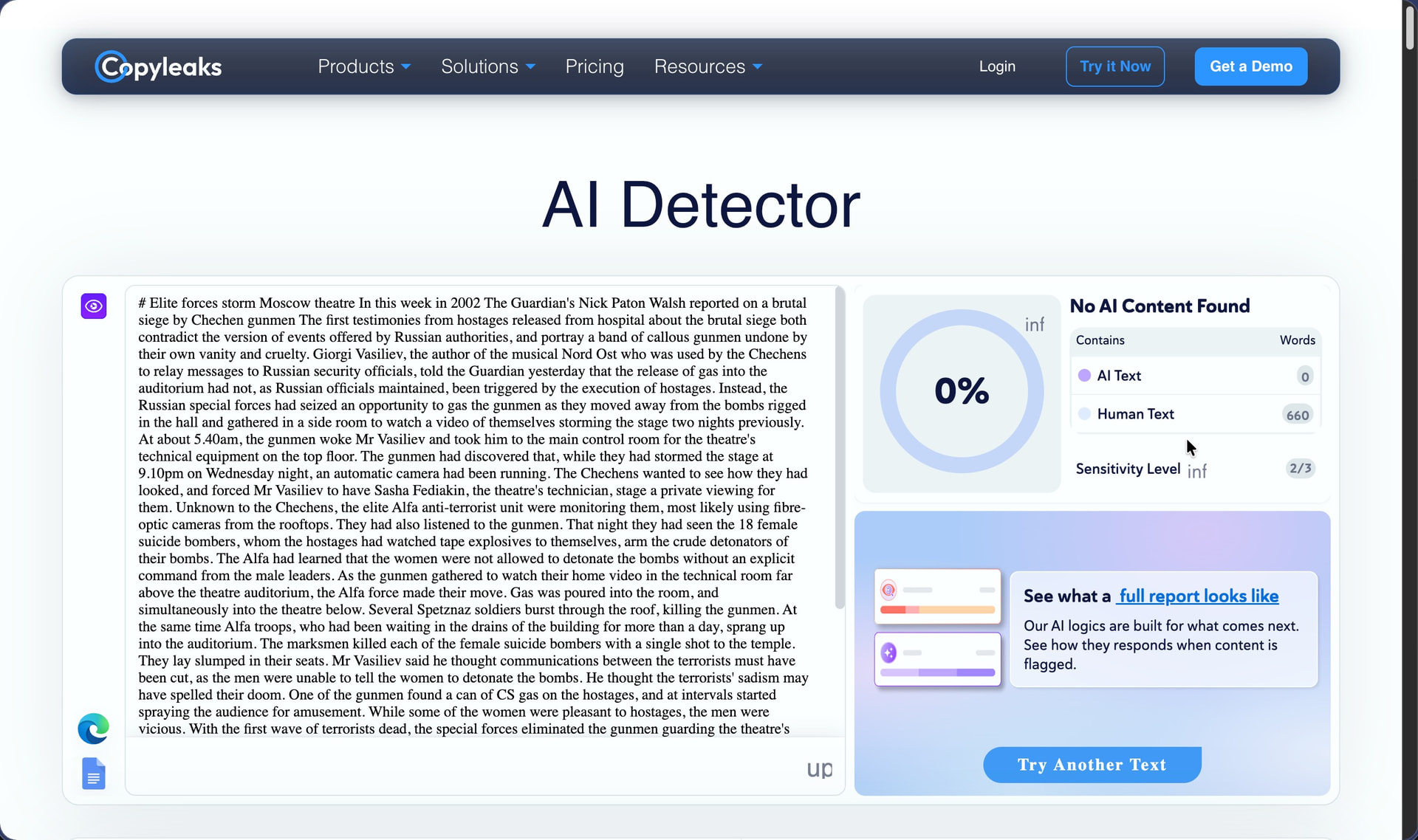
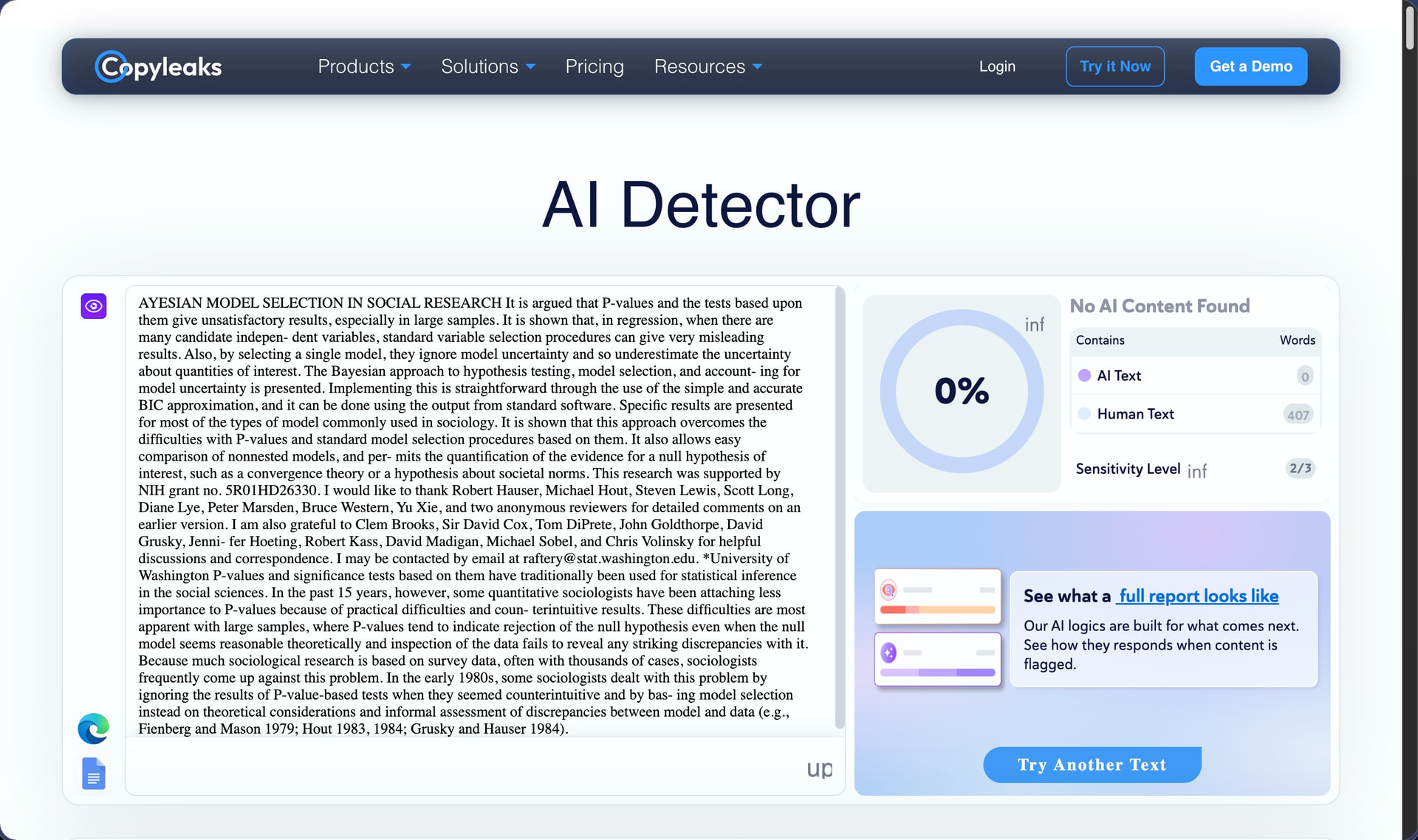
I understand that the purpose of the binary system is to give a quick, clear answer, and that users who want more detail can upgrade for AI Logic, which shows why specific text was flagged and where it may have appeared elsewhere. But a yes/no verdict can quickly turn an uncertain detection into an overly confident one. That’s why I consider this monetization approach to be unfortunate at best.
How Much Does Copyleaks Cost?
As a new user, you get a small number of credits to try the platform, but once those run out, you need a paid plan.
| Plan | Monthly Price | Annual Price | Credits |
|---|---|---|---|
| Personal | $16.99/mo | $13.99/mo ($167.88/year) | 100/month or 1,200 upfront (annual) |
| Pro | $99.99/mo | $74.99/mo ($899.88/year) | 1,000/month or 12,000 upfront (annual) |
| Enterprise | Custom | Custom | Custom |
| Education | Custom | Custom | Custom (per institution) |
Each credit covers one page of up to 250 words. So the Personal plan at $13.99/month (annual) gets you about 300,000 words over the year, and the Pro plan at $74.99/month (annual) gets you roughly 3 million. Unused credits on monthly plans don’t roll over to the next month.
The Personal plan includes AI and plagiarism detection in a single report, AI detection in 30+ languages, a Google Docs add-on, and a Chrome extension. The Pro plan adds full website scanning, cross-language translation detection, advanced detection filters, and an analytics dashboard. It’s aimed at small teams of 3 to 25 users.
Enterprise and Education plans are both custom-priced through sales. The Education tier is built for schools and universities, with LMS integrations for Canvas, Moodle, Blackboard, and others, plus institution-level analytics and grading tools. Enterprise adds API access, on-premises hosting options, and role-based permissions.
Compared to other AI detectors I’ve tested, Copyleaks is at the higher end. GPTZero’s Premium plan costs $12.99/month (annual) for 300,000 words, which is roughly the same volume as Copyleaks Personal but at the same price point. Winston AI’s Essential plan starts at $10/month (annual) for 80,000 words, so it’s cheaper but more limited. Last but not least, Originality AI charges $12.95/month for its Pro plan with 200,000 words of credits.
Does Copyleaks Respect User Privacy?
Copyleaks’ privacy policy and terms of service are both dated September 9, 2025. The company is registered as Copyleaks Inc. in New York.
Based on my analysis of the privacy policy, Copyleaks collects the following data when you use the service:
-
Account information: name, country, email address, and billing address.
-
Payment data: processed through Stripe (Copyleaks says it does not have access to credit card numbers).
-
Scanned content: all text and documents you upload or paste into the detector.
-
Technical data: IP address, browser type, device type, and last login session.
-
Cookie and tracking data: Google Analytics, Google Tag Manager, DoubleClick, Meta Pixel, and Microsoft Clarity.
-
Session replay data: Microsoft Clarity collects behavioral metrics, heatmaps, and session replays to track how you use the site.
The biggest concern is what happens to the text you scan. The privacy policy states clearly that Copyleaks uses scanned content “to train our models” after filtering out direct identifiers. To make things worse, the terms of service includes a broad content license in Section 6.1: you grant Copyleaks “a non-exclusive, royalty-free, worldwide, perpetual, irrevocable, non-compensatory license to use the User Content submitted, uploaded, or stored by you in order to provide and improve the quality of our Services.”
Interestingly, there is an opt-out, but you have to email support@copyleaks.com to request it (no toggle in your account settings). By comparison, Originality AI offers an opt-out toggle directly in your account settings. Winston AI states that scanned content is not used for model training at all.
One thing Copyleaks does better than some competitors is the “Hide Sensitive Data” feature, which filters out identifiers from scanned content before processing. I didn’t see anything similar offered by the other detectors in this series. That said, the feature is off by default, so you’d have to enable it yourself.