Undetectable AI is a free AI detector from a company whose main product is an AI humanizer, a tool that rewrites AI-generated text so it passes detection. A comparison table on the landing page puts Undetectable AI at 100% detection with 0% false positives, while listing Originality AI at 87.9% and GPTZero at 77.2%. A peer-reviewed study cited on the site reports that the tool caught all AI-generated and paraphrased content with perfect accuracy and zero false positives. If those numbers were accurate, this would be the best AI detector available. So, I ran it through the same tests I use for every detector in this series, and I’m excited to share my findings with you in this detailed review.
How I tested Undetectable AI: I scanned every sample from my standard test set through Undetectable AI’s detector one at a time. The AI group was nine freshly generated samples, three each from ChatGPT (5.2), Claude (Opus 4.6), and Gemini (3 Pro), on the topics of artificial intelligence, climate change, and technology trends. The human group was ten pieces pulled from sources where AI involvement is not possible: Wikipedia articles with documented edit histories stretching back years, classic novels from the 19th and early 20th centuries, BBC and Guardian news stories published in the early 2000s, pre-transformer academic papers, and blog posts that went live well before ChatGPT launched in November 2022. For each sample, I recorded the percentage score and the classification label that the scan returned.
| Pros | Cons |
|---|---|
| Caught every AI-generated sample | Poor false positive performance |
| No model-specific blind spots | Inconsistent sentence-level highlighting |
| Completely free with no account or credit limits | FAQ and terms of service contradict each other on data usage |
| Chrome extension available | Privacy policy is three years out of date |
| Supports 50+ languages | Cancellation restricted to email only for most users |
How accurate is Undetectable AI at detecting AI content?
| AI Model | Topic | Undetectable AI Score |
|---|---|---|
| ChatGPT (5.2) | AI Humanization | 99% AI |
| ChatGPT (5.2) | Climate Change | 99% AI |
| ChatGPT (5.2) | Technology Trends | 99% AI |
| Claude (Opus 4.6) | AI Humanization | 99% AI |
| Claude (Opus 4.6) | Climate Change | 99% AI |
| Claude (Opus 4.6) | Technology Trends | 99% AI |
| Gemini (3 Pro) | AI Humanization | 99% AI |
| Gemini (3 Pro) | Climate Change | 99% AI |
| Gemini (3 Pro) | Technology Trends | 99% AI |
All nine AI-generated samples I tested produced the same 99% AI scores (no variation by model or topic). For comparison, Originality AI returned 100% on everything, and Winston AI scored between 0% and 1% human.
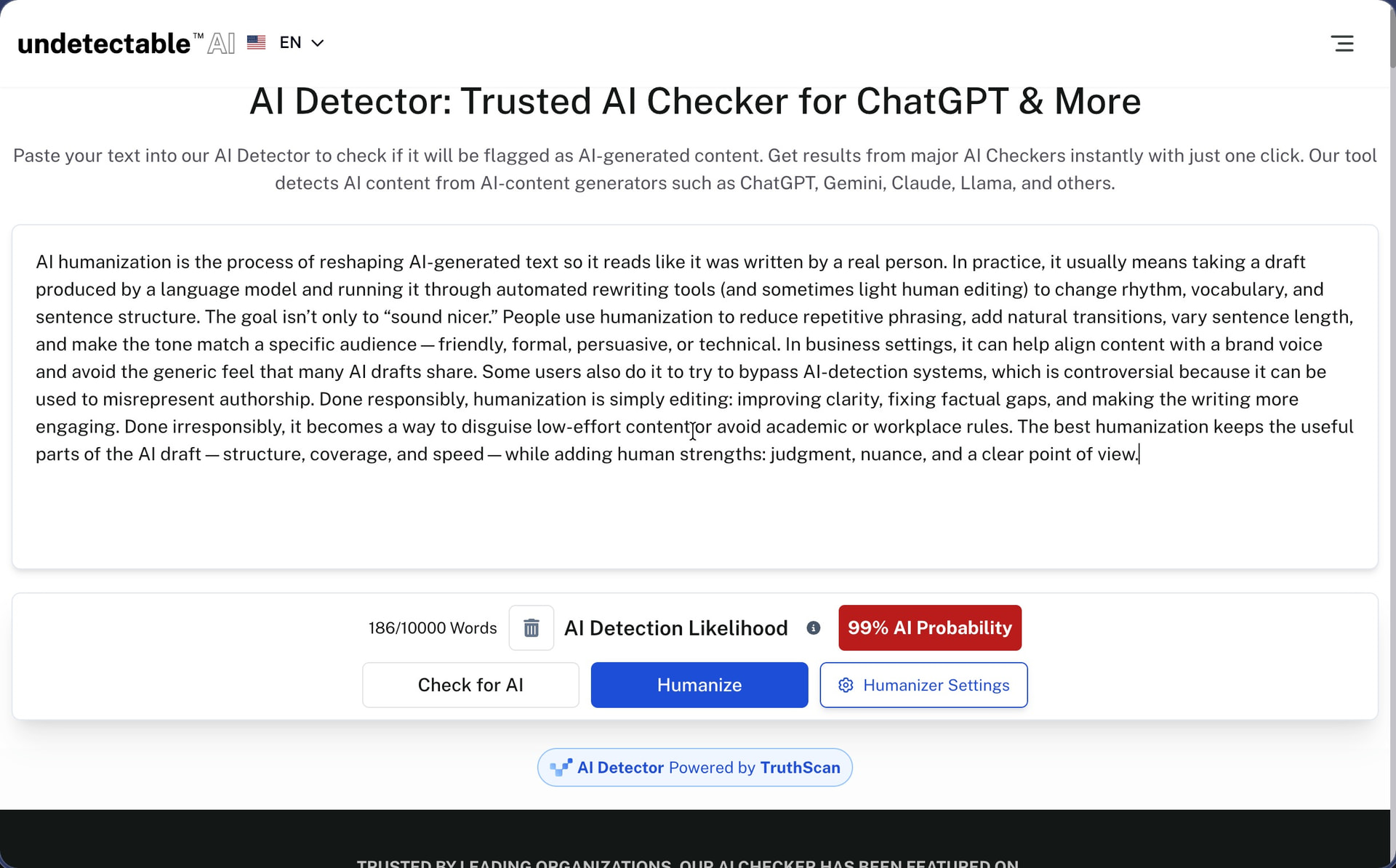

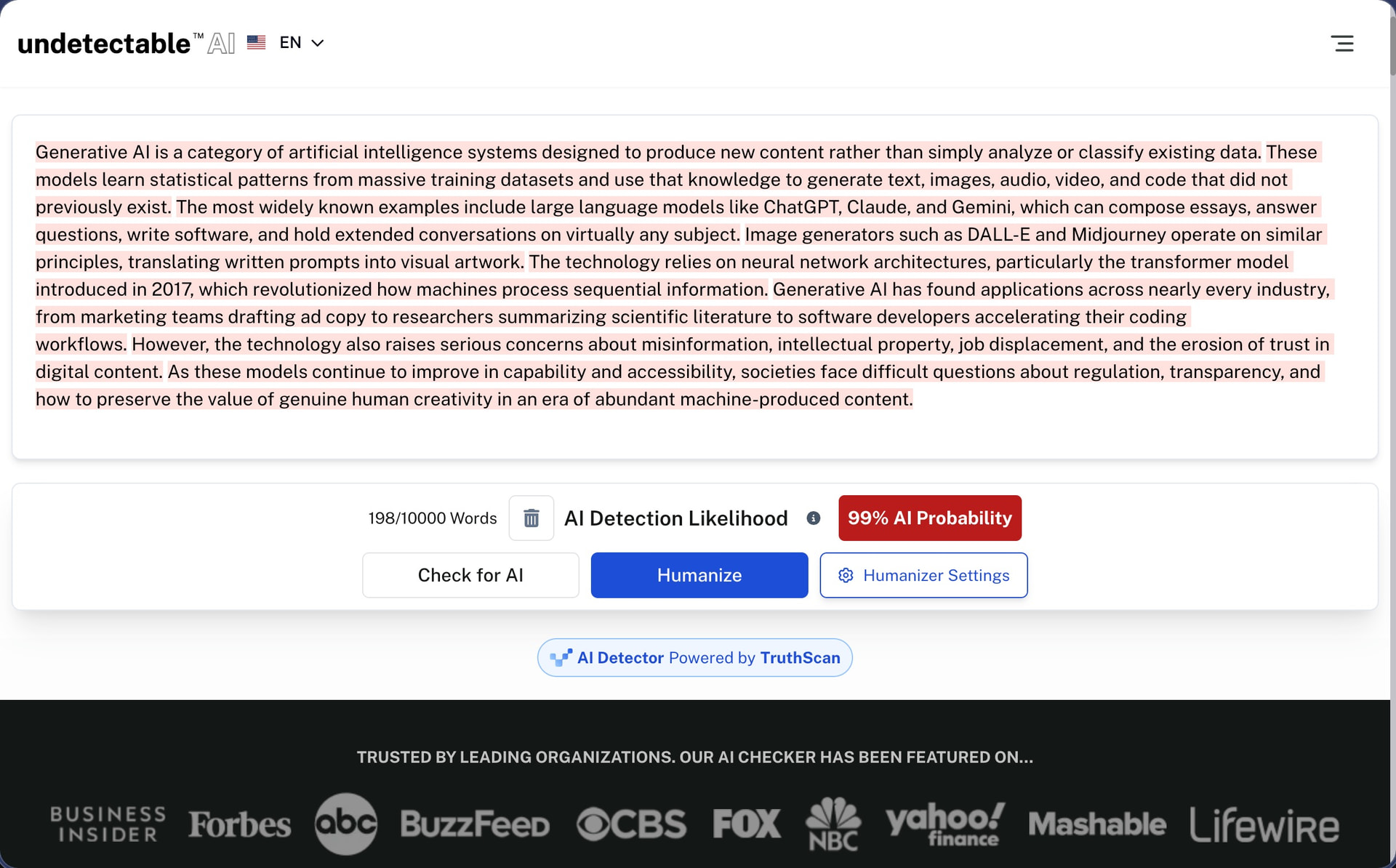
That 1% gap between Undetectable AI’s scores and a perfect 100% is probably not worth worrying about. A 99% AI classification is a clear verdict, and no reasonable person would look at that number and think the content might be human. What matters more is consistency, and there’s nothing to complain about in that regard.
One weakness in how Undetectable AI presents results is the inconsistency of its sentence-level detail. Some scans include colored highlighting over portions of the text, but this doesn’t appear on every scan, and there’s no explanation of what the colors mean or why certain sentences are marked. Originality AI and Winston AI both reliably color-code individual sentences on every scan so you can see exactly where the AI signal is coming from.
Does Undetectable AI produce false positives?
| Content | Source | Year | Undetectable AI Score |
|---|---|---|---|
| Dog | Wikipedia | Ongoing (est. 2003) | 73% AI Paraphrased |
| Gamergate (controversy) | Wikipedia | Ongoing (est. 2014) | 65% Likely Human |
| Alice’s Adventures in Wonderland | Project Gutenberg | 1865 | 95% Likely Human |
| The Wonderful Wizard of Oz | Project Gutenberg | 1900 | 80% Likely Human |
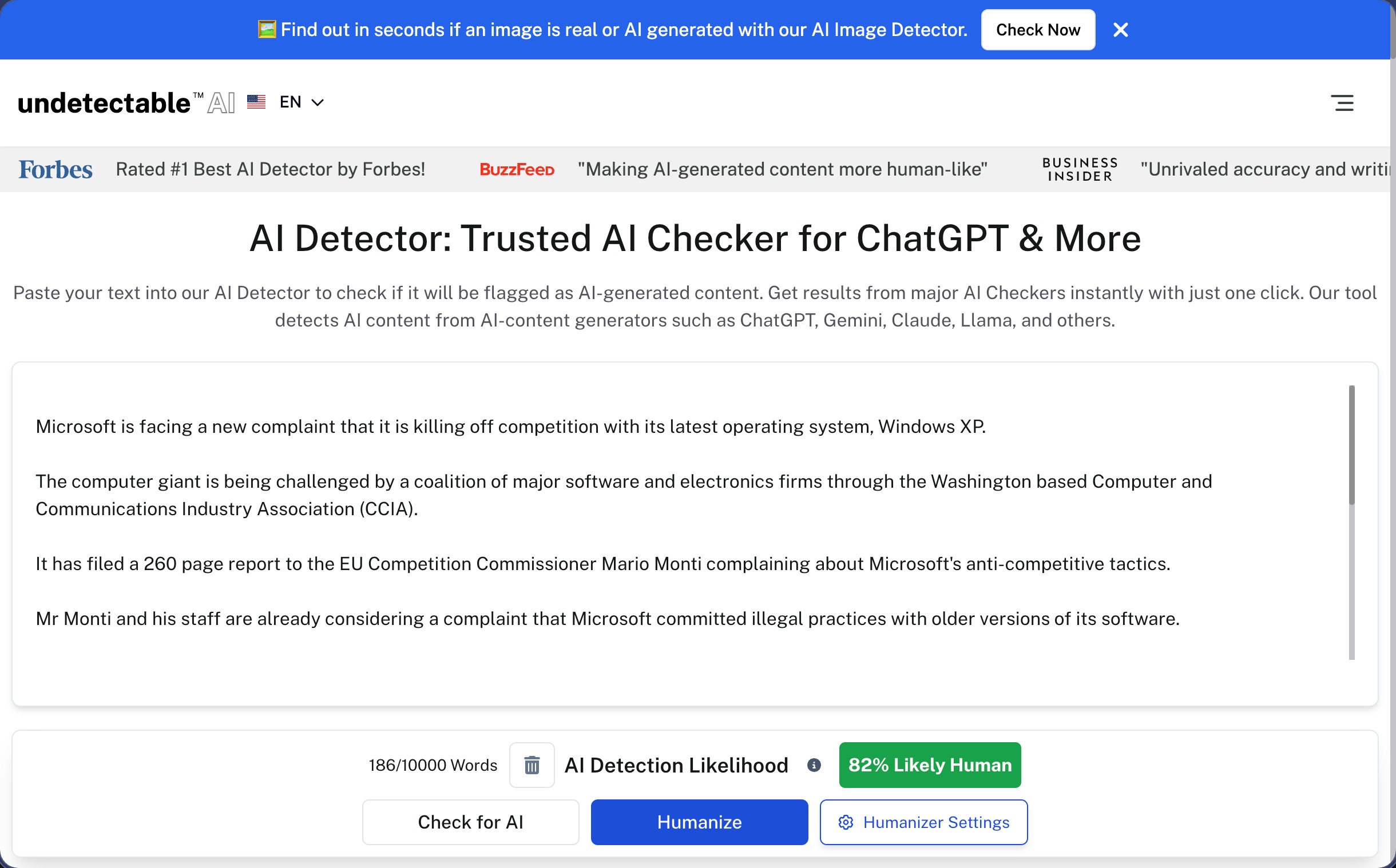
| Microsoft faces new complaint | BBC News | 2003 | 68% Likely Human |
| Elite forces storm Moscow theatre | The Guardian | 2002 | 99% Likely Human |
| Attention Is All You Need | NeurIPS | 2017 | 71% Likely Human |
| Bayesian Model Selection in Social Research | Academic journal | 1995 | 95% Likely Human |
| A digital generation where every girl counts | UNDP Blog | 2019 | 89% Likely Human |
| Customizing Windows Vista, Part 1 | PC Magazine | 2007 | 81% Likely Human |
Remember that “0% false positives” claim from the landing page I mentioned in the introduction to this review? Well, out of ten human-written samples, only one scored above 95%.
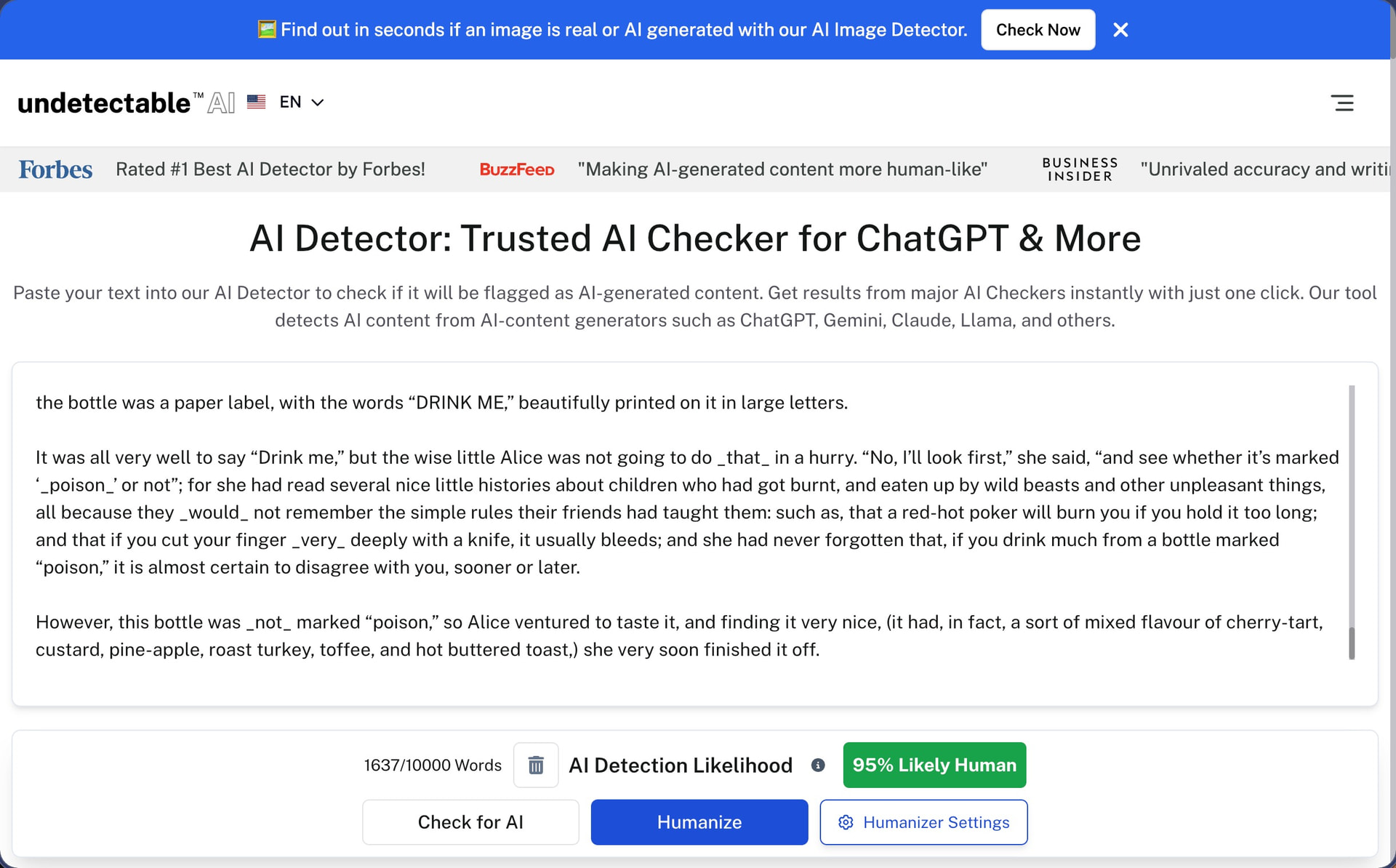
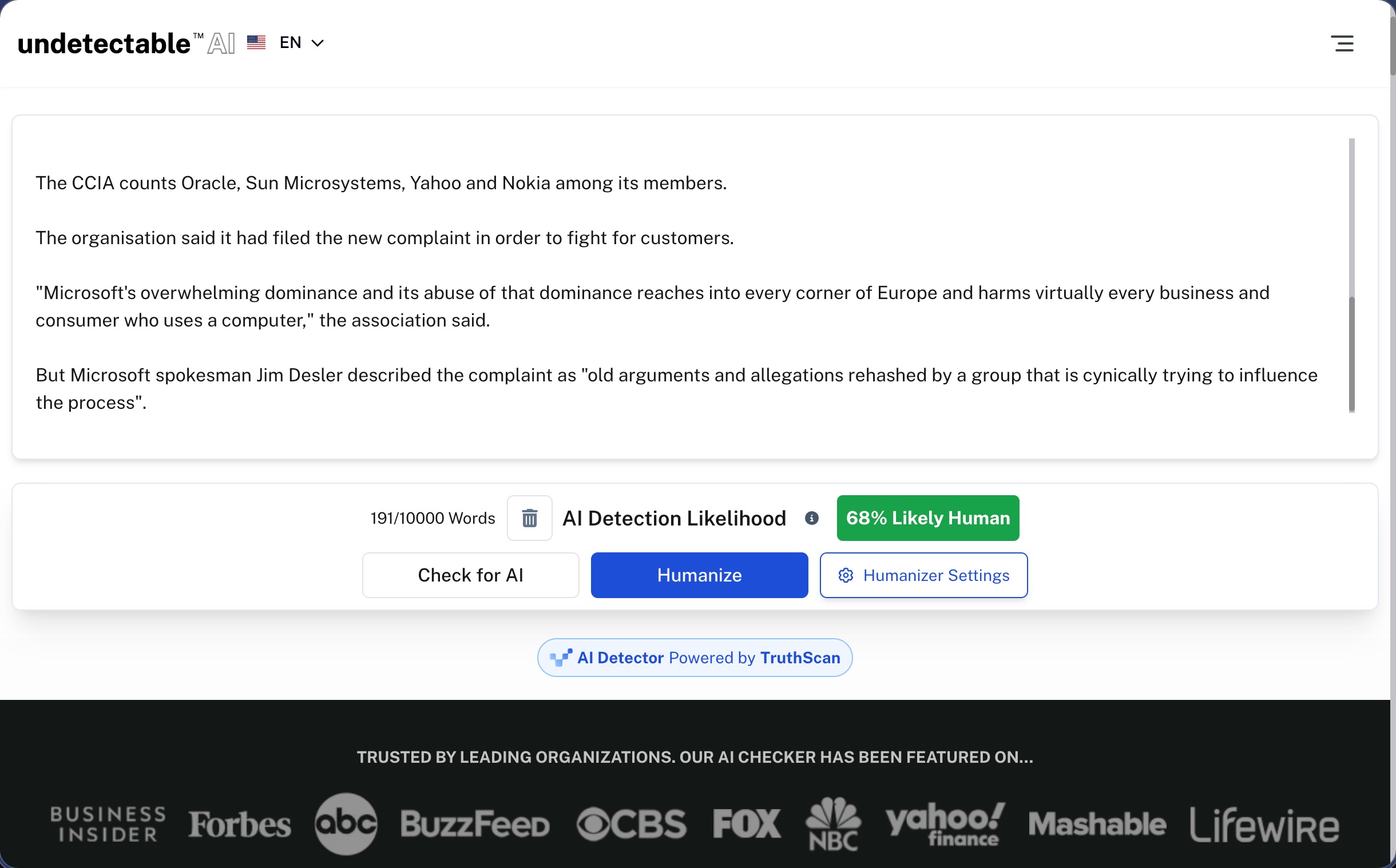
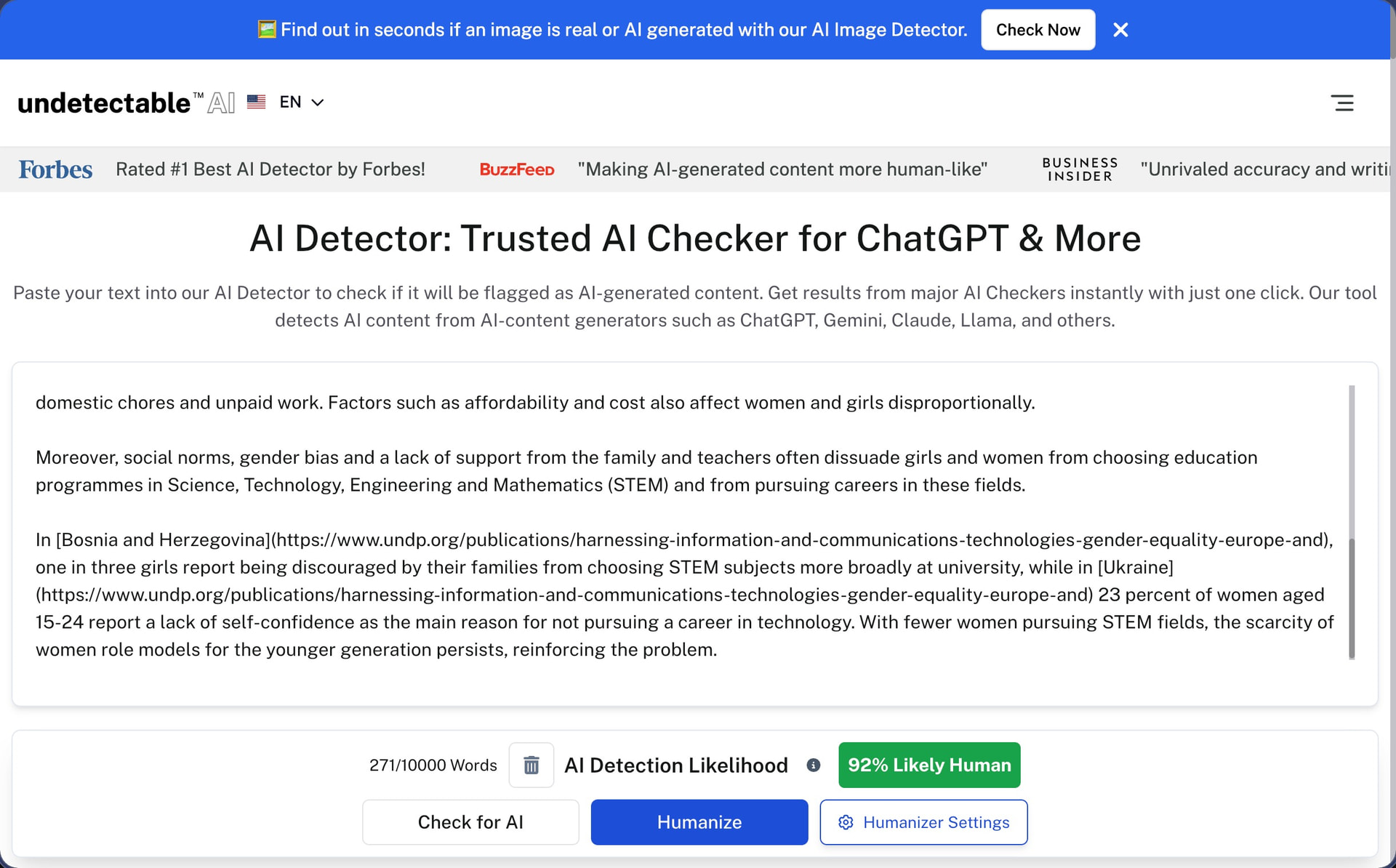
The Wikipedia article about dogs was outright labeled “AI Paraphrased” at 73%. The Guardian’s 2002 Moscow theatre story scored 99% Likely Human, but the BBC’s 2003 Microsoft story, published just one year later and written in a similar journalistic style, only managed 68%. Lewis Carroll’s Alice’s Adventures in Wonderland from 1865 scored 95%, while L. Frank Baum’s The Wonderful Wizard of Oz from 1900 scored 80%. The 1995 Bayesian statistics paper scored 95% Likely Human, but “Attention Is All You Need,” published in 2017, scored only 71%. There’s no clear logic to these differences.
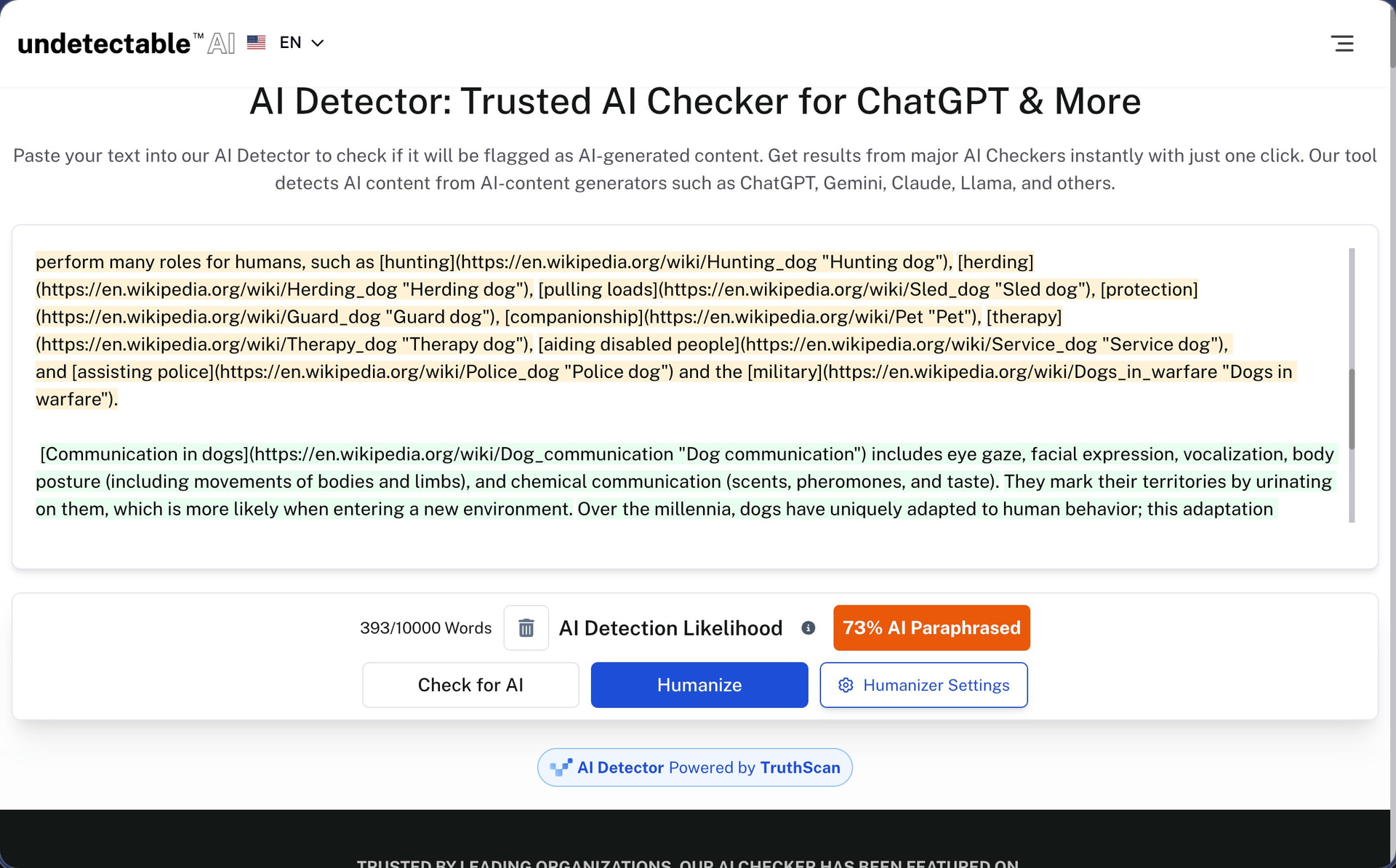
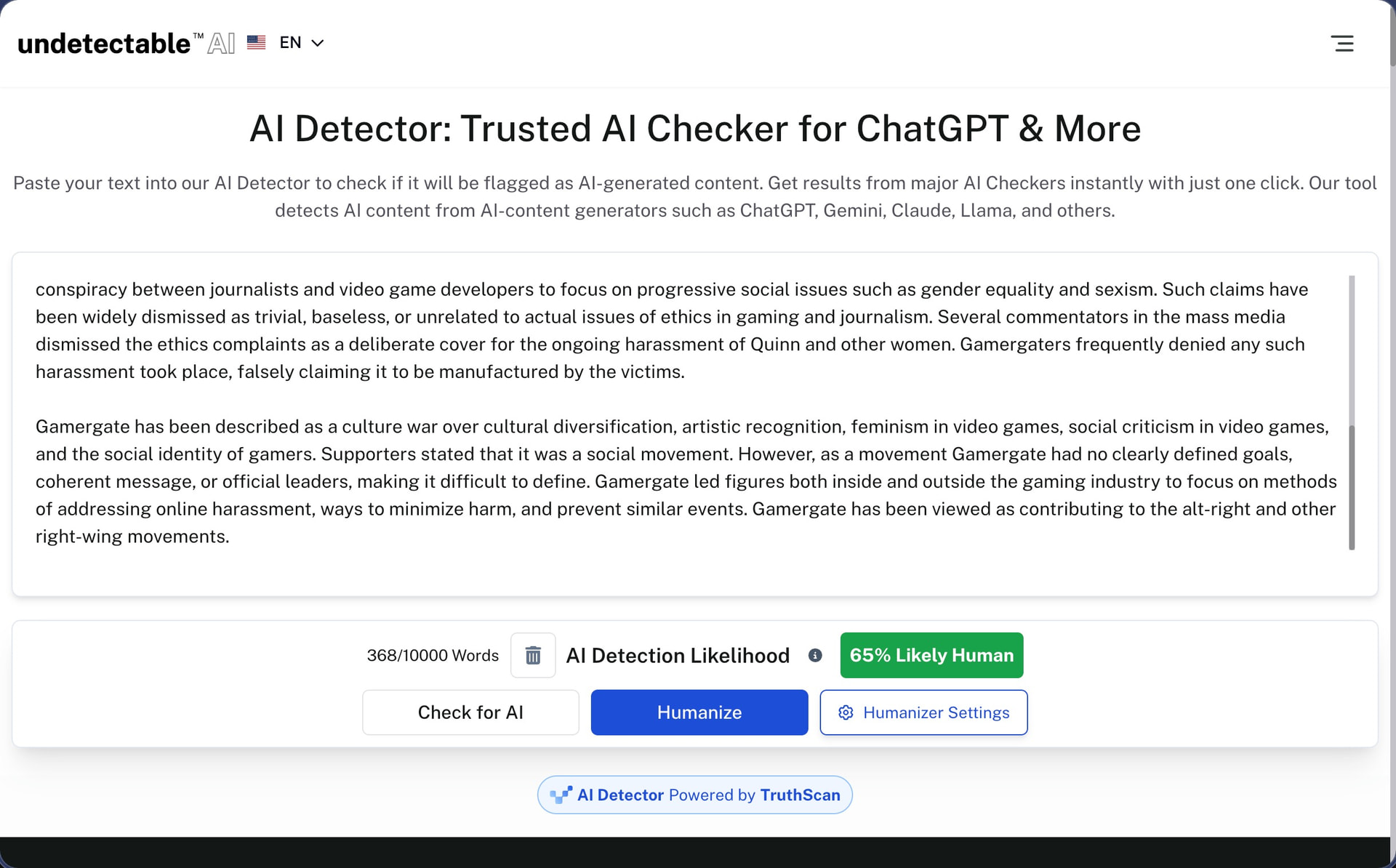
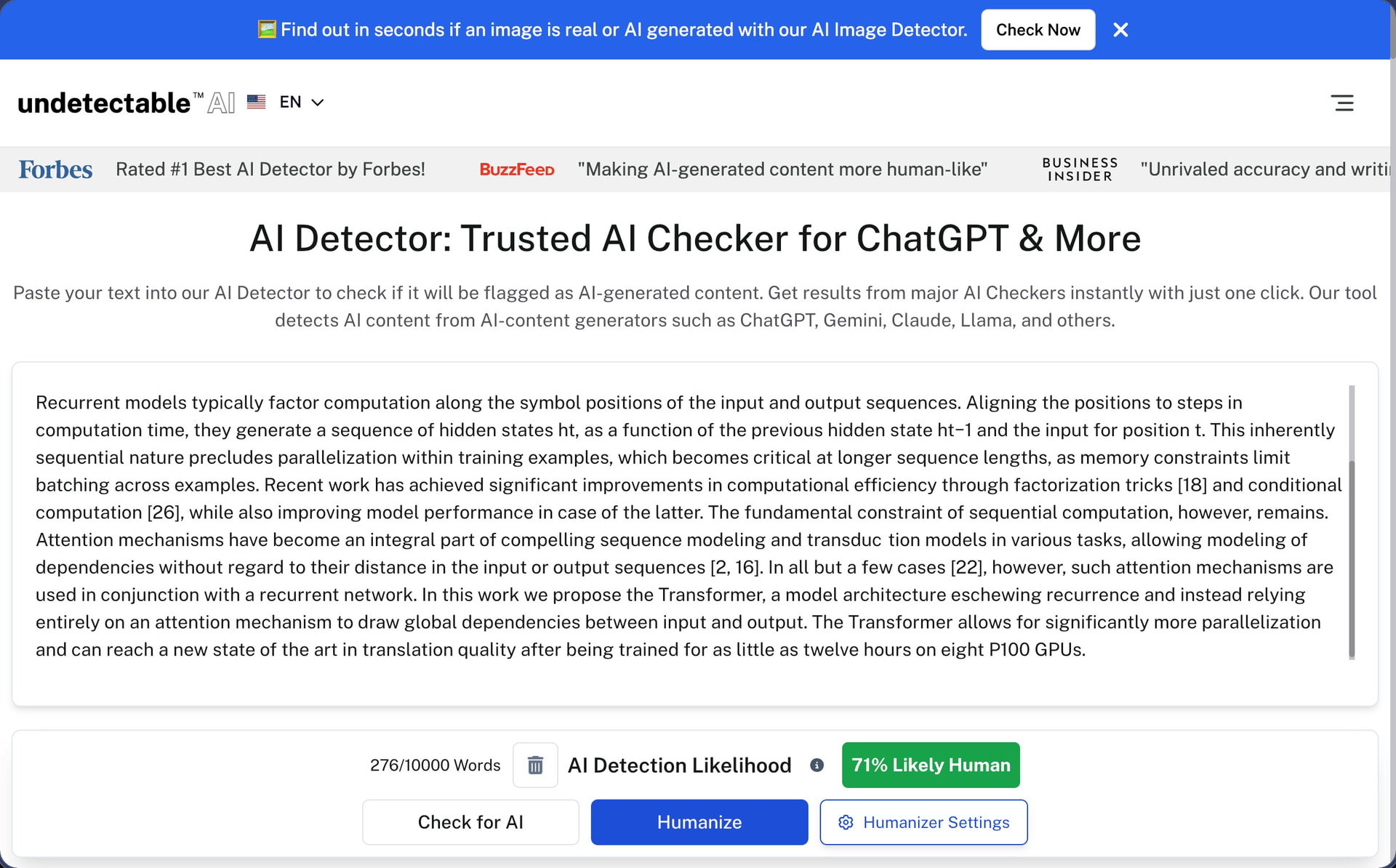
Except for the Wikipedia articles, none of my samples could contain AI writing because they all predate the public release of large language models. That’s bad news for anyone whose work gets scanned by this tool. A student who writes a well-structured essay could see a score in the low 70s and have no way to prove their innocence, especially since there’s no sentence-level breakdown to point to specific problems.
How much does Undetectable AI cost?
The Undetectable AI detector is free, and there are no account, credit, or word limits. You paste text, click “Check for AI,” and get a result. The paid plans on Undetectable AI’s pricing page are for the humanizer side of the business, not the detector. Here’s what they look like at annual pricing:
| Plan | Monthly price | Annual price | Humanization words/month |
|---|---|---|---|
| Free | $0 | $0 | None (detection only) |
| 10K words | $9.99/mo | $5.00/mo | 10,000 |
| 20K words | $19.00/mo | $9.50/mo | 20,000 |
| 35K words | $31.00/mo | $15.75/mo | 35,000 |
| 50K+ words | Custom | Custom | 50,000+ |
| Business | Custom | Custom | Custom (non-expiring credits) |
Every paid tier includes unlimited AI detection alongside the humanization allowance. So whether you’re on the free plan or paying $15.75 a month, the detection tool works the same way.
The pricing structure makes more sense once you understand that Undetectable AI is a humanizer company that happens to offer a free detector, not a detection company that charges for access. The detector exists to funnel users toward the paid humanization product. You scan your text, see it flagged as AI, and the big blue “Humanize” button is right there next to the results. It’s a smart sales strategy, and it explains why the detector costs nothing.
Does Undetectable AI respect user privacy?
The FAQ page states that “Your text is never stored or used to train models.” But section 9 (Contribution License) of the terms of service grants Undetectable AI “an unrestricted, unlimited, irrevocable, perpetual, non-exclusive, transferable, royalty-free, fully-paid, worldwide right, and license to host, use, copy, reproduce, disclose, sell, resell, publish, broadcast, retitle, archive, store, cache, publicly perform, publicly display, reformat, translate, transmit, excerpt (in whole or in part), and distribute” your contributions.
There’s an argument that “Contributions” in the legal sense refers to things like forum posts and comments rather than text pasted into the detector, and the terms do define Contributions separately from Submissions. But the license language is broad enough to cover both, and there’s no specific carve-out saying detection scans are excluded. If Undetectable AI truly never stores or trains on scanned text, the terms of service should say so explicitly.
The privacy policy was last updated in March 2023, so it’s three years old at the time of writing this review. The company (Undetectable Inc., based in Idaho) collects the following data according to the documentation:
-
Account information: name, email address, phone number, date of birth, gender, occupation, and education level.
-
Financial data: income level and payment information including credit card details and PayPal account information.
-
Technical data: IP address, device type, browser type, location data, and referring URLs.
-
Usage data: pages visited, time spent on each page, and user behavior tracking through cookies and similar technologies.
-
Social media data: account information if you log in through a social media provider.
That’s a longer list of personal information than what Originality AI, Winston AI, or Grammarly collect in their privacy policies. Fields like income level, education level, and occupation are unusual for an AI detection tool. The terms require binding arbitration in Ada County, Idaho for most disputes, and class action lawsuits are explicitly waived. There’s no mention of GDPR compliance beyond a generic statement that data may be transferred internationally.
If you subscribe to the humanizer and later want to cancel (and don’t live in California or New York), then you can only do so by email. The terms state that cancellations through “contact forms, social media messages, phone calls, chargebacks, or verbal communications” are not valid, which is extremely annoying and anti-consumer.