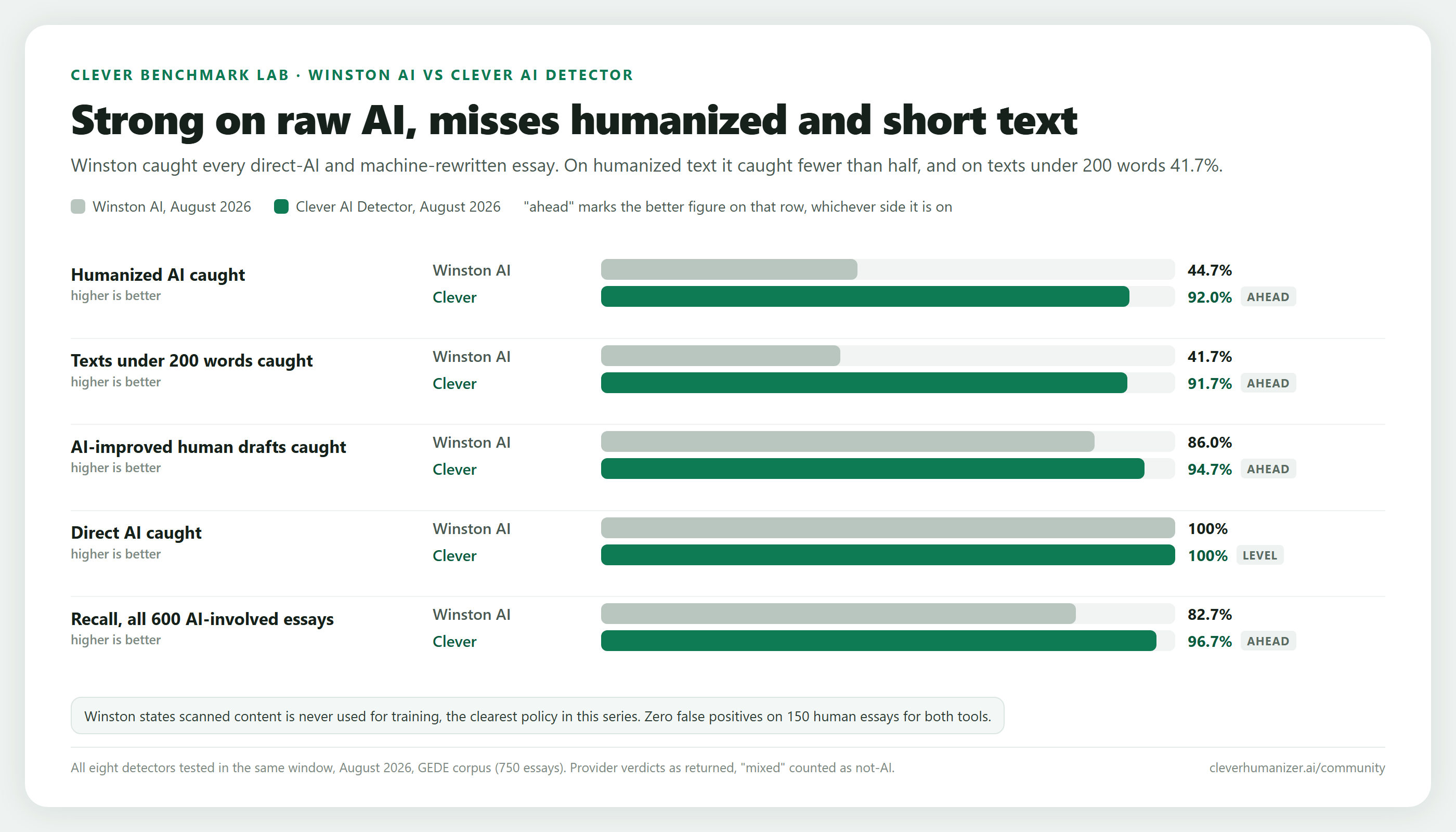
Winston AI claims to update its detection model weekly and detect bypassing strategies like paraphrasing tools and AI humanizers to catch content from ChatGPT, Claude, Gemini, and every other major language model with a 99.98% accuracy rate. But accuracy stats on a landing page mean little without independent testing, so I put Winston AI through the same set of tests I use for every detector review. The results were strong overall but not without some surprises.
How I tested Winston AI: I ran content samples through Winston AI in two groups: confirmed AI-generated text and confirmed human-written text. The AI group included nine samples generated fresh using ChatGPT (5.2), Claude (Opus 4.6), and Gemini (3 Pro), three per model, covering the topics of artificial intelligence, climate change, and technology trends. The human group included ten samples from sources that could not contain AI writing: Wikipedia articles with long edit histories, classic novels from Project Gutenberg, BBC and Guardian news stories from the early 2000s, academic papers published before the transformer era, and blog posts written years before ChatGPT launched in November 2022. I scanned each sample individually using Winston AI’s detection tool (model v4.14) and recorded the human score percentage it returned.
| Pros | Cons |
|---|---|
| Near-perfect AI detection across all three models tested | Not without false-positive results |
| No weakness against any specific model | Free tier is really just a 14-day trial |
| Color-coded prediction map with sentence-level detail | No one-time purchase option |
| Built-in text editor for quick edits and rescans | |
| Content is not used for model training | |
| Honest disclaimer about detection limitations in terms of service | |
| AI image and deepfake detection included on all plans |
How Accurate Is Winston AI at Detecting AI Content?
| AI Model | Topic | Winston AI Score |
|---|---|---|
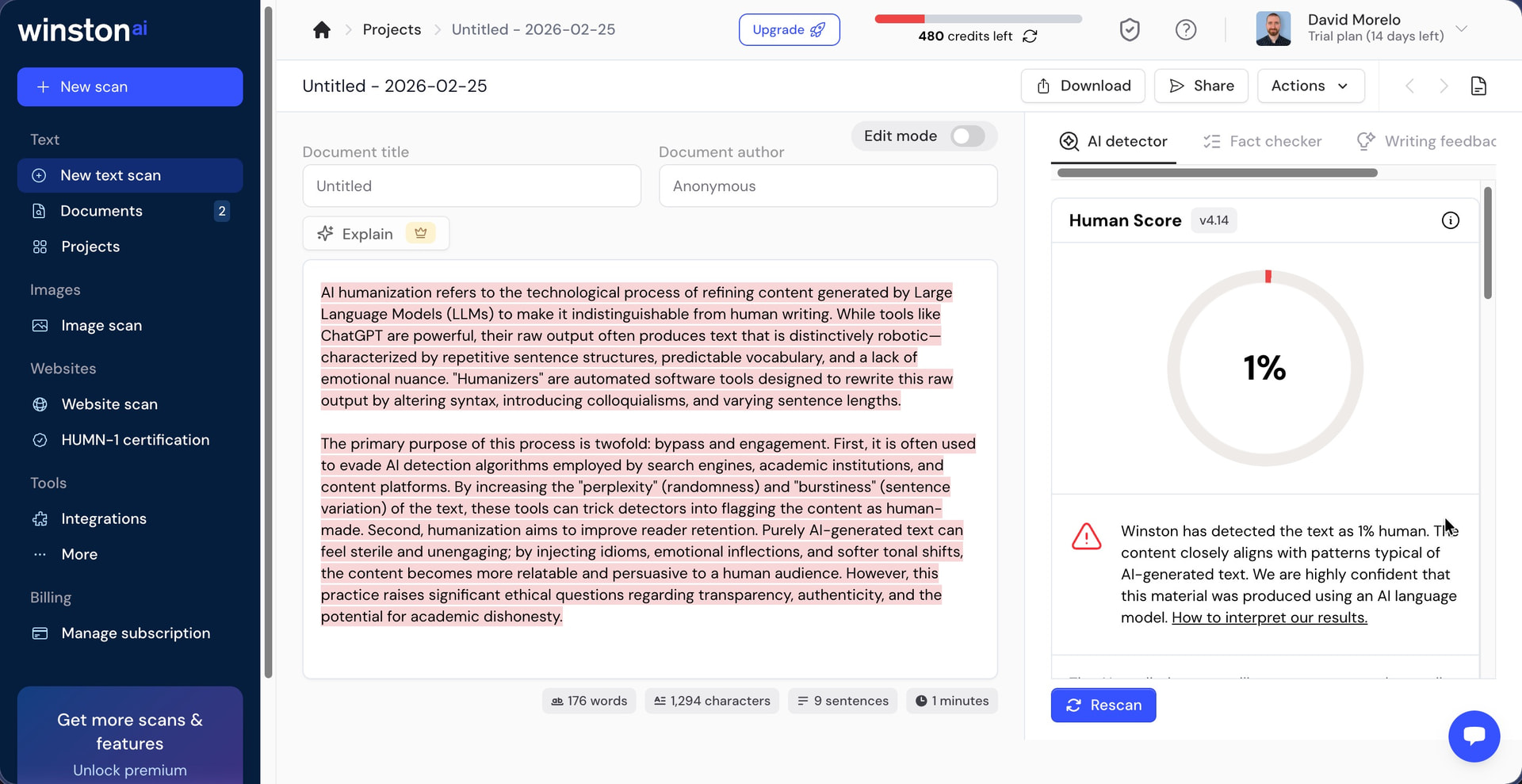
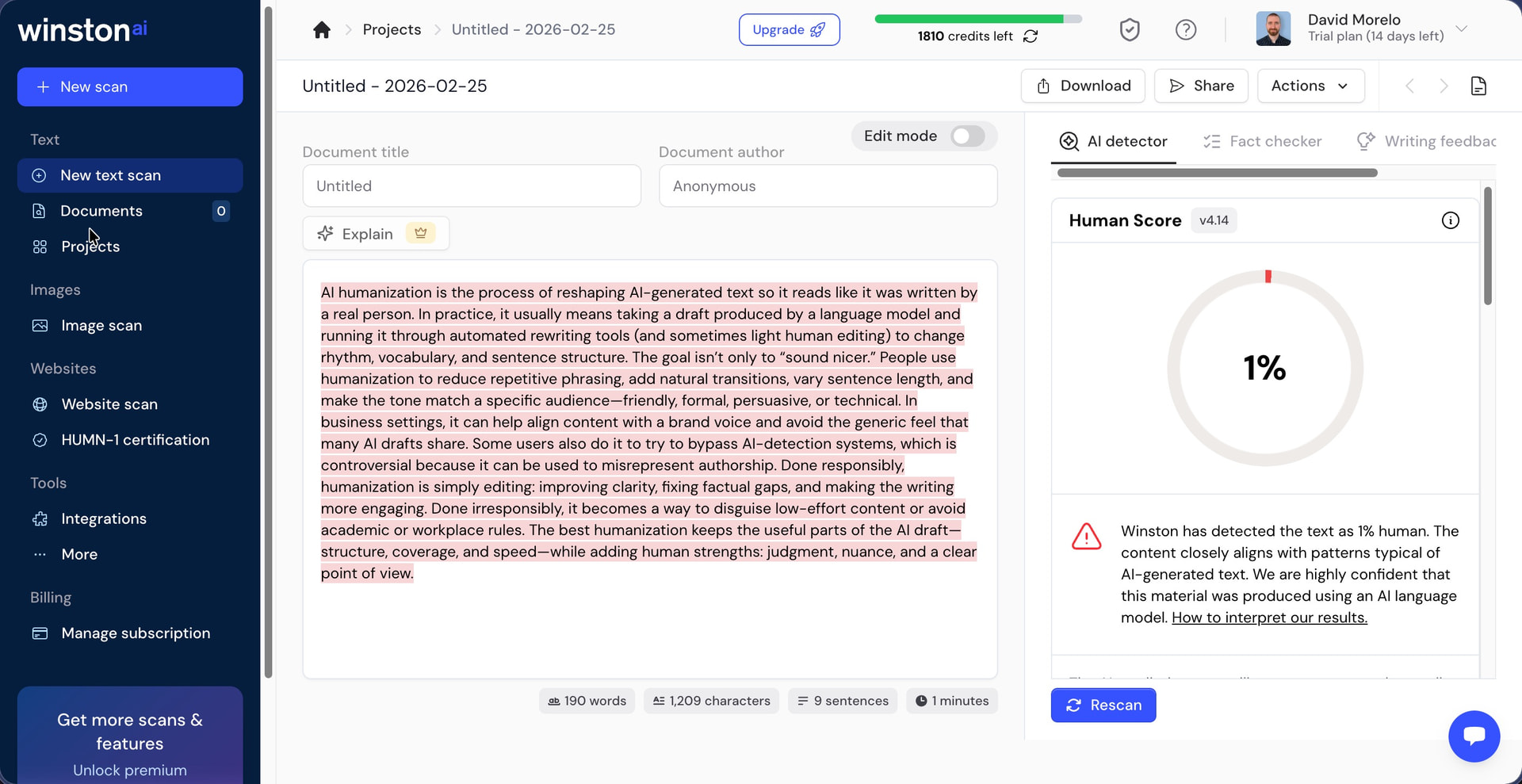
| ChatGPT (5.2) | AI Humanization | 1% Human |
| ChatGPT (5.2) | Climate Change | 1% Human |
| ChatGPT (5.2) | Technology Trends | 1% Human |
| Claude (Opus 4.6) | AI Humanization | 1% Human |
| Claude (Opus 4.6) | Climate Change | 1% Human |
| Claude (Opus 4.6) | Technology Trends | 0% Human |
| Gemini (3 Pro) | AI Humanization | 1% Human |
| Gemini (3 Pro) | Climate Change | 1% Human |
| Gemini (3 Pro) | Technology Trends | 0% Human |
Winston uses a “Human Score” that runs from 0 to 100, where higher numbers mean the text looks more human. In my testing, the AI detector correctly scored every single AI-generated sample at 1% human or lower. That is about as close to perfect detection as you can get. It did not matter whether the text was written by ChatGPT, Claude, and Gemini or what topic it covered.
Two samples (Claude’s Technology Trends piece and Gemini’s Technology Trends piece) were rated as 0% human, which means that Winston found zero trace of human writing in either one. The remaining seven samples landed at 1% human, and that still counts as a decisive AI verdict by any reasonable standard.
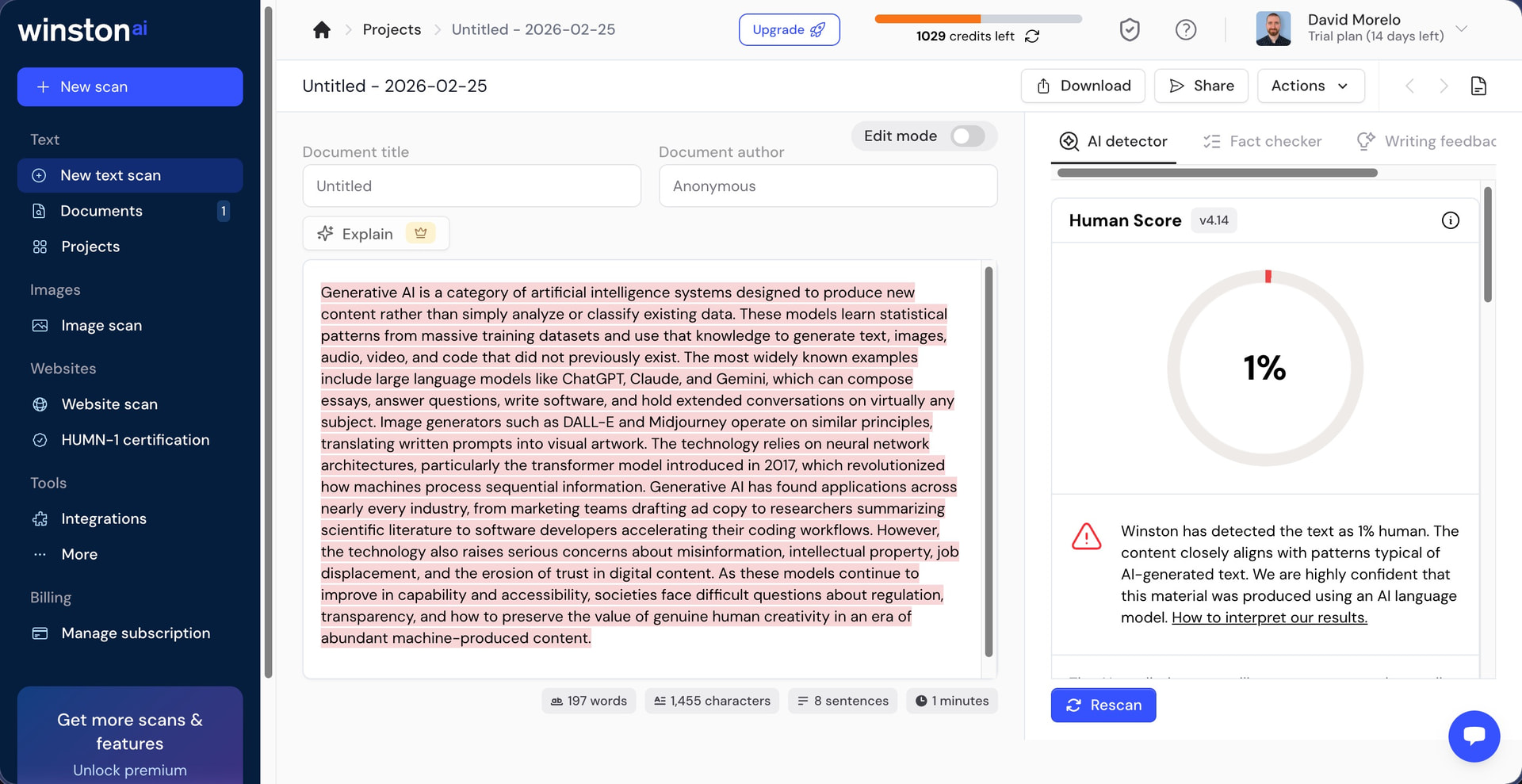
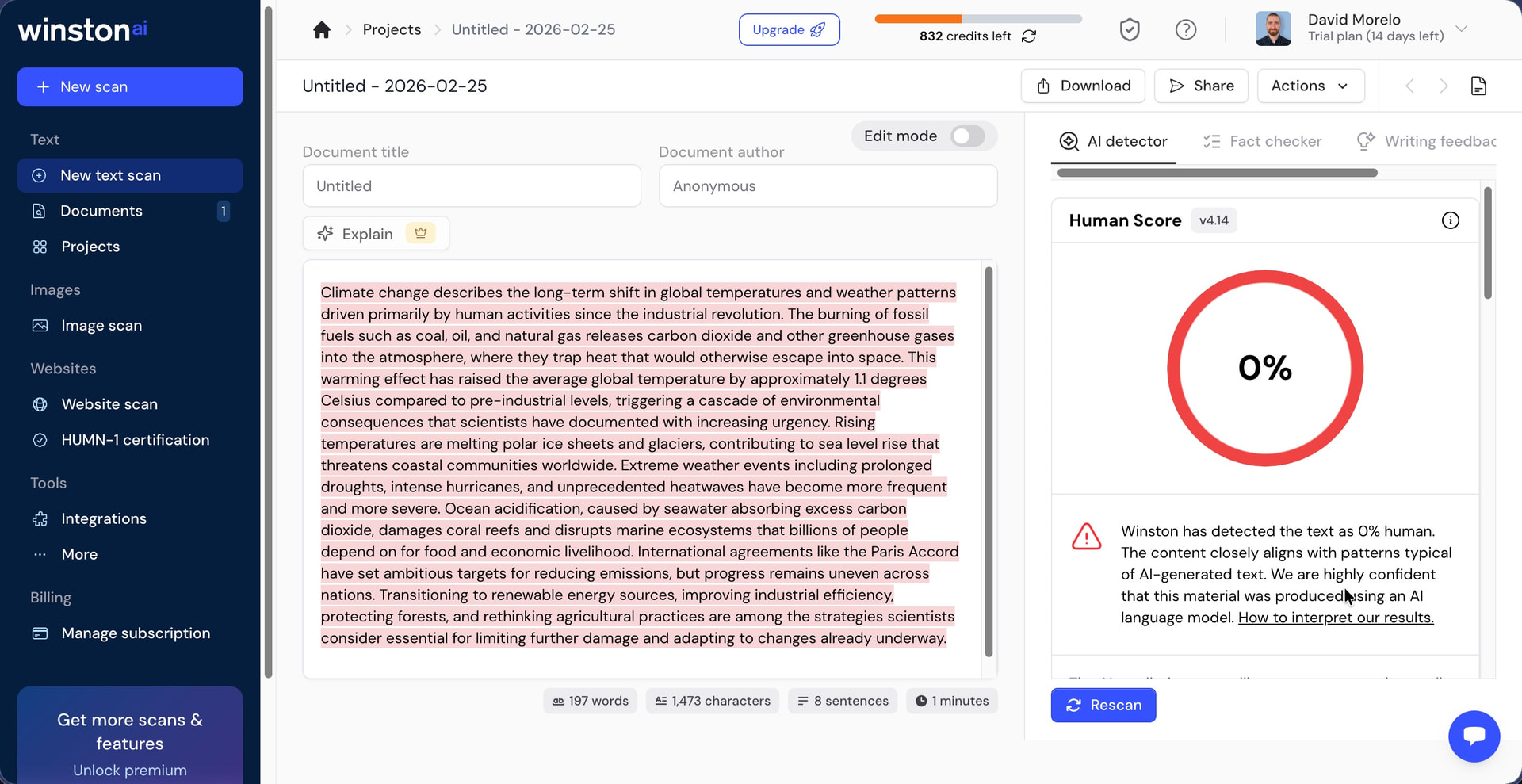
In comparison, Grammarly’s detector struggled badly with Gemini content in my testing. It averaged just 65% AI across three samples and even let one ChatGPT sample through at only 56% AI. Winston showed no such weakness against any model. Its results were just as confident on Gemini output as they were on Claude or ChatGPT, and they put it in the same tier as Originality AI and GPTZero when it comes to raw detection of unmodified AI text.
I really like how the tool includes a color-coded AI prediction map that breaks the text down sentence by sentence, highlighting which parts triggered the flag and how confident the model is about each one. This kind of detail is useful if you want to understand why a piece of text got flagged rather than just seeing a single number. There is also a basic text editor built right into the scan view, so you can make changes to your content and rescan without switching between tabs or tools.
Does Winston AI Produce False Positives?
To test if Winston AI produces false positives when presented with genuine human writing, I scanned ten samples from sources that could not possibly contain AI-generated text, and these are the results:
| Content | Source | Year | Winston AI Score |
|---|---|---|---|
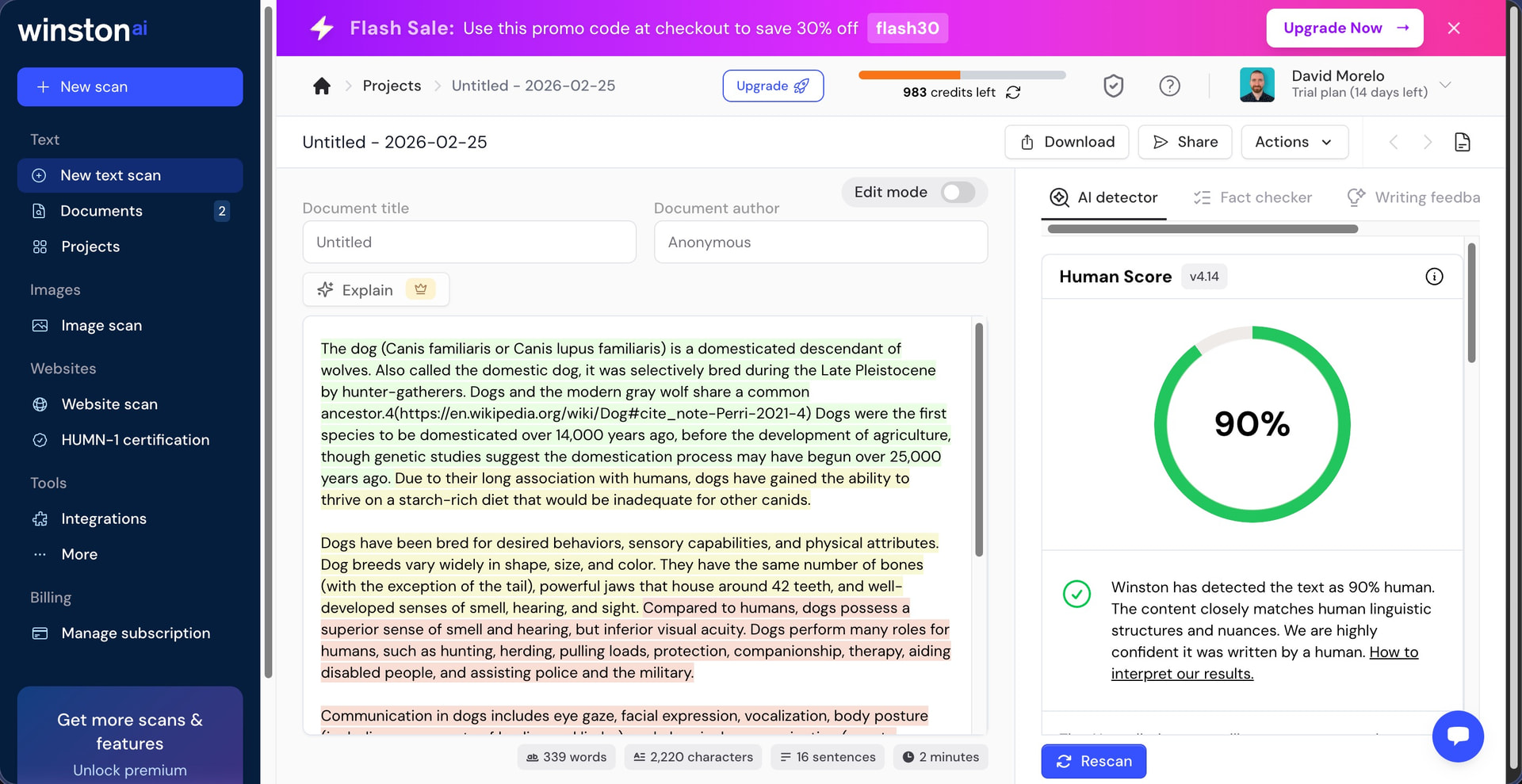
| Dog | Wikipedia | Ongoing (est. 2003) | 90% Human |
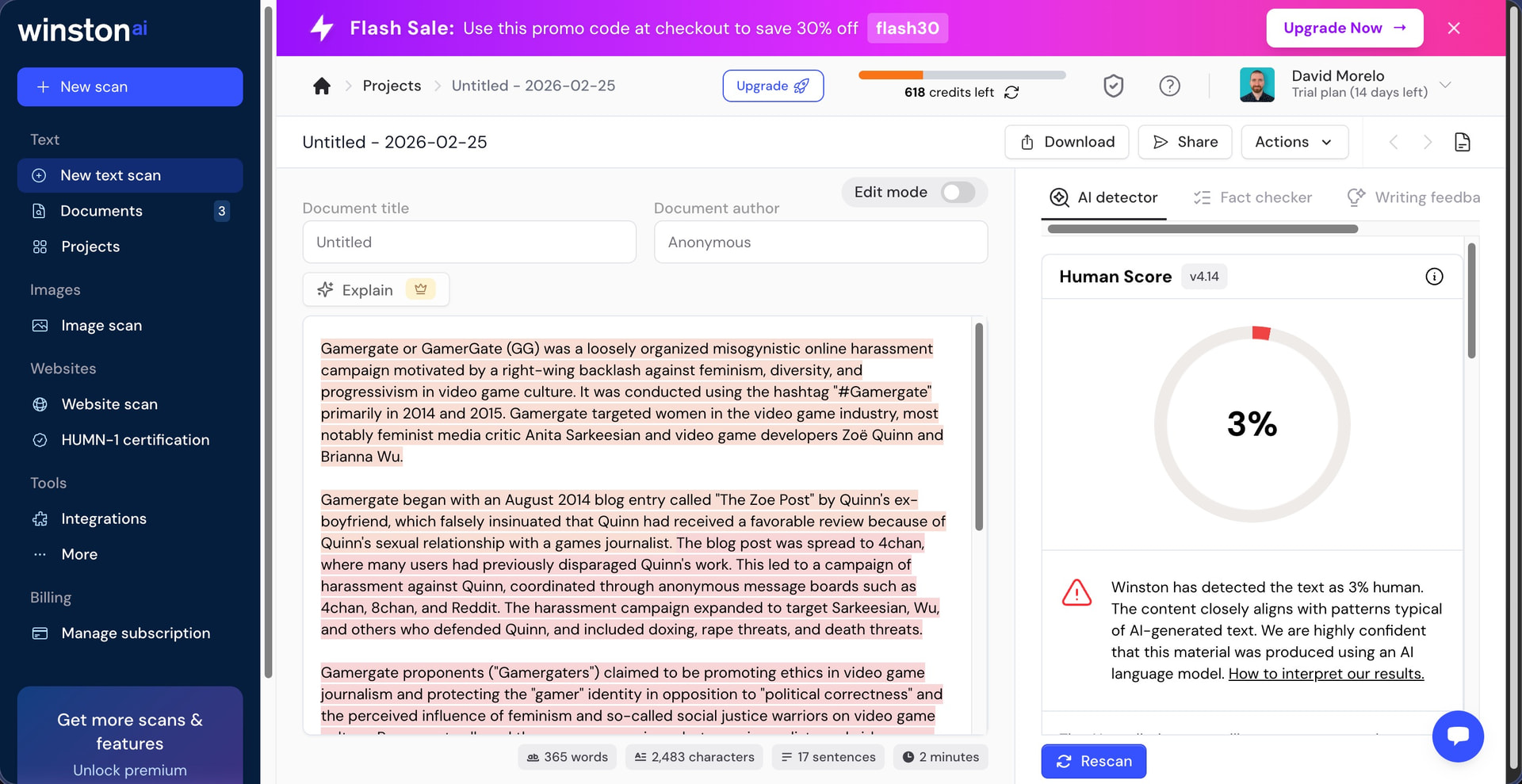
| Gamergate (controversy) | Wikipedia | Ongoing (est. 2014) | 3% Human |
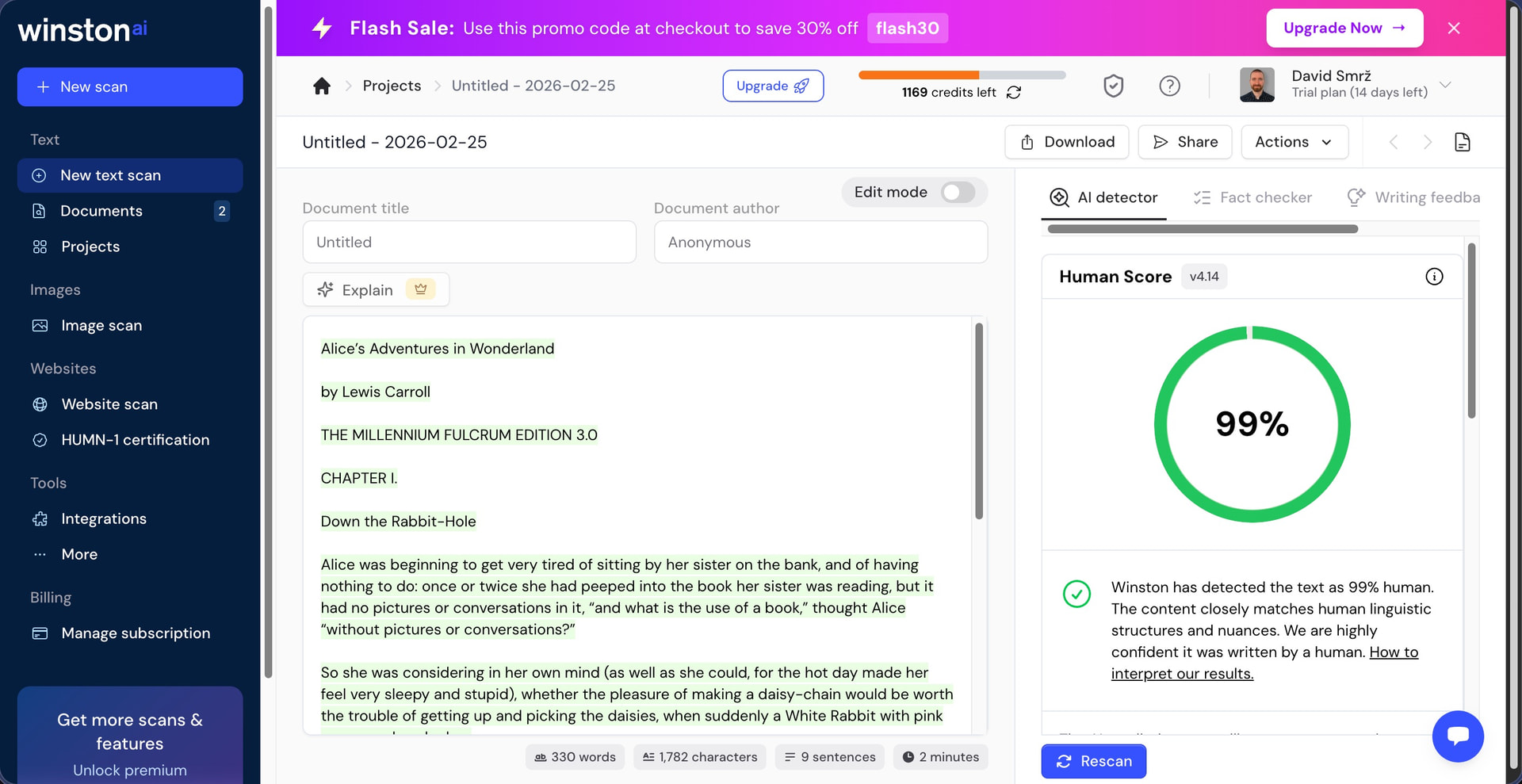
| Alice’s Adventures in Wonderland | Project Gutenberg | 1865 | 99% Human |
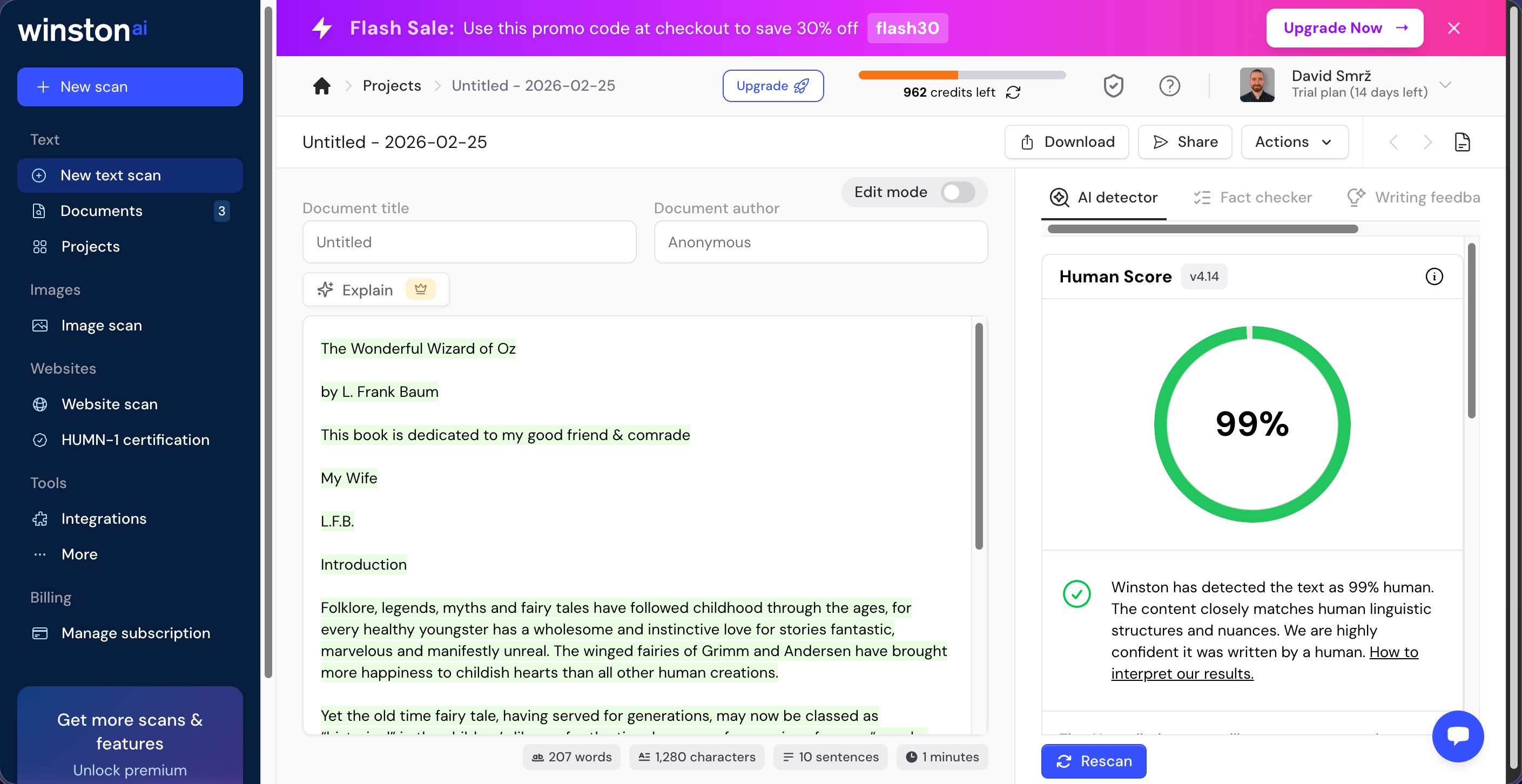
| The Wonderful Wizard of Oz | Project Gutenberg | 1900 | 99% Human |
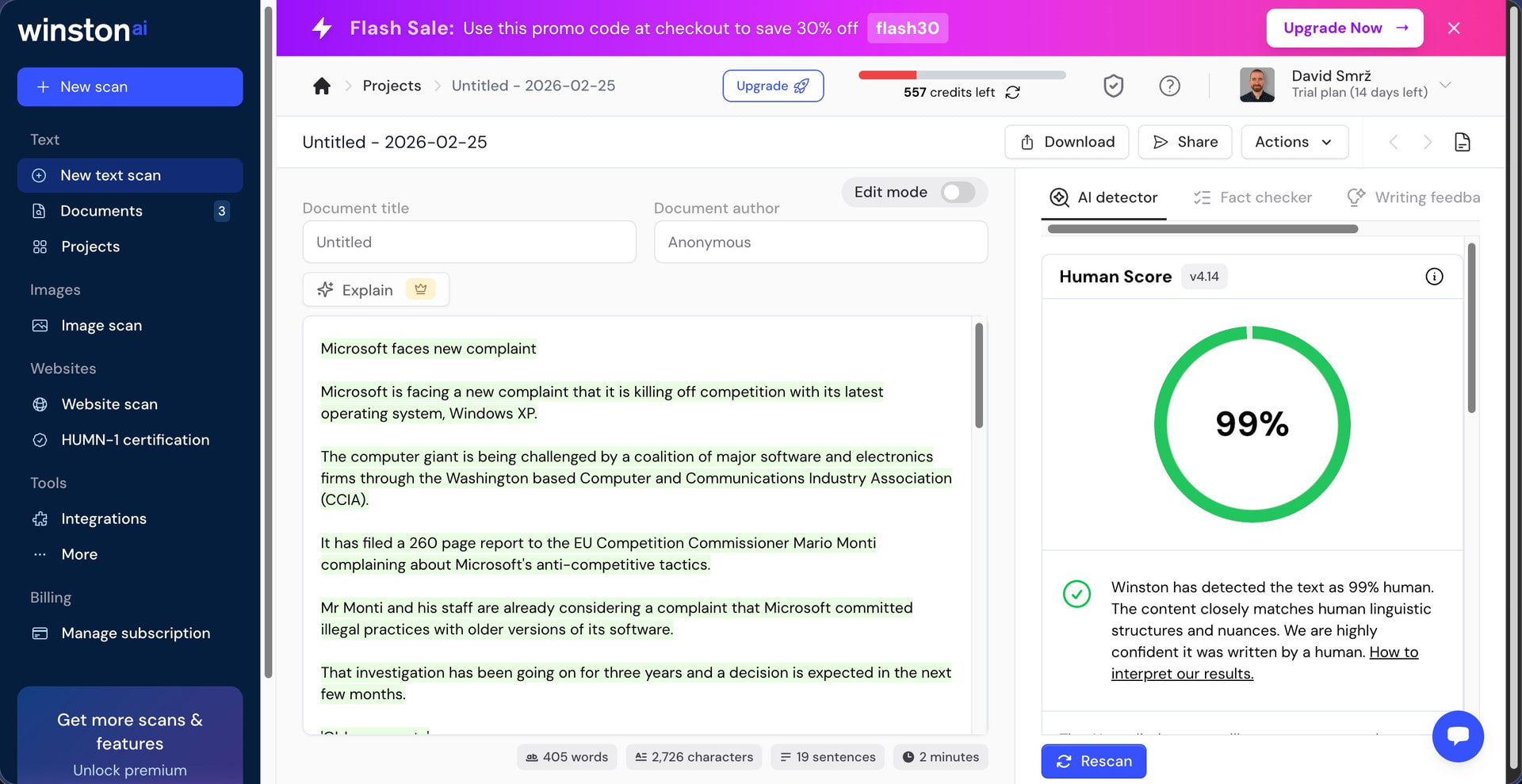
| Microsoft faces new complaint | BBC News | 2003 | 99% Human |
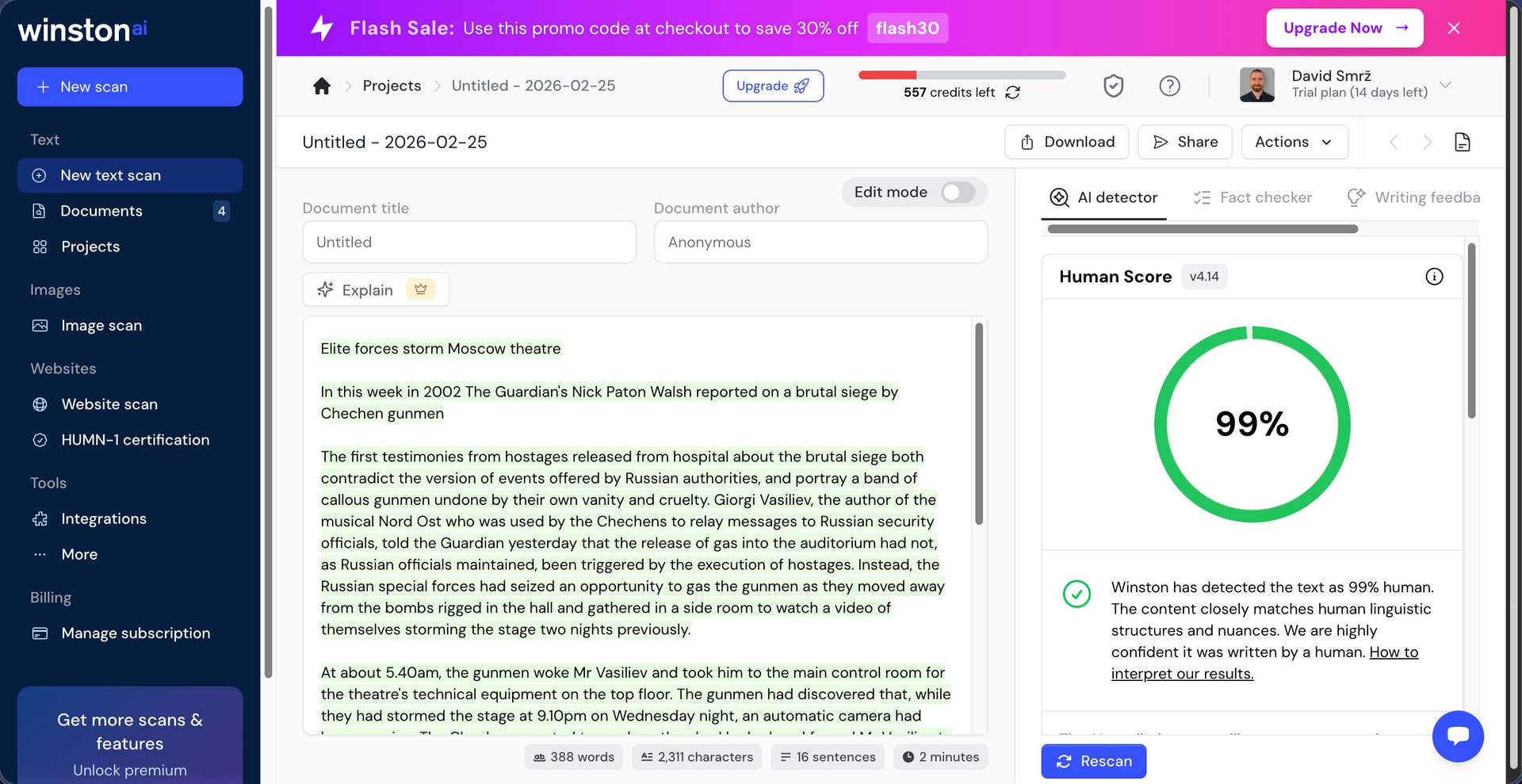
| Elite forces storm Moscow theatre | The Guardian | 2002 | 99% Human |
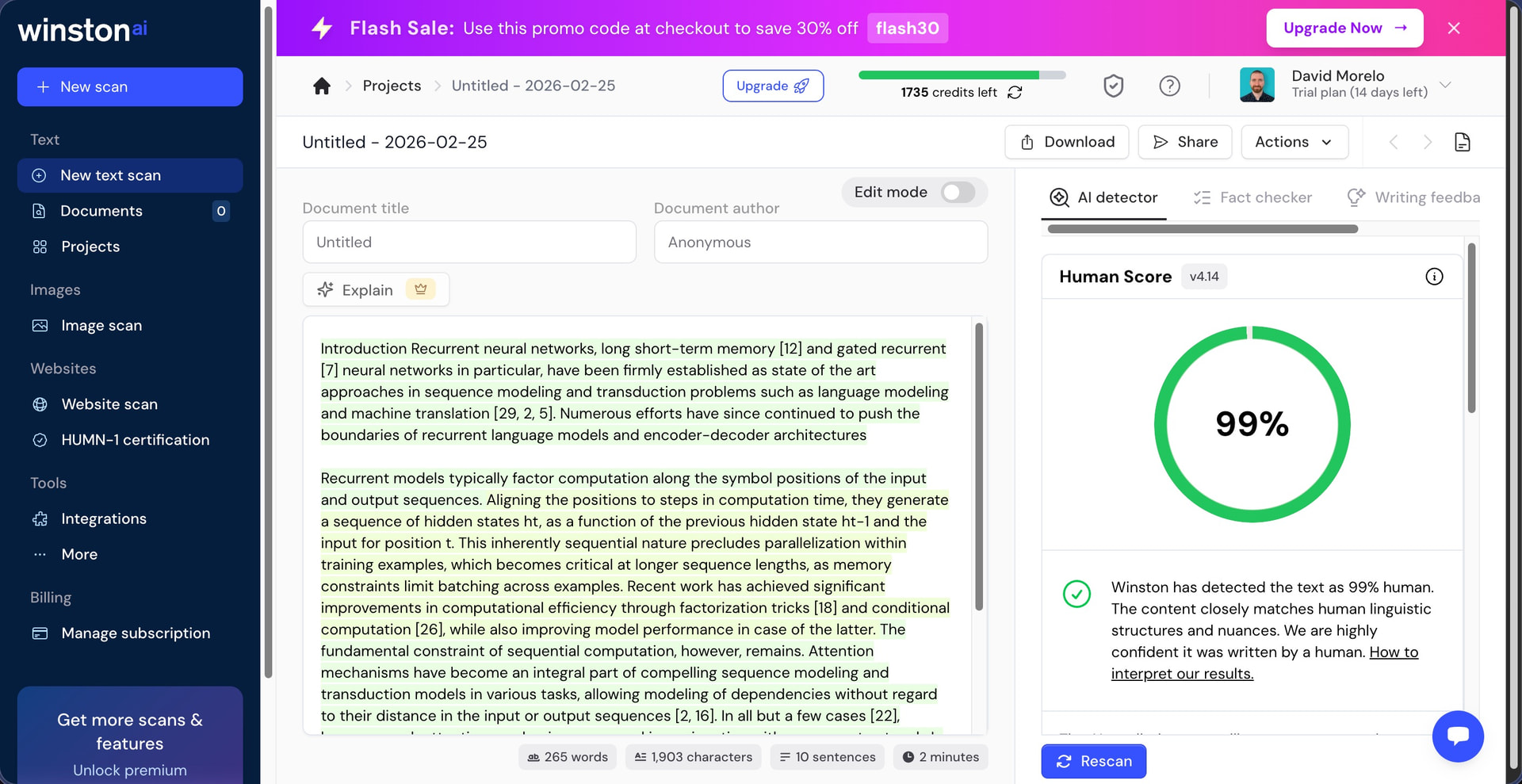
| Attention Is All You Need | NeurIPS | 2017 | 99% Human |
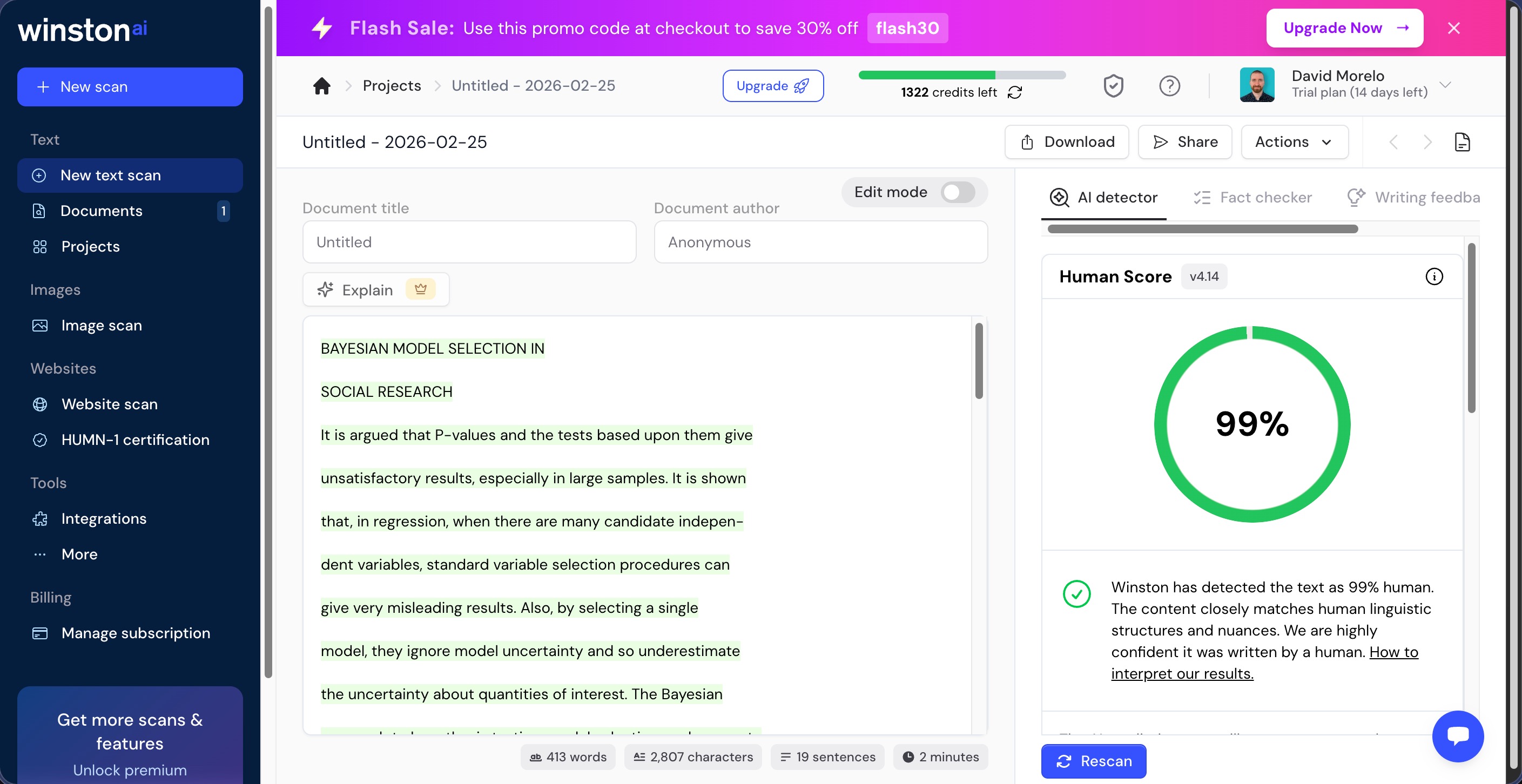
| Bayesian Model Selection in Social Research | Academic journal | 1995 | 99% Human |
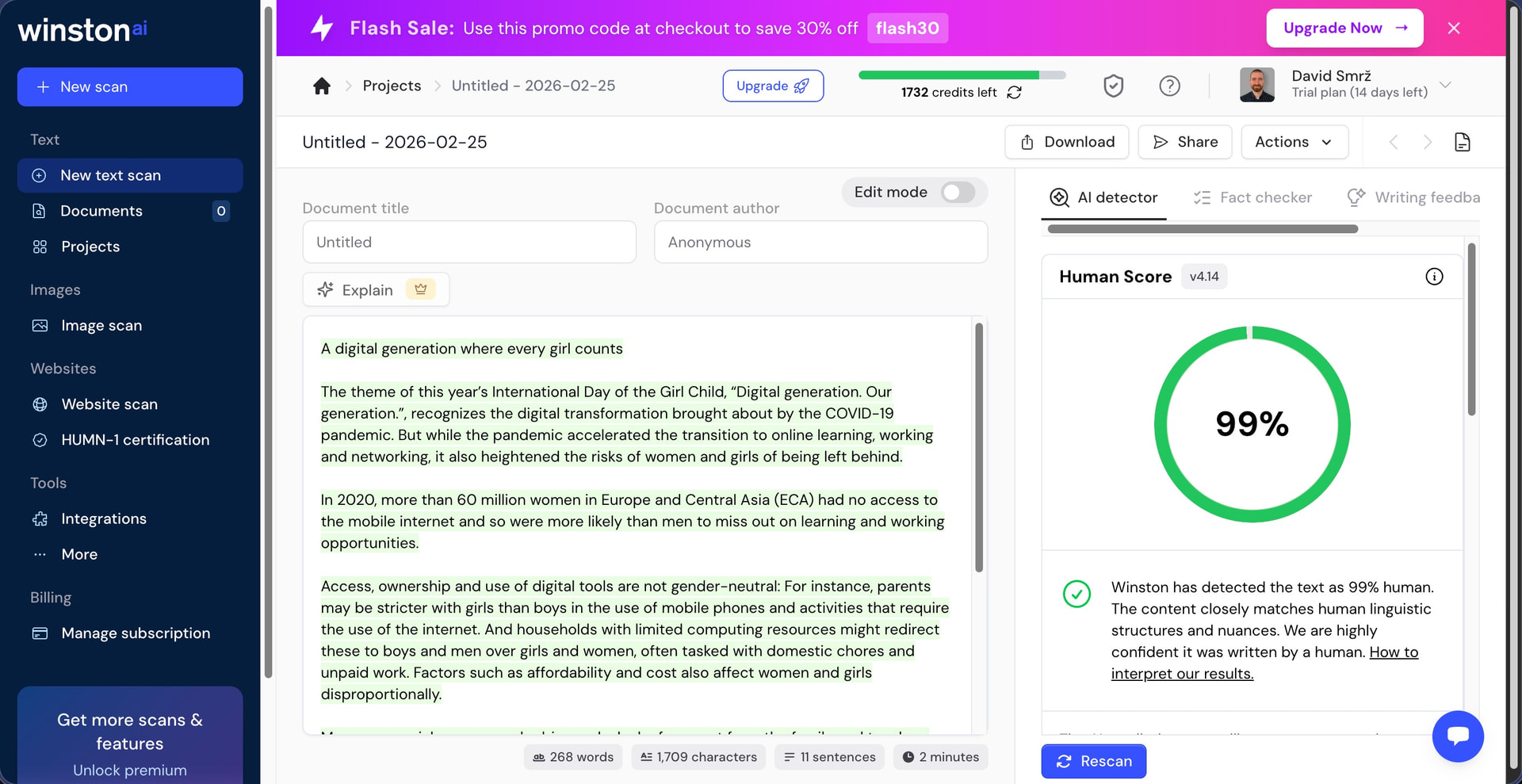
| A digital generation where every girl counts | UNDP Blog | 2019 | 99% Human |
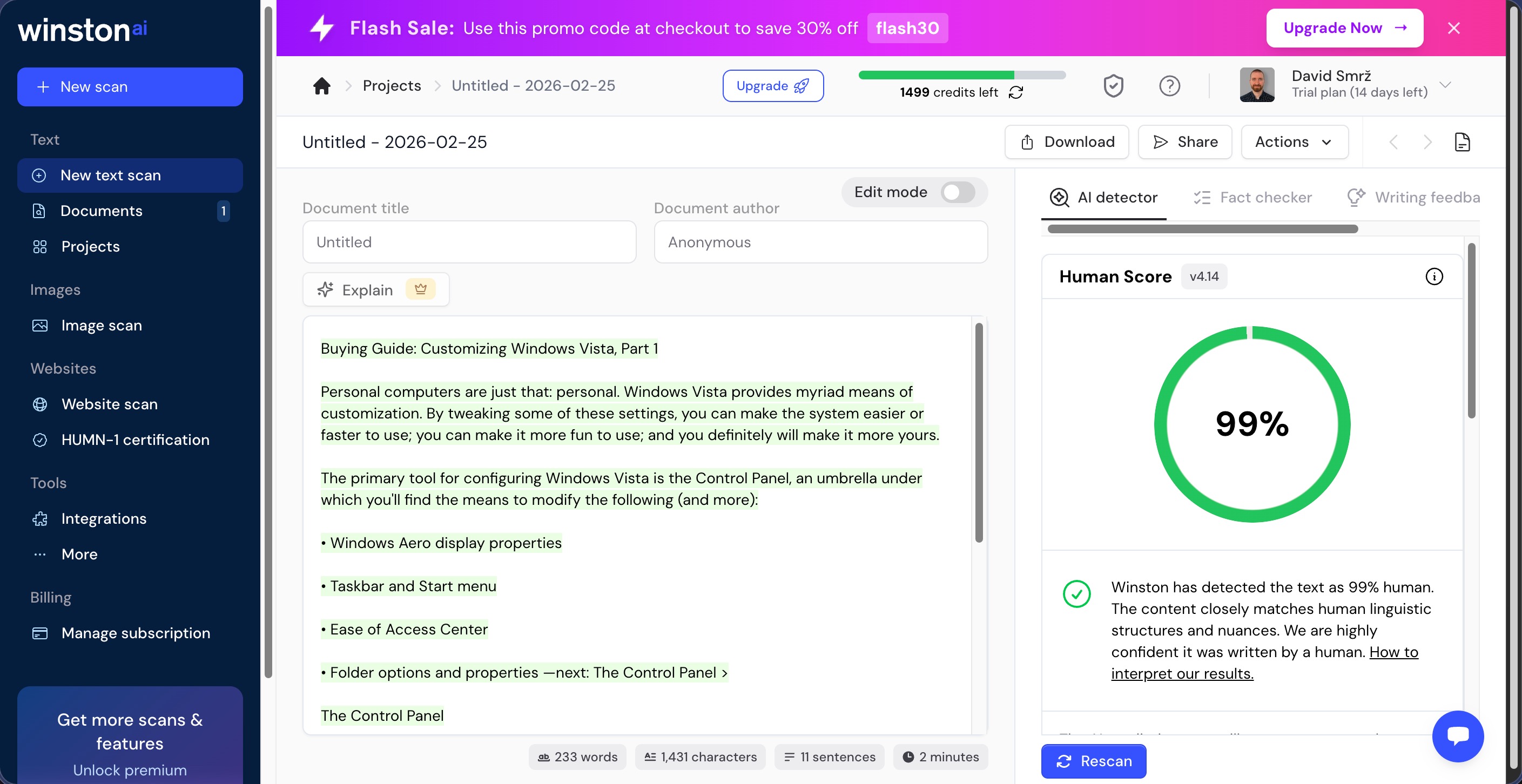
| Customizing Windows Vista, Part 1 | PC Magazine | 2007 | 99% Human |
Eight out of ten samples scored 99% human, and they include classic literature, archived news stories, academic papers, and blog posts.
The two exceptions were both Wikipedia articles. The one about dogs scored 90% human, which still counts as a pass under Winston’s own scale (anything above 80 falls in the “Mostly Human” range). But it’s worth noting that this same article received a 99% AI score from Originality AI and a 100% Human score from GPTZero. The article about the Gamergate controversy, however, scored just 3% human. Grammarly’s detector, by comparison, score it at 0% AI with no issues at all, and GPTZero rated it the same.
That said, Wikipedia articles are a unique challenge for any AI detector because they are not written the way most people write. The content is collaborative, stitched together by hundreds or thousands of editors over many years, and held to a strict neutral tone with no personal voice or opinion. Sentences tend to be direct, factual, and structured in a way that closely mirrors how language models produce text. What’s more, large language models like ChatGPT and Claude were trained on massive amounts of Wikipedia content, so their default output style naturally resembles it.
How much does Winston AI cost?
Winston AI uses a credit-based system where 1 credit equals 1 word. So, scanning a 1,000-word article costs 1,000 credits. Plagiarism checking is double that at 2 credits per word, and AI image detection costs 300 credits per image. A free tier is available, but it’s really just a 14-day trial with 2,000 credits. After that, you need a paid plan, and this is what you can choose from:
| Plan | Monthly price | Annual price | Credits/month |
|---|---|---|---|
| Free | $0 | $0 | 2,000 (14-day trial) |
| Essential | $18/mo | $10/mo | 80,000 |
| Advanced | $29/mo | $16/mo | 200,000 |
| Elite | $49/mo | $26/mo | 500,000 |
The Essential plan at $10/month (annual) gives you 80,000 credits, so roughly 80,000 words of AI detection per month. That is a decent amount for a freelance writer or a teacher checking student papers. You also get shareable PDF reports and writing feedback at this tier, which the free plan does not include.
The Advanced plan at $16/month (annual) adds plagiarism detection, up to 5 team members, and a HUMN-1 website certification badge. The Elite plan at $26/month (annual) bumps credits to 500,000, removes the team member cap, and lets you buy extra credits if you run out.
All plans include AI image and deepfake detection, OCR scanning for handwritten or printed documents, and document uploads. The OCR feature is unusual for an AI detector and could be useful in academic settings where students submit handwritten work or scanned PDFs.
Compared to Originality AI, Winston’s pricing is slightly cheaper at the lower tiers. Originality AI’s cheapest recurring option is $12.95/month for 2,000 credits (covering 200,000 words), while Winston’s Essential plan covers 80,000 words for $10/month on an annual commitment. But Originality AI also offers a one-time $30 purchase with 3,000 credits that last two years, which Winston does not have.
Does Winston AI respect user privacy?
According to Winston AI’s privacy policy and terms of service, the company (based in Montreal, Canada) collects the following data when you use the service:
-
Account information: name, email address, username, and password
-
Payment data: processed through Stripe and PayPal (Winston AI does not store card details directly)
-
Technical data: IP address, browser type, device information, operating system, language preferences, and referring URLs
-
Location data: device location, which can be precise (GPS-based) or approximate (IP-based) depending on your settings
-
Log and usage data: pages viewed, searches, feature usage, timestamps, and error reports
-
Cookie data: session cookies, preference cookies, and similar tracking technologies
The landing page states that Winston AI is “Secure and Confidential” and that “your content is never used to improve our models/capabilities.” I could not find anything in the privacy policy or terms of service that contradicts this. If accurate, it puts Winston in a better position than Originality AI, which uses scanned content for model training by default (with an opt-out option), and Grammarly, which grants itself a broad content license that lasts indefinitely.
The terms of service state that scores are probabilities, not definitive answers, and that Winston AI is not responsible for any actions taken based on a reported score. The terms also note that results may be biased for non-native English speakers, a proven fact that many non-native college students discovered the hard way.
As far as data retention goes, Winston AI keeps personal information for no longer than six months past the point your account goes idle, after which it gets deleted or anonymized. The company also states it has not sold or shared personal data with third parties for commercial purposes in the past twelve months.