Originality AI is widely considered to be one of the most (if not the most) accurate AI detectors available to the general public. That’s why its roster of clients includes Harvard University, The New York Times, and Reuters. But accuracy works both ways. A detector that flags everything as AI would technically catch 100% of AI content while also destroying its credibility with false positives.
Interestingly, Originality AI has expanded beyond detection into the humanization space as well. The company now offers its own AI Humanizer tool that claims to rewrite AI content “the smart way.” In my separate review of that tool, I found it made minimal changes to source text and failed to bypass any detectors, including its own. But can the detection side of Originality AI’s business live up to its reputation? That’s what I set out to test.
| Pros | Cons |
|---|---|
| 100% detection rate on all AI-generated samples | False positives encountered |
| Multiple detection models for different use cases | Can be bypassed by better humanizers |
| Fairly resistant to humanization attempts | Premium pricing |
| Comprehensive feature set | Monthly credits expire |
| Full website scanning by URL | Uploaded content may be used for model training |
| Team management and API access for enterprise users | |
| Opt-out option for training data usage | |
| Chrome extension for quick checks |
How I tested Originality AI: I submitted multiple samples to Originality AI across two main categories: confirmed AI-generated content and confirmed human-written content. For AI samples, I generated fresh text using ChatGPT, Claude, and Gemini on the topics of artificial intelligence, climate change, and technology trends. For human-written content, I deliberately selected sources that could not possibly contain AI writing. I then tested the samples using Originality AI and captured the results with screenshots showing the exact percentage scores and sentence-level highlighting. Where applicable, I also ran the same samples through GPTZero and ZeroGPT for comparison.
How Accurate Is Originality AI at Detecting AI Content?
| AI Model | Topic | Originality AI Score |
|---|---|---|
| ChatGPT (5.2) | AI Humanization | 100% AI |
| ChatGPT (5.2) | Climate Change | 100% AI |
| ChatGPT (5.2) | Technology Trends | 100% AI |
| Claude (Opus 4.5) | AI Humanization | 100% AI |
| Claude (Opus 4.5) | Climate Change | 100% AI |
| Claude (Opus 4.5) | Technology Trends | 100% AI |
| Gemini (2.5 Pro) | AI Humanization | 100% AI |
| Gemini 2.5 Pro) | Climate Change | 100% AI |
| Gemini 2.5 Pro) | Technology Trends | 100% AI |
Originality AI offers multiple detection models tuned for different use cases. The “Lite” model is designed for writers and editors who allow some AI assistance (similar to Grammarly), the “Academic” model targets educational settings with stricter thresholds, and the “Turbo” model enforces a zero-tolerance policy on AI content. According to Originality AI’s own documentation, the Turbo model achieves 99%+ accuracy with a 1.5% false positive rate. The company backs these claims by referencing multiple third-party studies, including peer-reviewed research that compared their detector against competitors like GPTZero, ZeroGPT, and Winston AI.
Before examining whether Originality AI produces false positives on human-written content, I first wanted to verify that it actually catches AI-generated text. There would be no point criticizing false positives if the detector failed at its primary job.
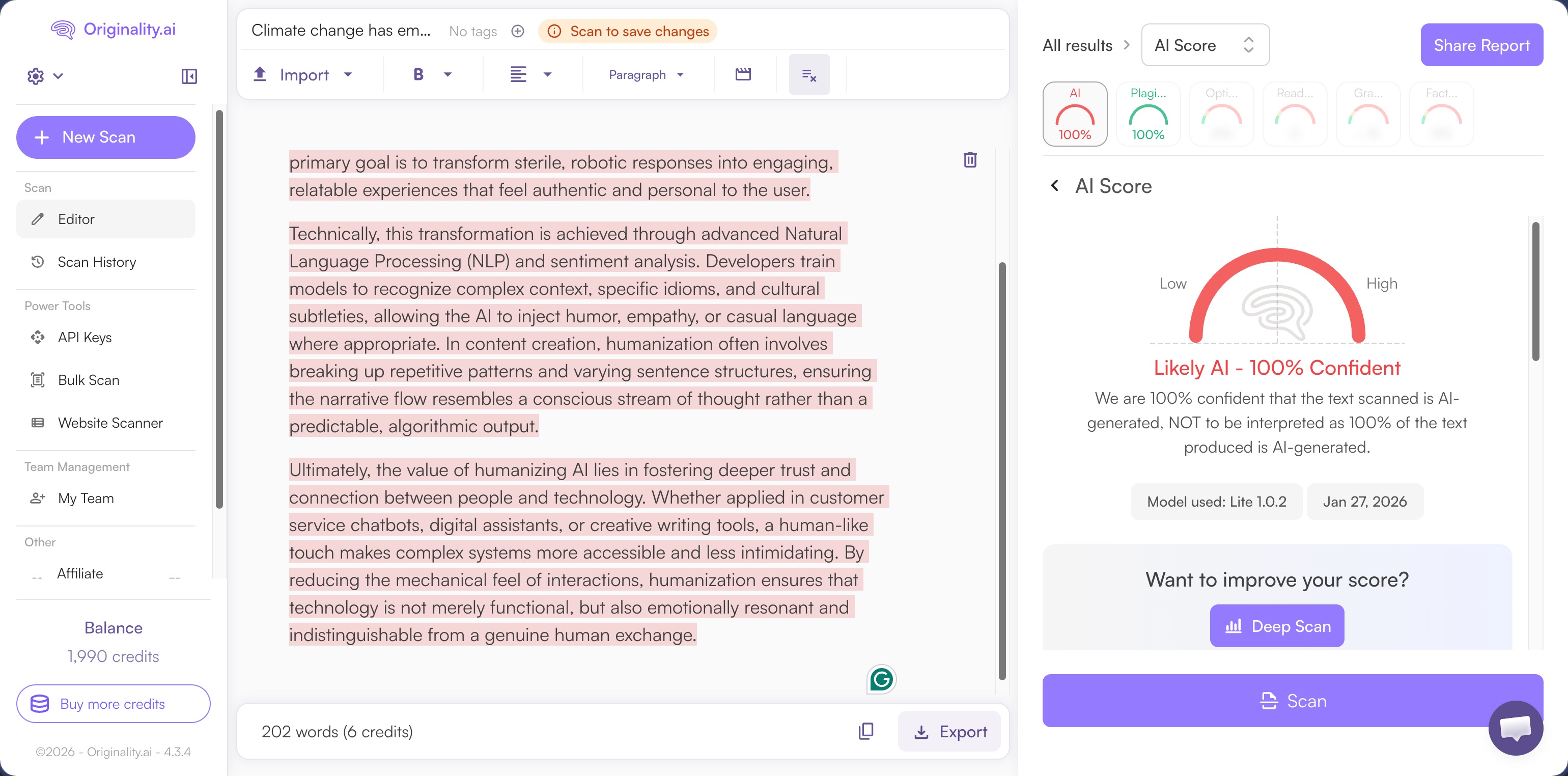
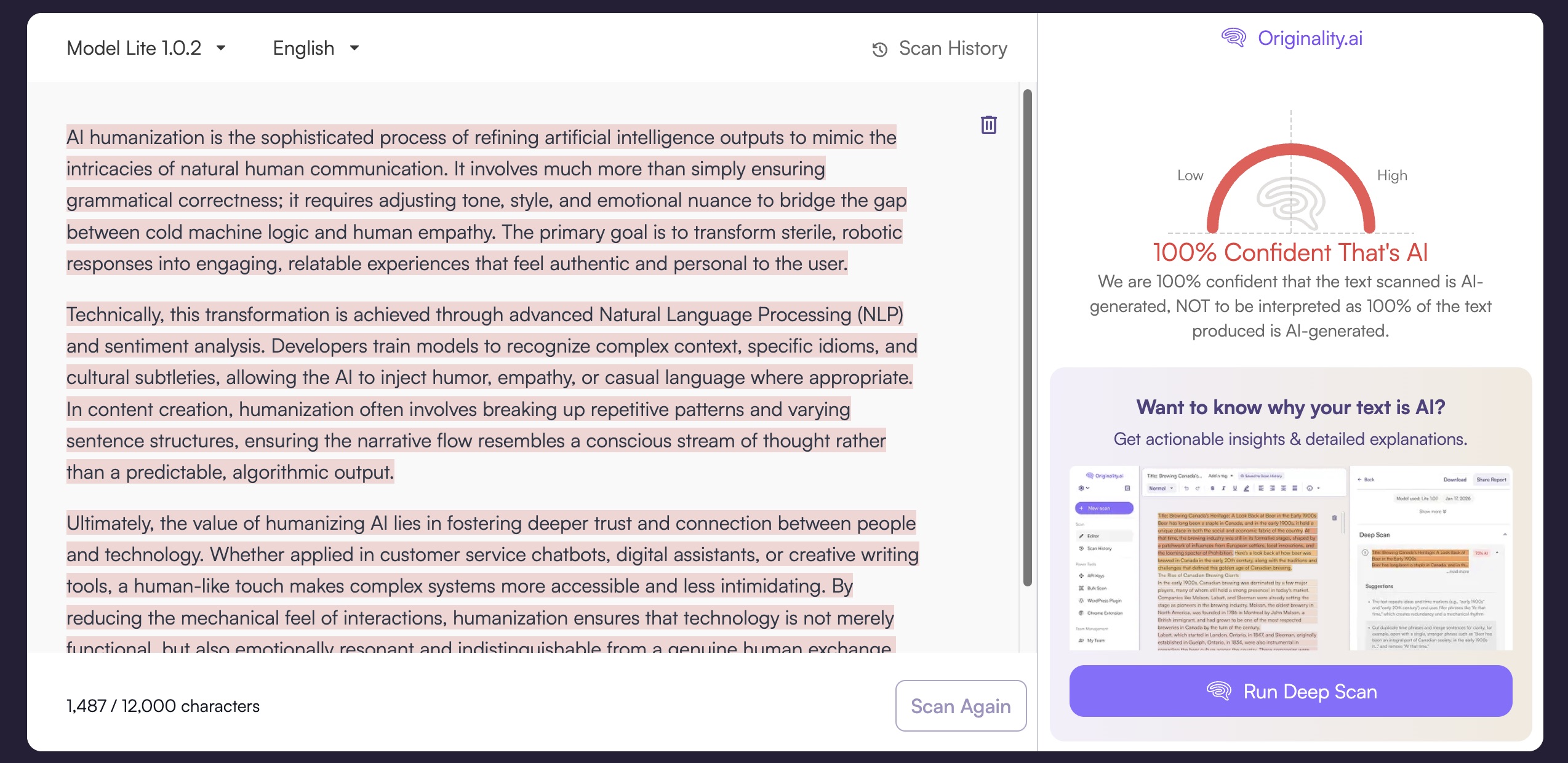
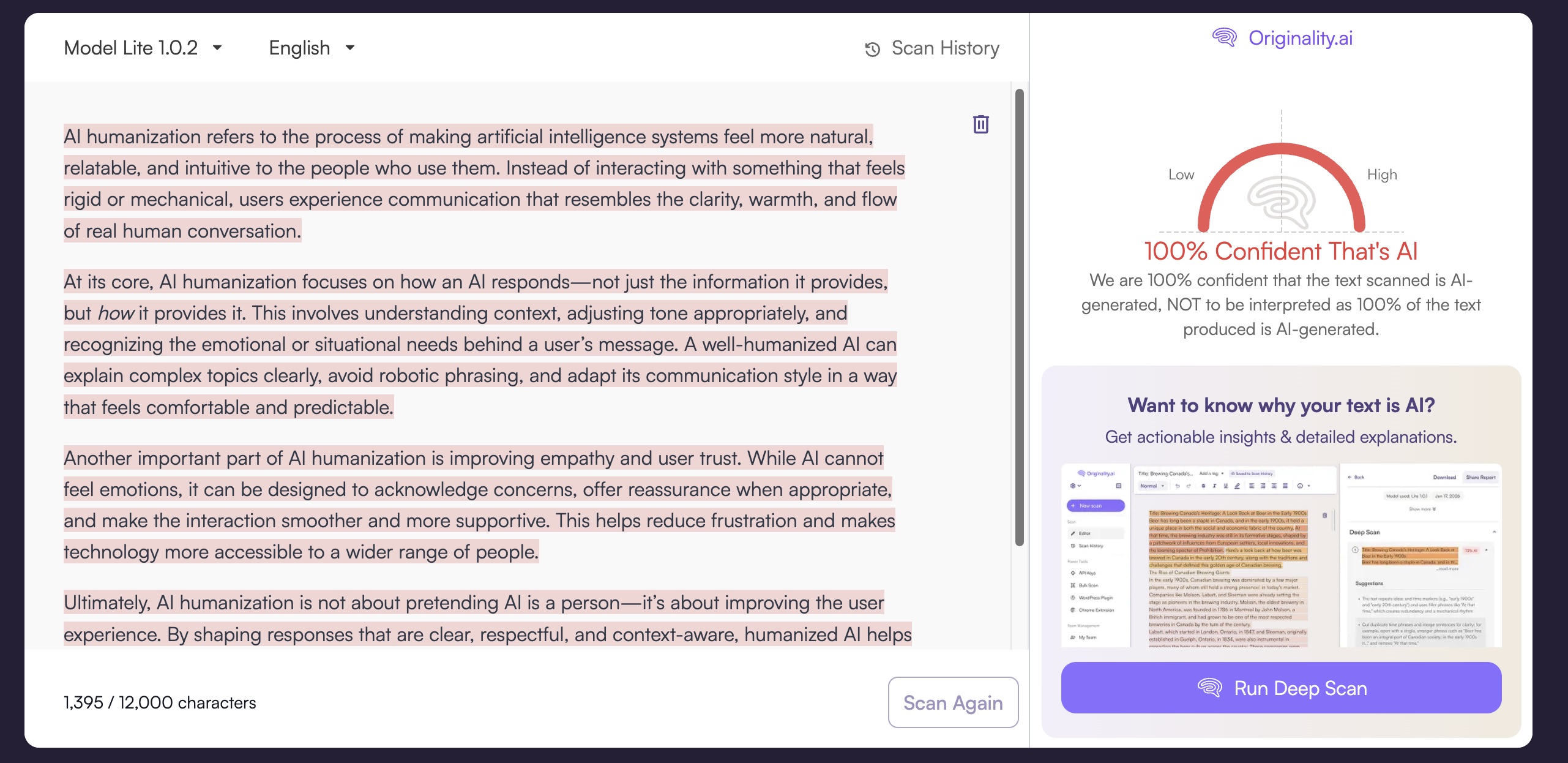
Originality AI had no trouble identifying AI-generated content regardless of which model produced it. Every single sample came back with a confident 100% AI score, with the sentence-level highlighting that marked virtually every line as machine-written regardless of whether the text discussed artificial intelligence, environmental science, or emerging technology.
I also tested whether superficial edits could reduce the detection scores. I removed all em dashes from the samples (since these punctuation marks have become associated with AI writing), split longer paragraphs into shorter chunks, and even manually swapped a few common words for synonyms. None of these changes moved the needle.
Does Originality AI Produce False Positives?
Catching AI-generated content means nothing if the tool simultaneously flags legitimate human writing as suspicious. To test this, I collected samples from sources that could not possibly contain AI-generated text: Wikipedia articles with years of documented edit history, news stories published in the early 2000s, classic literature from the 19th and early 20th centuries, academic papers from before the transformer architecture even existed, and blog posts written years before ChatGPT launched in November 2022.
Wikipedia Articles
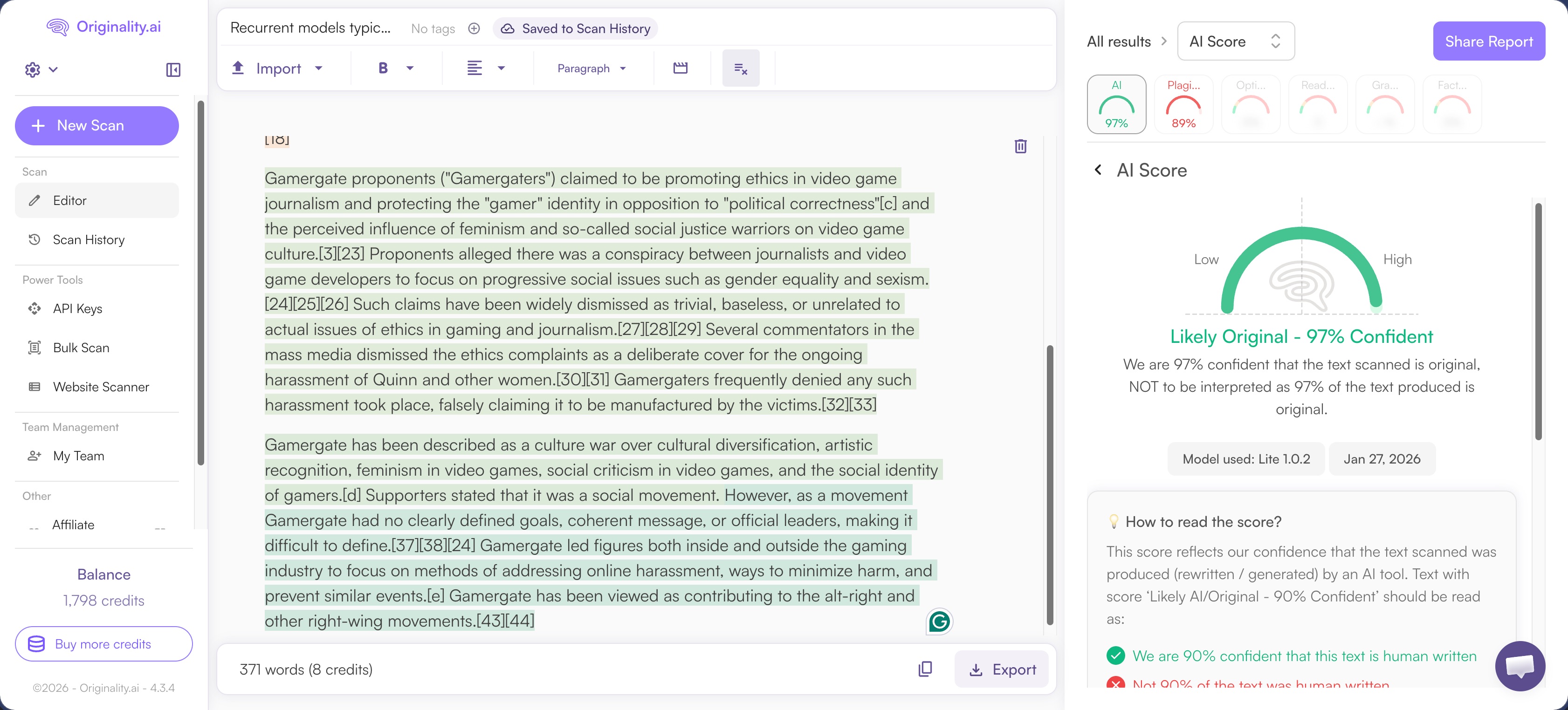
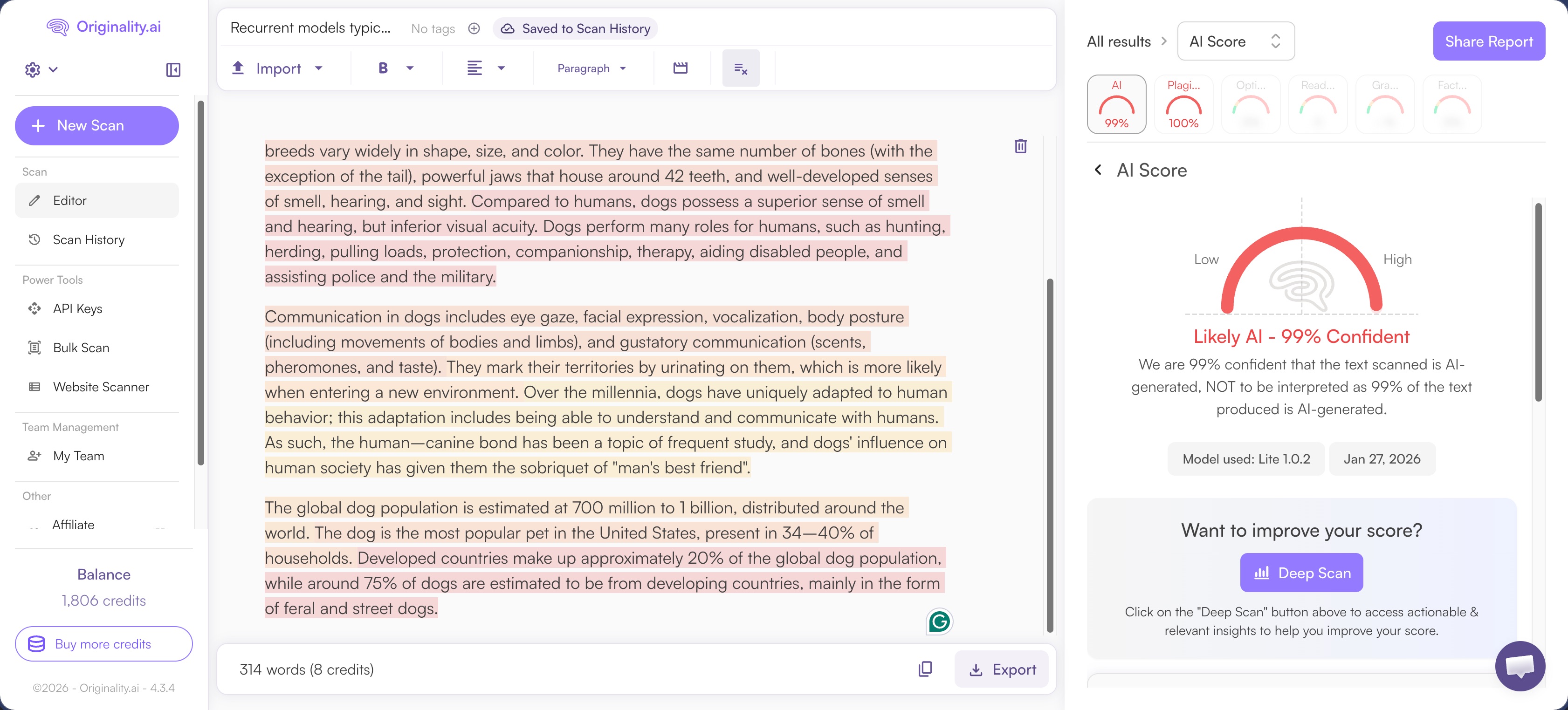
| Article | Source | Originality AI Result |
|---|---|---|
| Dog | Wikipedia | 99% AI |
| Gamergate (controversy) | Wikipedia | 97% Original |
The Wikipedia article about dogs, one of the most heavily edited and reviewed pages on the entire platform with contributions from thousands of human editors spanning nearly two decades, was flagged as 99% likely to be AI-generated. Meanwhile, the Gamergate controversy article passed with 97% confidence as original content.
Both articles follow identical Wikipedia formatting conventions, both have extensive edit histories documenting human authorship, and both cover well-established topics with citations and references. Yet Originality AI reached completely opposite conclusions about their origins.
There are several possible explanations for this discrepancy. First, it is theoretically possible that someone used AI tools to edit portions of the Dog article in recent years, though Wikipedia’s edit history and community moderation make large-scale AI insertion unlikely to go unnoticed. Second, the Dog article’s encyclopedic tone and structured presentation of factual information may simply resemble the patterns that AI models have learned to produce, since language models are trained extensively on Wikipedia content and naturally mimic its style. Third, and most concerning, Originality AI may have generated a false positive on content that is demonstrably human-written.
Outdated News Articles
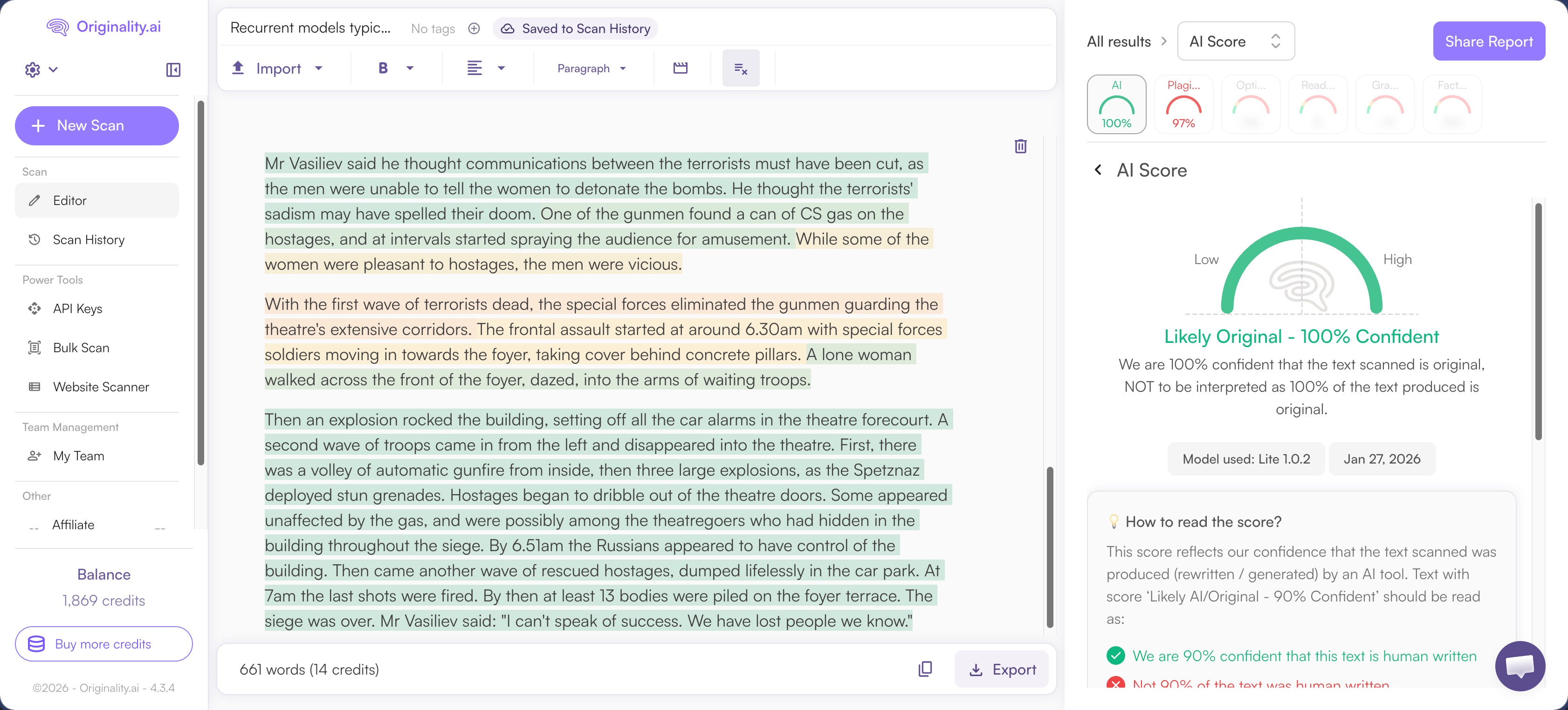
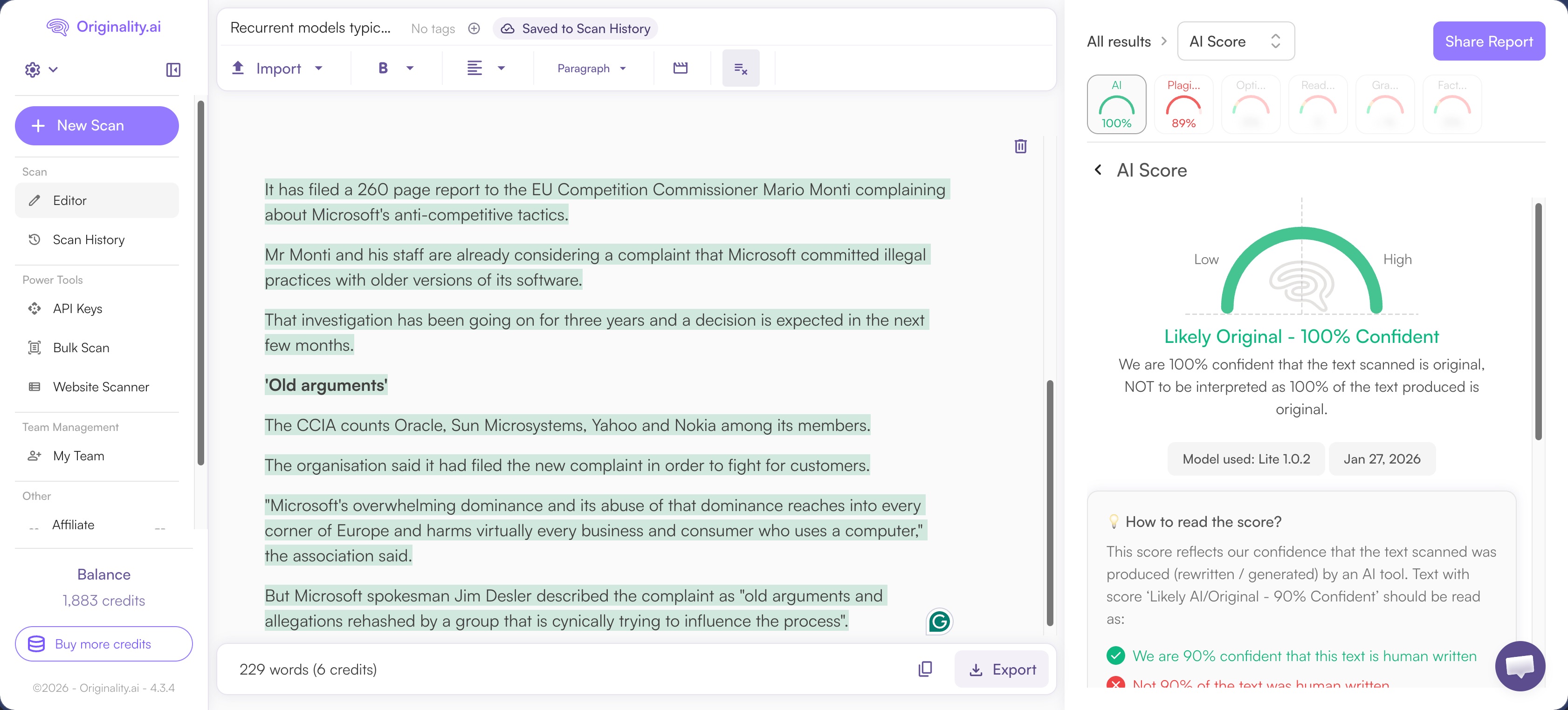
| Article | Publication | Year | Originality AI Result |
|---|---|---|---|
| Microsoft faces new complaint | BBC News | 2003 | 100% Original |
| Elite forces storm Moscow theatre | The Guardian | 2002 | 100% Original |
Originality AI performed correctly on archived news content. Both articles were published more than two decades ago, long before large language models capable of generating coherent text existed. The BBC business story about Microsoft antitrust complaints and The Guardian’s coverage of the Moscow theatre hostage crisis both returned 100% Original scores.
Classic Literature Excerpts
| Work | Author | Publication Year | Originality AI Result |
|---|---|---|---|
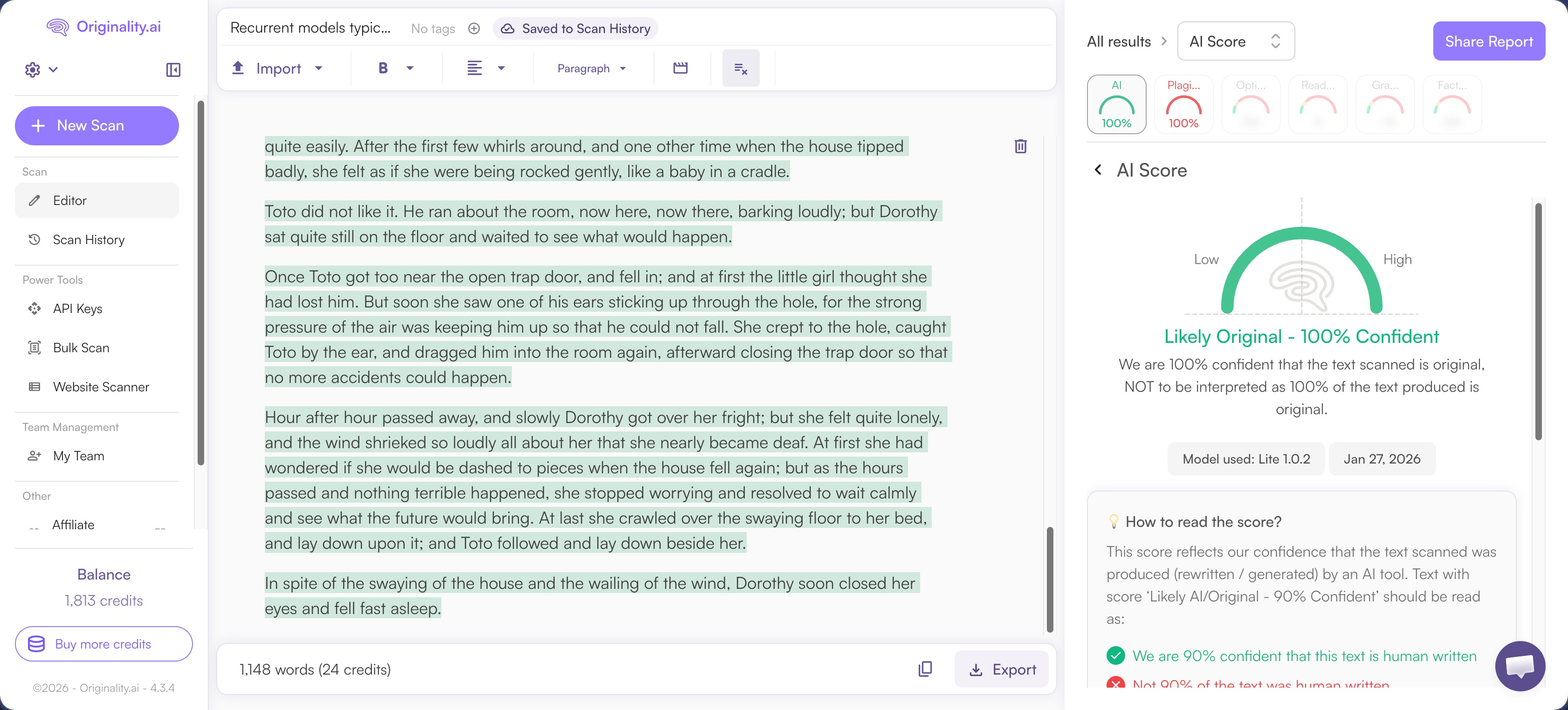
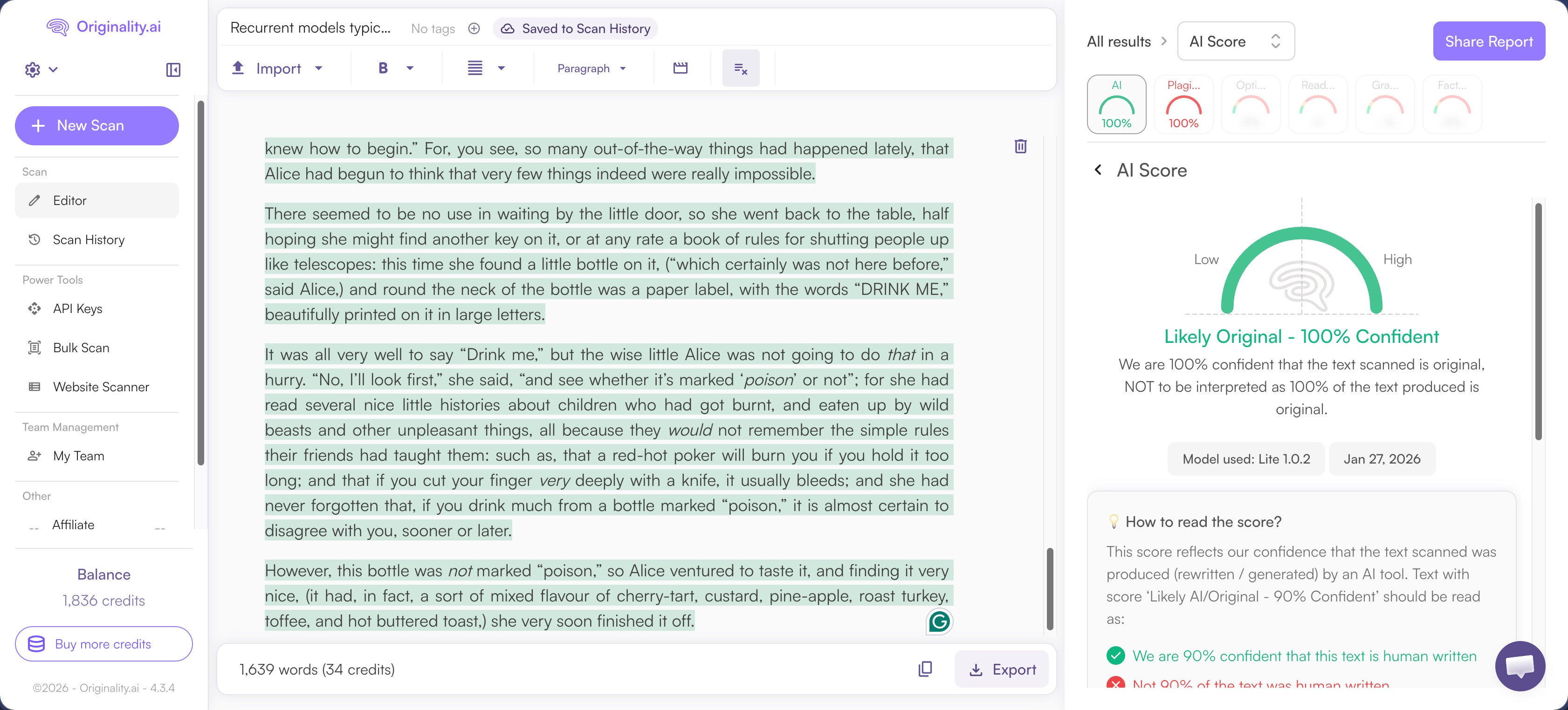
| Alice’s Adventures in Wonderland | Lewis Carroll | 1865 | 100% Original |
| The Wonderful Wizard of Oz | L. Frank Baum | 1900 | 100% Original |
Classic literature presented no problems for Originality AI. Excerpts from Lewis Carroll’s Alice’s Adventures in Wonderland (published in 1865) and L. Frank Baum’s The Wonderful Wizard of Oz (published in 1900) both received perfect scores as original human writing. These results are reassuring, though perhaps not surprising. The writing styles of 19th and early 20th century authors differ substantially from modern AI outputs, which are trained primarily on contemporary internet text.
Older Academic Papers
| Paper | Authors | Year | Originality AI Result |
|---|---|---|---|
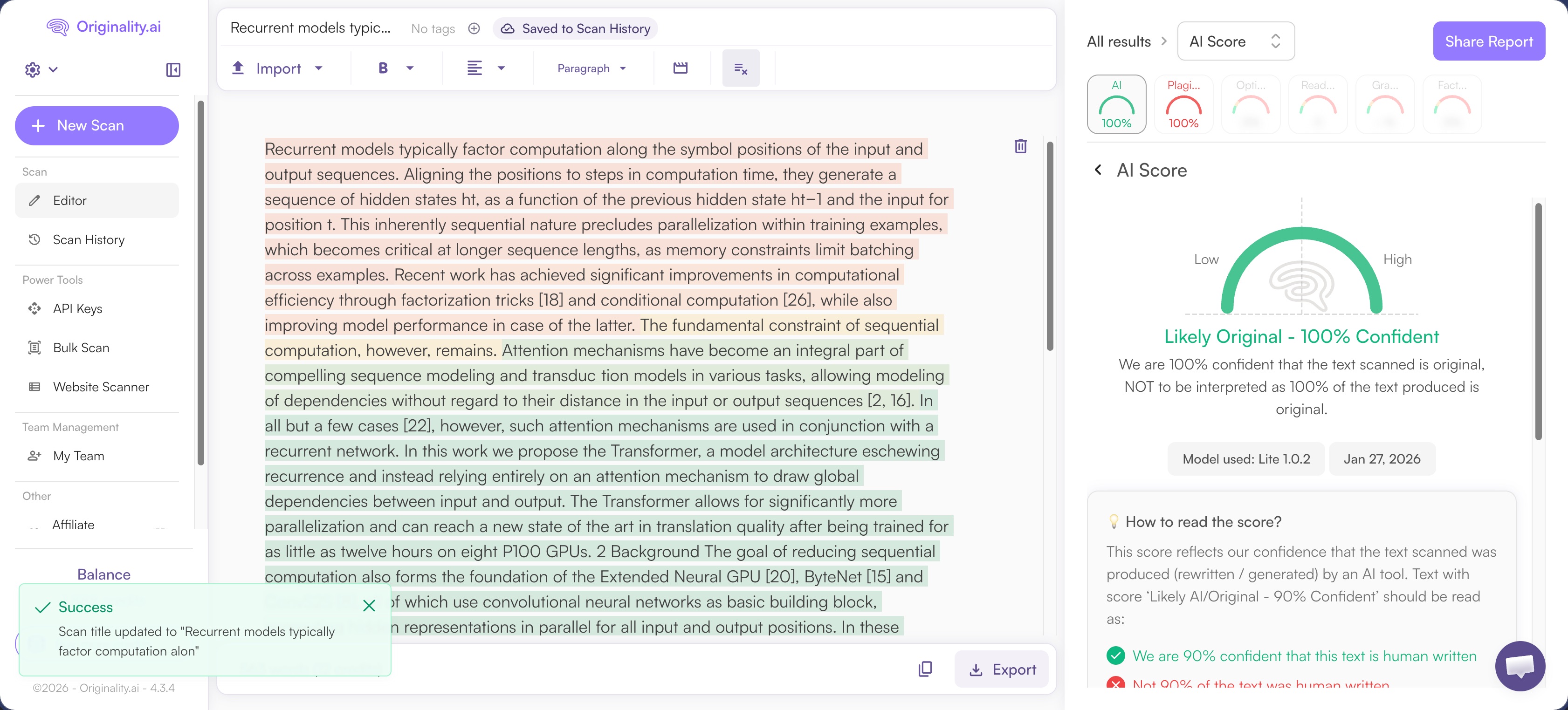
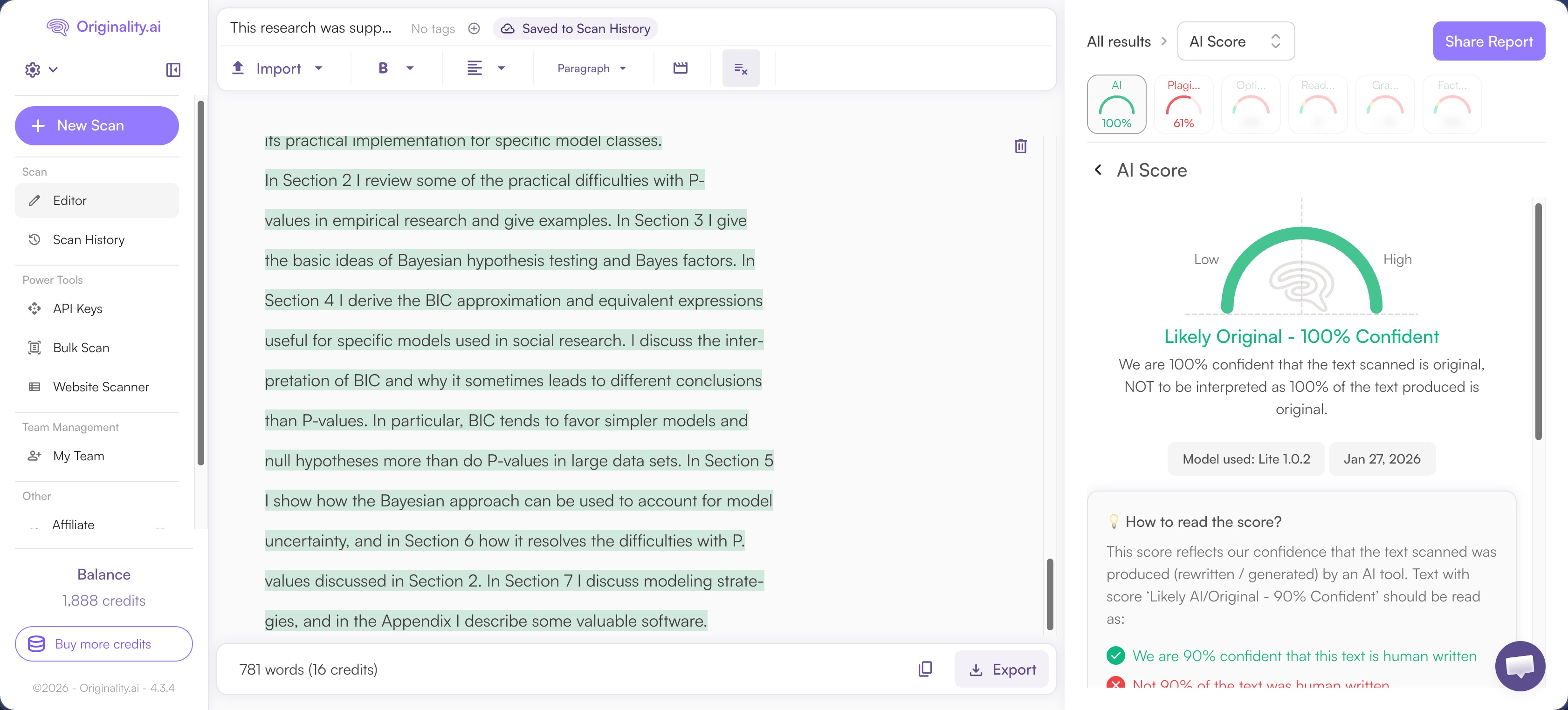
| Attention Is All You Need | Vaswani et al. | 2017 | 100% Original |
| Bayesian Model Selection in Social Research | Raftery | 1995 | 100% Original |
Academic papers also passed without issue. I deliberately selected “Attention Is All You Need” because this is the paper that introduced the transformer architecture, the very foundation upon which ChatGPT and other large language models are built. If any academic paper might confuse an AI detector due to its technical subject matter, this would be the one. Yet Originality AI correctly identified it as 100% human-written. The 1995 paper on Bayesian model selection similarly received a perfect score.
Blog Articles Written Before ChatGPT
| Article | Publication | Year | Originality AI Result |
|---|---|---|---|
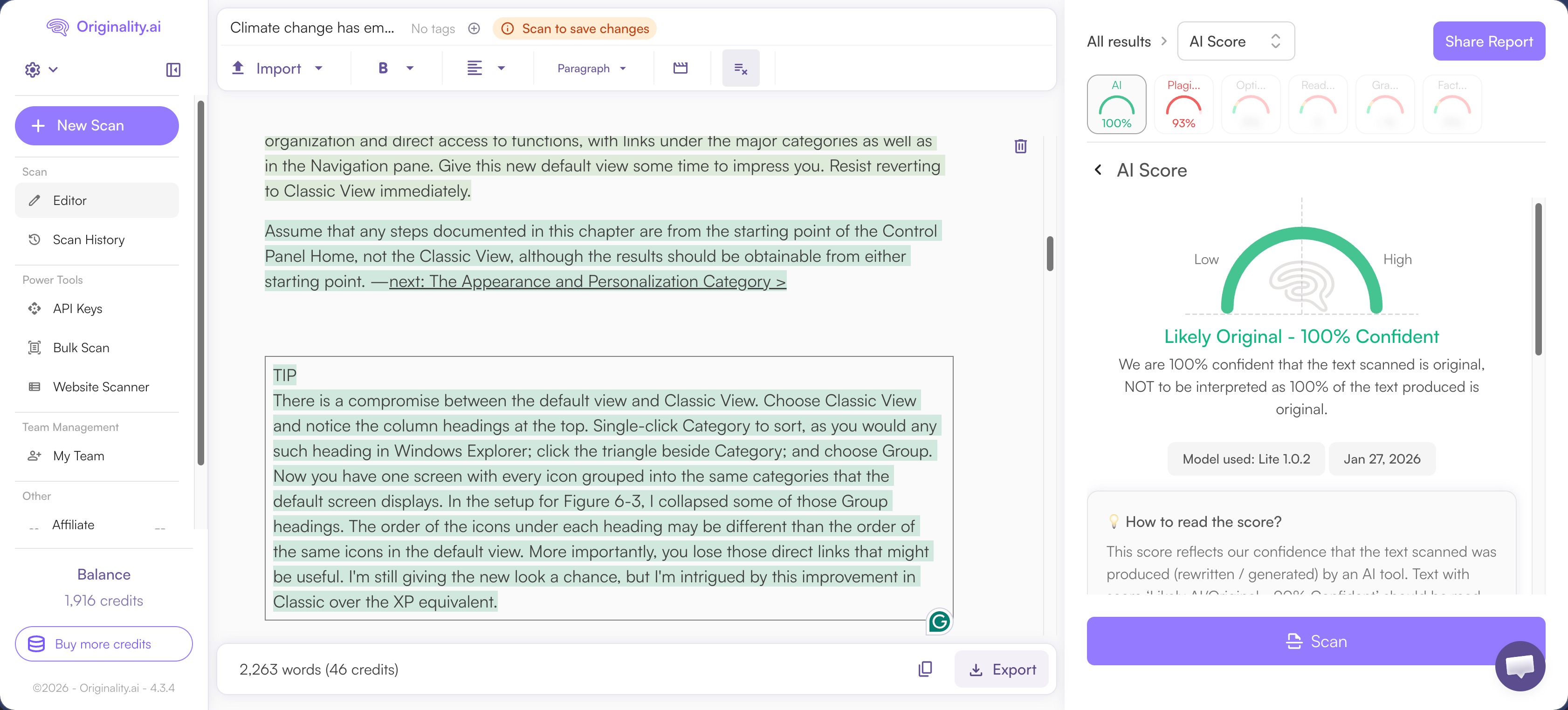
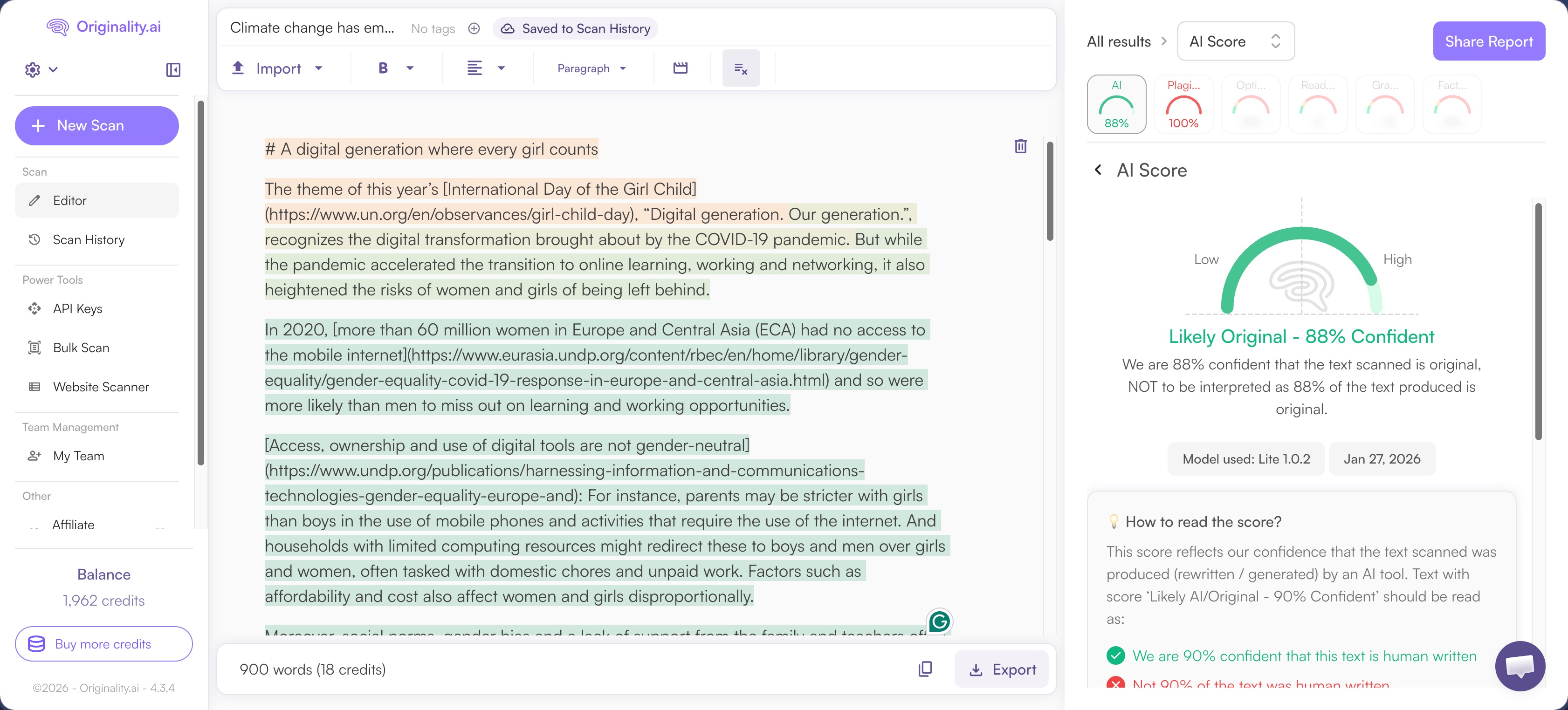
| A digital generation where every girl counts | UNDP Blog | 2019 | 88% Original |
| Customizing Windows Vista, Part 1 | PC Magazine | 2007 | 100% Original |
Blog content produced mixed results. The PC Magazine article from 2007 about Windows Vista customization received a perfect 100% Original score, which makes sense given its age and technical how-to format. However, the UNDP blog post from 2019 about digital inclusion for girls was flagged as only 88% original, meaning Originality AI believed 12% of the content was AI-generated.
Since the UNDP article was published three years before ChatGPT existed and two years before GPT-3 became publicly accessible, any AI detection on this content is, by definition, a false positive. While 12% might seem minor, consider the implications for a student or professional whose work contains similar false flags. Even partial AI detection can trigger academic integrity investigations or content rejection.
Can AI Humanizers Bypass Originality AI Detection?
Originality AI’s aggressive detection of the Wikipedia Dog article (99% AI on content that is verifiably human-written) created an interesting test case. If the detector flags legitimate human content as AI, can AI humanizers ironically make it appear more human? I ran the same Wikipedia excerpt through three humanizers I have previously reviewed: Walter Writes AI, HumanizeAI.pro, and Grubby AI. The results reveal significant differences in how these tools approach humanization and whether their strategies actually work against a strict detector like Originality AI.
| Humanizer | Original Score | After Humanization | Bypass Success |
|---|---|---|---|
| Walter Writes AI | 99% AI | 100% Original | Yes |
| HumanizeAI.pro | 99% AI | 99% AI | No |
| Grubby AI | 99% AI | 83% AI | No |
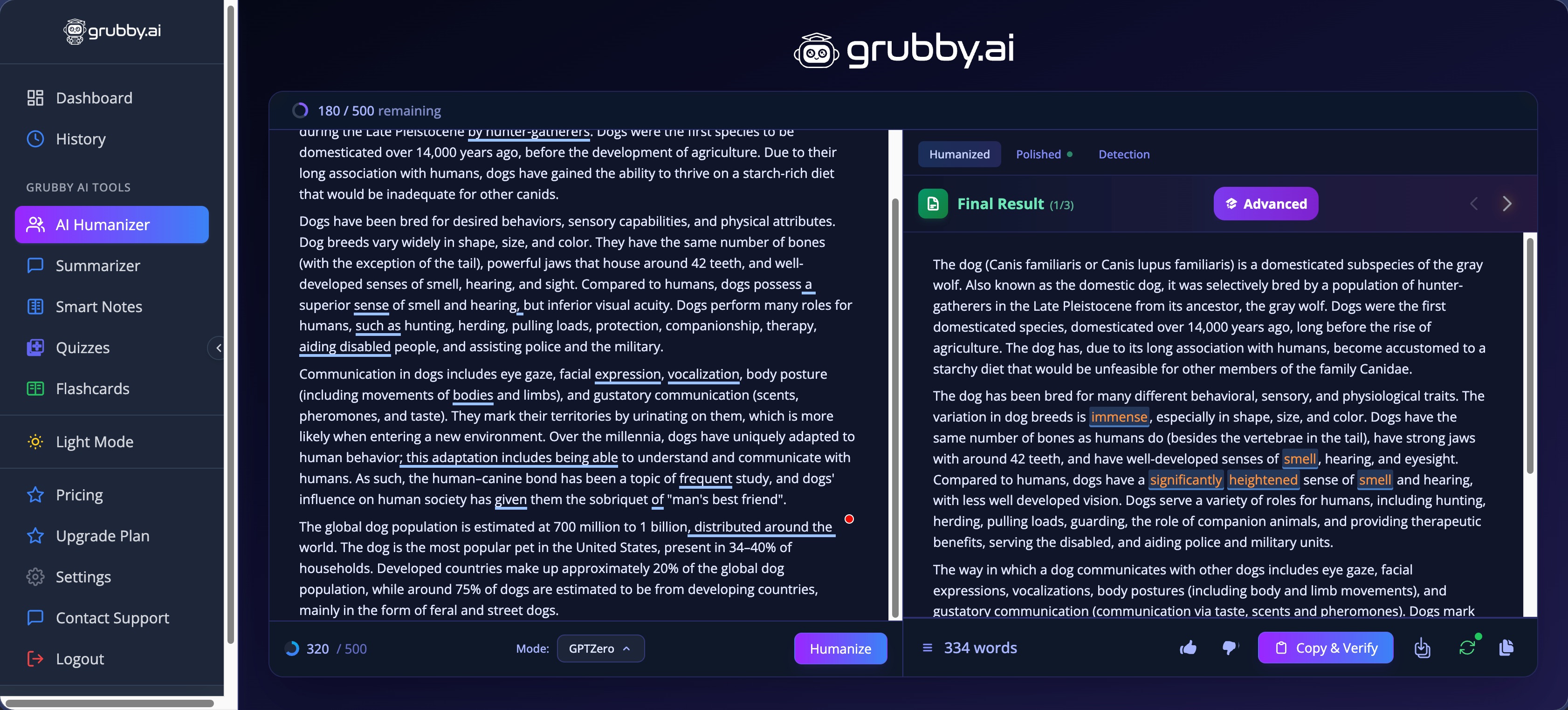
Only one humanizer successfully bypassed Originality AI’s detection, and that humanizer is Walter Writes AI. On the other hand, HumanizeAI.pro failed completely with the score remaining at 99% AI, while Grubby AI achieved a marginal improvement from 99% to 83% AI, which still means the content would be flagged as machine-generated.
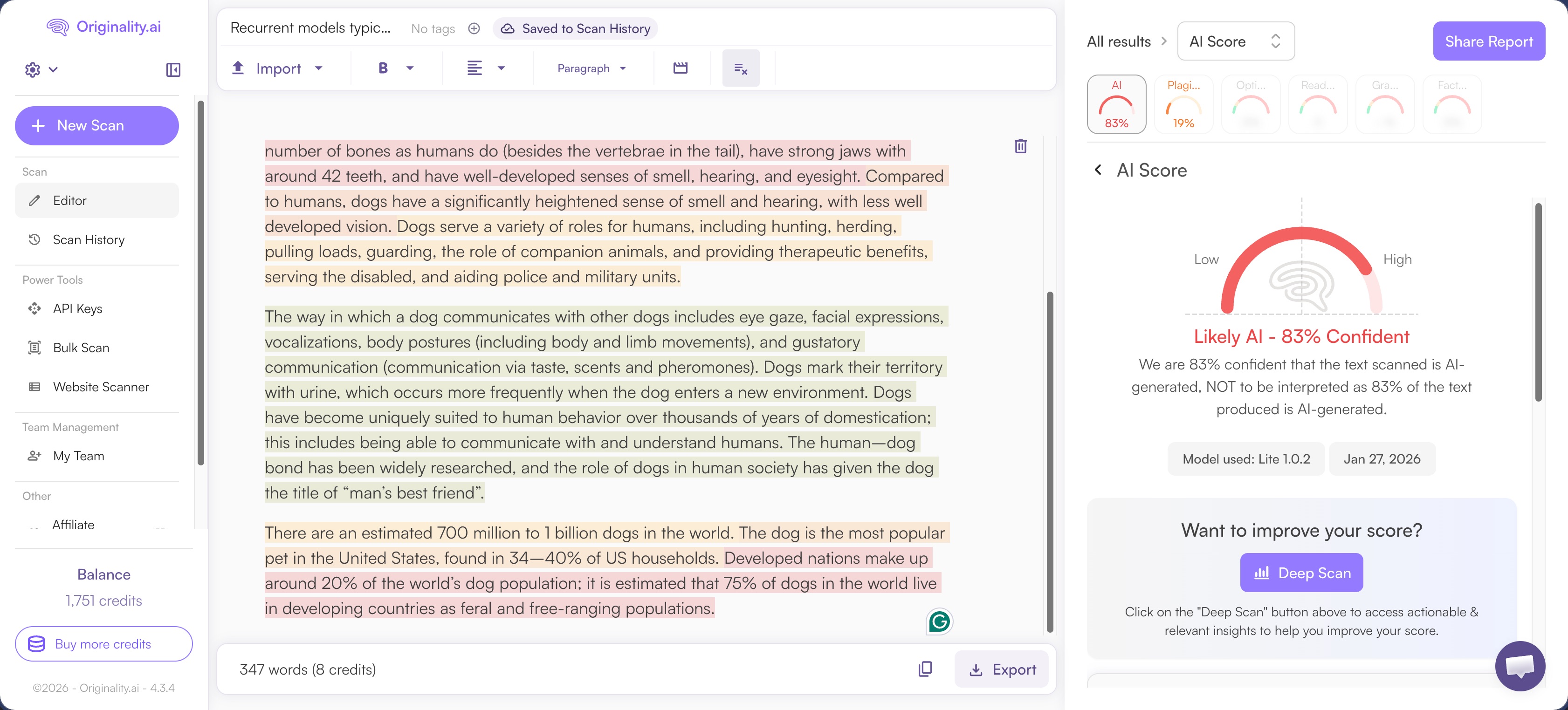
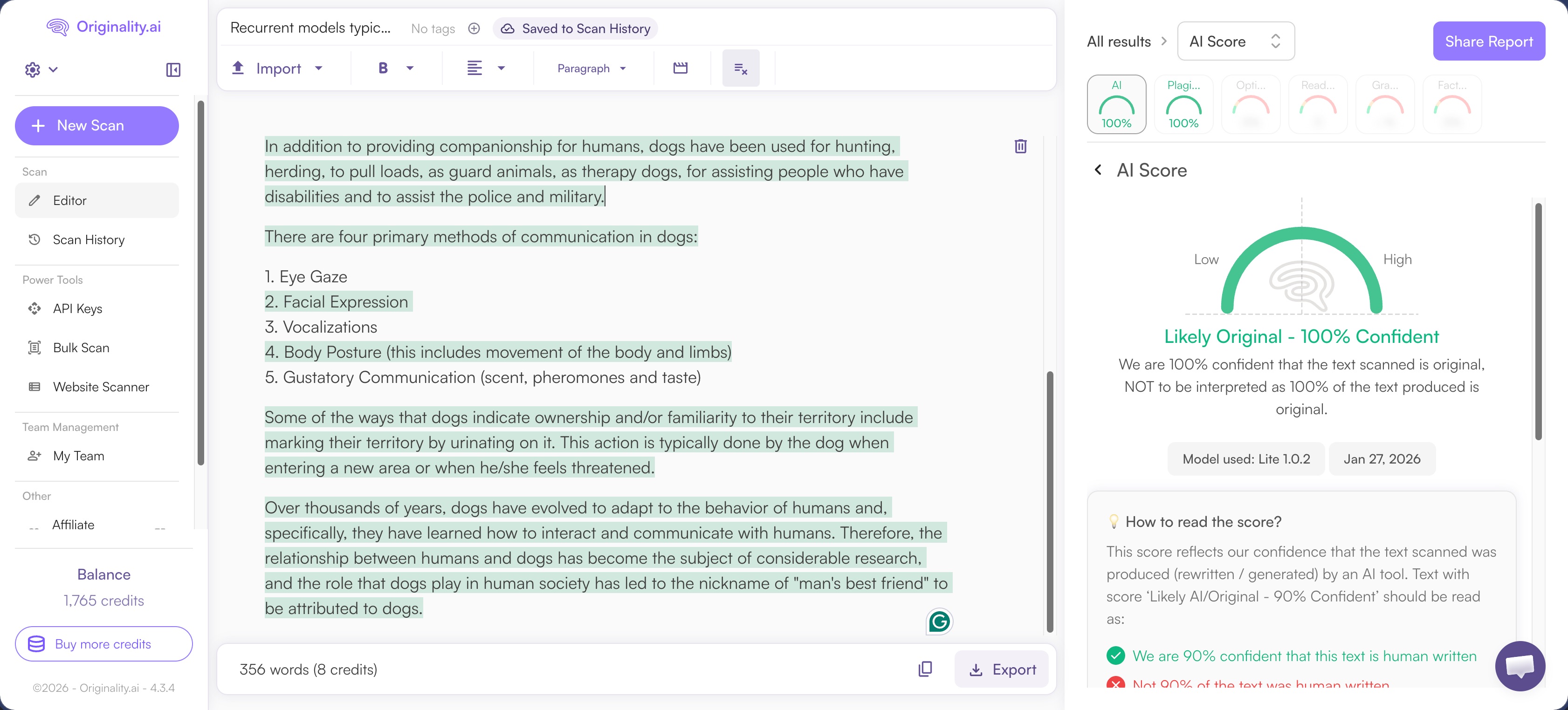
The question is: what did Walter Writes do differently that allowed it to succeed where the others failed? Let’s take a closer look:
-
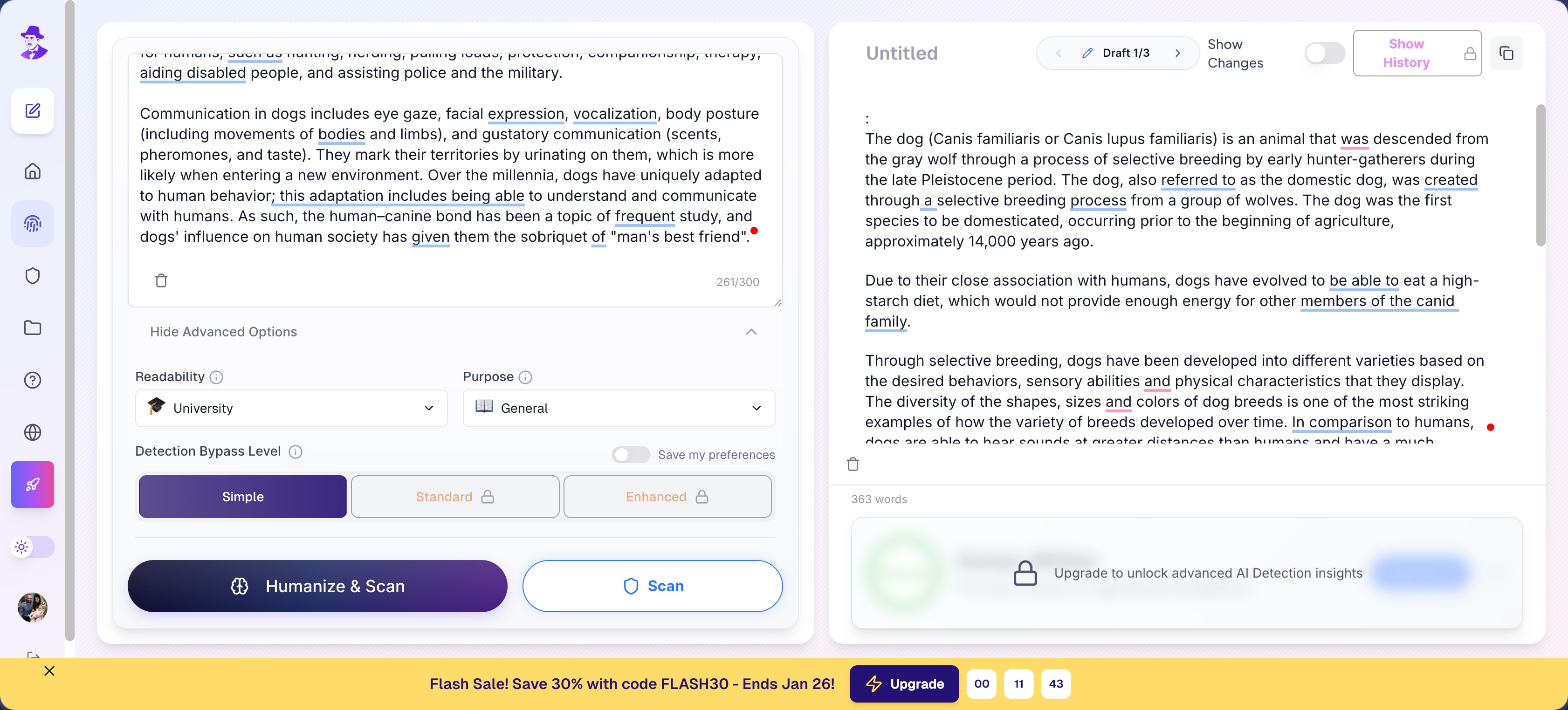
Walter Writes AI took the most aggressive approach to restructuring. The tool broke the original flowing paragraphs into shorter segments, converted implicit lists into explicit numbered formats, and added explanatory phrases throughout. For example, “Also called the domestic dog” became “The dog, also referred to as the domestic dog, was created through a selective breeding process from a group of wolves.” The humanizer also removed specific technical details like the exact number of teeth (42) and bone structure comparisons. Most notably, Walter Writes transformed the communication section into a numbered list with five distinct points.
-
HumanizeAI.pro made minimal changes to the original structure. The text retained its scientific formatting with italicized Latin names, kept the same paragraph organization, and preserved most technical details. The humanizer added a new paragraph about global dog population statistics (700 million to 1 billion dogs worldwide, 34-40% of US households owning dogs), which was not present in my original sample.
-
Grubby AI followed a similar approach to HumanizeAI.pro, making surface-level vocabulary swaps while preserving the overall structure. The phrase “inadequate for other canids” became “unfeasible for other members of the family Canidae,” and “well-developed senses” was rephrased as “well-developed senses of smell, hearing, and eyesight.” Like HumanizeAI.pro, Grubby AI also appended population statistics that were not in the original text.
It seems that vocabulary substitution alone does not fool Originality AI. Both HumanizeAI.pro and Grubby AI swapped words and added new information while keeping sentence structures and paragraph flow largely intact, and both failed. Walter Writes succeeded because it fundamentally reorganized how the content was presented.
How Does Originality AI Compare to Other Detectors?
To put Originality AI’s performance in context, I ran the same human-written samples through GPTZero and ZeroGPT, two of the most popular free AI detectors. Here are the results:
| Content | Originality AI | GPTZero | ZeroGPT |
|---|---|---|---|
| Human text 1 | 99% AI | 100% Human | 54.07% AI |
| Human text 2 | 100% Original | 100% Human | 89.48% AI |
| Human text 3 | 100% Original | 100% Human | 0% AI |
| Human text 4 | 88% Original | 100% Human | 31.37% AI |
| Human text 5 | 100% Original | 100% Human | 34.48% AI |
| AI text 1 | 100% AI | 100% AI | 100% AI |
| AI text 2 | 100% AI | 100% AI | 100% AI |
| AI text 3 | 100% AI | 100% AI | 100% AI |
| AI text 4 | 100% AI | 100% AI | 100% AI |
| AI text 5 | 100% AI | 100% AI | 100% AI |
| Humanized text (Walter Writes) | 93% human | 100% human | 11.03% AI |
GPTZero delivered the most consistent results across all samples. Every piece of human-written content received a 100% Human score without exception. Even the Wikipedia article that Originality AI flagged at 99% AI was correctly identified as entirely human-written.
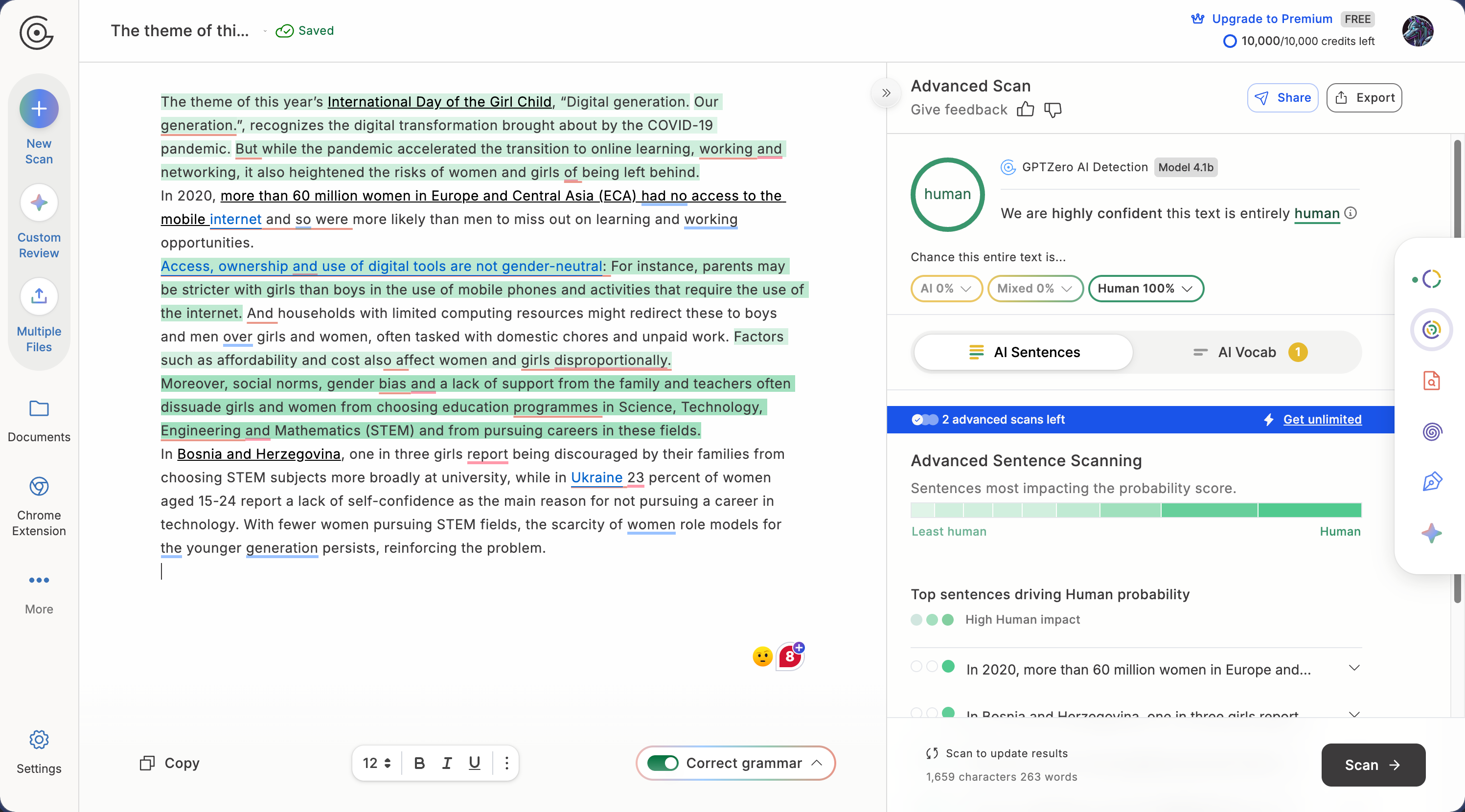
ZeroGPT produced the most erratic and unreliable results of the three detectors. The tool flagged Lewis Carroll’s Alice’s Adventures in Wonderland at 89.48% AI, which is absurd given that the book was published in 1865, more than 150 years before large language models existed. ZeroGPT also flagged the Wikipedia Dog article at 54.07% AI, the UNDP blog at 31.37% AI, and the PC Magazine article at 34.48% AI. The only sample that passed cleanly was the “Attention Is All You Need” academic paper.
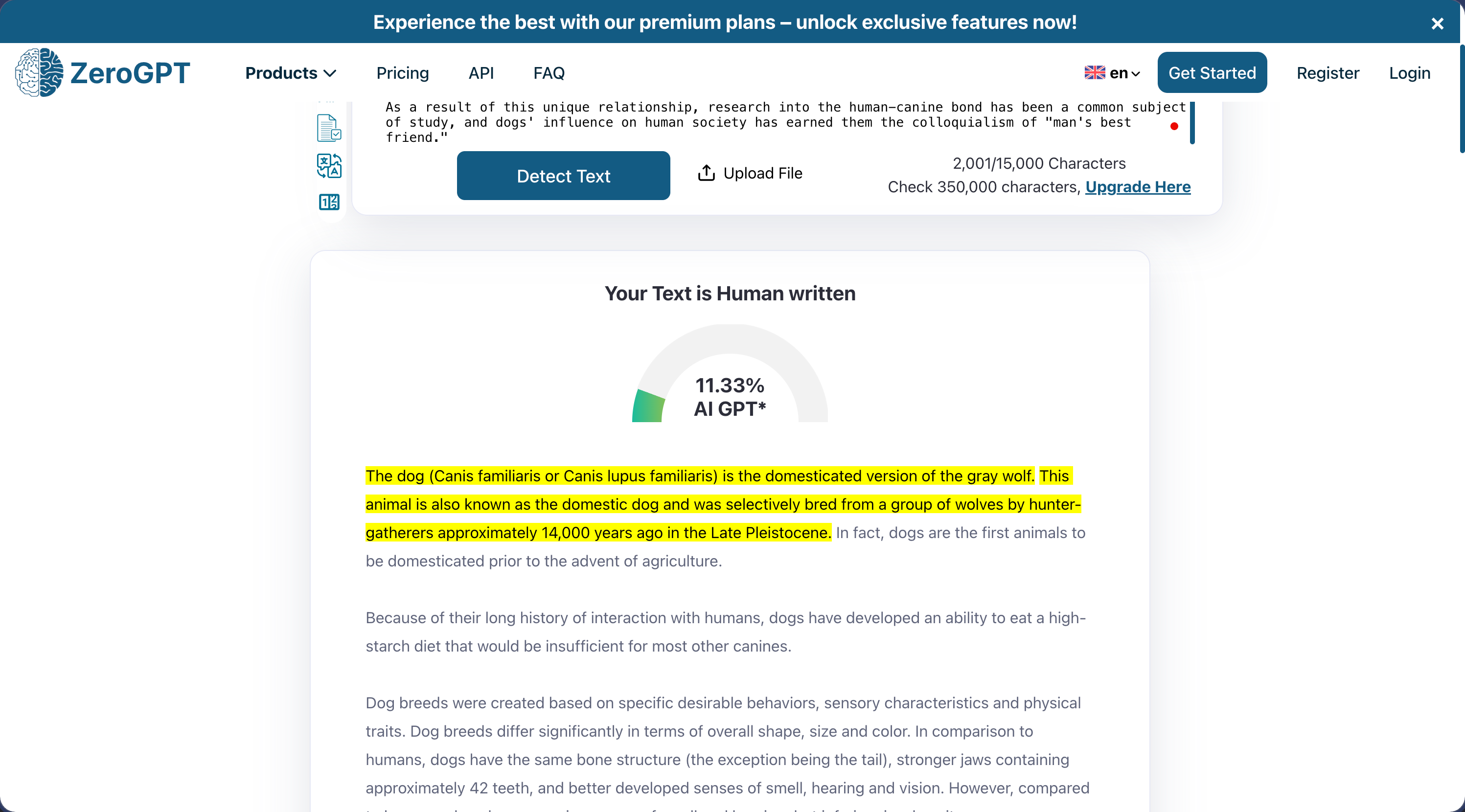
All three detectors successfully identified the five AI-generated samples with 100% confidence. This unanimous agreement suggests that raw, unmodified AI content from ChatGPT, Claude, and Gemini remains relatively easy to detect regardless of which tool you use.
When it comes to the detection of humanized AI-generated text, the picture changes dramatically. The Walter Writes output fooled all three detectors to varying degrees. Originality AI marked it as 93% human, GPTZero showed 100% human with zero suspicion, and even ZeroGPT only flagged 11.03% as AI. It seems that while current detectors can catch unmodified AI content, they struggle significantly when that content has been processed through an effective humanization tool.
The takeaway here is that no AI detector is infallible, but Originality AI is definitely among the best performing ones because it’s detection rate on actual AI content is flawless (100% across all samples from ChatGPT, Claude, and Gemini), and it showed more resistance to humanization attempts than GPTZero.
How Much Does Originality AI Cost?
Originality AI operates on a credit-based system where 1 credit equals 100 words of scanned content. Running an AI-only check costs 1 credit per 100 words, while combining AI detection with plagiarism checking costs 2 credits per 100 words. The platform offers both one-time purchases and monthly subscriptions.
| Plan | Price | Credits | Credit Expiry | Key Features |
|---|---|---|---|---|
| Pay As You Go | $30 (one-time) | 3,000 | 2 years | Basic features, 30-day scan history, shareable reports |
| Pro | $12.95/month | 2,000/month | 1 month (renews) | File uploads (docx, pdf), full site scans, team management, Chrome extension |
| Enterprise | $136.58/month | 15,000/month | 1 month (renews) | API access, 365-day scan history, priority support, dedicated account manager |
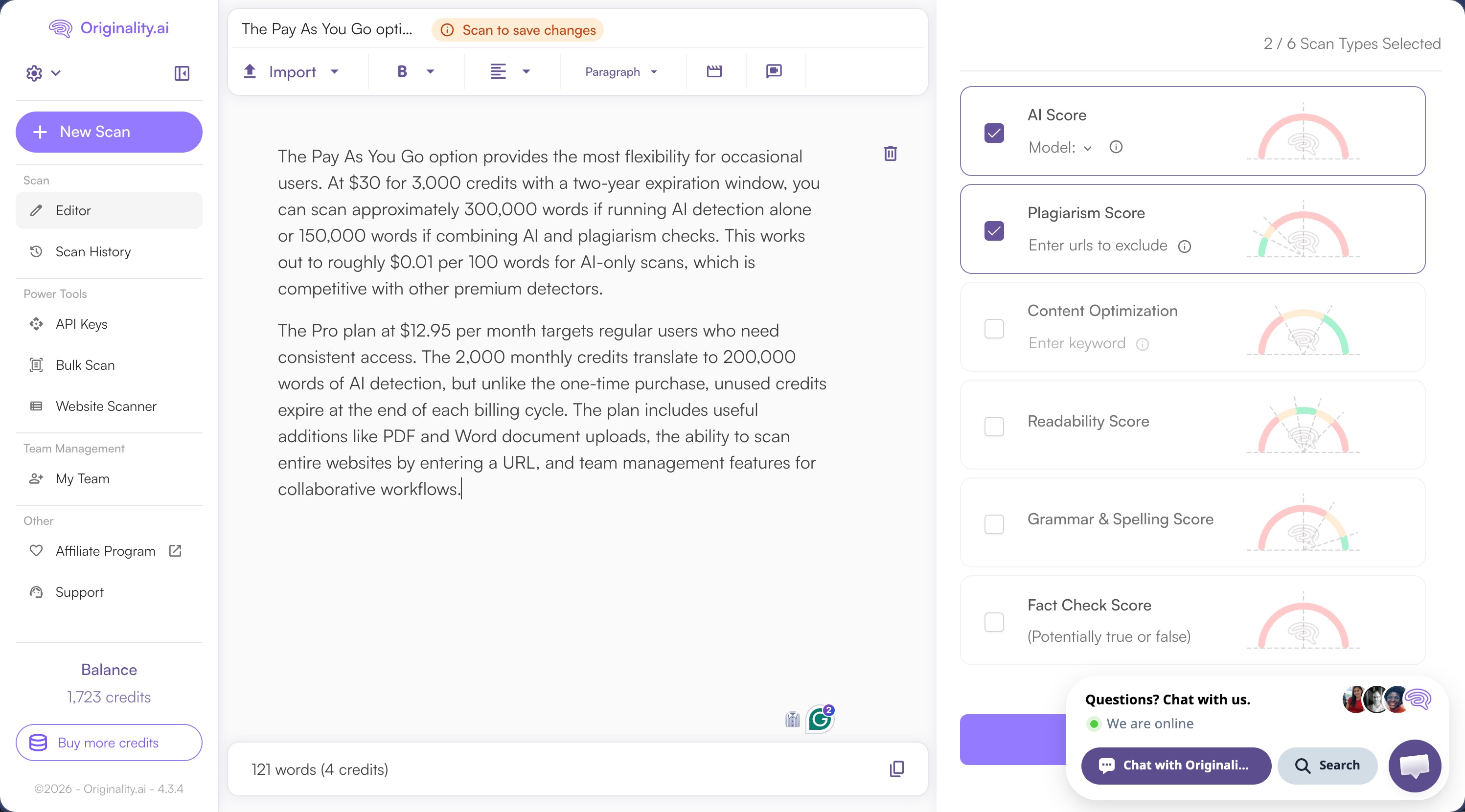
The Pay As You Go option provides the most flexibility for occasional users. At $30 for 3,000 credits with a two-year expiration window, you can scan approximately 300,000 words if running AI detection alone or 150,000 words if combining AI and plagiarism checks. This works out to roughly $0.01 per 100 words for AI-only scans, which is competitive with other premium detectors.
The Pro plan at $12.95 per month targets regular users who need consistent access. The 2,000 monthly credits translate to 200,000 words of AI detection, but unlike the one-time purchase, unused credits expire at the end of each billing cycle. The plan includes useful additions like PDF and Word document uploads, the ability to scan entire websites by entering a URL, and team management features for collaborative workflows.
Enterprise pricing jumps significantly to $136.58 per month, which makes sense only for agencies, publishers, or educational institutions processing large volumes of content. The 15,000 monthly credits cover 1.5 million words of AI detection, and the plan includes API access for integrating Originality AI into custom workflows. The extended 365-day scan history (compared to 30 days on other plans) is valuable for organizations that need to reference past results for compliance or auditing purposes.
Compared to competitors, Originality AI sits at the premium end of the market. GPTZero offers a free tier with limited monthly checks, and ZeroGPT provides unlimited free scans (though with questionable accuracy). The question is whether Originality AI’s claimed accuracy advantage justifies the higher cost, especially given the false positive issues documented earlier in this review.
Does Originality AI Respect User Privacy?
Originality AI’s privacy policy and terms of service are more detailed and professionally written than most AI detection tools I have reviewed. The company is based in Collingwood, Ontario, Canada and operates under Canadian privacy law, with additional provisions for GDPR and CCPA compliance.
According to the documentation, Originality AI collects:
-
Account information: Name, email address, and password.
-
Technical data: IP address, browser type, Internet Service Provider, date/time of visits, navigation history, and pages viewed.
-
Payment data: Processed through Stripe (Originality AI does not store credit card details directly).
-
Cookies: Session cookies, preference cookies, and analytics tracking through Google Analytics, Google Tag Manager, Microsoft Clarity, and Mixpanel.
According to the privacy policy, Active Campaign and SendGrid handle email marketing, Amazon Web Services and Kinsta provide hosting (meaning your data is stored on US servers), and Stripe processes payments. Google Ads and Meta Ads are used for advertising, which means some aggregate data about website visitors is shared with these platforms.
One section worth paying close attention to involves how Originality AI uses your uploaded content. The terms of service state that by uploading text for scanning, you grant the company “a perpetual, non-royalty-bearing, irrevocable, sublicensable, transferable, and worldwide license” to retain and use anonymized versions of your content “to evaluate and improve our plagiarism, AI detection, and fact-checking engines and services.” In plain language, your scanned text may be used to train their detection models.
The good news is that Originality AI provides an opt-out option. You can change your preferences in your account settings to prevent both past and future data associated with your account from being used for model improvement.
The terms also include an honest disclaimer about accuracy. The company explicitly states that Detect AI results “are probabilities and not definitive” and that users should not “assert a probability as fact.” They recommend conducting further investigation before taking action based on detection scores.